
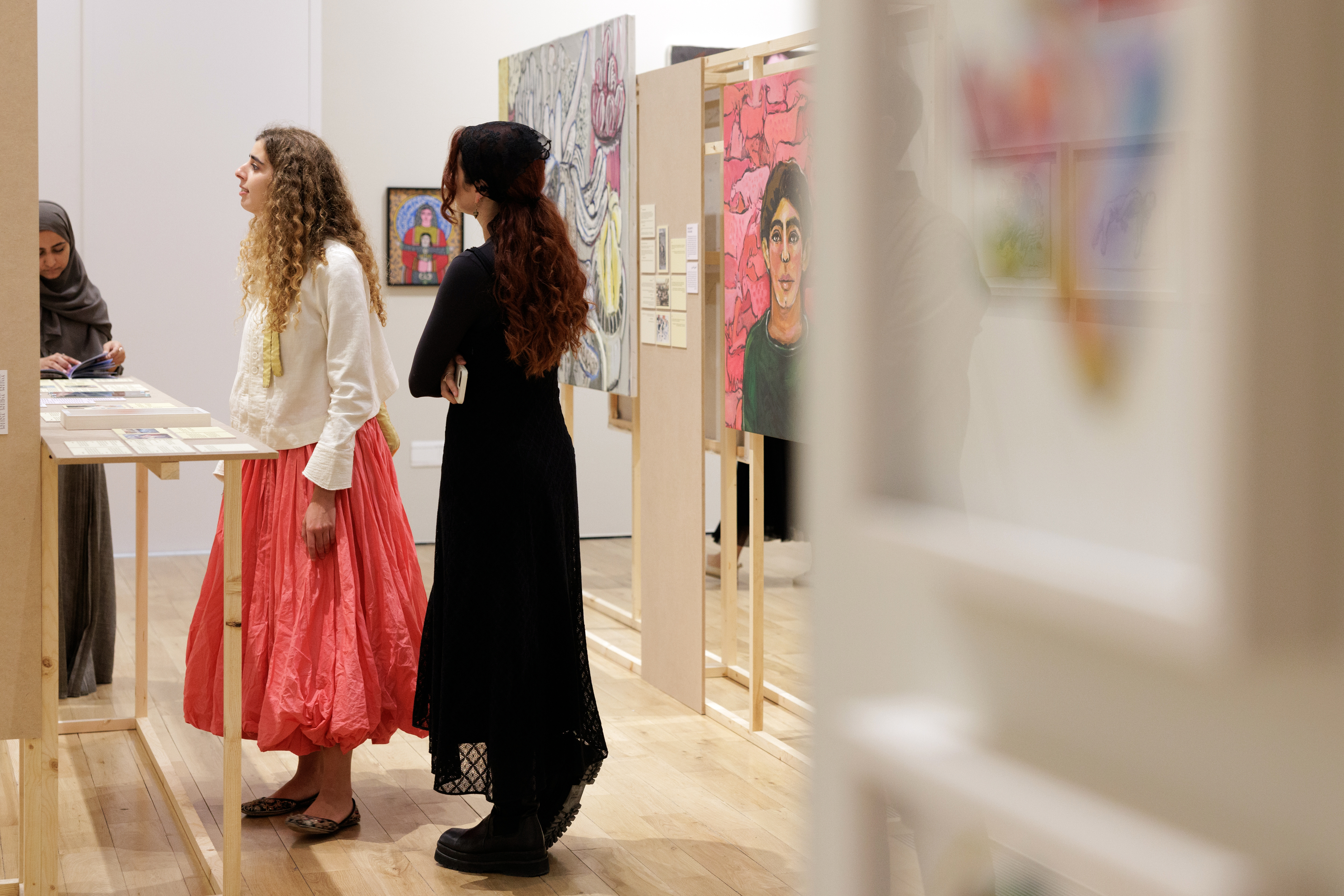
A selection of Palestinian artworks, including some that were smuggled out of Gaza during the ongoing genocide, will go on display in Dublin next week.
The Irish Museum of Modern Art (IMMA) presents How to Work Together?, an exhibition from the Eltiqa collective, curated by the Question of Funding community.
Speaking from Amsterdam, curator Yazan Khalili told TheCity how the exhibition came to fruition: “The first show was in Kassel in Germany in 2015.”
“Our art and our space was attacked in Germany for speaking on Palestine and showing Palestinian art in a German context,” he said.
He continued: “When the genocide took place, these artworks could not go back to Gaza – so they stayed in Germany.”
Khalili highlighted the importance of these artworks to the artists’ survival: “These works survived the genocide and became the cornerstone of helping those artists leave Gaza,”
“We managed to sell some of these artworks, and the money was used to help the artists resettle elsewhere.”
The Eltiqa collective was founded in 2000, and for more than two decades has found ways to create art under the harshest of conditions – even after their gallery space was destroyed by tank shells in 2023.
Some artists have managed to leave Gaza, while others remain under the Israeli occupation.
Khalili told TheCity about the difficulty of getting artwork out of Gaza, and into a Dubai gallery for an exhibition last year: “We did an exhibition last year… not only showing works that were in Kassel, but we brought and collected all the works that have been living in the world and unable to go back to Gaza.”
“Art Jameel in Dubai was very helpful in that process; we discussed continuing to work together and do a show in their space, and that’s what happened.”
He continued: “We managed to help smuggle out some artwork that was still in Gaza.”
Khalili recalled one specific case: “One artwork was a big canvas that had to be folded many times to fit in a small handbag… to get anything in or out of Gaza is nearly impossible.”
“Doctors and humanitarians carried things for people when they left – some of these things were artworks.”
Khalili aptly summed up the situation’s grim reality: “The artwork could move, whereas the humans could not.”

When asked what he hopes visitors will take away from the IMMA exhibition, Khalili turned to the show’s “colour” and “beauty”.
“People will see life… they will see how artists and people in Gaza really produce life and its beauty and its complexity,” he said.
“When people read the timeline and the history of the group, they will understand how this life is coming out of real struggles and real suffering.”
“It is coming out against all the oppression and suppression of Palestinian life that has been going on for many years.”
For Khalili, it is the tension between the beauty and the suffering that brings the exhibition to life: “[Visitors] will see that contrast, and that insistence on existing.”
“I hope people see that Palestine is the future of the world – what happens in Palestine will happen in the whole world.”
When asked about what work lights him up the most, Khalili named the work of Mohamed Abusal – specifically his cactus series.
“They are cactuses that he has been growing on the roof of his home [in Gaza],” he said.
“I always think now, especially after the genocide [started], one doesn’t know that we were documenting something that is so fragile, something that can simply be destroyed from the sky with bombs and drones.”
“I feel emotionally touched by these drawings… the cactuses themselves have been killed, just like the humans, the buildings, and the memories.”
Khalili stressed, however, that the exhibition is not about any particular artist: “What one needs to look at is the collective way that Eltiqa has managed to work, and create – from the ground up – a contemporary art scene that is exhibited across the world.”
“Against the impossible, they managed to create collectively – and insist on doing so.”
- Eltiqa: How to Work Together opens at the Irish Museum of Modern Art on October 22.
Academic integrity: I went to IMMA’s press office and got the contact of Yazan Khalili. Khalili co-founded the group that curated the exhibition. I spoke with him over Zoom for 30 minutes. All supplemental research on the Eltiqa collective came from their website, and from a separate interview I did with the artist Mohamed Abusal, who I’m currently writing a profile piece on.
You must be logged in to post a comment.