The Irish Rugby Football union is holding several combines to integrate female athletes from other sporting backgrounds into rugby.
by Rebecca Reilly
Photo credit: Pexels.com
From Tuesday the 24th of March the IRFU plans to run four combines to test high performing female athletes. Successful candidates will potentially be given the opportunity to forge a professional rugby career. TheCity.ie spoke to Aoife Clarke, Director of Communications at the IRFU, about the combines and what it takes to make it and what life might look like for a successful candidate.
TheCity caught up with up-and-coming comedian Darren Gaffney to chat about his first solo gig, the high and lows of live performance, and why getting barred from a place isn’t always permanent.
By Rebecca Reilly
Originally from the small village of Kilnaleck in County Cavan, which, according to Darren, had the record for most pubs per capita in Ireland, his upbringing was typical of rural Ireland. His mum is a nurse and dad a plumber, Darren was influenced heavily by the two f’s of country living – farming and football. “My uncle had a farm, so I spent a lot of time with him, playing football and going to mass – all that crack,” he laughs. A childhood that would be familiar to many rural inhabitants of Ireland, Darren maintains, is why his comedy hits. “People get it!”
Having been bitten by the performance bug early in life, Darren performed at Scór and Réadóirí competitions, both of which focused heavily on Irish culture. Participants would showcase the likes of Irish dancing, poetry, and music. “I remember there was a segment called recitations. I dressed up as a farmer and recited a funny poem. I always loved being on stage.”
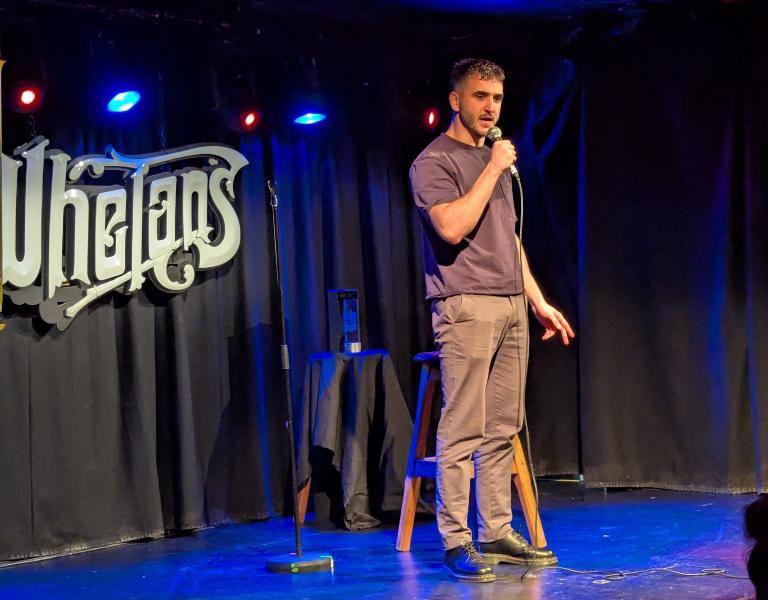
Darren Gaffney. Photo credit: Sinéad Murphy and Zoe Sanford
One would be forgiven for thinking Darren might have dived right into performing arts, but a more serious route came calling. “I did politics, economics and law in college. I thought it might become a TD for the craic!” But after a year’s Erasmus in Poland, Darren decided to bite the bullet and try to crack comedy on his return home. “I never thought about being a comedian. But I had a lot of friends who kept telling me I should do it. When I came back to Ireland, I signed up for an open mic on the Ha’penny Bridge.”
It was a daunting experience. “You don’t have a clue when you start, so I didn’t tell anyone. I kept it a secret and just drove up to Dublin,” he recalls. “The first gig went well, but I think on the second gig, I got drunk, and I was so nervous. And it went awful! I don’t drink at all now before going on stage.”
In 2020, COVID hit and like so many, Darren had to put his career on pause. It didn’t deter him; he was adamant he was going to succeed, a slog that was going to be much harder than he was prepared for. “You must have thick skin. Nobody cares about you at the start; you must fight for everything. If I knew how much work it was going to be, I don’t know if I would have done it!”
Darren Gaffney. Photo credit: Sinéad Murphy and Zoe Sanford.
A tenacious attitude led Darren to forge his own path, not to be dependent on others for his success. “That’s why I started a comedy club, Bite the Bullet, in the Cat and Cage in Drumcondra. Trying to book gigs at the start – you’re just another comedian; there are loads of them. Not everyone wants to help; you’re on your own, really. You get a bit of respect if you have some get-up-and-go.” Bite the Bullet comedy also runs in the Chelsea Drugstore in Dublin city centre, The Tap House in Ranelagh and an ad hoc show in the Imperial in Cavan – where, ironically, Darren was once barred from.
With his first solo gig in Dublin just around the corner (two sold-out nights in Little Whelans on the 12th and 13th of April and a third night added on the 14th), Darren says his comedy sets are very reflective of his genuine self. “I try to really like myself on stage. In real life, I’m always messing around. It’s high energy and unpredictable as hell,” he laughs. With a big emphasis on Irish life and growing up in rural Ireland, the 28-year-old draws his inspiration from observing life and interacting with the audience. “A lot of comedians look down on that audience interaction, but it was something I was good at from the outset.”
Observational and genuine comedy is something that has granted Darren success on TikTok, social media almost being a prerequisite for comedy now. Living a dual life online and on stage can come with its difficulties. “Stuff that works on TikTok might not work on stage and vice versa,” he said. “The stuff that comes out of nowhere is usually better. I was trying to think of content before a gig the last day, and I just came up with a video about how nobody puts children in the back of vans or cars anymore – and it blew up! I took it in one take. Other content I take a long time thinking of, maybe comes across a bit forced? It’s weird.”
Darren Gaffney. Photo credit: Sinéad Murphy and Zoe Sanford.
As the old saying goes, what goes up must come down, and being on stage has become something of an addiction to Darren. “It’s such a rollercoaster of emotion; you come from the highs of your life to crushing lows,” he reveals. “You get home after being mental on stage for an hour – you can’t sleep. I was chatting to a comedian who was doing a small gig in London once, and he went walking around London and ran into Ricky Gervais, who was on his way to Wembley on a post-gig walk as well.”
“One time after a good gig in Mullingar, I was driving home, and the guards started following me. They stopped me and asked me if I was on drugs. I drove the whole way out of the road with no lights on! Since that moment, I’ll always chill for half an hour after a gig.”
Darren is hoping to do a tour of Ireland, and all going well, across the water in the UK. Like his comedy hero, Tommy Tiernan, Vicar Street or the Olympia is the primary objective. “Selling out either of those would be class. Although if I did that, I’d probably be thinking of the next thing. That happens to me a lot. But if I sold out either of those, that would be the dream.”
Issues have been raised about the lack of standardisation across catering companies under the Government’s School Meals Scheme.
By Rebecca Reilly
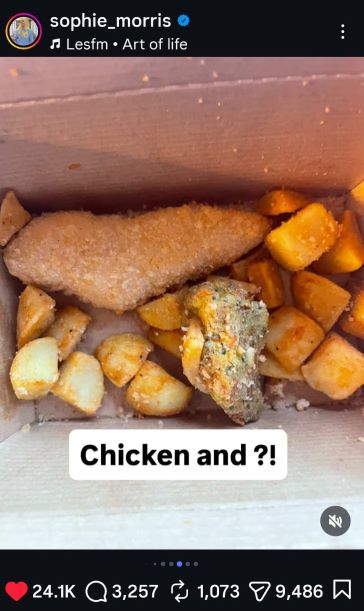
Nutrition coach Sophie Morris has posted images on social media reflecting parents’ concerns about the quality of meals being served in some schools.
In the post Sophie has said what she is “advocating for is improving the standard of the food that’s currently being served to our children.”
She also references the photos below saying that “this is what’s happening on the ground.” We reached out to Sophie, but she was unavailable for comment at this time.
A pilot for hot meals was introduced by the Department of Social Protection in 2019 to a select number of schools.
The scheme has been expanding since April 2025, with 3,149 schools awarded funding under the programme for the 2025/26 academic year.
There are approximately 100 schools with applications for funding pending, awaiting further information. The Department continues to receive applications as schools finalise their procurement process.
The budget for the scheme in 2026 is €286 million, with the aim of catering to all primary schools across Ireland on a phased basis.
The meals are provided by a number of suppliers such as The Lunch Bag, Freshtoday and Glanmore Foods.
TheCity.ie spoke to a number of parents about the scheme. They spoke to us on condition of anonymity.
“I personally believe it is a disappointing service. My children don’t like the meals, and I don’t believe they are nutritious. We have since opted out and send our kids to school with a packed lunch daily,” said one parent.
Another parent alleged that their 10-year-old child received undercooked chicken. “When I raised the issue at school, I was told to contact the supplier directly.”
According to the parent, the supplier told them that they could opt out of the meal again, apologised that their child did not enjoy it, and they hoped the following day’s meal would be better.
Speaking to TheCity.ie, one primary school teacher in Louth said: “Although the premise in theory is good, over a third of parents have stopped ordering lunch in my class. A handful of kids are now eating them.”
“I can only speak about what I see in my class, but meals are a far cry from the samples we received last year for staff to try and are not consistent week to week – the kids have commented on that.”
The teacher said they also questioned how nutritious the meals are.
“The ingredient list is extremely long. Some labels don’t show the percentage of meat content; some do. Some meals contain added preservatives, stabilisers, sulphites, raising agents, and more. Is there a way to reduce those extra ingredients that you wouldn’t typically put into a home-cooked meal?”
Waste has also become a growing concern in this teacher’s school.
“Parents don’t get to see how much or little their child is eating, as the food is placed into the insulated box it arrived in for the company to collect the next day to dispose of. It is a lot of waste – a waste of food and a waste of taxpayers’ money. Money that could surely be spent better.”
A spokesperson for the Minister for Social Protection Dara Calleary said: “The nutritional standards for school meals have been in place since its inception and were developed by a technical nutrition subgroup.”
This group included dieticians from the Irish Nutrition and Dietetic Institute of Ireland, the HSE, Safefood, and the Food Safety Authority of Ireland.
“Nutritional standards are a priority,” they said.
“Last September, the Department seconded a CORU-registered dietitian from the Department of Health to strengthen oversight of the School Meals Programme and conduct a review of the nutritional guidelines and the compliance of the main suppliers with the current guidelines.”
Since September 2025, foods high in saturated fat, sugar and salt have been removed from school menus.
Although calls for higher quality food echo many parents’ sentiments, some say there are many positive results from the scheme.
“My son is really happy with the food,” Pamela Lee, a mother-of -two from Galway told TheCity.ie.
“I do think there could be more variety – but I do think I could change it up for my son also in terms of my ordering.”
“My son eats everything and has never complained to me about the meals yet,” said Paula Madden from Galway, whose son avails of the programme.
Sinéad Crowe, a nutritional therapist and intuitive eating counsellor, praised the scheme for encouraging independence among children, but said regulation needs to be reviewed.
“My kids go on to the app every week and see what new specials are out and they like going through what to order. I think that encourages some autonomy and agency and promote decision making skills around what they are going to eat themselves,” she said.
“The providers are all different, so it isn’t standardised. Companies are going to vary in terms of what they are offering. I think that would need to be addressed and looked at. The companies need to be more direct with what ingredients are in the food – we need complete transparency.”
Crowe, who co-founded the Intuitive Eating Hub, has also raised concerns about how we frame this conversation.
“We need to be careful about the exposure that our children might have to this conversation… it could negatively affect a child’s relationship with food. We can talk about balanced and optimised nutrition without coming from a place of fear or scaremongering.”
Fine Gael is currently running a public survey on the scheme to inform the next phase of improvements and rollouts.
A Galway medical centre has stopped taking private patients following the retirement of a local GP.
By Rebecca Reilly
Photo credit: pexels.com
Culleen Medical Centre in Headford said the decision was made to temporarily pause the acceptance of new private patient registrations with effect from 7 January 2026.
They have received an unprecedented number of enquiries and registration requests from private patients since the retirement of a GP in the community late last year.
Under Irish legislation, private patients’ medical records cannot be automatically transferred from one practitioner to another without written consent.
In the statement, the centre said: “Such consent must be freely given, specific, informed, and unambiguous. There is therefore no legal basis for the automatic transfer of private patient care or medical records without a patient’s informed consent.”
The statement read: “Where patients are not notified of a GP’s retirement promptly, their ability to register elsewhere and provide the necessary consent for records transfer may be significantly constrained.”
It is the responsibility of the Health Service Executive (HSE) to ensure the transfer of records for medical card holders and the practice has taken on all medical card holders from the retiring GP.
Several private patients have expressed their worry, particularly those with ongoing medical issues.
One patient has said: “I am on HRT (Hormone Replacement Therapy), and I have asthma. It’s disgraceful that we are left without. What if a GP dropped dead tomorrow? There needs to be provisions in place for exceptional circumstances like a sudden retirement.”
Another man in his 60s said he is seriously apprehensive about managing his diabetes: “How do I fill my next prescription? Does my life mean less because I am a private patient?”
Photo credit: pexels.com
Local councillors are hoping to provide relief for private patients.
Fine Gael Councillor for the area, Andrew Reddington said that the HSE has informed him that “their duty has been fulfilled. They won’t be advertising for another doctor as all medical card patients have been allocated.”
“There is no point in depending on the HSE [….] I won’t be misleading anyone by saying that it will happen and doctors will come – that’s just wrong,” he said.
“I am currently trying to navigate the situation and have had success in getting sorted to date, as a doctor clinic contacted me offering help.”
Local Fianna Fáil Councillor Mary Hoade said that the country needs more GPs.
“In 2024, the Irish College of Surgeons said that of the 2,500 GPs in the country, three-quarters of them were at capacity and not taking new patients. So, this really is a national issue,” said Cllr. Hoade.
She has called on the Department of Health and the Minister for Health to address these growing issues.
“My concern is to find a GP for private patients who are left without one and to ask the Department of Health to address this, so we don’t ever find ourselves in this situation again.”
Fianna Fáil TD for Galway East, Albert Dolan raised the growing problem of GP retention in the Dáil recently.
“I believe there is a crisis at the moment in retaining GPs and in terms of our GP capacity in rural locations,” Deputy Dolan told TheCity.ie.
“We are hearing across the board that GPs are at capacity and are refusing to take on new patients. This means people are having to travel further to access care,” he said
“What’s vital here is that we retain our young doctors coming out of university. Many people are graduating, qualified to the highest level, and are going to Australia and Canada and are serving other systems.”
“We need to ensure that young people feel like there are opportunities here for them. We need to improve conditions but also reduce the burden on young doctors,” he continued.
While Culleen Medical Centre is hoping to expand its premises, it acknowledged “this is deeply regrettable situation,” and “sincerely sympathises with all those affected.”
You must be logged in to post a comment.