Author: Charles E Heasman

  • Water charges: the story trickles on…

    Water charges: the story trickles on…

    Whatever the ongoing Irish Water debacle may yet throw up, it has so far provided some memorable quotes.

    2nd WAter Protest-stills 019
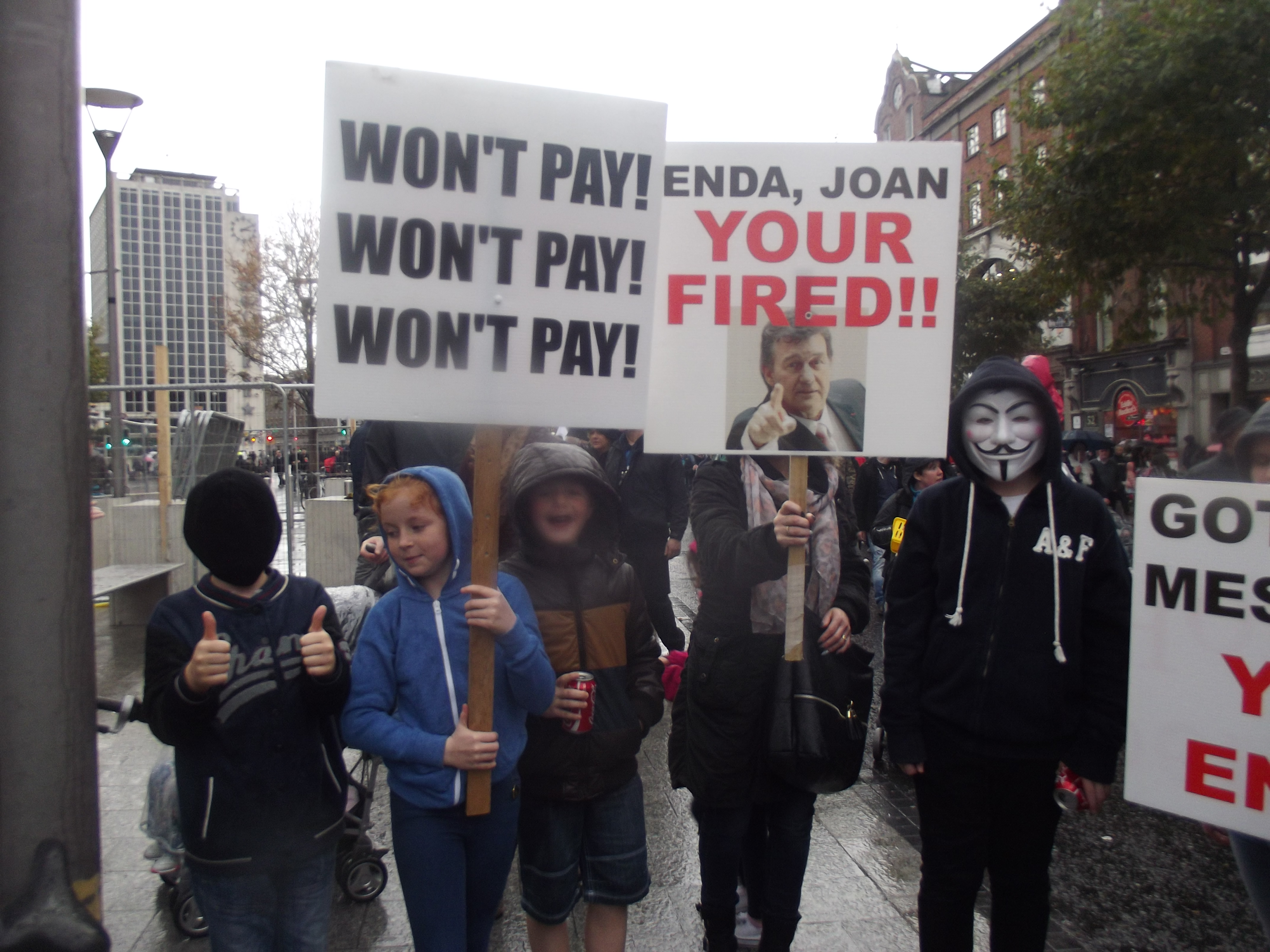
    Still not happy, the protest goes on. Photo: Charlie Heasman

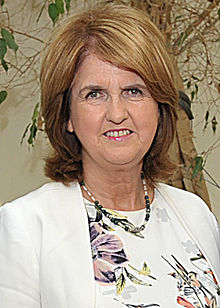
    Tánaiste Joan Burton was first off the mark when, at the beginning of October, she made her infamous statement in the Dáil condemning protesters who filmed Garda handling of demonstrations on their “expensive phones, tablets and video cameras.”

    Given the circumstances it probably ranks as one of the most ill-advised comments ever made by a serving Irish politician, and her opponents fell upon it gleefully. She might not have actually said that if they can afford iphones they can afford to pay for water, but this was the meaning inferred from her words and her tone. It immediately appeared to turn  her into a figure of hate for the anti-water movement.

    Since then she has been booed and heckled wherever she goes, with protesters sharing and mobilising through social media in order to keep track of her movements.

    The culmination of all this so far was the fracas in Jobstown, Dublin.

    Allegations and counter-allegations have been made as to who did what and who was to blame for it, whether it was a peaceful protest or a riot, who should apologise and on what basis to who, but what is not disputed is that Burton was trapped in her ministerial car for two hours by angry demonstrators.

    This led to Enda Kenny bitterly complaining in the Dáil that the protesters had “descended on her like hounds after a fox”. One organisation responded immediately.  Sensing an opportunity, The Irish Council Against Blood Sports stated that if Mr Kenny felt that strongly on the subject he should…

    … Ban fox hunting.

    Meanwhile as far as the demonstrators are concerned it is still open season on politicians.

    At the Rochestown Park Hotel in Cork, Fine Gael citing “security fears”, pulled out of a planned regional meeting which Mr Kenny was due to attend.  Perhaps in part because Enda himself attended a function in Dublin where he was confronted outside the Mansion House by a group of some 50 protesters.

    When asked to comment on their concerns he replied: “Well it’s not about water, is it?”

    His response might have been off the cuff but nevertheless it happens to be the most succinct and insightful comment he has made so far. It is not just about water any more; it is about the Irish people saying enough is enough, and a significant portion of them bringing the Government to account.

    Unfortunately Enda’s moment of lucidity did not last long. Two days later, appearing on RTE’s Nine News to discuss changes to the water charges, he managed to iterate “The average worker, a single worker on the minimum wage of €35,000 is going to get back €400 in the income tax returns starting in January…”

    Once again the mob bayed for blood; the man’s so out of touch with the people he thinks the minimum wage is twice what it actually is. No wonder himself and Joan think that people can afford to own mobile phones and pay water charges.

    To be fair to Enda, it was probably simply a slip of the tongue, which is something we are all occasionally prone to. The difference is that when we suffer one it is invariably either ignored or immediately forgotten; a politician, and a Taoiseach at that, must always be on his guard or regret it. Like Joan Burton’s faux pas earlier, this one did him no favours.

    Meanwhile the Government has been forced into a massive climb-down. PPS numbers are gone, a €100 Water Conservation Grant promised to every household that signs up, rates reduced and capped until 2018. Opposition TDs are accusing the Government of “buying votes for the next election”,  and in a way they are correct in saying so.

    But the simple fact is that the Government had no choice. To carry on regardless against the will of the people would have been political suicide at the next election.  For the time being at least the situation has been defused, but there is still a long way to go.

    What happens after 2018? Will charges inevitably go up? People still remember the introduction of the Bin Tax: recyclables free and “You only pay for what you throw away.” The service was to be Local Authority run and not to be privatised.

    What happened to all those promises then? Can we expect the ones we are getting now to be broken in the same manner in three year’s time?
  • Listen to the People Enda

    Listen to the People Enda

    “People shouldn’t be afraid of their government. Governments should be afraid of their people.”  So said the 2005 film V for Vendetta.  Right now Enda Kenny should be very afraid of his people.

    220px-EndaKenny
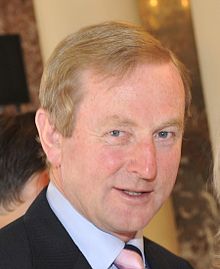
    Enda. Out of Touch

    When the Fine Gail/Labour coalition came to power they faced an onerous task.  The banks were bust, the economy was in ribbons and some tough decisions had to be made in order to clear up the mess left by the previous Fianna Fáil administration.  The electorate knew this and left them to get on with the job.

    To be fair, the Government made a pretty good job of it for a while. Yes, austerity hurt, but sacrifices had to be made and the people uncomplainingly acquiesced.  Wages were cut and taxes raised.  As a result things slowly seemed to be getting better.

    And then came Irish Water.

    Whatever any one person might think about the merits of water metering, the state of the infrastructure and the necessity of paying for its refurbishment, the roll-out of Irish Water was a farce on the grandest scale.  It provides the ultimate textbook working model on how not to go about setting up such an institution.

    The NAMA sale of Siteserve, a bankrupt company with debts of €100m, to Denis O’Brien, Ireland’s richest man, was the first of a long litany of controversies.  That €100m was immediately written off and the debt foisted on to the taxpayer.  A few months later Siteserve was awarded, by the Government, the very lucrative contract to install the new water meters.

    Shortly after this every household in the country was sent an ‘Information pack’ inviting them, with a deadline, to apply for metering.  This without any indication whatsoever at the time of how much they were agreeing to be charged for the service.

    PPS numbers were demanded, not just for the principal occupier, but for every man, woman and child in the house.  Bank details and email addresses were also requested.

    The arrogance of the Government and Irish Water was breathtaking.  What right had they to expect people to sign a legally binding contract for water without even being told how much it was going to cost?  And to then demand their personal details and PPS numbers to keep on file into the bargain?  Who in their right mind would ever agree to such a thing?

    Unsurprisingly the people were outraged and took to the streets in protest.  Some marched; others blocked the installation of the meters themselves.  Many filmed themselves doing so.

    Joan Burton, in a further show of Government arrogance, subsequently complained in the Dáil that if people could afford expensive mobile phones to film with then they could certainly afford water charges.  Who pays for your phone Joan?  Answer: the taxpayer.

    The people have continued to march and plan to march again.

    All of this means that the country is rapidly becoming ungovernable.  A government rules by the consent of the people and the people are withdrawing that consent.

    Enda Kenny says that the only alternative to water charges is to raise income tax on the upper four per cent.  What is so very wrong with that?

    The poor and lower income earners of Ireland have borne the brunt of austerity for years.  Cuts in incomes and Social Welfare have been mirrored by increased taxation.  A little trimmed off here, a little taken from there.  They have given up to the point where they have nothing left to give.  Meanwhile the rich have escaped and become progressively richer at their expense.

    If this Government is to survive it must win back the trust and confidence of its people.  To do this it must first admit it has made mistakes and then redress them.  An admission might be humiliating, but it will be telling no-one anything that they don’t already know.  It is their only course of action.

    And it is to be hoped that they succeed.

    Never in the history of the Irish State has the electorate been so divided. If an election were to be held tomorrow many Irish voters may decide not to vote at all or lend their support to non-party candidates.

    Voters have always had notoriously short political memories, but even they are not yet ready to forgive Fianna Fáil.  Labour has all but disappeared off the bottom of the opinion polls and the various socialist parties never seem able to pull together in a coherent way.  Green is gone; if anyone even remembers them.

    The rising star in the Irish political firmament is now Sinn Fein; despite all the controversy regarding alleged IRA killings and the moving of sex offenders south of the border.  Ordinarily it would be more than reasonable to expect these allegations to damage the party; but this does not seem to be the case now.  Could it be that the people are so desperate for a party to vote for that they are prepared to overlook these transgressions?

    In any case, for all its political posturing Sinn Fein has no experience of government at national level and experience is what is needed now.

    Much the same can be said about the only other option: Independents.  While there are many laudable and honourable such politicians out there, and I for one would be tempted to vote for some of them, a rainbow coalition of Independent TDs is not what a strong government is about.

    Ireland needs a strong government, now as much as ever. Fine Gael can still be that government but it is absolutely essential that it gets back on track and becomes a government for the people; not against the people.

  • Mind, body, spirit and yoga

    The Royal Dublin Showground once again hosted the twice-yearly Mind, Body, Soul and Yoga exhibition over the October bank holiday weekend.

    This hugely popular event has been running for a number of years and attracts both visitors and exhibitors from all over the country and also many from abroad. This year’s event saw a record number of over 150 stalls, with practitioners coming from as far away as Japan and India.

    The range of treatments and therapies was as diverse as it was large. Everything from Tarot Card Reading to Aromatherapy to Reflexology was on offer, and visitors could avail of home-grown Shamanic Healing if they wished to shop locally, or try Oriental Medicine and Feng Shui if they wished to travel further afield.

    In addition to the stands themselves there was a schedule of lectures and workshops running through the three days of the event teaching such diverse subjects as Numerology & Your Soul Contract, How To Do An Angel Card Reading and Crystal Consciousness – The Power of Living Through Joy & Lightness.

    There were also plenty of demonstrations. One of the most spectacular was  the Anti-Gravity Yoga Demonstration, presented by Tara O’Neill of Yoga Therapy Ireland. Meditative Yoga performed while swinging in a harness several feet above the floor looked to be really interesting to say the least.

    By the end of the show the consensus among both exhibitors and visitors alike was that the event had been a success. Medium Patricia Weston said that she had been in constant demand doing Card readings and John Ellis of the Sunstone Trading Co said that it had been the busiest event he had ever attended.

    To learn more about the history and ethos of the event listen to this interview with event organiser Louis O’Sullivan:

    Photographs by Martin Phelan

  • Dublin Protest Against Water Charges

    Dublin Protest Against Water Charges

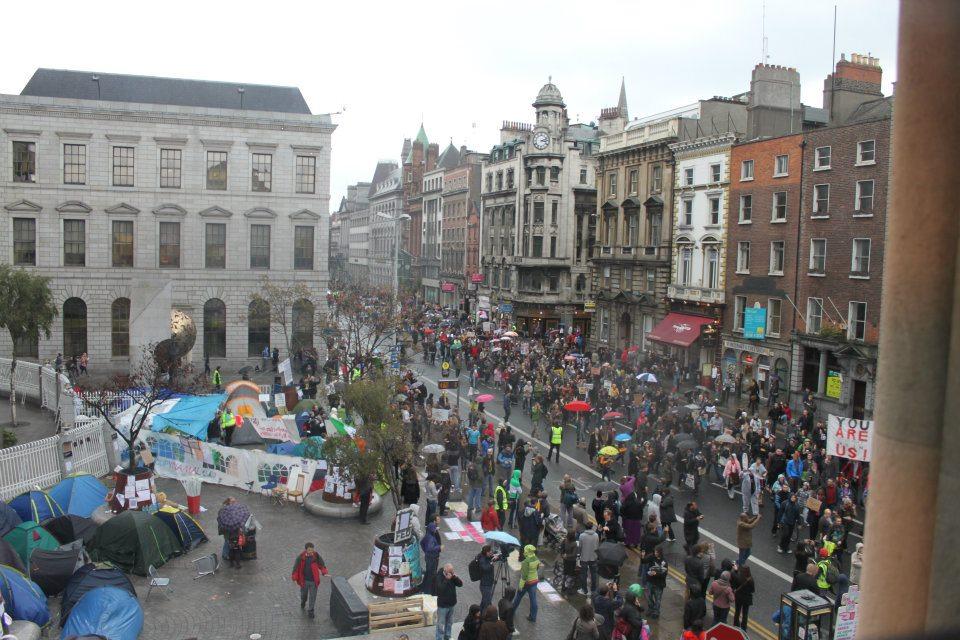
    Saturday November 1 saw a nationwide day of protest against the proposed introduction of water charges.

    Marches were organised in all the major cities and towns across the country, with the largest gathering taking place in Dublin.  Smaller local marches took place throughout the greater Dublin region in the morning, with protesters then coming together in the city for the main event at 2pm.

    There were two starting points: one at Connolly Station, the other at Heuston.  The two groups marched on their respective sides of the Quays before joining and converging at the GPO in O’Connell Street.

    As with last month’s march the atmosphere was good, with no reports of arrests. At the same time, however, a palpable feeling of anger against the Government and Irish Water pervaded.  The message which the people were sending out was “enough is enough”, and that after years of austerity they were not prepared to be squeezed any more.

    Unlike many parts of the country the rain held off for most of the day, but by late afternoon the bad weather had set in and many people did not stay for the end of the speeches.  Nonetheless, the organisers once again claimed a higher turnout than expected, pointing out that the sheer volume of protesters sent a clear message to the Government.

    Speaking at the Fine Gael presidential dinner in Dublin that evening, Taoiseach Enda Kenny said that the Government would not be scrapping water charges. He admitted, however, that mistakes had been made in their introduction, and that the setting up of Irish Water had been badly handled.

    He went on to point out that the alternative to water charges would be an increase of 4% on the higher bracket of income tax, an option which he was not prepared to consider.

    Meanwhile, the latest opinion poll for the Sunday Independent shows a further slip in Government popularity.

    Dissatisfaction with the Taoiseach has grown to 67%, up 9% since September; Joan Burton’s popularity has also slipped by 8% in the same period.

    The poll also asked voters who they would vote for if a general election was called tomorrow.  Results suggest that Sinn Féin, at 26%, is now the most popular political party in the country, ahead of Fine Gael at 22% and Fianna Fail at 20%.

    Further water protests are planned for the end of this month.

  • Password Management Meltdown

    One of the problems of modern life is that of creating and managing passwords.  Many of us choose too simple a password and use the same one for multiple accounts, thus seriously compromising our online security.

    And it’s not just passwords either; we also have PIN numbers for our mobile phones, bank cards and whatever else.  Add them all together and the result is an impossible number of letters, symbols and digits to keep in our heads.  Worse still, we then have to remember which passwords match which account and, indeed, what username we chose for that account in the first place.

    I am a pretty average user and at a rough estimate have about 25 such combinations to remember.  Rather unsurprisingly I often don’t.

    So what’s the answer?  How best to create, organise and remember all the tricky little blighters without making it too easy for the hackers?  Help is at hand, but before we begin please, please, please do not be clever and use ‘password’ or ‘backdoor’ or similar as your password.  Lots of other clever people do that, and lots of other equally clever people will consider them worth a guess to see if you’re not as clever as you think you are.

    Having got that out of the way, we give answers to your most frequently asked questions:

    I know I shouldn’t use short passwords but my dog has a fairly long name and it’s easy for me to remember, so why not?

    Okay, a complete stranger might not know the dog’s moniker but what about friends and acquaintances?  Also, have you ever posted a picture of your pampered pooch doing something endearing on Facebook with his name included?  You have, haven’t you?  Anyone looking at your page already knows your name; now all they need is your password.  A quick guess at ‘Marmaduke’ will do the trick.  Prepare to be fraped.

    What about those preset security questions for when you’ve lost your password; surely the same applies?

    Good point.  “Where did you go to school?” and “What was your mother’s maiden name?” are both eminently Googlable.  The more you interact on the internet the more information about yourself you’ve put out to add to whatever’s out there already.  Consider password reset questions carefully.

    I have a special password for important stuff like my online banking; for all the rest I use the same password.

    Congratulations on keeping your money safe, but consider this:  You’ve attempted to log onto one of your accounts, let’s say it’s Netflix, and you’ve forgotten your password.  You click forgotten password, follow the prompts and a message is sent to your inbox allowing you to reset it.  Fine.  But now suppose I have your email address and password (your email address is easy to find and I know your dog’s name remember), not only can I go in and watch movies at your expense; I’ve also caused you future inconvenience by changing your password in order to do so.   And of course the same principle applies to any other accounts you might be subscribed to.

    Your email password is more important than you might think; it can be the key to all the rest.  Guard it carefully.

    I store all my information on my phone, that way it’s always to hand.

    Fine, just don’t lose it.

    And just in case you do, for heaven’s sake make sure you have a security lock on it.

    I’ve thought about what would happen if I lost my phone, so I back up my information in The Cloud where it’s safe.

    Good for you, but bear in mind that even if your files are high above and out of reach in the stratosphere, or wherever this Cloud thing is, they can still be hacked.  Just ask certain recently under-dressed and overexposed celebrities.  You’re probably all right though; it’s highly unlikely that professional hackers are desperate to uncover saucy photos of your dog.

    Okay, I get the message: I need long convoluted passwords incorporating higher and lower case letters, numerals and symbols and a different one every time. I’m never going to be able to remember them all, putting them on my phone may not be the best of ideas, storing on-line or on my computer carries risks of hacking, so what the heck am I supposed to do?

    That is a very good question to which I do not have a definitive answer.  You could try doing what I do and write them all down on a piece of paper.

    Of course, security buffs would say that this is not a good idea either because burglars might break in and make off with your precious details.  It is probably safest to put it in a locked lead-lined casket and bury it at the bottom of the garden, only to retrieve it at dead of night when the neighbours aren’t watching.

    Just make sure the dog isn’t looking either in case he digs it up; there’s nothing more embarrassing than being hacked by a family pet.

    ———————

    We went out onto the streets of the city to find out how people do actually manage their passwords…


  • Whatever happened to Occupy Dame Street?

    Whatever happened to Occupy Dame Street?

    This slideshow requires JavaScript.

    Last Saturday saw, according to whoever’s statistics one chooses to believe, 30,000, 100,000 or even 150,000 protesters marching through Dublin.  But what became of the people we were all talking about three years ago: the Occupy Dame Street Movement?

    The short answer is that, like Monty Python’s legendary parrot, it is dead and deceased.  It is no more.  The only visible surviving remnant is the group’s original Facebook page, still active, but according to the original members, long-since hijacked by outsiders.  The vast majority people who marched on Saturday did so of their own volition; others were part of larger protest groups and organisations.

    Rob Dunlop was one of those original members of Occupy Dame Street and was one of the first to arrive at the steps of the Central Bank.  He had protested a week or so earlier outside the Dáil on the night of the now infamous signing of the bank bailout and was excited to hear of the planned Occupy protest.  “I took myself and my sleeping-bag down there straight away” he says. “I was really concerned about how the economy and society in general were going and did not want to have it on my conscience for the rest of my life that I stood idly by and did nothing.

    “At first there was a good atmosphere.  People were on our side, and that included the gardaí, who would stand around chatting to us.  Anyone was free to come along; the only rules we had were no drugs, no alcohol and no politically affiliated parties.  Unfortunately this meant that we had no way of keeping certain flaky elements out, and it was they who were mostly responsible for eventually turning public opinion against us.”

    The protest came to an end when the gardaí eventually moved in to clear the camp in February 2012, concerned as they were that conflict might arise as the forthcoming Patrick’s Day parade, with its inevitable component of alcohol, passed right by it.

    The protesters were offered the option at the time of moving out for the duration of the parade and returning after, but many were suspicious and refused, believing that once out they would be stopped from coming back.  Rob believes that they should have accepted the offer.

    Another core member at the time was Darragh Kenny.

    “When I heard I went straight down, full of enthusiasm, and ended up camping for two months” he says.  “Within a few days I had somehow become treasurer.  Someone had to do it because we were getting a lot of donations at the time.  The problem was that there was no structure for appointing the right person to the right job; people just volunteered.  I was probably the worst person to be treasurer, I knew nothing about it but did my best.  There was a lot of that sort of thing going on.”

    Would the movement have survived had its members agreed to absent themselves over Patrick’s day and return after?  Darragh thinks not: “To be honest it [the protest] was on life-support by Christmas anyway.”

    Helena Sheehan, a respected academic and a professor emerita at DCU, was instrumental in the original setting up of the protest.

    In November 2011 Occupy Wall Street was making headlines around the world and she tweeted “#OccupyIFSC. Up for it?”  The result was a flurry of communications via Facebook and Twitter and on October 8th a group of people came together on the steps of the Central Bank.

    A veteran of anti-Vietnam war protests in Washington exactly 40 years previously, Helena deemed it “inappropriate at my age” to camp out and instead slept in her own bed.  Nonetheless she says “I look back on that day with fondness, because the atmosphere was so fresh and open, because all voices were equal, because there was such hope in the air.”

    So why did the hope eventually die?

    Helena advocated political inclusion rather than exclusion right from the start, believing that the way forward was to unite and work with all parties with a similar mandate; however, the general consensus was that ‘this is our movement, it stays our movement and others can leave their own politics at the door if they wish to enter’.  Many did turn up at the door, and many were turned away. The result was much bickering and bad feeling, leading to groups which really should have been pulling together pulling in opposite directions instead.  From here the movement went into an irreversible decline.

    Helena attempted an initiative on a different front.  She set up “Occupy University”, an academic forum intended to encourage structured debate on the issues of the day.  Sadly this is now also defunct.

    Despite this she remains positive.  “The movement may have ceased to exist but nonetheless it had an effect.  It provoked debate and raised an awareness of social issues.  Its members might have all gone their separate ways, but many are still politically active in their chosen spheres and many of those cut their teeth on the Occupy movement.”

    And the current Occupy Dame Street page on Facebook?

    “They do not represent us.  They do not like us and we do not like them.  They do not believe in dialogue; they are mostly concerned with antagonism and getting themselves arrested for the publicity it brings.  If they cannot get arrested they are not happy.”

    Strong words, but words which might go some way towards explaining why no-one from that group, despite repeated requests, came forward to be interviewed for this article.

  • Thousands protest water charges

    Thousands protest water charges

    This protester had a message for Joan Brution
    This protester had a message for Joan Brution

    The sheer scale of yesterday’s water protest march in Dublin yesterday appeared to take both the organisers and the Gardaí by surprise.

    The march was originally planned to start at Parnell Square at 2 pm and proceed down O’Connell Street, but by 1.30 pm the square was already full and newly arrived protesters were diverted around the Rotunda Hospital to form up. Eventually the queue stretched back as far as Dorset Street.

    From O’Connell Street the intended route was across the river and down D’Olier Street before doubling back down Westmoreland Street to assemble at the GPO. In the event the Gardaí realised that the crowd was too large and that the head of the procession would collide with the middle going in the opposite direction. Barriers were opened at College Green and the march was allowed to proceed unplanned past Leinster House and on round Stephen’s Green. From here it carried on to Aungier Street, down George’s Street, and rejoined the original route back at College Green.

    By the time the tail of the march had left Dorset Street the head was already at Leinster House.

    Water march
    Planned route in green; route on the day in red

    The result was that traffic was brought to a standstill on both sides of the city, and many drivers found themselves immobilised as the marchers swept past. Despite this the atmosphere remained good, with many of these same motorists sounding their horns in support.

    As always, it is impossible to accurately gauge the number of protesters. RTE last night quoted a Garda source at 30,000; other estimates are much higher, with many in excess of 100,000. Certainly from the ground a figure of 30,000 would appear impossibly low. Many of the protesters were critical of media coverage of the Irish Water issue, with RTE being singled out for alleged bias more than most.

    Much was made, by both the protesters themselves and the speakers back at the GPO, of Joan Burton’s recent comment about protesters owning expensive iphones. One placard read “Who pays for your smartphone Joan? We do”, people defiantly waved their camera phones in the air at every opportunity. Richard Boyd-Barrett urged everyone to take selfies and email them to the Tánaiste.

    Audrey Clancey, of the Edenmore Says No campaign, thanked Irish Water in a backhanded way by congratulating them on doing what no-one had managed to do before: to finally unite the people of Ireland in saying that “enough is enough”. This drew a large cheer.

    Independent TD Clare Daly declared that “today is an historic day when things will finally change”, and Richard Boyd-Barrett urged everyone present to keep the momentum going by supporting the next stage of the campaign: a day of nationwide protest in all towns and villages on November 1st.

    This slideshow requires JavaScript.