On the 19th of November 2025, a protest took place outside the Dáil calling for the Occupied Territories Bill to be implemented.
The Bill is a proposed law which would ban trade with countries who are illegally occupying territory, most notably Israel’s current occupation of Palestine.
This would lead to Ireland no longer engaging in the trading of goods with the Occupied Palestinian Territories.
There was a meeting that morning in which People Before Profit-Solidarity tabled a motion calling for the Bill to be passed through the Oireachtas before the end of the year, with other opposition parties also in support of the motion.
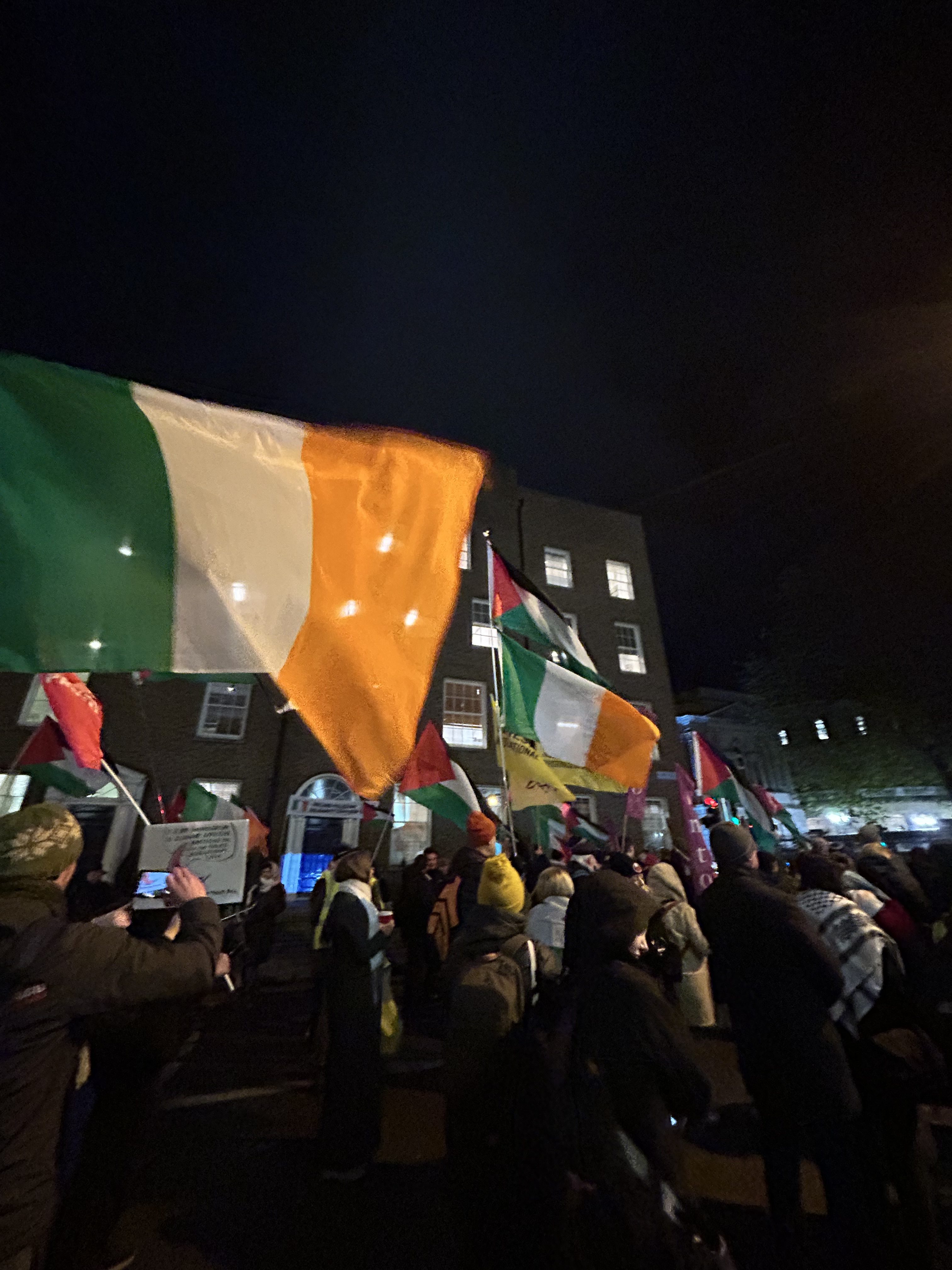
The protest was full of Irish and Palestinian flags, and everyone was in support of the Bill being passed.
With loud chanting and a clear message, here is how the protest unfolded.
Photo 1: The calm before the storm. The ever-bright Dáil Eireann lights up the area, half an hour before the protest was set to begin. As the numbers began to build, so did the police presence, with multiple guards and a Garda car in attendance. Photo 2: The protest began at 5:30pm just opposite the Dáil. Crowds began to increase at around 5:15pm, with banners, such as the “Ireland – Palestine Solidarity” banner, being raised above the gathering crowd.Photo 3: A man pictured with the Palestinian flag draped around him, anticipating the beginning of the protest. Photo 4: The man making all the noise. Constantly beating his Palestinian drum to show his support and make his voice heard, while inspiring others around him to make as much noise as him. Photo 5: This man had a clear message at the protest: “Pass The Damn Bill”. A message to the Irish Government to get the Bill passed as soon as possible, with bombs seen within some of the letters on the sign, highlighting the violence in the Middle East at the moment. Photo 6: As the flags began to be raised, so did the signs. This woman pictured holds hers up proudly, demanding the Bill be passed in its entirety. The speech bubble on the sign is being said by a watermelon, a symbol of Palestinian resistance and solidarity. Photo 7: This photo shows how large the crowd grew during the protest. At this point, everybody had their flags and banners but most importantly, their voices. With never-ending chanting, the crowd started to cover every inch of the road just across from the Dáil. Photo 8: With both Irish and Palestinian flags now on full display, hand in hand, a message is projected on one of the buildings, calling for the end of arms trade with Israel.
The undeniable growth of Artificial Intelligence (AI) over the last few years has led to a massive increase in AI data centres all over the world, including Ireland. These are buildings that host a large number of infrastructures in order to keep internet servers running smoothly.
As of October 2025, there are approximately 82 data centres in Ireland, with an additional 40 having already been granted planning permission. It is a market that is constantly growing due to the increased demand of AI tools, with 1,200 data centres in Europe. This number is expected to see a huge increase in the next few years.
These data centres have come about from the European Union’s AI Act, which will be governed by the National AI Office in April 2026. The goal of the act will be to implement more AI data centres but ensure the AI systems are regulated and safe for all involved.
A proposed design for an AI data centre in Dublin: Photo from datacentredynamics.com
In a press release from gov.ie, the Minister for Enterprise, Tourism, and Employment, Peter Burke, said “Ireland is building a future where AI is transformative, trusted, and transparent. We’re balancing innovation with safeguards, ensuring AI works for people, not against them.”
As well as these comments from Burke, the Minister of State for Trade Promotion, Artificial Intelligence, and Digital Transformation, Niamh Smyth, spoke about the hopes she has for the act:
“This is about leadership with purpose. We’re creating a system that protects the vulnerable, empowers innovators, and positions Ireland as a global hub for ethical AI. The successful implementation of the AI act requires collaboration, co-operation and collective responsibility amongst all stakeholders,” she said.
However, one prominent issue that has become cause for concern as a result of these new data centres is the effect on Ireland’s climate goals. The current goal set out in the Climate Action Plan is to reduce greenhouse gas emissions by 51% by 2030. The Environmental Protection Agency (EPA) projects a reduction of only about 22-29% by 2030.
AI data centres have led to a major increase in environmental issues. Some of these include a high water and energy consumption and a massive amount of greenhouse gas emissions. With all these new AI data centres being constructed in Ireland, it is likely that these projections will further hinder Ireland’s attempt to hit their climate goals.
In order to get some insight into how damaging the climate effects could potentially be, I spoke to a climate activist, Olivia Byrne:
“Our greenhouse gas emissions are already really bad, especially in comparison with other European countries, considering our population and size. It’s scary to think what they’ll be in the next few years. The data centres are only something I’ve recently been looking into and while I get the argument that they have a place in the modern world, they have to be regulated. They use an extraordinary amount of water to cool the systems and huge CO2 emissions. It’s only going to get worse in the next few years. I’d be shocked if we hit those climate goals, I think they have to be revised eventually.”
It is clear that while these centres are necessary in this ever-changing world, the proposed National AI Office as well as the government’s climate department have to ensure that everything is regulated in order to keep climate goals to an acceptable level.
Being a pilot is an occupation that the majority of us would imagine to be of high importance and extremely pressurised. Now, imagine being in that position as young as 23-years-old. While that would sound daunting to most, that is the reality for Dáire Murphy, a young man from Lucan, Dublin, who will complete his training to become fully-fledged pilot.
Murphy started honing his craft at the National Flight Centre (NFC) where he completed all his necessary training as a student pilot and got a commercial flying license. This allowed him to continue his training and get inside the cockpit.
“I’m with Emerald Airlines now, so I’ve done my initial training with them, health and safety, fire training, all that sort of stuff,” said Murphy. “I’m doing a two-week course doing flight simulations, then I do what’s called line training, where I fly with a specialised captain until they deem me fit enough to not need anyone there and I can be a fully unrestricted commercial pilot flying passengers.”
It is a job that is heavily sought after, but extremely tough to get into, due to the harsh nature of flying and the long process of the training and exams, which many people who think they want to go into aviation simply cannot complete.
“The exams are designed to filter out people who aren’t suitable for the job, they don’t want people who just like the idea of being in uniform and sitting up the front. You can’t just pick someone off the street and teach them how to fly an airplane. You do have to put the work in,” said Murphy.
Daire Murphy pictured after receiving his Private Pilot License. Photo from nfc.ie
An obvious factor which may turn a lot of people off aviation is the cost. Like many other things, the cost of training would instantly discourage many young hopeful pilots, with Murphy himself further showing how much commitment he had to this course:
“By the time you’re walking into an airline, you could have shelled out around €100,000 or €120,000, which is a huge amount of money. I was working in retail before and 50%, sometimes more, of what I was earning was put aside into a different account for my training. If I was earning around €3,000 a month I wasn’t actually seeing much of it.”
Like any other sort of course, there are always people who will drop out. Dropout rates are usually correlated with the difficulty level of a course with “4 out of 13 dropped out of [Murphy’s] full time course during the exams, so only 9 will graduate from the class, which is sad because you make friends with these people, but you have to want it.”
While it could be assumed that a line of work such as this would require intense studying and training, the short time frame given to complete these hours may come as a surprise to some.
“It is a legal requirement to complete 13 exams and 750 hours in the classroom, which is about 6 or 7 months. It’s the equivalent of a 4-year masters condensed into these 7 months or so,” he said.
The common narrative is that people go into this line of work because they got the idea from a family member, but not Murphy. He explains how flying has been the only thing he was talking about “since [he] could talk”.
He said, “maybe it’s rare that someone with no aviation background wants to do it, but I’ve never questioned it, I never thought that it wasn’t for me and I wouldn’t change any decisions I’ve made along the way.”
In a world in which there are so many different lines of work to go into, it is rare that somebody sticks to what they are doing from, in Murphy’s case, as young as 17 years old.
“There were times when I was sat there doubting myself, thinking I’d never be able to get through it, or I’d never see the end of it.”
This line of work really is a one step at a time type of work, with even Murphy himself evidently feeling that it is almost never ending at times. However, he can see the light at the end of the tunnel now.
“I still have a few more weeks in the classroom, making sure we know everything, then a few more flight simulations which will be done by December. Then I have to fly the aircraft and do what’s called a circuit, which is basically just flying the aircraft around, practicing takeoffs and landings, then I’m ready to have passengers on board. I’ll still be observed at that point because safety is the priority,” he explained.
Emerald airlines are unofficially known as a stepping stone towards being an Aer Lingus pilot, which Murphy hopes will get him one foot in the door in order to achieve his ultimate goal.
“When Aer Lingus go hiring and recruiting pilots, they do take a lot of young pilots from Emerald. They’re starting a new course in January, and they’re talking 10% of Emerald’s pilots, which is a huge number. Aer Lingus would definitely be my end goal, like a lot of other Irish pilots would say.”
While it’s been established how this business is not suitable for everyone, Murphy would encourage people who are considering aviation to “not overthink it and just go for it”.
“The more you think about it, the more reasons you’ll come up with not to do it. Definitely do your research and don’t dwell on it too much. You’ll start coming up with reasons not to do it if you just start thinking negatively.”
Dublin Airport has recently announced new security measures involving liquids, gels and electronics, with it now not being necessary to take electronics out of carry on bags, as well as now being allowed to have liquids and gels up to 2 litres.
These gels and liquids can now be kept in hand luggage, a big change to the previous rules of needing to keep liquids and gels under 100ml and having to keep them in a see-through bag.
However, these are not the only changes to the new security measures, with around 30 new C3 scanners being implemented to both terminals in Dublin Airport. These C3 scanners use advanced technology to see through materials and make any possible security threats easily detectable.
This addition makes Dublin Airport one of the first in Europe to fully switch to C3 scanners, which DAA (Dublin Airport Authority) CEO Kenny Jacobs is thrilled about:
“The completion of the C3 scanner rollout at Dublin Airport marks a major milestone in enhancing the passenger experience. Travellers no longer need to remove liquids or electronics from their hand luggage during security screening, making the process faster, smoother and more secure. This multi-million-euro investment reflects our commitment to reducing queues and improving efficiency, ensuring passengers spend less time waiting and more time enjoying their journey.”
These changes have been introduced as measures to achieve the DAA goal of ensuring 90% of passengers take less than twenty minutes to get past security at Dublin Airport.
The DAA set the same goal for their 2024 year, confirming in their annual reports and accounts that they comfortably exceeded this target at both Dublin and Cork Airport.
However, how impactful will those changes really be? Not just for passengers, but for those who work in airport security and other staff alike. To find out their opinion on the subject, I spoke to Lauren Toland, an air hostess with plenty of knowledge on security in Dublin Airport, who described the changes as “necessary”.
“I think it’s always necessary to keep updating things and trying to make things easier for passengers. I know more than anyone how stressful the airport can be, busy literally all the time, so any little help that can make things slightly easier is always welcome. People just want to get through security as quick as possible, obviously the checks have to be done thoroughly, but to be able to do it to the best of the security’s ability just means it’s a better scenario for everyone involved.”
Lauren went on to describe how the complaints about security become “tiring”.
“I don’t think anyone on the planet enjoys going through security, it can be tiring to hear people complaining about it but I’m definitely hearing less and less of it as the years go by, which is a credit to the company for genuinely trying to improve things.”
With this response, as well as the optimistic statement made by the DAA CEO Kenny Jacobs, it is clear that these new security measures appear to be bringing positive change so far. Shorter waiting times for passengers as well as new advanced equipment for staff appears to be leading to a smoother experience for all involved.
We will soon discover the true extent to which the new measures have had once the DAA releases its annual report for 2025 later on this year.
The Dublin Fringe Festival 2025 has come to an end, with thousands of people attending different events of creative and performing arts.
The 31st annual edition of the festival showcased its usual sites of creative and performing arts, with some events being ticketed and some being free, providing an affordable experience for anybody interested in engaging with cultures such as this.
The festival is known for its inclusivity, with a diverse group of performers and attendees alike visible in every corner.
With ranges of performances, there is also art exhibits, such as the Minaw Collective, an outdoor visual art exhibition, completely free to the public to go and see.
Art piece at the Minaw Collective. Photo by Nathan Clarke
While there were many venues that transformed into a culture hub during the festival, Bewley’s Café Theatre turned into a hotspot for events, with five different events taking place over September.
I spoke to Colm Maher, who was involved in the running of these shows in the café theatre and described the importance the festival brings in providing “a platform to young artists starting their career in theatre.”
“It also gives a platform for artists in other disciplines to tell their story on stage. For example, in Bewley’s this year Davina Devine, who is a drag queen, put a show together telling her story. And Farah Elle, a singer/songwriter, got to tell her story about growing up in Libya.”
As well as this, Colm also explained the importance that events like this brings to the venues themselves, explaining that “for Bewley’s the Fringe brings in a demograph of young people that the café might not otherwise attract.”
Of course, it is mainly the performers who can reap the rewards from performing at the Fringe Festival, as Colm proudly explained the many success stories that have come from some of these shows:
“Dublin Old School that transferred to the National Theatre in London and was then made into a movie and My Left Nut, going on to become a TV series. They follow this format of one hour shows breaking out of a fertile festival environment, in Edinburgh they had Fleabag and Baby Reindeer. In short, a Fringe show mounted on a shoe-string budget has the potential to break out into the mainstream. That is the dream! Which is part of what Fringe is all about.”
Bewley’ Café. Photo by Nathan Clarke
Stories such as this perfectly encapsulate why it is so important to have shows such as this, opening the doors for young and talented performers to further develop their stage skills and provide a platform to be picked up by other venues.
Colm goes onto develop this point, as “the intense and concentrated atmosphere of a festival environment help incubate fresh and exciting talent, ensuring theatre is kept alive in our age of online streaming platforms; Fringe festival remind people that you can’t beat a live show!”
The festival is renowned for it’s incredible atmosphere, which evidently takes a lot of parties’ involvement to foster.
With the Fringe Festival entering it’s 32nd year next year, it is clear to see the impact it can have on businesses, performers and consumers alike, as Colm put it:
“Though, more importantly, I like to ensure all the companies have a good experience in the venue. I like to foster a collaborative and creative atmosphere, which is what the spirit of Fringe is all about.”








You must be logged in to post a comment.