
Author: steacykarloutlookcom

  • Vacancy reports lack correct ‘classification and consistency’ says TU Dublin Planning professor

    A planning professor has called for a consistent definition of vacancy and dereliction across all stakeholders as “fit for purpose data has not been achieved”.

    The Residential Buildings Report by GeoDirectory found that the number of vacant properties in Q4 of 2021 represented 4.4% of the national housing stock.

    In comparison, the Census Vacancy report shows 166,000 vacant properties in Ireland, with 48,000 dwellings recorded as vacant since 2016, according to the Central Statistics Office (CSO).

    Helen Murray O’Connor of the School of Transport Engineering, Environment & Planning at TU Dublin has called for ‘stronger definition and classification’ when preparing reports on dereliction and vacancy. 

    “These reports are authoritative and statutory sources of data, but we need to look at what definitions they are using,” she said. 

    GeoDirectory says their database distinguishes between a ‘dwelling’ which is a single residential unit as opposed to a ‘building’ which can comprise one or more dwellings”, the Residential Building Report predominantly focused on individual ‘dwellings’.

    In comparison, the CSO, who deems a vacant dwelling as “classed as vacant by census enumerators if it is unoccupied on Census night, is not used as a holiday home and is not usually inhabited by occupants who are temporarily absent at the time of the census”.

    The Census definition of a vacant dwelling is a point-in-time indicator taken on Census night as to whether the property was inhabited or not on Sunday 03 April 2022.

    The GeoDirectory report contained a range of variables on residential dwellings such as address point for each dwelling and building type, dwellings by building type (detached, semi-detached, terraced, duplexes, bungalows, temporary), there was no separate classification for apartments, but GeoDirectory defines an apartment as a dwelling which exists in a building of 5 or more dwelling and buildings under construction. 

    “Although both the Census and GeoDirectory’s databases are thorough and useful data, I do not think there’s consistency in it as we don’t know what they are measuring and what they are counting,”

    “There needs to be a consistent definition between vacancy and dereliction across all researchers, publishers, county councils, and government departments to achieve truly fit-for-purpose data”, O’Connor said. 

    Reports findings 

    According to the report, the counties with the highest rates of vacant properties were Leitrim (13.3%), Mayo (11.9%) and Roscommon (11.6%). Dublin had the lowest vacancy rate with 1.4%, followed by Kildare (2.1%), Waterford, and Louth (both 2.8%).

    In addition, the report said there were 22,096 residences classed as derelict, a 7.3% decrease since 2016. 

    Annette Hughes, director of EY Economic Advisory, said “based on our analysis for this report, the 90,158 vacant residential properties and the 22,096 derelict residential properties across Ireland should be investigated to ascertain if they can be returned to the housing stock, a move which would also support our retrofitting targets.”

    Kevin Duff, Planning Officer for An Taisce believes stakeholders do not have the resources or the correct understanding of the vacancy and dereliction issue in Ireland. 

    “We need to look at how councils and agencies are differentiating between a dwelling or a building, while also ensuring the stakeholders have defined the difference between a vacancy and a derelict building”, he said.

    Duff believes the regeneration or redevelopment of derelict buildings can help aid the current housing crisis, whilst also maintaining the heritage and history of the city. 

    The redevelopment of formerly derelict buildings at 71-75 Aungier Street is a perfect example of this he says. Truncated buildings were retained and reconstructed adding additional stories, with individual shop units developed below. 

    Speaking of the redevelopment, Duff said “This is a great example of inner-city regeneration, where 

    derelict buildings were maintained and reconstructed with a new student housing development behind,”

    “It goes to show how derelict buildings can provide a good mix of uses that add to a city.”
  • Vendor’s fury as Dublin County Council aim to close food and wellness space 

    Vendor’s fury as Dublin County Council aim to close food and wellness space 

    By Karl Steacy

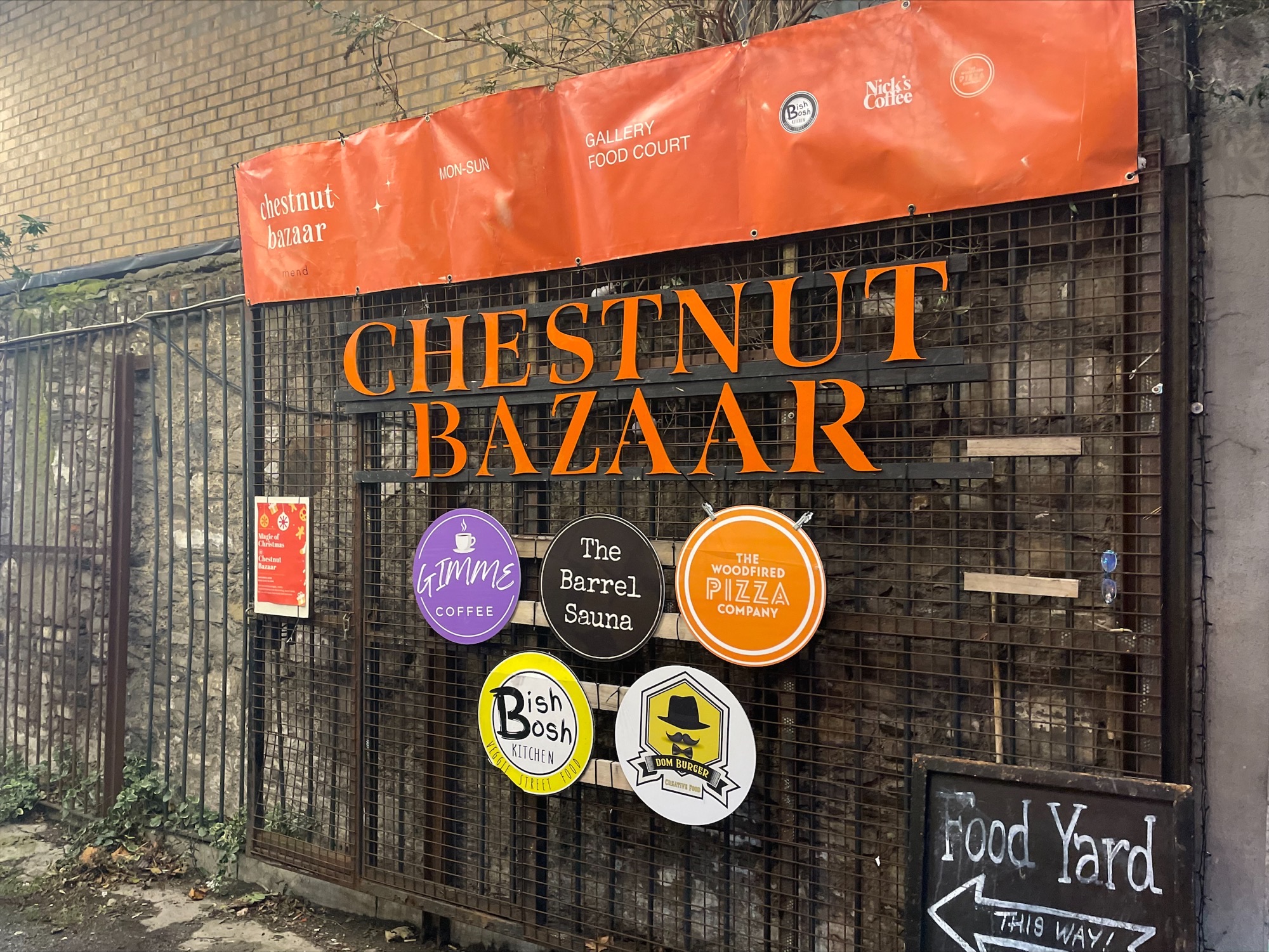
    Chestnut Bazaar sits in the heart of the Liberties, nestled down a side alley on the busy Clanbrassil Street. 

    Walking up to its entrance, it’s striking that it lies between a block of apartments and a derelict building, perhaps symbolic of the current housing and planning issues in Dublin City. 

    As you venture down the laneway, you can hear the chatter of vendors and visitors being accompanied by a busker.

    A neglected vacant yard has been brought back to life as a food and wellness space in Dublin’s inner city. 

    Set up in October of last year by Mend, a Dublin based artistic group, the Chestnut Bazaar has become a community hub for an eclectic mix of art, food, and wellness. The vendors at the bazaar include BishBosh Kitchen, Dom Burger, The Woodfired Pizza Company, and AA’s Caribbean which offers a taste of Trinidad in Dublin.

    The entrance of Chestnut Bazaar. (Image by Karl Steacy)

    The Bazaar also includes the traditional Brazilian food truck Juca BBQ, the Gimme Dublin Coffee truck, Ama Acai, the Barrel Sauna offering relaxing saunas, and Alanina Therapies which offers therapeutic massages and meditation.

    All of which is surrounded by eye-catching and thought-provoking art from the likes of Dirty Dublin, Niall O’Lochlainn, KAMBO, EOIN, PENS, and Conan Wynn.

    “The whole idea behind Chestnut Bazaar was to make a difference with a community space,” says Sean Hussey of BishBosh Kitchen who co-founded the Bazaar. 

    The bazaar on a winter’s night. (Image by Karl Steacy)

    “You shouldn’t have to spend €100 every time you leave your house to do anything in Dublin, we feel we have provided a place where you can have either a sauna, a massage, get a coffee, eat a meal or all of the above for under €50.

    “That’s not achievable anywhere in Dublin, apart from at the Chestnut Bazaar”.

    However, Dublin City Council (DCC) has deemed the bazaar as an “unauthorised development” instructing the Chestnut Bazaar team to close the space by December 31st.  

    The culture and food yard requested to extend its use of the Dublin 8 space, only for DCC to refuse. Dublin City Council has not responded to The City’s request for comment. 

    Eamon de Freitas, owner of AA’s Caribbean said he did not understand the council’s decision, arguing that the site has a history of commercial use. 

    “It was a fuel depot before it was vacant for a number of years, so historically it had been publicly accessible for the sale and goods or services.

    “Does the city council want the space to store rocks on the ground or to be a space where communities can get together and entrepreneurs can start to grow their businesses?” de Freitas asks. 

    The group has launched a petition urging the council to keep the space open while it remains vacant and awaits development.

    “We’re trying to get as many signatures as possible in the hope that it will show the appreciation for the space and the value it brings to the community,” Hussey said. 

    You can sign the petition here.

  • A 5-hour daily trip to college: Students commuting long distances on the rise

    A 5-hour daily trip to college: Students commuting long distances on the rise

    Hannah Cahill’s morning alarm sounds at the ripe time of 6 am. She hastily showers and gathers her belongings.

    Every morning Hannah comes from Ballybrophy – a small village just outside of Portlaoise – to Dublin. As commuter trains do not run every hour, Hannah must get the 6.30 am train to Heuston Station to arrive on time for her first lecture at 9 am. When lectures finish at 5 pm, she hurriedly leaves TU Dublin, Grangegorman to get the train at 5.30 pm.  

    Living in the commuter belt, Hannah is reliant on patchy public transport that can take hours to get to and from college.

    “This is incredibly frustrating, but I can’t afford accommodation in Dublin – it’s easier to spend €20 a day commuting than to rent in Dublin,” says Cahill (22), who is studying Journalism. 

    “Walking off campus with the knowledge of a long commute ahead of you is draining,”

     “It’s a life of constant clock watching – most days I’m commuting longer than I am actually in class,” Cahill says. 

    Speaking to Hannah, you get a sense of her frustration. It seems the strain of commuting is beginning to take its toll. She believes commuting such a long distance has affected her attendance.

    Many college students feel the same way as Cahill. The recent walkout of lectures in protest of the student accommodation crisis by thousands of third-level students highlights this. 

    Ballybrophy Train Station 

    As part of a Union of Students in Ireland campaign, students all over the county walked out of lectures and tutorials at 11 minutes past 11 am and congregated in college outdoor spaces to highlight their financial struggles. 

    The USI said the action was to remind government and college authorities that students are “not an endless money pit” and to call for “meaningful” change in the way third-level education is funded.

    Speaking to The Irish Times, USI president Beth O’Reilly said the union was not surprised by the large numbers of students who turned out today as it is “well aware of the depth of feeling on the issue”. 

    It is estimated that 2600 students across all three Technological University of Dublin campuses took part in the protest. 

    Brian Jordan, TU Dublin Students Union President believes the protest was key, showing that “students care, that they are angry and they’re nowhere near done yet”.

    More students have to make unsustainable commutes, meaning students’ academic work suffers, whilst missing out on the whole college experience due to not being able to take part in clubs and societies. 

    Speaking of the rise of students commuting long distances, Jordan said: “We know countless students who have contacted us about accommodation queries, issues, and scams. So many of our students can’t afford accommodation in Dublin, they’re commuting hours every day, and they’re missing out on lectures, labs, clubs, and societies. We know students are commuting from Mayo and Kerry, and others live in hostels night to night.”

    According to the latest Census, the proportion of third-level students travelling more than two hours a day is increasing, with 17 percent now doing so. 

    So, how might we ensure that fewer students are commuting long distances to college? 

    Jordan believes there needs to be a legislative change that protects renters such as digs protections, and rights for tenancies under six months. 

    “They need to reduce rents, cap rents and subsidise affordable purpose-built student accommodation from public funds. They have to abolish the student contribution charge, better fund the higher education sector,” Jordan added. 

    For commuting students such as Hannah Cahill, the longer-term solution is much clearer. “We need more affordable accommodation and fast,” she warned.