Tag: alcohol

  • ‘Just one won’t hurt’:  A closer look into Ireland’s drinking habits 

    ‘Just one won’t hurt’:  A closer look into Ireland’s drinking habits 

    By Áine McKeon  

    ‘Don’t be rude, have a drink with me’, ‘You deserve a drink, after the week you’ve had’, ‘It’s tradition, you have to’ – these are just a few phrases you may hear around the table while having a few drinks.  

    Drinking as a social activity is quite common between friends and family across Ireland. 

    Stereotypes surrounding Irish people and drinking are deeply ingrained in popular culture, often exaggerating or misrepresenting the role of drinking in Irish society – whether that be heavy drinking or holding our liquor well. 

    But how much truth is behind them? If you read between the lines, you could argue that Ireland may have a few underlying issues with drinking that may have been swept under the rug. 

    As figures rise, an increasing worry is brewing regarding the effects of drinking, shifting how Irish people view their  drinking habits. 

    But how much do we really drink in Ireland? 

    When experts talk about the dire health implications linked to excessive alcohol use, people tend to assume that it’s directed at individuals who have an alcohol use disorder – but health risks from drinking can come from moderate consumption as well. 

    In 2023, alcohol consumption was 9.9 liters of pure alcohol per capita over the age of 15 years. This shows a fall of 10% since the passage of the Public Health (Alcohol) Act in 2018. 

    Alcohol consumption per capita has reduced in recent years from its historically high point, in the early 2000s. We are now drinking at a level of just under 10 liters per capita. 

    According to |Alcohol Action Ireland per capita consumption in Ireland in 2023 equated to 284 cans of beer, 12 bottles of spirits, 43 bottles of wine, and 35 cans of cider.

    Photo Credit: Sheila Gilheany, Alcohol Action Ireland 

    “If the whole of the country was drinking within the HSE lower risk drinking guidelines, we would be consuming about 40% less,” said Dr. Sheila Gilheany, CEO of Alcohol Action Ireland.  

    “We have very high levels of ‘binge drinking’. Ireland is the 8th highest within OECD countries,” she added. 

    About 70% of the population consume alcohol. Over half of all drinkers do so in a manner that is considered hazardous. About 20% of the drinking population have an alcohol use disorder. 

    Consumption and affordability  

    “Consumption patterns are driven by price, marketing and availability. You can see the changes in consumption in the graph above. In recent years, drops in consumption are usually linked to changes in alcohol taxation. Alcohol remains very affordable, despite industry protests,” said Dr Sheila Gilheany. 

    The price of alcohol in shops today is essentially the same as it was 20 years ago. 

                    Alcohol-Affordability-Ireland – Photo Credit: (Sheila Gilheany, Alcohol Action Ireland) 

    The Organization for Economic Co-operation and Development (OECD) found that Ireland has the second most affordable alcohol across OECD countries. 

     The Irish alcohol business spends a minimum of €115 million a year promoting its goods. This excludes sponsorship agreements like those for Guinness Six Nations.  

    Ireland ranks the 3rd highest in the world for the number of pubs per head, and three-in-four people live within walking distance of a premises licensed to sell alcohol. 

    “The term ‘responsible drinking’ is very much an industry term which has no public health meaning – i.e. it is not defined,” said Dr. Sheila Gilheany. 

    The HSE has guidelines on lower risk drinking, although, as these are now in the process of being revised, it likely will decrease in common with other jurisdictions which have examined this recently in Canada. 

    Finance and office manager Jennifer Bergin at Drinkaware said, “Anybody wanting to change up their drinking habits and are looking for information can access our 2023 barometer research paper and consumption page available on our website.” 

    It’s likely that the majority of people have encountered someone who has struggled with their alcohol intake. Excessive drinking is a widespread problem in Ireland that affects not only the individual, but also those around them. Alcoholism can affect a drinker’s emotional, financial, and physical well-being, which can be harmful to those around them as well.  

    According to Alcohol Action Ireland, Ireland’s drinking culture is evolving towards more mindful consumption, with health becoming a priority.  

    The impact of these changes on the country’s drinking culture remains uncertain. 

  • Explainer: What is the government’s minimum alcohol pricing all about?

    Explainer: What is the government’s minimum alcohol pricing all about?

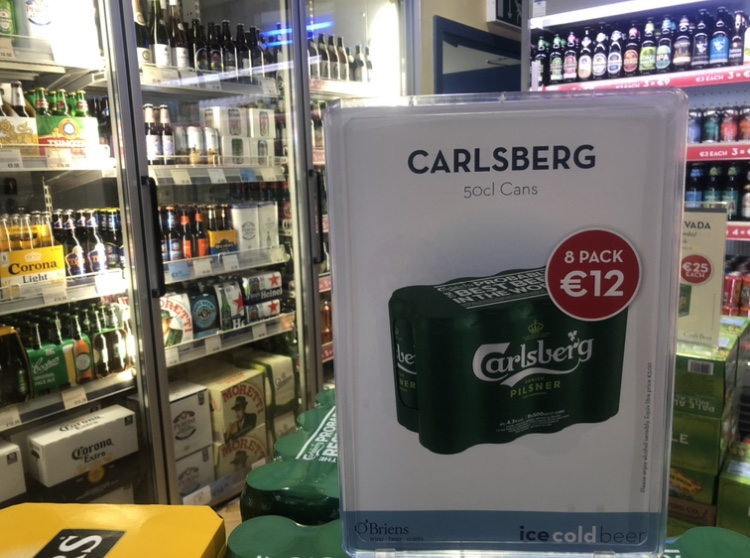
    Carlsberg advertisement in O’Briens Wines Glasnevin. Photo by Mario Bowden

    On Tuesday 4 May 2021, the government revealed plans to implement a minimum pricing on the sale of alcoholic products in of January 2022. 

    In a nutshell, the price of alcohol sold in off-licences will be determined by the strength of the product – priced at 10 cents per gram of alcohol. The higher the alcohol content, the higher the price.

    This policy is based on the 2018 Public Health Alcohol Act that the previous government decided not to put into action before the last election.

    Minimum pricing will not apply to bars and pubs, only to the off-licence sector.

    At the press conference to announce this policy, Minister for Health Stephen Donnelly and Tániaste Leo Varadkar spoke about the proposal’s aim to reduce the health harms of excessive drinking. The hope is that minimum pricing will curtail alcohol-related death and disease rates in Ireland. 

    Data shows that alcohol misuse is responsible for 2,700 deaths each year in Ireland.

    Data released by the health research board (HRB) revealed that during the pandemic in 2020, the average Irish person consumed 10.1 litres of pure alcohol – the equivalent of 116 bottles of wine and 445 pints of beer per person each year. This is a slight reduction from the 2019 average of 10.8 litres.

    The HRB noted this was a “relatively small decline, considering pubs have been closed for the majority of the year”.

    It’s also pretty far off the government’s goal to reduce the average per person alcohol consumption to 9.1 litres in 2020.

    Beer fridge in O’Briens Glasnevin. Photo by Mario Bowden

    “It’s understandable that people are drinking more at home,” said Varadkar at the press conference. “I’m doing so myself. To most drinkers, I want to say this: minimum pricing is not targeted at you. But, rather at the heaviest drinkers, those who attempt to seek out the cheapest alcohol. And particularly children, experimenting with alcohol for the first time.” 

    There is sufficient evidence to back the government’s plans. In 2018, Scotland introduced a similar minimum pricing system. Since its introduction, alcohol related deaths have fallen significantly. Canada has also had minimum pricing in place since 2010. 

    So, what will minimum pricing look like? 

    Minimum pricing will vary depending on the product being sold and its alcohol content.

    For instance, a 500ml can of lager will start at €1.70, whereas a 500ml can of cider will begin at €1.78. A bottle of wine’s minimum price will be €7.40, while 700ml bottles of vodka start at €20.71 and gins and whiskeys at €22.09.

    As the price is decided per gram of alcohol, it significantly increases as the percentage of alcohol increases – designed to impact on the strongest alcohol most.

    For example, a bottle of wine at 14% alcohol by volume (ABV), not an uncommon strength, works out at a minimum of €8.28.

    In shops like Lidl and Aldi, a number of good wines come in underneath this threshold – the shelves will be transformed.

    For those of us who enjoy a craft beer, you won’t be able to get a relatively strong IPA (6.5% ABV) in a 500ml can or bottle for €2.56 per can/bottle. We can wave goodbye to any four for €10 deals.

    Unpopular plan

    To little surprise, the new pricing scheme has come under scrutiny from both retailers and consumers alike. For consumers, the proposal mostly targets those with lower-incomes who will now be spending a bigger proportion of their income on drink. 

    Ireland’s alcohol prices already remain the second-highest in Europe – 88.9% higher than the EU average, only lower than Finland. 

    In Italy, for instance, a country closer to the EU average, a 660ml bottle of beer costs as little as 90 cents in a supermarket and imported German beer only around €1.60.

    Beer fridge in O’Briens Glasnevin. Photo by Mario Bowden

    For retailers like Pearse Greally, the manager of O’Brien’s Wines of Glasnevin branch, the lack of clarity communicated by the government has been frustrating. 

    “There’s not been that much information [given] to retailers yet. For example, how it will work with the smaller brands? We sell Tennents for €1. If the minimum price of that is going to be at €1.72, what does that mean for more premium beers like Heineken? Will Heineken then increase their price to €2.50 or three euro a can to keep its premium headline? Because this increase [in price] isn’t a tax, where is that increase coming from or going to?” asks Greally. 

    The government in the Republic of Ireland  is also calling on Northern Ireland’s government to implement its plans for minimum pricing at the same time as the south. Especially around Christmas time, when cross-border shopping is most active. Northern Ireland is set to introduce minimum pricing in 2023, a year after the Republic.

    “We have high competition with the North because drink is much cheaper there.” says Greally. “And if their minimum pricing doesn’t come into effect until January 2023, why are we doing it a year early? We’ve already increased the tax on drink as well and now we get this? So no one really understands from a retail point of view.” 

    While a number of unanswered questions remain, not least how off-licences will compete with pubs and restaurants, one thing is for sure: students can wave goodbye to cheap cans.

  • Don’t pass the Dutch: Off-licence customers ‘spoiling themselves’ during pandemic

    Don’t pass the Dutch: Off-licence customers ‘spoiling themselves’ during pandemic

    A shot outside of Fagan’s off-licence by Colm McGuirk

    Along with Jeff Bezos, Cavan GAA, and plexiglass salespeople, off-licences can be counted among the ‘winners’ of the past 12 months.

    Although pub and nightclub closures meant that alcohol consumption fell in Ireland during 2020, the inevitable switch to home boozing ensured it didn’t fall by much.

    A staff member in O’Briens at Hart’s Corner tells us “it’s been manic, really busy. Fridays are like Christmas Eve every weekend.”

    Her colleague remembers their spacious stock room as nearly too jammed to enter in December, though it’s not just in quantity that buying patterns have changed.

    “People are treating themselves to better quality,” she continues. “At the weekend, people are spoiling themselves and paying maybe €20 for a nice bottle of wine, or a bottle of bubbly or something. Maybe going the extra mile or two because obviously they can’t go to the pub, they can’t go out for meals. Instead of buying their regular bottle of whiskey, people are splashing out the extra 10, 20, 30 euro, or maybe even more,” she explains.

    A worker in Carolan’s Corner on the North Circular Road details even more extravagant spending.

    Carolan’s Corner on North Circular Road. Photo by Colm McGuirk

    “Green Spot, Yellow Spot and Midleton [whiskeys] – they’re more popular now,” she says. The latter sells in Carolan’s for €350.

    “We’re selling more top whiskeys than we’ve ever done,” she says.

    Down the road in Drumcondra, Tom O’Connor of McGrath’s has recorded “a huge uptake in wine. It has gone through the roof,” he says.

    “It was experimentation at first but I’d say now nearly two out of every three customers that are buying beer will go with craft beers”

    Tom O’Connor

    Beer drinkers might have noticed of late an extra shelf or two in their local off-licence devoted to pricier craft beers. Has the pandemic accelerated their creep into mainstream tastes? O’Connor’s experience would suggest so.

    “When the first lockdown happened,” he says, “people were looking for more variety. That’s why we started getting them in. And it was experimentation at first but I’d say now nearly two out of every three customers that are buying beer will go with craft beers, and will spend more in the off-licence than they used to spend. I would think mainly because they’re not drinking in pubs, so they’ve got more income to buy better beers.”

    McGrath’s in Drumcondra. Photo by Colm McGuirk

    Among the leaders in the Irish craft beer market are O’Hara’s of Carlow, and its chief executive Seamus O’Hara has a similar take to O’Connor.

    He tells The City, “My impression over the lockdown has been that people are maybe a bit more adventurous and trying different beers and getting into craft beer – mixing and matching and talking to their friends on Zoom or whatever.”

    While larger companies like O’Hara’s have had to take the hit on lost pub and festival sales, for some smaller breweries it’s been all positive in business terms.

    “We’re doing better than we would have been before the pandemic,” says Seamus McMahon of Brehon Brewhouse in Co Monaghan, who used 2020’s lockdowns to rebrand and expand their product range. “We have sold a lot more beer. Domestically and internationally as well. We’ve put a lot of beer into England, and [business] has been holding up pretty well since the lockdown.”

     “There’s an old man who only drank Guinness his whole life. Now he’s always asking for recommendations for new stuff”

    Brehon’s bottom line has been enhanced by exports, but complications relating to imports may have inadvertently helped out Irish breweries too. Back in O’Brien’s, The City is told that they’ve “found it hard to get stock in, specifically from places like America or Germany, but certainly the Irish stuff has come through. We’ve had a lot more Irish craft beer coming in.”

    The expanded selection has broken lifetime habits for some. We’re told of an older regular customer who “only drank Guinness his whole life. I’ve seen him every week and now he’s always asking for recommendations for new stuff.”

    Lucas Gomes, who works in Fagan’s in Phibsborough, points out a more dispiriting consequence of the enforced change of routine for some older customers.

    “There’s one fella in his 80s who comes here, and he always asks me when we’re going to get back to normal, because it’s bad to be sitting at home drinking, wanting to chat. He was saying it’s strange because now he drinks much more than he used to in the pubs.

    “I think [some of the older customers] are more lonely,” Gomes continues. “There is one guy who comes here three or four times a day. So, instead of buying everything together, he comes in the morning and then at one or two o’clock and again in the evening. He always stands here and talks about the day, the news… It’s an opportunity to have a good chat.”

    Another grim aspect that shouldn’t be ignored here is the reported increase in alcohol misuse during the pandemic, which at its worst can manifest itself in domestic abuse. Tanya Ward, chief executive of the Children’s Rights Alliance, told the Irish Independent in January “it can get very toxic at home, as people have lost jobs because of Covid and are struggling with mental health and every day is a grind, so we are concerned.

    “It has definitely been an issue that has hugely come up. If people are drinking harmfully every day, that impacts their ability to parent their children… and it can sometimes result in them being violent.”

    Drinks Ireland has predicted that the current emphasis on quality over quantity will outlive the pandemic.

    We’ll have to wait for the ‘last orders’ bell to ring again to find out.

  • Budget 2019 leaves the price of alcohol untouched

    Budget 2019 leaves the price of alcohol untouched

    Minister for Finance Paschal Donohoe described the 2019 Budget as being “a caring budget”.

    It is the hope of Mr Donohoe and the Taoiseach Leo Varadkar that this budget can keep Ireland’s future secure.

    The main talking points of this year’s budget include, the rise in the minimum wage to €9.80 an hour, which will be in effect from January, the increase of social welfare payments by €5 from next March and the full restoration of the Christmas bonus.

    The price of cigarettes went up as expected by fifty cent, but the price of alcohol was untouched by the Minister for Finance, which came as a surprise to many. However, managing director of the off license chain, Next Door, Brian O’Sullivan was not surprised.

    “Obviously I was relieved to hear that they didn’t put up the price of alcohol, but it didn’t surprise me at all,” he said. “With the legislation expected to be put in place in the next three years or so, that is going to put minimum pricing on the sale of alcohol, I assumed that they wouldn’t touch the price of alcohol this year and it is great for us that they didn’t.”

    Surprisingly, Mr. O’Sullivan is more optimistic than pessimistic about the pending legislation.

    “I actually think it’s going to be great for off licenses. So often us at Next Door nationwide lose out on business to supermarket chains such as Tesco due to their ability to put on deals for alcohol that we simply cannot compete with.

    “I think that the minimum pricing legislation, when put into place is going to greatly benefit us. Many people see it as being more convenient to purchase alcohol at off-licenses than supermarkets and only tend to go to supermarkets when there are better deals on offer, so I am hoping when the good deals are no longer possible at the supermarkets due to the legislation, it will see a rise in business for us here at Next Door.”

    The Public Health Alcohol Bill, which will eventually bring in the minimum pricing legislation, was only passed last week after over 1,000 days of debate.

    Minister for Health Simon Harris called the passing of the bill “a groundbreaking measure” in what many are calling a landmark piece of legislation.

    “We are legislating for alcohol as it affects our health,” he said, “we know we have a relationship with alcohol in this country that is not good, that damages our health, that harms our community. This will help to change the culture of drinking in Ireland over a period of time.”

  • Ireland continues to fuel ‘Heavy Drinkers’ stereotype

    Ireland continues to fuel ‘Heavy Drinkers’ stereotype

    “The number of new cases of alcohol-related cancers in Ireland is expected to double by 2020.”

    This is the stark statement by the Irish Cancer Society’s Cancer Prevention Manager Kevin O’Hagan on the Central Statistics Office (CSO) report released on October 18th 2017. A grim picture was painted, which showed that in 2014, Irish people between the ages of 18 and 24 topped the EU table for excessively drinking alcohol.

    Irish people have a reputation for being heavy drinkers. The average EU rate of alcohol consumption between people aged 18-24 is 11.7% for men and 4.3% for women. More than a quarter of Irish males (26.8%) aged 18-24 engaged in binge drinking at least once a week in 2014, which was over double the EU average. The figure for Irish women of the same age was over treble the EU average at 15.5%.

    The data from the CSO report looks like this:

    5.17  EU: Persons with heavy episodic drinking at least once a week, 2014
      % of cohort
    Country Males   Females   Total
    18-24 25-64 18+   18-24 25-64 18+   18-24 25-64 18+
    Cyprus 0.5 1.6 1.4 0.4 0.1 0.1 0.4 0.8 0.7
    Latvia 0.6 2.2 1.9 0.7 0.1 0.1 0.7 1.1 0.9
    Lithuania 2.0 6.9 5.7 0.0 0.7 0.5 1.0 3.7 2.8
    Croatia 2.3 3.4 3.3 0.0 0.8 0.6 1.2 2.0 1.9
    Italy 2.9 1.8 1.8 0.7 0.4 0.4 1.8 1.1 1.1
    Slovakia 3.2 2.9 2.7 0.6 0.3 0.3 1.9 1.6 1.5
    Greece 3.6 2.8 2.5 0.8 0.4 0.4 2.2 1.6 1.4
    Hungary 3.6 3.8 3.9 0.0 0.6 0.6 1.8 2.2 2.2
    Bulgaria 4.6 4.5 4.0 0.0 0.5 0.5 2.4 2.4 2.1
    Poland 5.4 6.1 5.5 2.1 0.7 0.7 3.8 3.3 2.9
    Portugal 6.6 5.3 5.0 1.3 0.6 0.5 4.0 2.8 2.6
    Romania 6.6 23.2 20.3 1.2 2.6 2.4 4.0 12.9 11.0
    Spain 7.3 4.3 4.1 2.3 1.5 1.2 4.9 2.9 2.7
    Czech Republic 10.2 3.7 4.0 0.9 0.3 0.3 5.8 2.0 2.1
    Austria 10.3 3.6 3.9 4.3 0.7 1.0 7.3 2.2 2.4
    EU 28 11.7 9.3 9.0 4.3 2.6 2.6 8.0 5.9 5.6
    Estonia 12.0 10.9 9.8 1.4 0.9 0.8 7.4 6.4 5.4
    Slovenia 12.7 5.3 5.6 4.3 1.0 1.2 8.5 3.2 3.3
    Luxembourg 14.4 18.5 17.4 7.2 5.7 5.5 10.9 12.2 11.4
    Sweden 14.4 6.4 6.8 7.1 1.5 2.0 10.9 4.0 4.4
    Denmark 16.0 14.2 14.3 10.7 3.7 4.5 13.2 9.0 9.3
    United Kingdom 17.0 17.8 15.5 6.5 6.2 4.9 11.0 11.6 9.8
    Finland 19.4 21.2 18.9 10.7 4.4 4.4 14.6 12.6 11.3
    Germany 22.0 12.7 13.5 8.0 4.9 5.4 15.2 8.8 9.4
    Malta 25.8 10.2 11.6 11.2 2.1 2.8 18.7 6.2 7.2
    Belgium 25.9 14.1 13.6 9.5 3.1 3.7 17.2 8.5 8.5
    Ireland 26.8 21.2 20.8 15.5 6.5 6.8 21.4 13.8 13.7
    Turkey 2.3 3.3 2.9 0.1 0.2 0.2 1.2 1.7 1.5
    Iceland 4.1 3.3 3.0 6.3 0.5 1.3 5.1 1.9 2.1
    Norway 8.7 3.6 3.7 5.1 0.7 1.1 7.0 2.1 2.4
    Source: CSO IHS, Eurostat EHIS

    “The statistics are very disappointing in that we have known for some time that alcohol consumption is the third leading risk factor for disease and mortality in Europe.” Kevin O’Hagan, the Irish Cancer Society’s Cancer Prevention Manager said.

    According to the society’s website, alcohol is associated with seven different types of cancer: throat cancer, mouth cancer, cancer of the voice box, cancer of the oesophagus, breast cancer, liver cancer and bowel cancer.

    Every year, 900 people develop cancer from excessively drinking alcohol. Of those 900, over 500 die from the disease.

    Excessive drinking or ‘binge drinking’ is described by the HSE’s website as drinking more than six standard drinks in one sitting. A standard drink is a pub measure of spirits, a small glass of wine, an alcopop or a half pint of beer.

    For drinkers of alcohol, the recommended weekly intake for women is 11 standard drinks and 17 standard drinks for men.

    In Europe, an estimated 10% of all cancer cases in men and 3% of all cancer cases in women are attributable to alcohol consumption, according to the Irish Cancer Society.

    Kevin O’Hagan highlights some of the risks associated with alcohol consumption for women.

    “More than 100 studies have looked at the link between alcohol and breast cancer in women. These studies have time and time again found that drinking alcohol increases breast cancer risk.” He explained: “Evidence has shown that drinking one standard drink a day is associated with a 9% increase in the risk of a women developing breast cancer, while drinking 3 to 6 standard drinks a day increases the risk by 41%.”   

    It is obvious that we have a problem in Ireland with drinking too much alcohol. As well as the CSO data, a global report from May 2014 by the World Health Organisation (WHO) put Ireland as second out of 194 WHO countries for binge drinking.

    The report found that 39% of all Irish people aged 15 and over had excessively drank alcohol in the past 30 days, which put us ahead of the UK (28%) and only below Austria’s 40.5%.

    Ireland has had a complex relationship with alcohol for decades. Since 1960, our levels of drinking almost trebled and are still more than double despite a near 20% drop since reaching its peak.

    Alcohol 1

    Alcohol consumption in Ireland almost trebled over four decades between 1960 (4.9 litres of pure alcohol per capita) and 2000 (14.1 litres of pure alcohol per capita), as alcohol became much more affordable and more widely available. Since then, our alcohol consumption has declined by 19.6%, from a peak of 14.3 litres of pure alcohol per capita in 2001, to 11.5 litres in 2016.”

    These figures were obtained from Alcohol Action Ireland’s website, a national charity that aims to reduce levels of alcohol harm by trying to improve public policy and safety on the matter.

    CEO of Drink Aware, Niamh Gallagher who campaigns for an Ireland without alcohol abuse is well aware of the problems associated with alcohol consumption.

    “We know that regularly drinking alcohol at this level can increase the risk of experiencing alcohol-related harms, including accidents, injuries, violence, stomach disease, cancer and strokes. As well as the impact on physical health, alcohol can have a serious impact on mental health, affecting ability to cope with everyday stresses. It is also linked with particular mental health issues including depression and anxiety,” said Ms Gallagher.

    Solutions

    The solutions to reducing alcohol intake are complex.

    “We need a combination of measures; education and awareness to communicate the impact of alcohol on young people and to build the skills and resilience required to say no; and enforcement of the law, to ensure that young people under age cannot access alcohol and those who supply it to them are punished,” said Ms Gallagher. 

    The Irish Cancer Society’s Cancer Prevention Manager, Kevin O’Hagan said: “The most important thing at the moment is to continue to increase awareness of the link between alcohol and cancer. Presenting this message is particularly challenging in the context of considerable investment by the alcohol industry on marketing and advertising to influence people’s alcohol beliefs and behaviour.”

    Suzanne Costello, Interim Leader of the HSE Alcohol Programme, agreed with Mr O’ Hagan.

    “Alcohol marketing is designed to make alcohol sell. A huge amount of money is invested in it and so alcohol is marketed as something that is largely risk-free. It’s glamorous and aligned with social success in how it’s marketed and hence, for young people, that makes it attractive. The key point to reducing alcohol harm with consumption is the fact that it’s very difficult to achieve because there’s a very strong industry lobby opposing those things. It’s a contested space and the public health community need to make the case and display the evidence in order to get politicians to take action to progress the legislation.”

    The Alcohol Beverage Federation of Ireland (ABFI) represents alcoholic drinks manufacturers and suppliers in Ireland. The Director of ABFI, Patricia Callan, defended the statements made by saying that the drinks industry supports measures to tackle misuse of alcohol and to reduce alcohol consumption of young people.

    “The position of the drinks industry has always been to support the introduction of measures to tackle alcohol misuse and alcohol consumption by young people,” said Ms Callan.

    Ms Callan also said alcohol abuse damages the drinks industry and its reputation and is not something they want.

    It is not in the best interests of the drinks industry when people misuse our product. Ultimately, alcohol misuse damages our brands and our reputation,” she said. “Our industry engages in responsible marketing and promotion, and is governed by some of the strictest regulatory codes in the world.”

    In December 2015, the legislation for the Public Health Bill was approved by the Irish government. The bill’s aim is to deal with minimum unit pricing of alcohol, labelling laws on alcohol, advertising laws and availability of alcohol in Ireland.

    It is our hope that the new Public Health (Alcohol) Bill will introduce much stricter legislation governing alcohol advertising and sponsorship and also health labelling of alcohol products since there is widespread misunderstanding and denial of the harmful effects of alcohol on health,” said Mr O’ Hagan of The Irish Cancer Society.

    Drink Aware are also supportive of the Public Health Bill. CEO Niamh Gallagher said, “We are supportive of the bill but it’s a matter of what happens next.”

    The HSE Interim Leader of the Alcohol Programme, Suzanne Costello, finds this statement to be ‘contradictory’, given the fact that Drink Aware are funded by the alcohol industry.

    “That’s a position that we would find contradictory because if the people that fund Drink Aware are funding the lobbyists to derail the bill, I’m not sure what exactly their position is.”

    Niamh Gallagher admitted to being funded by the alcohol industry but stressed that the governance of Drink Aware is separate to the funding.

    “Drink Aware does receive funding from the alcohol industry and the grocery retail industry so we’re not just funded by the alcohol industry. We receive funding from both but our governance is absolutely separate to our funding. Our Board drives our strategy and oversees our work and they have no links to the alcohol industry. They’re completely independent,” Ms Gallagher said.

    The Public Health Bill is still being debated, with it moving back and forth between the Dáil and the Seanad. It is hoped that the Bill will come before the Seanad again in November of this year.

    By Leanne Salmon
  • Waiting for Wetherspoons

    Waiting for Wetherspoons

    With An Bord Pleanála’s decision on the Camden Street location to be released tomorrow, Hannah Lemass looks for the real scoop behind Wetherspoons’ expansion in the capital 

    (more…)

  • Dubliners react to proposed minimum pricing on alcohol

    Dubliners react to proposed minimum pricing on alcohol

    How the people of Dublin have reacted to government plans for the introduction of minimum pricing for alcohol:

    https://www.youtube.com/watch?v=IluZJ4Gmcb8

  • Budget 2014 Illustrated: What does it mean for you?

    Budget 2014 Illustrated: What does it mean for you?

    There is no doubt that Budget 2014 will have implications for every person living in Ireland. However, students and jobseekers are bearing the brunt of these cuts. Dole payments for under-25s, hiked student fees, prescription charges and a 10 cent hike on cigarettes and alcohol are just some of the cutbacks facing young people.

    Alcohol

    Student Fees

    Dole Payment

    Cigarettes