The City’s Cameron Weymes compares historical Google Earth imagery to illustrate human rights violations committed by various governments in the Middle East.
Human rights have been defined as “norms that aspire to protect all people everywhere from severe political, legal, and social abuses.”
Each event shown below has been documented by rights organizations to be contrary to these principles.
Slide the bar left and right to reveal differences
The Iraqi government assault on the Marsh Arabs
[twentytwenty]


[/twentytwenty]
What Human Rights Watch said:
“HRW believe that many of the acts of the Iraqi government’s systematic repression of the Marsh Arabs constitute a crime against humanity”
The Background
In March 1991, in the aftermath of the Gulf War, uncoordinated uprisings against Baath Party rule broke out in Iraq, one in the Kurdish majority north and another in the Shia south. The revolts were in response to George H.W. Bush’s appeal for the Iraqi people to “Take matters in to their own hands and force Saddam Hussein to step aside.”
While the Kurds achieved success by establishing an autonomous zone in the north, the Shia rebellion had been put down by Saddam by early April.
During the conflict many rebels had sought refuge in Iraq’s marshlands, home to 200,000 people who relied on the area for fishing and agriculture. In response to the perceived disloyalty of the Marsh Arabs, Saddam executed hundreds of locals, forcibly transferred its population to the cities and began draining the wetlands.
The Satellite Photos
The tragic environmental and humanitarian effects of these actions can be seen from the above satellite photos. The ‘Hawizeh Marshes’ were left almost entirely devoid of water, halting a way of life that had existed for centuries.
Systematic destruction of Kurdish towns in southeastern Turkey
[twentytwenty]


[/twentytwenty]
What the UN said:
“The UN Human Rights Office published a report detailing allegations of massive destruction, killings and numerous other serious human rights violations committed between July 2015 and December 2016 in southeast Turkey, during Government security operations that have affected more than 30 towns and neighbourhoods and displaced between 355,000 and half a million people, mostly of Kurdish origin.”
The Background
Nusaybin is a city of 80,000 people in southeastern Turkey, a region with an ethnic Kurdish majority. In late 2015, fighting broke out between the Turkish army and Kurdish militants. By the summer of 2016, Turkish government forces had put down the insurrection and began demolishing thousands of homes, leading to accusations of collective punishment against Nusaybin’s residents.
The Satellite Photos
The above images show houses destroyed by the Turkish government in Nusaybin.
[twentytwenty]


[/twentytwenty]
The Satellite Photos
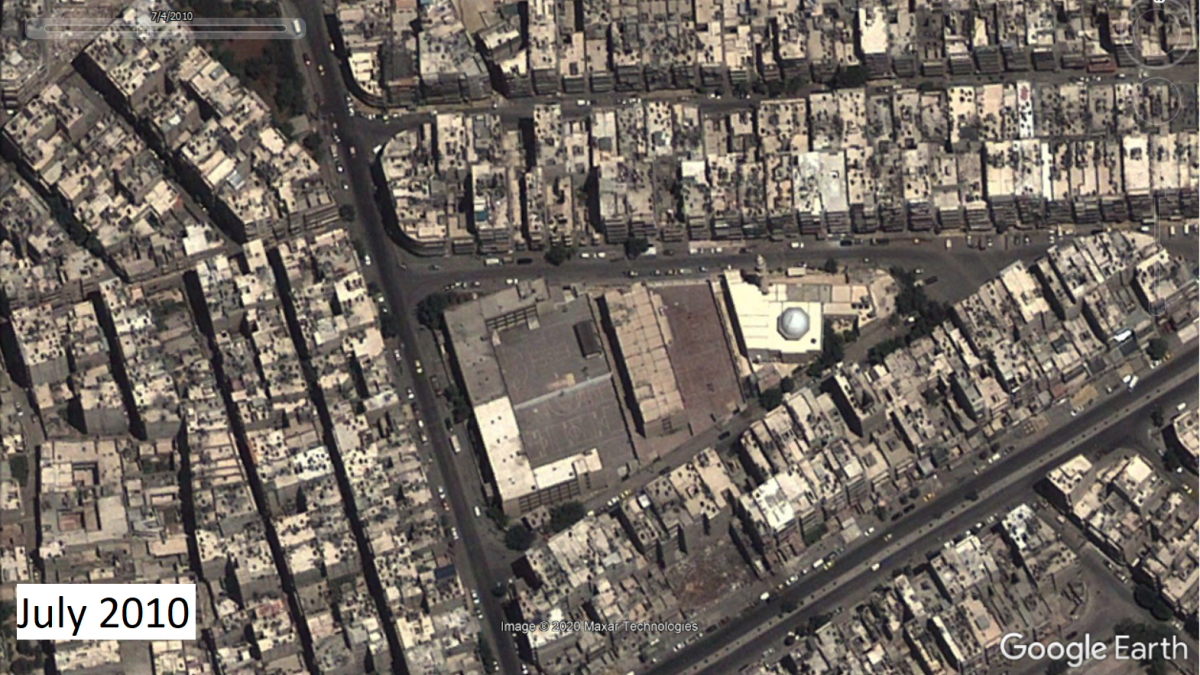
Similarly to Nusaybin, large parts of Diyarbakir, the largest Kurdish majority city in Turkey, were flattened after fighting broke out in 2016 between Kurdish militants and the Turkish army.
The indiscriminate aerial bombardment of rebel-held Aleppo
[twentytwenty]


[/twentytwenty]
What Human Rights Watch said:
“The Syrian military has dropped barrel bombs, sometimes dozens in one day, on opposition-held neighborhoods in Aleppo, Idlib, Dara’a and other cities and towns. They have pulverized markets, schools, hospitals and countless residences. Syrians have described to me the sheer terror of waiting the 30 seconds or so for the barrel bomb to tumble to earth from a helicopter hovering overhead, not knowing until near the very end where its deadly point of impact will be.”
The Background
In 2012, Syrian rebels fighting Bashar al-Assad began taking control of large swaths of Aleppo, Syria’s largest city. The rebels would eventually take the eastern half of the city, before a regime offensive backed by Russian airpower regained control in late 2016.
The conduct of the Syrian regime and its Russian allies during the battle led to widespread allegations of war crimes, as highly inaccurate barrel bombs (barrels full of scrap metal and explosives) were dropped on densely populated rebel-held areas.
The Satellite Photos
The above images show the effect of regime and Russian airstrikes on buildings in eastern Aleppo.
The expansion of Illegal Israeli settlements in the West Bank
[twentytwenty]


[/twentytwenty]
What Amnesty International says:
“Israel’s policy of settling its civilians in occupied Palestinian territory and displacing the local population contravenes fundamental rules of international humanitarian law.”
The Background
Israel took control of the West Bank following a Six-Day War with its Arab neighbours in 1967. The territory has subsequently undergone a process of colonisation as over half a million Israeli settlers have moved into the West Bank and East Jerusalem, an act illegal under international law.
The Satellite Photos
The above image shows the illegal expansion of the Nofei HaSela settlement in the occupied West Bank.

You must be logged in to post a comment.