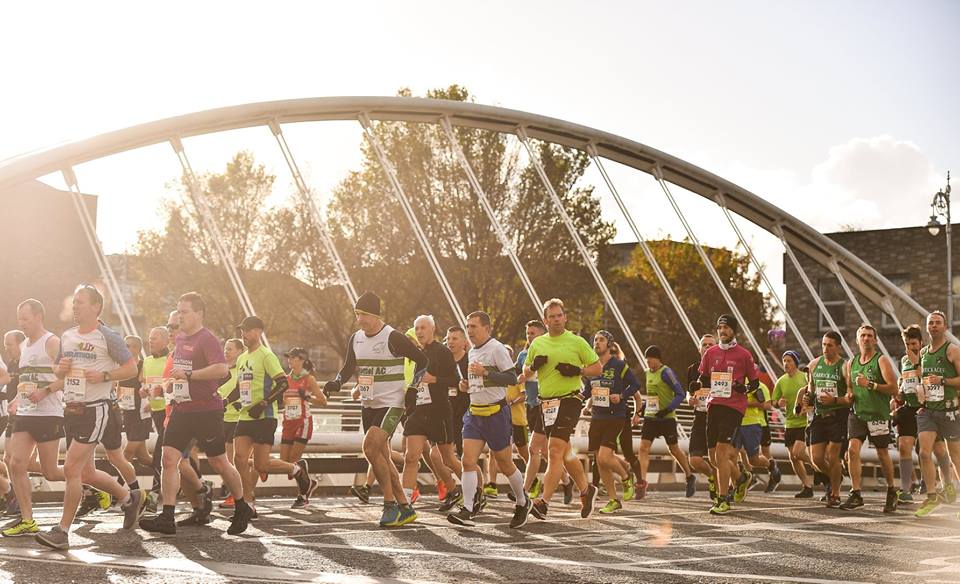
20,000 people showed up to the startline of the 39th Dublin marathon, from runners just hoping to finish to elite athletes looking to get their share of the €120,000 prize pool.
The Dublin Marathon began in 1980 and has since been an annual event. Over the years, roughly 306,000 runners have taken part in what is now one of the biggest marathons in Europe.
This year’s event pulled in 20,000 runners compared to its year of inception, when only 2,100 runners braved the 42.1km course.
Since the Marathon began there have been 12 Irish lady winners. Christine Kennedy (1990 + 1991) and Cathy Shum (1993 + 1996) both winning two marathons each. In that time there have also been 11 Irish Men’s winners, Dick Hooper holding three wins to his name.

However, Sunday’s gold medals were claimed by two Ethiopian athletes: Asefa Bekele who finished with a time of 2:13:23, and Mesera Dubiso with 2:33:48.
There are two trends we can see by looking at the data graphs. Firstly, women’s times are getting faster, and the graph shows a positive correlation with faster times being posted as the years go on. However, times for men don’t seem to follow such a consistent trend.
The second thing we notice is the number of Irish athletes winning the Dublin Marathon effectively stopping after the 2000s. That is apart from 2013 when there were two Irish winners, Sean Hehir and Maria McCambridge, the first Irish winners in their categories since 1993 (John Tracey) and 2000 (Sonia O’ Sullivan).
The reason for this was the event failed to get a headline sponsor, and the usual invitations that are sent out to East African athletes were not issued.
The first major sponsorship was in 2001 when Adidas sponsored the race. Since then, the number of participants and the size of the prize money has increased with this year’s race having a prize pool of €120,000.
The splitting of the prize pool between the runners and wheelchair athletes raised controversy on Twitter, with many users confused about the disparity in the winnings. First male and female received €12,000 each, while first male and female wheelchair athletes receive €750.
There is also time bonus prizes for Irish athletes who complete the marathon in certain time brackets starting at 02:35:00 for males and 03:00:00 for women.
The first Irish athletes over the line this year were Lizzie Lee who took third place overall but won the women’s Irish National Marathon title in a time of 2:35:04. Mick Clohisey won the men’s Irish National Marathon title with a time of 2:15:57 (which is only five seconds slower than the 2017 winner’s time).
The Dublin Marathon takes place every year on the Sunday of the October Bank Holiday. Registration starts at €70 for the early bird and gradually reaches €90 as it reaches capacity.
You must be logged in to post a comment.