
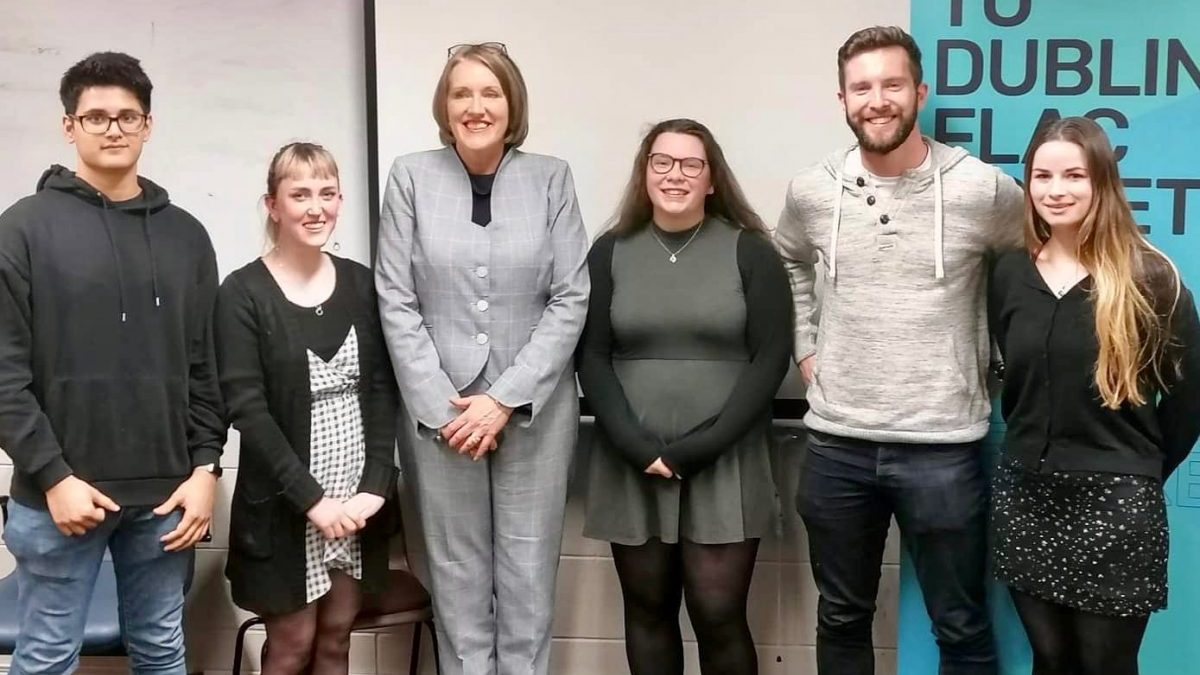

Claire Loftus, the Director of Public Prosecutions (DPP), gave a rare behind-the-scenes insight into how she operates at a pre-Coronavirus shutdown TU Dublin Free Legal Aid Centres (FLAC) Society event. TheCity.ie’s Paul Caffrey, who attended the talk, describes how she keeps politics out of her decision-making
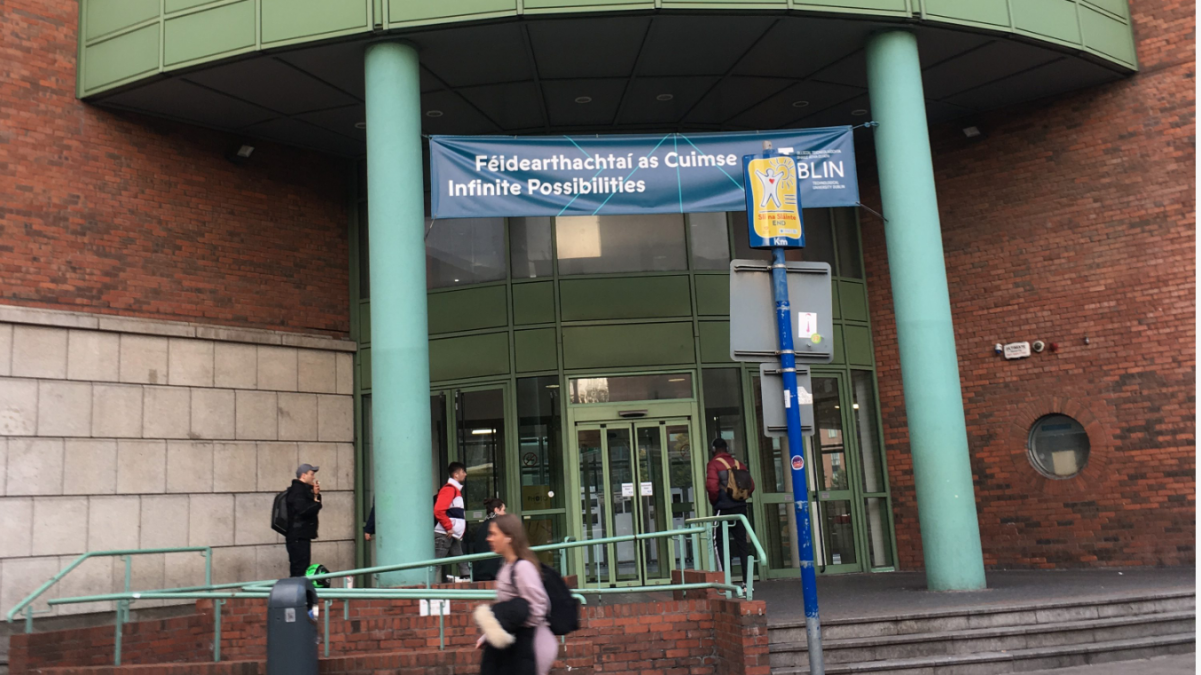
During a wide-ranging hour-long talk at the Aungier Street campus, the State’s current prosecutor-in-chief explained to students why she chooses not to prosecute in certain cases.
Claire Loftus said that in most cases, “crime should be punished”, but that sometimes her office concludes that “there is a public interest not to prosecute.”
Loftus said this is down to a range of factors including a suspect’s age (“very old or very young”) and whether their alleged offence could be viewed as a “one-off” or an “error of judgment”.

(Photo: Kim O’Leary for TheCity.ie)
Her job involves deciding who should be put on trial in the law courts on the basis of evidence gathered by gardaí or another investigating authority. In each case, she’s tasked with deciding if there’s a reasonable prospect that the evidence available will lead to a conviction by a jury.
Loftus also revealed how she got “completely hooked” on crime as a young woman in her mid-20s and still finds her work “fascinating”.
Loftus — who became Ireland’s first-ever woman DPP in 2011 — insisted there is “no political interference” in her decisions.
She also vowed to “revolutionise” the courts system before she finishes her 10-year run as DPP next year.
She wants more pre-trial procedures used so that juries and witnesses are not left “hanging around” for weeks on end while lengthy legal arguments hold up major criminal trials, she said.

While she didn’t specify a particular case, former Anglo Irish Bank chairman Seán Fitzpatrick was acquitted in 2017 following the State’s longest-ever criminal trial. It was the second time in two years that he’d been put on trial and walked free.
The 2017 Circuit Criminal Court trial was so dogged by delays that it dragged on over an eight-month period with 126 days in court.
In 2017, Fitzpatrick had faced 27 charges of misleading the now-defunct bank’s auditors and of giving false information about multi-million euro loans between 2002 and 2007. Mr Fitzpatrick was cleared on all counts.
That trial became controversial after it emerged a lawyer in the Office of the Director of Corporate Enforcement (ODCE) shredded documents relevant to the criminal case against Fitzpatrick.
In the end, Judge John Aylmer directed the jury to acquit Fitzpatrick. Outside court afterwards, Fitzpatrick said it was “a wonderful day for me and my family”. In one post-verdict report, RTÉ said the trial “became a shambles”.
Addressing a tightly-packed roomful of about 50 law students at Technological University Dublin last month, Loftus lamented the “huge amount of time lost” during some major criminal trials:
“Juries are being asked to come in and sit around for days or weeks. The issues aren’t crystallised because there is no pre-trial hearing.”
Vowing to change this before she departs as DPP in late 2021, she said: “It would revolutionise the whole system in the courts. Victims wouldn’t be hanging around. The system would be much more efficient. I’d love to see that [in place] before I go.”

Loftus said there is “no mathematical formula”, but that in most cases, “crime should be punished”.
The 52-year-old Dubliner said the law must strike a balance “between society’s right to see crime prosecuted and the rights of the defendant.”
Speaking in a small ground floor lecture hall less than 24 hours before Leo Varadkar ordered all places of education to close for now, Loftus specified some factors that might potentially persuade her not to prosecute.
The DPP reasoned that in some cases, either the adult caution scheme or juvenile liaison scheme might be the best way to deal with a suspected offender.

The DPP is now obliged to review her decisions not to prosecute under the EU Victims’ Directive, introduced here in 2015.
In 2017, Loftus reversed earlier decisions not to prosecute in eight cases.
She told the law students: “We have to be satisfied there is a prima facie [on its face] case and a reasonable prospect of a conviction…every case is considered on its own merits. There is no mathematical formula. It’s the product of a lot of experience.”
She added: “In most cases, the public interest requires a prosecution. Crime should be punished and people should be prosecuted and brought to justice. Sometimes, we decide there is a public interest not to prosecute.”

In reaching such decisions, “the office [of the DPP] is entirely independent of government”, Loftus stressed.
“I’m not required to report to the Minister for Justice or the Taoiseach. There is no question of any attempt to influence decisions.”
There is “no political interference in the process,” she added.

Back in the 1990s, after two months working in the Chief State Solicitor’s office as a recently qualified solicitor in her mid-20s, “I was completely hooked,” Loftus said.
“Twenty-seven years later I’m still in crime. I’m a career prosecutor. The work is really rewarding. I didn’t expect to get into crime,” she told the students.
She has worked as a prosecutor since 1993 and started out working on robbery and criminal damage cases and later moved on to murders.
She was also very interested in fraud and “white-collar” crime.
Her work as DPP since 2011 is “extremely varied…no two days are the same. It’s a fascinating job,” she said.

Her office receives thousands of investigation files from gardaí yearly. Each day, she personally looks at “quite a number of files”, including “a lot of gangland crime cases”, and “every case is different”, she said.
Loftus revealed that gardaí “can phone us 24/7. If there is sufficient evidence, we’ll allow the guards to charge straight away.”
Renewing her commitment to setting up a dedicated sex offences unit in the DPP’s office by the end of 2020, she said: “We think this might help in these very sensitive and complex cases – hopefully by the end of the year, we’ll be in a position to get it up and running. The advantage for victims is of continuity…I’m very pleased, given the focus on sex offences currently.”
During her March 11 visit to the Aungier Street campus, she also wished TU Dublin students well in their exams and future endeavours.

You must be logged in to post a comment.