A young Irish man in Melbourne has spoken of the ‘pandemonium’ around him as a tram he was travelling on stopped less than five hundred metres away from the scene of a deadly terror attack.
Sam Fearon, 21, from Bayside, Dublin is currently living in Melbourne with friends and said that the city has come together following the violent incident which left one man dead and several others injured.
The Dubliner revealed that he was on board a tram less than half a kilometre away from where the attack took place at Bourke Street. He said: “I was on the 16 tram from St Kilda Road to CBD [Central Business District]. We were coming down Swanston Street which is very near where the incident took place, and the tram stopped really suddenly. We could hear an unusual siren in the distance, I hadn’t a clue what the siren was for, it was like nothing I’ve ever heard before.”
A photo of the Melbourne attack // Sam Fearon
This alarm was a ‘terrorism siren’, the first time the siren has ever been put to use in Melbourne.
The passengers began to speculate, particularly those on social media. “I didn’t have a clue what was going on, but people on the tram started sharing videos on their phones and gossiping and other passengers started saying that there had been some sort of attack.
“It was pretty scary, and it was pandemonium on board the tram, everyone just wanted to get off really quickly, as at this stage people had an idea it was a terrorist attack of some sort,” said Mr Fearon.
There was a sense of calm when the passengers were let off the train, said Mr Fearon. “We were eventually let off the carriage and people started growing a little more confident that the incident was under control and started getting closer to the scene to see what was going on.
“The photo I took was of a man who was considered to be a threat by the police at the time because he had a bag on him which the police confiscated. The police were quite efficient in their role I must say,” he added.
Picture of Sam at the Melbourne Cup // Facebook @SamFearon
Mr Fearon explains the terror attack sent shock waves through the city, but the annual Melbourne Cup, which takes place over two weeks, has improved the local atmosphere. “This incident is a big deal, people were very worried, but we’re all fine.
“Now that the whole thing is under control, everyone in the city is banding together,” he said.
We all know somebody who has left Ireland for a better life in Australia, but what really attracts people to the land down under?
Despite a drop in emigration, 40,700 Irish people packed their bags and left in the 12 months up to April 2014, according to the latest Central Statistics Office figures, with 10,000 of them opting to go to Oz.
Mairead O’Connor, from Co Wexford, left Ireland in 2003 for a better life in Australia and hasn’t looked back since.
“I had travelled to Australia on holidays for three months in 1998, and fell in love with the place. I always knew I’d go back,” Mairead said.
For Mairead, the biggest factors which drew her back to Australia were the lifestyle and the weather.
“Obviously the weather plays a huge part to the lifestyle we live in Australia. Waking up early, being able to get out and about, plan days at the beach, BBQ’s, is really a great scenario,” she said, “I love being able to relax in the sun for an hour or two, after a long day at work. At weekends, it’s fun to jump in the car and head off somewhere – the country is endless, so there is just so much to do and see.”
“Life just seems easier here, and the job prospects are endless, if you are hard working, with a good attitude,” adds Mairead who now works as a Migration Officer in Sydney.
Sydney’s Iconic Bondi beach in July (Australia’s Winter)
Mairead said the hardest part of moving to Australia was leaving her family.
“The distance from family and childhood friends is tough, and it is difficult missing out on various important events,” she says. “Goodbyes never get easier, but it’s where my life is for now, and you just have to learn to live with it.
“I think it can be worse for the family back home because they don’t see what is on the other side, and the reason you are there. My family haven’t been to Australia yet, so hopefully one day they’ll come over, and then they’ll get it too,” she says.
Despite being over 17,000 kilometres away from her hometown of Shielbaggan in County Wexford, Mairead never feels too far from home.
“There is a huge Irish and English community, so it’s nice to have that around you too. Your friends become your family in Oz,” she says.
“I never say never to [going] home, at the end of the day it’s where you were brought up and where all your family are. Nobody knows what the future holds, or what circumstances could change your plans, I just take it one day at a time. I’ll only make that decision when I have to.”
Mairead feels that the lack of employment opportunities in Ireland and better work prospects abroad are undeniable.
“The departure of young, educated and adaptable people is of course a huge loss to Ireland, but we do what they have to do,” she says. “On the upside, those who do leave can always return to Ireland, with new skills and experiences that they have developed from living overseas, which will benefit them and Ireland in the future.
“Something that is predominantly negative and pessimistic, can also be positive and optimistic. It depends on how we look at it. The glass is half full.”
For Gary Traynor from Dublin, his reason for leaving Ireland was a bit different to Mairead’s. He left because he simply felt he was getting nowhere in Ireland.
“I was in a job in Dunnes Stores where I was only getting 15 hours a week and I knew people on the dole coming out with more than me after tax and travel fare to work. So with no girlfriend or kids I thought I’d give Australia a go,” he says.
After only two weeks in the land down under Gary got a job in accounts for an engineering company, which he said was a big difference to working in Dunnes Stores.
“I didn’t know what to expect when I first got here. I was very lucky at the start here because I had my mate from home and his roommate, and then I met the rest of his friends over here and I became great friends with all them.”
Unlike many Irish that travel to Australia, who chose to live in big cities such as Perth or Sydney, Gary prefers life in the countryside.
“I couldn’t live in a city over here but I’m in the countryside now on a dairy farm. I could stay here but sponsorship got knocked back,” he says.
Despite having lived a better life in Australia for the past year and a half, Gary doesn’t plan to settle down there forever.
“I will always go home to Ireland one day. I will work and travel a bit more, but Ireland is home no matter what state the government has it in,” he says.
Flinders Street Train Station in Melbourne.
Some young Irish people are just leaving the Emerald Isle to try to experience life somewhere different after finishing college, just like Muireann Flannery and Kerry Dixon from Dublin, who are both moving to Sydney.
Kerry feels that she needs time to think about what she wants in life before rushing into a job, and that travelling for a while is her best option.
“I’ve finished college and I want a break before I start a career because there is too much pressure on graduates here but also not many options for them, so hopefully by the time I get back I’ll know what I want to do with my life instead of being forced into something,” she says.
“I worry that if I stay here I’ll end up doing something that I don’t particularly want to just because it’s a job and that doesn’t sit right with me,” Kerry adds.
A recent report from Trinity College Dublin’s Longitudinal Study on Ageing (TILDA), has found that women whose children have emigrated in recent years have had an increase of symptoms of depression and loneliness, and Kerry doesn’t think that her moving abroad will be easy for her own mother.
“I think my Mam will find it really hard, she’s already bought a puppy to replace me and has said that she doesn’t mind me leaving but if I didn’t come back it would kill her”, she said, “I’m the youngest child so I suppose they’ll all just be worried about me. I think they’ll all be fine once they’ve adjusted, but leaving just before Christmas probably won’t help.”
Sydney’s Opera House.
Muireann Flannery has always wanted to see Australia since she was a child and she, like her friend Kerry, has just finished college and wants to travel before settling down into a career.
“I want to see if Australia will bring more opportunity for a better standard of living than Ireland is offering at the moment. So really I feel I need to leave to see if there’s anything better for me over there but I don’t necessarily have to go,” she says.
“I have been looking into college courses in Australia so that is something I’m considering doing if I like it over there.”
Like Kerry, Muireann feels it will be tough for her family when she goes, and her mother has told her she can only leave once she comes back.
“It’s very scary deciding to leave and move so far away,” Muireann says, “but there is so much more in the world to see than just what’s here in Ireland and I think there’s nothing worse than being so insular about the place you live and narrow minded to the rest of the world. Broaden your horizons and all that.”
With the latest set of International Rules tests between Ireland and Australia now in full swing, many people are wondering whether or not the compromise rules concept has a viable future.
Given its former reputation of being a hard-hitting and fiercely-contested battle between two proud sporting cultures, the appetite for future installments of the hybrid game between Gaelic and Australian rules football appears to be waning.
Growing Apathy
Although Ireland’s 57-35 victory over the Australian select was regarded as an enthralling spectacle by some, there appears to be a growing apathy amongst the sporting public in both countries which is beginning to be reflected in the attitude of the associations involved.
By and large the mass brawls of earlier years have been confined to the history books (Photo credit Jimmy Harris on Flickr)
Australia caused controversy this year with the announcement of an all-indigenous selection for the first time in series history. Labelled by some as ‘reverse racism’, the Australian Football League wanted to honour the contribution of Aboriginal players to the country’s national sport, and picked what they believed to be a more agile and skilful selection in the process.
However, despite the best intentions in the world, the fact remains that not one member of Australia’s 33-man panel was part of this year’s All-Australian team lineup. Ireland, in stark contrast, had five members of last year’s equivalent All-Star side included in the home squad, with many more set to be named in the 2013 selection later this month.
Declining player standards on one side at least has led to a predictable fall-off in support.
From capacity crowds in both countries during the series’ reinstatement during the late ’90s and early 2000s, the average attendance figure of just 17’000 recorded during the 2011 test series in Australia was compounded by the sight of a half-full Breffni Park for Ireland’s victory at the weekend.
Attendances for the rules matches have been dwindling Down Under (Photo credit Michael Spencer on Flickr)
Indicative of this decline was the Australian media’s complete lack of interest in the event. With not one major national broadcaster providing coverage of this latest series, the press Down Under generally seems to have gotten fed up with the sanitised version of what was once regarded as all-out warfare with a ball (merely incidental, of course) involved.
Hope Remains
However far it’s fallen from grace, the International Rules series does still retain some of its merits.
From what started as a tenuous association during the two sports at the time of the series’ inauguration in 1984, relations have blossomed between the AFL and GAA in recent times, with intercounty luminaries such as Jim Stynes, Tadhg Kennelly and Marty Clarke swapping the round ball for an oval version in their quest to make it big in the Aussies’ premier indigenous sport.
With many school and college teams from both codes now traipsing around the planet to test their skills against their compromise rules counterparts, it’s also initiated a valuable cultural exchange between the young peoples of two countries with a lot in common.
But the fact remains that at its highest level, the series is plagued by a diverse set of problems. Speaking in Melbourne in 2011, GAA Árd Stiúrthór Páraic Duffy stated that unless series interest and attendances picked up in Australia, the Irish audience wouldn’t maintain a reciprocal interest.
It appears that, following a sad and gradual decline, we’ve finally reached that crossroads. It’s now down to the GAA and AFL to pull their formerly proud combined sporting tradition back from the brink, or risk losing it forever.
A massive third quarter from Australia kept the series alive on Saturday, scores from Jake Neade and Lance ‘Buddy’ Franklin preventing a run-away Ireland victory.
Michael Murphy opened the scoring for the home side, the Donegal and Ireland captain not letting thoughts of Glenswilly’s Donegal county final distract him as he put in a typically superlative performance.
He was best assisted on the night by Laois trio Ross Munnelly, Colm Begley and Zach Touhy. Munnelly top-scored for Ireland, while Begley’s influence and experience from the interchange was vital as Ireland took an early lead.
Munnelly and Touhy celebrate during the first test last week [credit: news.msn.ie]It was Touhy that really shone though, scoring Ireland’s first goal with a magnificent run through the centre of the Australia defence, less than 24-hours before he would appear for Portlaoise as they recorded their seventh Laois county championship in a row.
Despite some impressive Franklin scores and a third quarter that saw them outscore Ireland 18-11, the visitors couldn’t manage to close the gap, Kevin McLoughlin with Ireland’s second goal to really put the gloss on the performance.
The indigenous Australia side’s improvement as the game wore on showed they are capable of adapting to the new game however, and the series is far from over going into the second test next week.
Ireland: P O’Rourke; N McGee, F Hanley, C McKaigue; L Keegan, Z Tuohy (1-0-0), J McCaffrey (0-0-1); A Walsh, S Cavanagh (0-1-0); P Flynn (0-1-0), C Byrne (0-1-1), C Sheehan (0-1-1); P McBrearty, M Murphy (0-2-1), R Munnelly (0-2-3).
Interchange: C Boyle (0-1-0), P Conroy, C Kilkenny, K McLoughlin (1-0-0), C McManus (0-1-2), A O’Shea (0-1-0), C Begley (0-1-0), M Shields.
Australia: A McGrath; J Harbrow, C Yarran, T Armstrong; C Ellis-Yolmen, N Lovett-Murray, A Davey; L Franklin(0-1-3), D Wells (0-0-1); S Motlop (0-2-2), L Thomas, Leyroy Jetta; E Betts, M Stokes (0-1-0), J Hill.
Interchange: Lewis Jetta (0-2-0), Alywn Davey (0-1-0), Aaron Davey (0-0-1), M Stokes, D Barry (0-0-1), S Edwards, S Wellingham, J Neade (1-0-0).




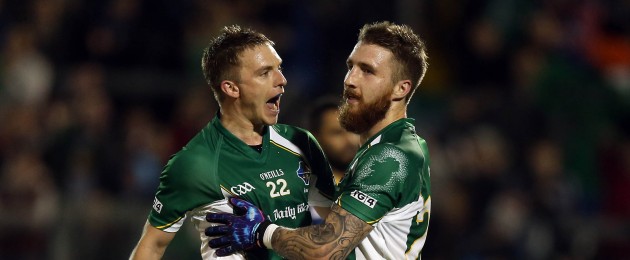
![Munnelly and Touhy celebrate during the first test last week [credit: news.msn.ie]](https://i0.wp.com/thecity.ie/wp-content/uploads/2013/10/international-rules1.jpg?ssl=1)
You must be logged in to post a comment.