Tag: Beer

  • Oktoberfest 2025 in photos

    Oktoberfest 2025 in photos

    By Daniel Keegan

    The 2025 Oktoberfest returned to the Theresienwiese public square in Munich this year. Monstrous beers and hearty Bavarian food filled each marquee table. The place was as loud as a rock concert with guests singing their hearts out to the many drinking songs.

    The 16-day festival took place from September 20th to October 5th and, according to organisers, attracted 6.5 million jubilant visitors, with around 30% coming from abroad. Additionally, they estimated that 6.5 million litres of beer were consumed.

    Each day began with the anticipation of the craziness that would inevitably ensue, and in ceremonial Bavarian style, the men wore their Lederhosen, and the women wore their Dirndls. The streets surrounding the festival were crowded, and the energy was high, as everyone eagerly approached the Oktoberfest.

    The first glimpse of the Theresienwiese, which showcases the towering amusements and monstrous beer tents, marvellously captures the ludicrous nature of the festival.

    Photo 1 – The early morning rush at Oktoberfest from above. Every morning at 10 am, a wave of attendees arrived. There was a mix of families deciding which ride to go on first and groups of friends swiftly trying to navigate the Theresienwiese to find which marquee to spend the next few hours in.

    Photo 2 – Once inside the marquee, folks quickly gathered at their tables and got settled. The waiters hurried to take their first orders of the hectic day. The excitement only grew from here.

    Photo 3 – The first round of the day was a moment of pure anticipation. Glasses were full, and the energy ran high. Everyone raised their glasses and clinked them together like tiny bells, followed by a chorus of ‘Prostttt’ from everyone in the marquee.

    Photo 4 – Each tent is owned and run by different beer companies, so the beer you receive varies from tent to tent. However, one thing always remains the same: you are served your beer in a large glass, which is called a Maß.

    Photo 5 – After about an hour of eating and drinking, a band arrived and started to play many traditional Oktoberfest songs. Initially, they focused on German Oktoberfest music, but later they raised the noise and played more internationally known songs such as Neil Diamond’s ‘Sweet Caroline’.

    Photo 6 – However, there was no song more important than ‘Ein Prosit’. Whenever this song was played, everyone raised their Maß and chugged. The song was played every 15 minutes throughout the entirety of the day.

    Photo 7 – After people had their fill of eating, drinking, and singing, they stepped outside to find a crowd of others at the outdoor activities. Many joined in and enjoyed some rides themselves.

    Photo 8 – Many of the taller amusements provided great scenery of the areas surrounding the Theresenwiese. Not only was a magical birds-eye view available, but from this ride, a view of the stunning St.Paulskirche was in full sight.
  • Explainer: What is the government’s minimum alcohol pricing all about?

    Explainer: What is the government’s minimum alcohol pricing all about?

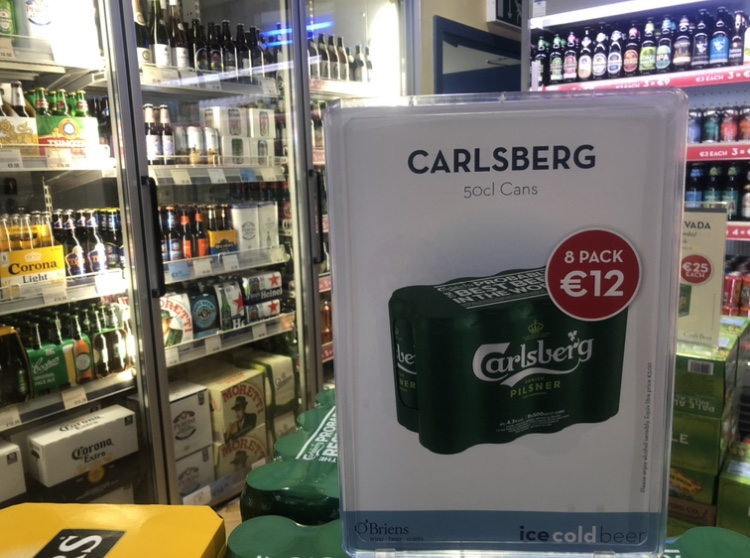
    Carlsberg advertisement in O’Briens Wines Glasnevin. Photo by Mario Bowden

    On Tuesday 4 May 2021, the government revealed plans to implement a minimum pricing on the sale of alcoholic products in of January 2022. 

    In a nutshell, the price of alcohol sold in off-licences will be determined by the strength of the product – priced at 10 cents per gram of alcohol. The higher the alcohol content, the higher the price.

    This policy is based on the 2018 Public Health Alcohol Act that the previous government decided not to put into action before the last election.

    Minimum pricing will not apply to bars and pubs, only to the off-licence sector.

    At the press conference to announce this policy, Minister for Health Stephen Donnelly and Tániaste Leo Varadkar spoke about the proposal’s aim to reduce the health harms of excessive drinking. The hope is that minimum pricing will curtail alcohol-related death and disease rates in Ireland. 

    Data shows that alcohol misuse is responsible for 2,700 deaths each year in Ireland.

    Data released by the health research board (HRB) revealed that during the pandemic in 2020, the average Irish person consumed 10.1 litres of pure alcohol – the equivalent of 116 bottles of wine and 445 pints of beer per person each year. This is a slight reduction from the 2019 average of 10.8 litres.

    The HRB noted this was a “relatively small decline, considering pubs have been closed for the majority of the year”.

    It’s also pretty far off the government’s goal to reduce the average per person alcohol consumption to 9.1 litres in 2020.

    Beer fridge in O’Briens Glasnevin. Photo by Mario Bowden

    “It’s understandable that people are drinking more at home,” said Varadkar at the press conference. “I’m doing so myself. To most drinkers, I want to say this: minimum pricing is not targeted at you. But, rather at the heaviest drinkers, those who attempt to seek out the cheapest alcohol. And particularly children, experimenting with alcohol for the first time.” 

    There is sufficient evidence to back the government’s plans. In 2018, Scotland introduced a similar minimum pricing system. Since its introduction, alcohol related deaths have fallen significantly. Canada has also had minimum pricing in place since 2010. 

    So, what will minimum pricing look like? 

    Minimum pricing will vary depending on the product being sold and its alcohol content.

    For instance, a 500ml can of lager will start at €1.70, whereas a 500ml can of cider will begin at €1.78. A bottle of wine’s minimum price will be €7.40, while 700ml bottles of vodka start at €20.71 and gins and whiskeys at €22.09.

    As the price is decided per gram of alcohol, it significantly increases as the percentage of alcohol increases – designed to impact on the strongest alcohol most.

    For example, a bottle of wine at 14% alcohol by volume (ABV), not an uncommon strength, works out at a minimum of €8.28.

    In shops like Lidl and Aldi, a number of good wines come in underneath this threshold – the shelves will be transformed.

    For those of us who enjoy a craft beer, you won’t be able to get a relatively strong IPA (6.5% ABV) in a 500ml can or bottle for €2.56 per can/bottle. We can wave goodbye to any four for €10 deals.

    Unpopular plan

    To little surprise, the new pricing scheme has come under scrutiny from both retailers and consumers alike. For consumers, the proposal mostly targets those with lower-incomes who will now be spending a bigger proportion of their income on drink. 

    Ireland’s alcohol prices already remain the second-highest in Europe – 88.9% higher than the EU average, only lower than Finland. 

    In Italy, for instance, a country closer to the EU average, a 660ml bottle of beer costs as little as 90 cents in a supermarket and imported German beer only around €1.60.

    Beer fridge in O’Briens Glasnevin. Photo by Mario Bowden

    For retailers like Pearse Greally, the manager of O’Brien’s Wines of Glasnevin branch, the lack of clarity communicated by the government has been frustrating. 

    “There’s not been that much information [given] to retailers yet. For example, how it will work with the smaller brands? We sell Tennents for €1. If the minimum price of that is going to be at €1.72, what does that mean for more premium beers like Heineken? Will Heineken then increase their price to €2.50 or three euro a can to keep its premium headline? Because this increase [in price] isn’t a tax, where is that increase coming from or going to?” asks Greally. 

    The government in the Republic of Ireland  is also calling on Northern Ireland’s government to implement its plans for minimum pricing at the same time as the south. Especially around Christmas time, when cross-border shopping is most active. Northern Ireland is set to introduce minimum pricing in 2023, a year after the Republic.

    “We have high competition with the North because drink is much cheaper there.” says Greally. “And if their minimum pricing doesn’t come into effect until January 2023, why are we doing it a year early? We’ve already increased the tax on drink as well and now we get this? So no one really understands from a retail point of view.” 

    While a number of unanswered questions remain, not least how off-licences will compete with pubs and restaurants, one thing is for sure: students can wave goodbye to cheap cans.