Tag: climate crisis

  • Where is Ireland’s Solar Panels Plan headed?

    Two African men install solar panels neatly on a residential roof of a house near the ocean. Sustainable living. Photo credit- Unsplash

    Solar panels, an option for combatting increasing energy bills

    By Nimra Ahmed

    There is a climate and biodiversity emergency across the world, yet Ireland has been slow in finding solutions to slash the rising costs of energy.

    An attractive system for household electricity generation could be solar photovoltaic (PV) panels.

    Most solar PV systems feed excess power back to the electricity grid where it is consumed by residential, commercial and industrial users. These solar panels would be an additional source of domestically generated energy and help reduce dependency on imported fossil fuels.

    According to a national study of domestic solar potential, if residents fitted solar panels it could reduce electricity bills by €900 per annum and produce 36 per cent of all residential demand. The solar PV system would pay for itself in seven years. Furthermore, the EU policy aspires to have rooftop panels for all new residences by 2029.


    The MaREI Research Centre at University College Cork used satellite data to look at every rooftop in Ireland and found there was enough roof space for 10 solar panels in more than one million homes. Furthermore, residents could also benefit from a substantial grant from the Sustainable Energy Authority of Ireland. Developers also approached Irish landowners for potential solar farms. As of January 2012, farmers who want to install a solar PV system can claim back the VAT incurred on the purchase of the system.


    The review of Irish planning laws began in 2019 but it has taken an energy crisis to push the government into action three years later. The government has finally decided to amend its very restrictive planning rules. As of 2022, the Irish government has said that homeowners will be paid for the exported electricity they produce through their solar PV system to the grid by their energy supplier.

    However, the initial €200 million fund to provide grants to install these panels is not enough and should be increased. Households were given up to €2,400 to install solar panels, this should be doubled to up to €4,800 so that families who are eager to get the benefits but can’t afford the upfront payment can avail of the scheme.

    “The Climate Action Plan process outlines a series of actions that need to be taken by government, by sector and by citizens to meet the ambitious target of a 51 % reduction in greenhouse gas emissions by 2023.”

    Charlie McConalogue, Minister for Agriculture, Food and the Marine

    The government also has plans to put solar panels in every school in the country. Another step Ireland has taken towards sustainability is wind turbines. This has helped in cutting costs and increasing productivity for the future.

    Do you think the government will give more incentives to farmers to increase the number of wind turbines to make it 100% on all farms?

    “The government is fully committed to and recognises the benefits of the deployment of renewable technology at a farm level, as a cost-saving measure and a diversification opportunity as well as contributing in a positive way to the decarbonisation of the energy system. Under the Microgeneration Support scheme, micro-wind is one of four technologies included for support. More details on this scheme can be found here. Homes, farms, businesses and communities to benefit as Eamon Ryan, the Minister for the Environment, Climate and Communications, announces the Micro-generation Support Scheme,” said Charlie McConalogue, Minister for Agriculture, Food and the Marine.

    What can farmers in Ireland do on a small scale that would help increase sustainability on their farms?

    “At a farm scale, there are three ways in which farms can increase their sustainability by: reducing absolute emissions through activities such as reducing chemical fertiliser at farm level, using low emissions slurry spreading (LESS) technologies for spreading animal manures and adopting nutrient planning at a farm level.

    “Increasing carbon sequestration through forestry and better management of organic and mineral soils.”Increasing carbon sequestration through forestry and better management of organic and mineral soils.

    “Contributing to sustainable energy through adopting energy efficiency measures,
    deployment of renewables and the provision of bioenergy materials as a displacement for fossil fuels and energy-intensive materials. The Teagasc Signpost Farm Programme provides further details on the types of measures that can be taken at a farm level: Signpost Programme – Teagasc I Agriculture and Food Development Authority, said McConalogue.”

    Do you think rural Ireland is doing enough to meet the future demands of Carbon
    footprint?

    “Reducing greenhouse gas emissions will require an economy-wide and all-of -L approach where each member of society will have an important contribution to make, including rural Ireland. The Climate Action Plan process outlines a series of actions that need to be taken by government, by sector and by citizens to meet the ambitious target of a 51% reduction in greenhouse gas emissions by 2023. Agriculture must and will play its part in meeting this objective to ensure that we have economically and environmentally sustainable rural and coastal communities, said McConalogue.”

               Charlie McConalogue, Minister for Agriculture, Food and the Marine 
                Photo Courtesy of  Charlie McConalogue.

    “Systems cost roughly between €4,500 and €5,500 typically, to include the inverter, controls and meters. Solar users prioritize their energy, first on the fridge, then the cooker, lights, laptop and other devices, and directing any excess to hot water if they have a hot water diverter installed,” James Boland (48) a solar panel installation businessman.

    “Unwieldy planning processes are hindering Ireland’s transition to cleaner energy with unnecessary delays. But there has been an increase in domestic solar PV panels after the government’s incentives. Unfortunately, there aren’t enough trained workers to put in the panels, so even when homeowners are keen on it, they aren’t ready to wait for a long time for the installation, said Boland.”

  • ‘We’re no open borders party…climate-related migration must be avoided’ – examining Sinn Féin’s immigration stance

    ‘We’re no open borders party…climate-related migration must be avoided’ – examining Sinn Féin’s immigration stance

    As Mary Lou McDonald’s party soars in the General Election 2020 polls, Sinn Féin’s manifesto reaffirms their emphasis on domestic policies of health and housing. TheCity’s Kate Brayden examines their immigration stance and statements on climate refugees.

    Sinn Féin’s rise in popularity in this General Election campaign — especially with younger voters — is a historic change to the usual Fianna Fáil/Fine Gael power duo. 

    But does their manifesto prove that they are ready to ascend to the global stage of foreign affairs, which is changing by the day as a result of climate breakdown? And what is their policy on refugees fleeing persecution?

    In a recent landmark ruling, the United Nations Human Rights Committee stated that “without robust national and international efforts, the effects of climate change in receiving states may expose individuals to violations of their rights.” 

    Therefore, a country cannot send a person back to their home state if their life is threatened by climate change. 

    Much work must be done to ensure that this ruling becomes legally binding to protect citizens from developing countries who are destitute as a result of C02 emissions altering the climate, creating dangerous weather events and pollution. 

    Under Justice Minister Charlie Flanagan’s latest plans, Ireland is set to accept up to 2,900 refugees over the next four years – using a combination of resettlement and community sponsorship. 

    The new arrivals will mostly be Syrian refugees who are currently living in refugee camps in Jordan and Lebanon – and 150 Eritrean refugees living in Ethiopia.

    In 2015, the Irish Refugee Protection Programme (IRPP) was created as part of Ireland’s response to the global humanitarian migration crisis.

    That crisis has become steadily more concerning as extreme weather events and wars decimate poorer parts of the world. 

    A new phase of the IRPP will see 650 resettlements in 2020, 700 in 2021, 750 in 2022 and 800 in 2023. 

    But if Fine Gael return to power, will they live up to these claims – and are these numbers high enough to make a valuable impact?

    Does Sinn Féin have any better plans? 

    SF’s election manifesto states the party is “determined to avoid the failed policies that have fostered resentments and tensions in other countries” as a result of immigration and foreign policy decisions.

    Sinn Fein Councillor Chris Andrews. Credit: Twitter – @an_phoblacht

    The party declares unequivocally that they are not an “open borders” party – and do not believe in any such thing. 

    SF Councillor Chris Andrews, who’s standing for election to the Dáil in Dublin Bay South, told TheCity.ie: “I don’t think I’ve ever heard anyone advocating ‘open borders’, but rather, it’s a dog whistle used by the far-right to spread fear. 

    “It’s used to give fair migration systems a bad name.

    “Every state has to have an immigration system with well-functioning rules and regulation that everyone understands and that serves the interests of the people of the country – but which also protects people fleeing persecution and war. 

    “Our international obligations must be fulfilled, and in an orderly manner.

    “This system must have regard to how many people are needed to meet shortfalls in the labour market and how many people can be integrated effectively with adequate support and resourcing.”

    Plenty of progressives have pledged their support for open borders, such as Israeli-Irish Jewish political sociologist and author Ronit Lentin. The activist for Palestinian liberation and for the Palestinian right of return opposes all deportations in Ireland.

    Andrews’ remarks match up with his party’s manifesto, which states that: “Where we do need migrant workers, such as to fill vacancies in our health system, our migration system should facilitate this efficiently.”

    While some may read this as viewing human beings only in terms of their economic worth, the party stresses that Ireland must cope with issues of housing and health before tackling migration issues. 

    Sinn Féin are also in favour of ending the Direct Provision system of accommodation for asylum seekers.

    In terms of climate refugees, the party says a pledge to take in climate refugees “does not solve the problem which caused it”.

    “We must avoid a situation of mass climate-related migration – not solely for the difficulty it will pose to recipient nations, but because people deserve to live in their own nations and communities,” their manifesto reads. 

    “They should not have to flee their land because of polluting activities of far-away nations and, most of all, foreign corporations.”

    The party also pledge to ensure that the Irish Navy plays an active role in search and rescue missions in the Mediterranean.

    Seán Crowe, Sinn Féin TD for Dublin South-West, told this website: “Internationalism is at the core of Irish republicanism. 

    “We will never be blind and ignorant to injustices abroad.

    “I have long called out the Government for not reaching its targets on the resettlement and relocating of refugees in Ireland.”

    Twitter/@SeanCroweTD

    “We need to reach these targets and ensure we do more to protect people fleeing persecution and war.

    “Sinn Féin will restore and enhance our international reputation.”

    Irish aid is currently about 0.4% of Gross National Income.

    Ireland’s “A Better World” development strategy emphasises gender equality, climate action, governance and humanitarian need – and commits Ireland to achieve a target of 0.7% by 2030. 

    Sinn Féin pledges to strongly support Irish Aid, would increase funding on Overseas Development Aid (ODA), ensure the State works towards its ODA targets and would commence work on an interdepartmental plan to increase Irish ODA to reach the 0.7% GNI target.  

    Historically, our nation is strongly in favour of neutrality – but participates in peace operations, deploying 623 peacekeepers (not including U2′s Bono).

  • ‘1.44 million people globally will need to resettle by 2020’ –  Green Party take progressive stance on global refugee crisis

    ‘1.44 million people globally will need to resettle by 2020’ – Green Party take progressive stance on global refugee crisis

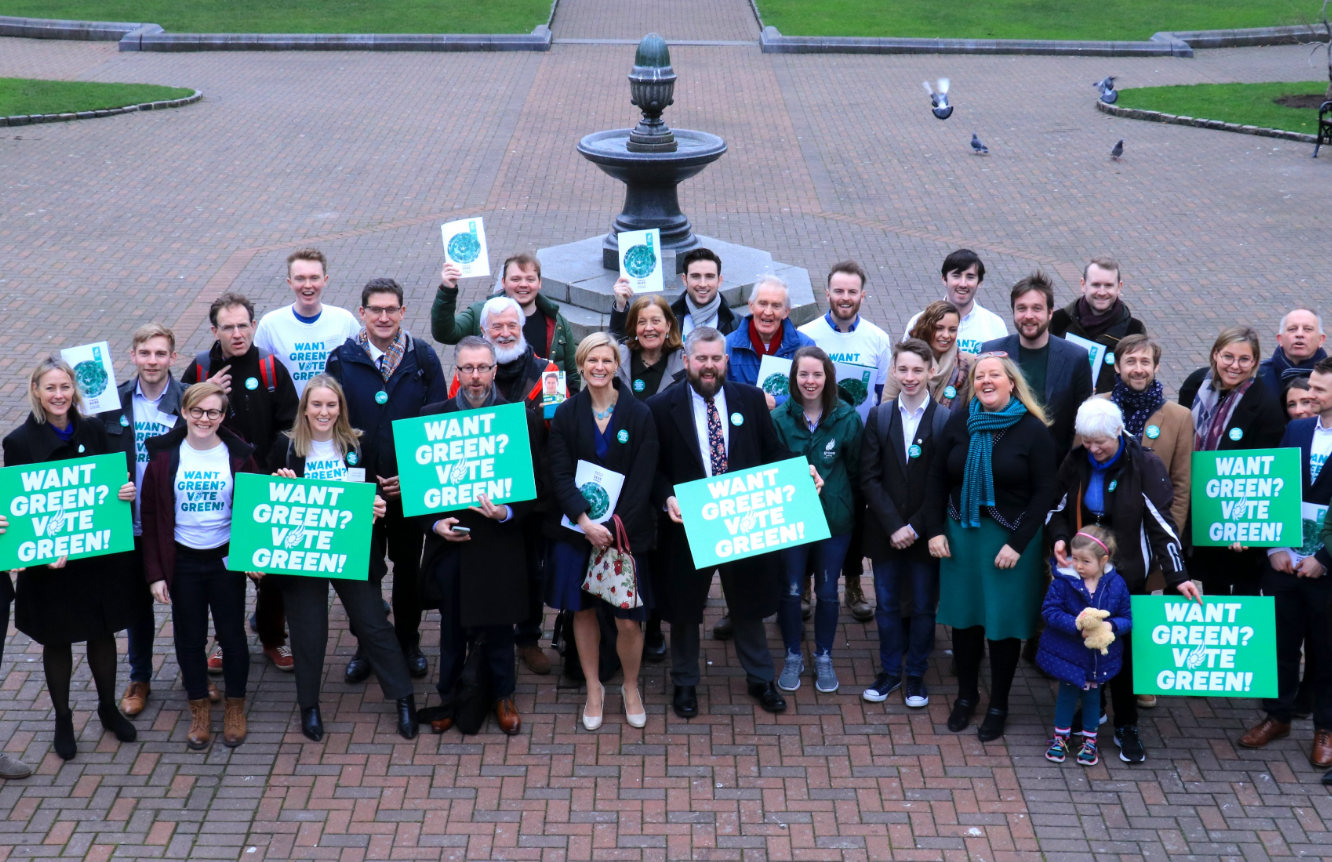
    With the Green Party ready and waiting to help form the next government, KATE BRAYDEN has been closely examining their vision for an Ireland free of marginalisation – and grilling their politicians on policy relating to open borders, Direct Provision and refugees.

    The 2020 General Election has seen a predictable emphasis on domestic policies — particularly on housing and health — with foreign policy firmly taking a back seat. 

    And considering the ever-increasing climate crisis, there will be an undeniable rise in the number of refugees in Ireland, as well as asylum seekers and migrants. 

    According to the UNHCR, refugees – protected by the 1951 Refugee Convention – are people fleeing persecution and armed conflict. 

    By the end of 2014, there were 19.5 million refugees worldwide, seeking to escape perilous circumstances by crossing borders to seek safety.

    Twitter/@xrwsm

    An asylum seeker is someone seeking international protection (refugee status) – but whose application has yet been approved or rejected. They seek asylum on the basis that returning to their country of origin would lead to persecution on account of race, religion, nationality or political beliefs. 

    Unfortunately, international law is still catching up to the impact of climate breakdown on refugee applications. A displaced person must go through a Refugee Status Determination (RSD) process, conducted by the government of the country of asylum or the UNHCR.

    On the other hand, migrants choose to move mainly to improve their lives, rather than because of a direct threat or persecution. 

    While migrants can return safely home, refugees are not safe to do so.

    In 2019, 4,487 people applied for international protection in this country; an increase of 814 on the previous year. 

    From my own close examination of the Green Party’s manifesto for General Election 2020, their foreign affairs policies suggest a strong commitment to playing a role on the international stage – both when it comes to the climate crisis and the resulting increase in refugee applications.

    Twitter/@IrishRefugeeCo

    The Greens are firmly of the view that global co-operation and co-ordination will be needed to address the challenges that lie ahead. 

    European Union policy and practice must prioritise the rights of the vulnerable over the interests of multinational companies, they feel.

    The movement of people has become increasingly restricted with some countries appearing to adopt a “Fortress Europe” mindset by closing borders, preventing search-and-rescue operations in the Mediterranean by NGOs and stoking fears through far-right rhetoric of “The Other”.

    Speaking to The City.ie, Dublin West Green party councillor Daniel Whooley said Ireland is failing to take in its “fair share” of refugees at present.

    The young politician also feels that our own ‘troubled history’ with famine and emigration should push us to “help those in need” even more.

    “The UN Refugee Agency has estimated that 1.44 million people globally will need to resettle by 2020.” 

    When compared with other countries, you might be forgiven for thinking that Ireland appears to take a somewhat hardline stance on asylum seekers.

    Photo credit: Unsplash

    In 2015, the number of asylum applications allowed by the Irish authorities was 20 times less than in Norway – a country with an almost identical population to ours but significantly wealthier. 

    Whooley said that “reflects a slow system of dealing with asylum backlogs, as well as a tendency to reject applications more often than we accept them.”

    Pointing out 17% of Irish citizens live abroad, the politician added: “It’s only fair that we take up the mantle that many nations did for our ancestors during our troubled history and help those in need.” 

    In terms of foreign policy, the Green Party manifesto asserts ‘that the need for world peace and justice overrides national and commercial interests.’

    “There is no place for violence – or threat of violence – in the democratic political process,” they say. 

    The party is also calling for – among other international development proposals – immediate recognition of the State of Palestine, an end to arms trading with Israel and an end to the blockade and closure of Gaza.

    The party proposes to increase Ireland’s Overseas Development Aid contribution to 0.7% of Gross National Income by 2025.

    Aid directed towards the ongoing refugee crisis in the Mediterranean should be co-ordinated with the EU – with funding for refugee housing a priority, they suggest. 

    The Green Party’s manifesto outlines their vision for an Ireland free of marginalisation.

    It stresses how we’ve benefited from increased cultural, social and political diversity through the arrival of a new generation of migrants.

    To achieve their goal, the Greens hope to develop a new Migrant Integration Strategy and revive the National Action Plan Against Racism – which expired in 2008.

    Green Party chairperson Hazel Chu told TheCity.ie: “The problem with anti-refugee stances and anti-immigration rhetoric is that people are going for what the populist vote would be, which is to blame it on someone else. 

    “If you have more refugees coming in, people will say those are the ones who are burdening us. 

    “Right now, people are claiming there is mass immigration in Ireland when there’s not.”

    Nasc CEO Fiona Finn said her organisation is disappointed by Fine Gael’s plan – announced in recent weeks – to home a mere 2,900 refugees here over the next four years. 

    She told TheCity.ie: “The 2,900 promised places over the next four years represents a reduction on Ireland’s previous resettlement commitments.

    “Only 7% of the resettlement places needed globally are available. 

    “Now is the time for progressive and ambitious programmes to meet those needs. 

    “We hope to work with whoever is in government next, to push for expanded resettlement quotas and new solutions.”

    Meanwhile, the Greens want to work towards ending Direct Provision and replacing it with a not-for-profit system based on accommodation provided through existing or new approved housing bodies. 

    The stated vision of the Greens embraces the responsibility of the Irish Government to step up to the plate in the realm of foreign affairs and climate refugees – who are still not protected by international law. 

    A landmark United Nations ruling that governments cannot return people to countries where their lives are threatened by climate change is a momentous first step for global climate action. But it’s not yet legally binding.

    Refugees do not travel in search of economic opportunity but to escape war, persecution, death, torture and rape. They are entitled to the protection and assistance of other states under international law, and under shared principles of human decency.”
    Filippo Grandi
    UN High Commissioner for Refugees