
Tag: Colm McGuirk

  • Cosy for Covid: House-hunting in lockdown

    Cosy for Covid: House-hunting in lockdown

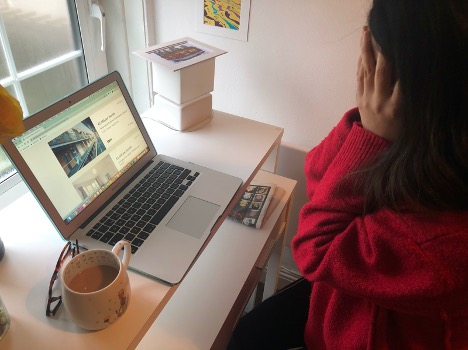
    House-hunting can be an ordeal! A disgruntled hunter clutches their face in despair. Photo by Colm McGuirk

    Regular renters in Dublin may know the feeling – you pour your heart out across dozens of viewing requests, then watch tumbleweed blow through your inbox.

    The pandemic has gone some way to reducing the numbers in this scrap for exorbitantly priced rooms. According to property site Daft.ie, there are around a thousand more homes available to rent in Dublin today than at this time last year. 

    Properties previously listed on AirBnB but now being advertised as short-term lets are the main contributor to this rise. Another is the mini-exodus to other counties and countries prompted by lost jobs and a shift online for work and study.

    Software developer Mo Fiebiger has seen this reflected in the numbers applying for rooms in the Northside house she shares with six others.

    “We’re quite close to the city centre and in the past we would get between 50 and a hundred applicants. Now we’re lucky if we even get 10 to 20. That can be quite stressful, because we have a lot of people here and we really focus on having a good dynamic for those who live here, so you want to have plenty of options to choose from.

    “But on the other hand, you obviously don’t want to invite too many strangers in at the moment.”

    For house viewings in the last year, she has asked applicants to wear a mask and sanitise their hands on entering. A fairly obvious request, it might seem, but artist Alan Hall encountered a range of Covid caution when looking for a room last autumn.

    “Now with the pandemic there’s an extra level to navigate, because everyone has their own way of living and dealing with it, so it becomes very personal”

    Alan Hall

    “It went from people who were really regimented about it – keep the distance, do Zoom calls first; to people who worked in hospitals and weren’t wearing masks; to people that were still having parties. I went to one house and they told me they had parties. I was like, ‘OK, cool, obviously not now?’ And they said, ‘Yeah, now’.

    “When you’re viewing a house,” Hall continues, “you only have 10 minutes to figure out if you like it, if you like the vibe. Now with the pandemic there’s an extra level to navigate, because everyone has their own way of living and dealing with it, so it becomes very personal – these extra indicators about whether or not you might gel with the people you’re about to live with. I’d bring my own sanitiser, for example, and for some people that seemed like overkill. I said no to a few places I thought weren’t taking it seriously enough.”

    As of January, in-person viewing is advised against until you’re ready to sign a contract, with virtual viewings recommended. Having your disembodied head guided around via smartphone doesn’t always leave you with the full picture, as audio-visual technician Jeff Doolin has learned.

    An applicant being doused in hand sanitiser at the entrance of a house viewing. Photo by Colm McGuirk

    “Virtual viewings are a bit strange,” he says, “because you just can’t get the real feel for it – someone just walking around, maybe with a dodgy connection. Some of them walk around slowly, which is good, and then some of them just run around. And you’re like, ‘Wait, what? Hold on, pause that for a second. Was that the jacks?’”

    Daithí Ó Cinnéide, who works in film, was left frustrated by a virtual viewing experience.

    “I had to do an interview on Zoom first before they decided to offer me a viewing,” he tells us. “I liked the room and they liked me. But then when I got there it was a different room from the one I’d seen, and only the box room was left for the same price. So I had to keep searching.”

    Beauty therapist Kathleen O’Reilly thinks this new means of viewing a home may have encouraged scammers to pounce. She has come across a few herself.

    “One lady I was talking to sent me a video of an apartment. I thought it looked great so she sent me a contract. I read it and she sent me her bank details. I said I’d think about it over the weekend, but she was very abrupt. She said, ‘No, this needs to be sent now, €1,400.’ She said she was Irish, but from her texts she clearly wasn’t. So, I wrote back saying I hoped she found someone for the room and reported her to Daft.”

    “For what we’re looking for, there still isn’t much out there, and there’s always a price on desperation”

    Sarah Jane Doogan

    The property site reported a 3.3% fall in rent prices in Dublin last year – a drop that was barely perceptible to Sarah Jane Doogan, a software engineer on the lookout for a place to share with her boyfriend.

    “I would have expected the prices to fall a lot more,” she says. “For what we’re looking for, there still isn’t much out there, and there’s always a price on desperation.”

    She’s noticed a surprising positive upshot of viewing a non-house share home during a pandemic.

    “The thing that stood out to me was how it’s less dehumanising now, because you get an individual slot for viewing. I’ve been renting for 15 years and back in the day you’d book a time when you’d go to a viewing. But in the last five or six years [before the pandemic], it started to change, where you’d go to a viewing and there’d be loads of people there, some of them throwing deposit money at the agent.”

    The modest fall in rent prices last year was only reported for Dublin, with the rest of the country seeing a slight increase. The landlords, it would seem, still have the upper hand.

  • Gaelic games players reflect on importance of competitions lost to level five

    Gaelic games players reflect on importance of competitions lost to level five

    Aishling Moloney and Sarah Rowe celebrate winning the 2018 O’Connor Cup. Photo courtesy of Eóin Noonan/Sportsfile

    Let’s not kid ourselves here; the cancellation of camogie, football and hurling competitions for higher education students measures fairly low on the adversity scale in the current scheme of things.

    Parking perspective for a moment though, to compete and succeed in these tournaments is often a huge honour for young players, and an important formative experience on and away from the pitch. It’s another experience the class of 2020/21 will have to do without.

    Tipperary star and Ladies Gaelic Football Association ambassador Aishling Moloney has, at 22, a mantlepiece for a veteran to envy — two intermediate football All-Ireland medals, two national league titles, and a Player of the Year award, not to speak of club honours. Representing her university, DCU, has brought more glory.

    “I was honoured to be captain of the O’Connor Cup winning team in 2018, and to live that all over again would be a dream,” she says. “It’s sad to see that it won’t be going ahead this year but, given the circumstances, it is the appropriate call.”

    “I’ve made best friends for life playing with DCU, and will always cherish the wonderful memories”

    Aisling Moloney

    Sporting accomplishment is one thing; forging friendships that can long outlast a student’s playing days is at least as valuable for many players. Moloney describes her time playing for DCU as “a very special part of my experience as a student. It’s different from any other competition; your social life mixed with playing football. It’s a roller-coaster. I’ve made best friends for life and will always cherish the wonderful memories.”

    Dozens of competitions across four codes give students of all levels the chance to compete, and the upper tiers feature much of the best young talent around. 

    “Getting the opportunity to play among and against some of the best players in the country is a real privilege,” Moloney says.

    Aishling Moloney receives the Player of the Match award for the 2018 O’Connor Cup final. Photo courtesy of Eóin Noonan/Sportsfile

    Monaghan footballer Conor Boyle agrees. Now a regular starter with his county, he was on the fringes when he won a Sigerson Cup with DCU in 2015.

    “It’s a very high standard and it’s a great opportunity to get onto your county squad. If you start on a UCD team, for example, you’re not going to be far off getting on your county panel, even for the top counties.

    “The DIT team of 2013 was ridiculous! I remember their full-forward line was Darren O’Sullivan, Aiden O’Shea and Jason Doherty. You’re looking at those three walking on and thinking, ‘What have I signed up for here?’”

    He remembers, too, the confidence he gained from excelling among such company.

    “I found after a while it made you see that you’re at a similar level to a lot of these players you’d play against on the inter-county scene. The year before we won it we were playing with the likes of Johnny Cooper, James McCarthy, Dean Rock, and when you were playing with Monaghan you’d nearly look at these boys like they’re at a different level. But playing with them on the college team can open your eyes that there’s no big gap between players in a lot of these top teams, and those from smaller counties.

    “I trained with Dean Rock for a full year and I can’t say that he’s any better than [Boyle’s club-mate] Conor McManus. It’s a good leveller because you put a lot of these boys from more successful counties on pedestals sometimes.”

    While undergrads missing out this year may at least get another bite at the cherry, there may be, in the words of Kildare hurler Martin Fitzgerald, “no tomorrow” for postgraduate students.

    “Most of what I learned in hurling, I learned playing Fitzgibbon Cup”

    Martin Fitzgerald

    Fitzgerald captained Limerick Institute of Technology in hurling’s coveted Fitzgibbon Cup while studying for a Master’s in 2013, before going on to win two Christy Ring Cups with his county.

    He sees that year in Munster — under the management of Davy Fitzgerald — as crucial to his development.

    “Most of what I learned in hurling, I learned playing Fitzgibbon Cup. That was the best year I had of my playing career, and if I hadn’t had it, I probably wouldn’t have experienced that level of hurling ever.”

    Martin Fitzgerald in action for his club Ardclough

    He notes the value of training and preparing alongside county players from the country’s top sides.

    “I found it really interesting when I went in there to see what the Laois hurlers, the Clare hurlers, the Limerick hurlers were doing. Everybody brought something different that you might not be exposed to at club and county level. So you got insights into how the rest of the country was preparing.

    “You pick up things that you can implement at home, that I could have implemented with Kildare and my own club Ardclough as well.”

    Fitzgerald says the self-discipline and focus required to lead his LIT team fed into his studies too.

    “Playing Fitzgibbon cup put a huge amount of structure on my college life,” he tells The City, “because it’s the highest level of hurling there is really at that age group.”

    Camogie player Sinead Murphy has represented Dublin at intermediate level and should have been playing in the Ashbourne Cup for UCD this year.

    “I think it’s great for player development,” she says. “Especially for players like myself that don’t play senior inter-county. It allows you to play at a higher level and train with and play against some of the best camogie players in the country.”

    Murphy is next in line to stress the value of these tournaments for their off-field perks.

    “From a social side, I think, especially in first year, it’s a great way to get to know people and to have a few more familiar faces around campus. I think what’s great about college sport is the mix of people you meet that you wouldn’t have met otherwise. You’re playing with girls doing a wide range of courses from different counties.”

    Darragh Biddlecombe, GAA Development Officer at TU Dublin, feels sorry “for this year’s freshers cohort especially, who have missed out on their camogie, ladies football and GAA experience. It can be so important for making friends and settling into university life.

    “In light of public health and the safety of everyone, [cancelling the tournaments] was the right thing to do. If it’s safe to return, hopefully a dedicated second year championship can be run next year for this group.”