Tag: Complaints

  • Taxi complaints on the rise in Ireland

    Taxi complaints on the rise in Ireland

    Figures released by the National Transport Authority have revealed that the number of complaints lodged against taxi services in Ireland is rising. Nathan Davies explores the statistics behind the rising complaints.


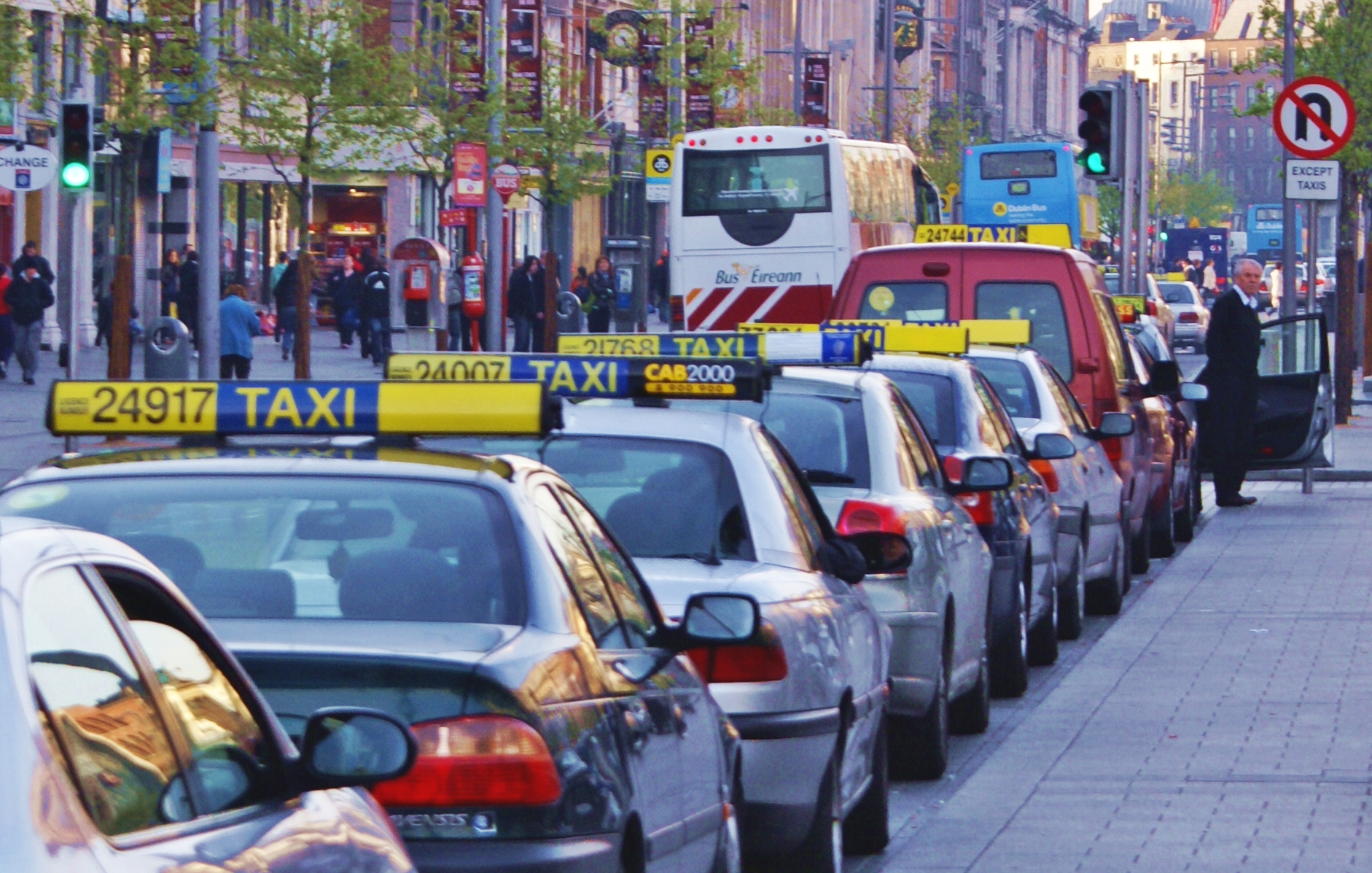
    Photo taken by Jaqian, sourced from Wikimedia Commons

    The figures cover complaints lodged against all Small Public Service Vehicle (SPSV) licensed drivers. This includes all taxi, hackney, limousine, and dispatch operator services in the country.

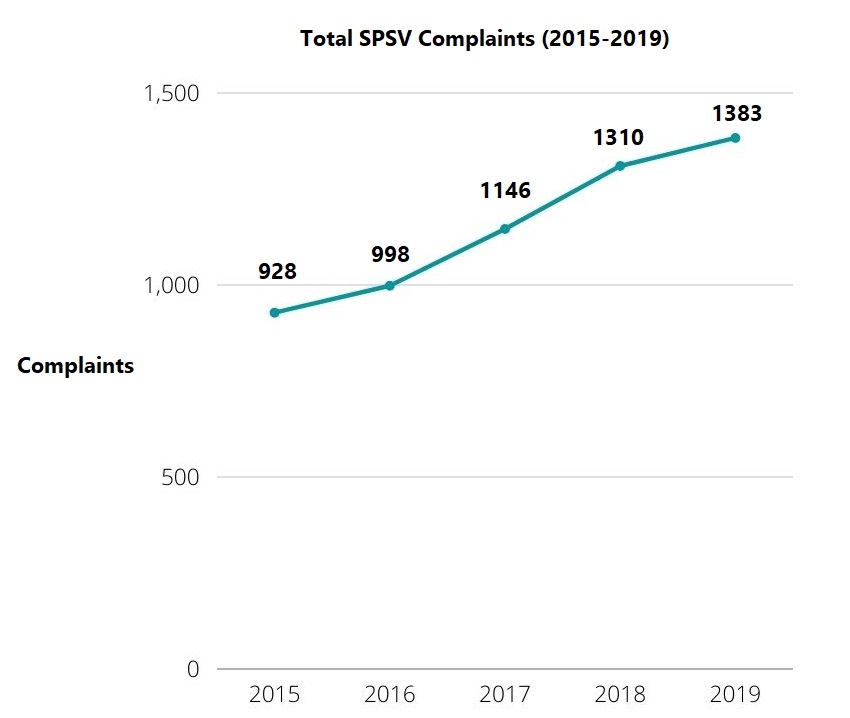
    The statistics from the National Transport Authority (NTA) show that 1,383 complaints were filed with the NTA in the year of 2019. This number is larger than the previous year which stood at 1,310.

    In fact, every year on record that has been published by the NTA has seen a higher number of complaints than the year before it.

    Complaints in the year of 2015 stood at just 928, meaning that there has been a 50% rise in official complaints in the past five years.

    Figures from 2020 have not been finalised yet, however early numbers suggest that the trend is continuing, with complaints filed in January and February of 2020 being higher than the respective months in 2019.
    The figures released by the NTA come as part of the “complaints procedure” introduced with the Taxi Regulation Act 2013. The legislation requires that the NTA receives and lodges any SPSV-related complaints under the following categories:

    a)      Condition, roadworthiness, and cleanliness,

    b)     Conduct, behaviour, and identification of a driver,

    c)      Overcharging or other matters related to fares charged by the driver,

    d)     Matters relating to hiring and booking,

    e)     Identification and the general appearance of the vehicle.

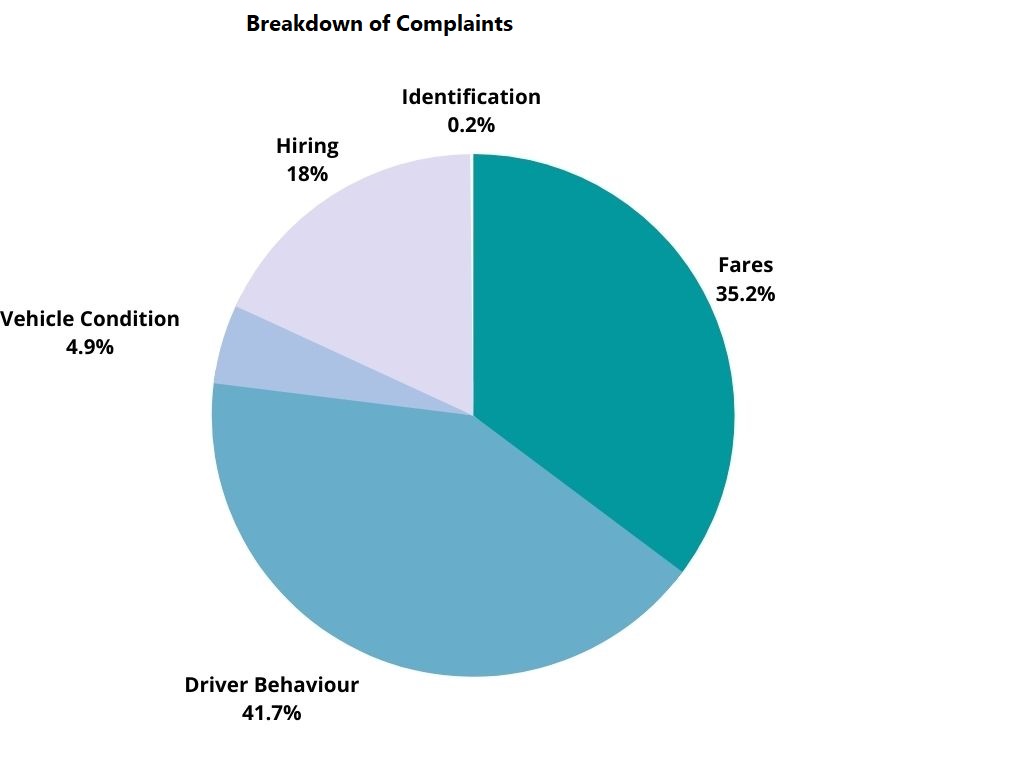
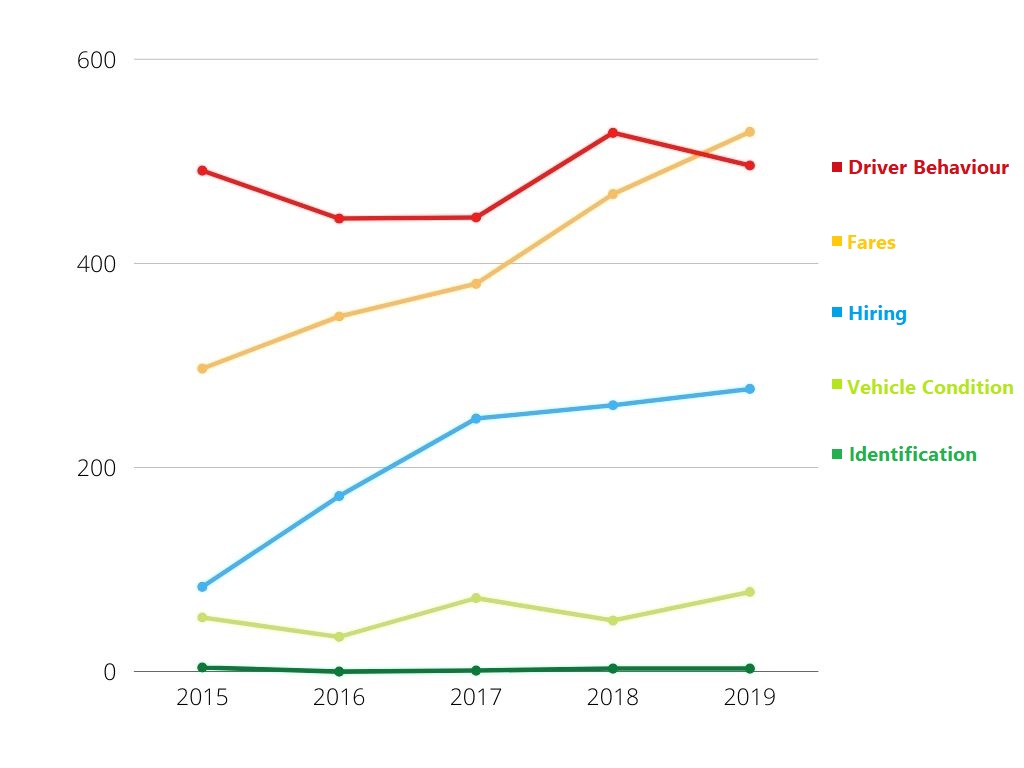
    The total number of complaints are divided into these five categories and reveal that fare matters and driver behaviour are the most common reason a complaint is made. Here is a breakdown of the specific complaints over the past five years:
    More than three quarters of all complaints lodged relate to issues with either fares or driver behaviour. While driver behaviour has been the most reported issue, the number of complaints have remained stable over the five year period. In contrast, the number of fare and hiring complaints have risen dramatically, with hiring complaints more than tripling in five years.
    When questioned by TheCity.ie on the statistics, NTA representative Dermot O’Gara suggested that the rise in numbers was due to an improved complaint-lodging system introduced in 2014:

     “Improved contact forms have made it easier for consumers to submit compliments or complaints about taxi services nationwide” he said.

    “This, together with enhanced consumer education, have had a positive impact leading to an increase in both the compliments and complaints received.”

    While it is true that easier access to complaint forms would increase numbers, this does not explain the continued rise over several years. This also fails to explain why some complaints are increasing faster than others. With no figures on SPSV compliments being released it is also impossible to compare the two to see any correlation.
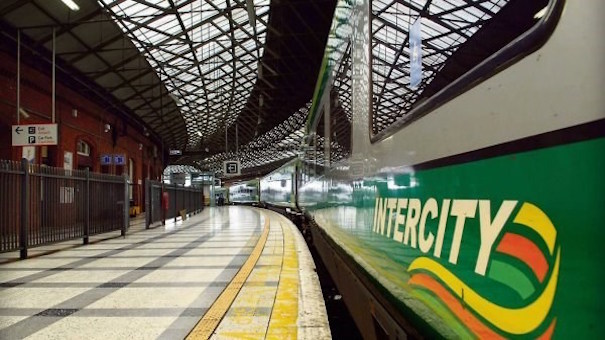
  • Irish Rail: Disorder  solutions continue to disappoint

    Irish Rail: Disorder solutions continue to disappoint

    By Mark Donlon

    The new live text alert system put in place by Irish rail to tackle anti-social behaviour, was used by 145 passengers between its inception on 16 August and 18 October, new figures have shown.

    The system was implemented by Irish Rail after a considerable rise in the number of complaints logged by passengers over disorder and anti-social behavior aboard trains.

    According to information obtained under the Freedom of Information Act, there has been 427 disorderly passenger cases logged aboard Irish Rail services between January 2017 and September 2018.

    The DART accounts for a majority of these complaints, with 120 filed, while the Cork and Galway lines are the most troublesome with 57 and 44 complaints respectively. It is important to note that these figures only account for cases logged owing to disorderly behavior and do not represent the number of overall complaints.

    Previously released figures detailed that there had been over 900 complaints made about passengers aboard Irish Rail trains since 2015. Of that number, 498 complaints were made about disorderly passengers across all routes. This demonstrates an increase in complaint numbers in the time that has since passed, even allowing for an overlap period between the two sets of statistics of the eight months between January and September 2018.

    The older findings were released in early September 2017, and accounted for the 32 previous months dating back to the start of 2015. With the disorderly passenger number at 498, this would have tallied to an average of 15 complaints of that nature a month. The new figures account for the 20 months between January 2017 and September 2018, and with this figure at 427, this would pertain to an average of 21 complaints a month.

    This means that disorderly conduct complaints increased in the 12 months following the publication of the 2017 figures.

    Back in September 2017,  Irish Rail commented that in light of the findings it would look to increase the number of staff on its trains. However, the upturn in complaints would suggest something to the contrary.

    Furthermore, action that is being taken is very recent in the context of the longevity of the problem. Prior to 12 October 2018, Irish Rail only listed six services whereby alcohol was not permitted; two Friday afternoon services from Dublin to Waterford; three Sunday services from Waterford to Dublin, and finally Sunday’s midday train from Galway to Dublin.

    However, when Irish Rail announced bans on further routes from 12 October 2018 onwards, they only added another four services to the list. All were Friday services from Dublin: two travelling towards Galway, one towards Waterford, and one to Westport.

    This underlines the fact that so many of the company’s services are environments where alcohol is permitted. Granted, services to and from Waterford were dealt bans, but between January 2017 and September 2018, the Belfast route had received one more complaint than the number received in relation to the Waterford route.

    This doesn’t seem like a huge difference, but when one route has one rule and the other has another, the difference for a paying customer could be considerable.

    The banning of alcohol is not the true resolution to the matter of disorder on trains, however. Even if it was, it is notable that Irish Rail is nowhere close to applying a no-alcohol policy across the board. And so, this begs the question, what is the solution to problems of traveller unrest aboard Irish Rail services?

    An Garda Síochána’s Press Office said: “Any incidents that are reported to Gardaí are fully investigated. An Garda Síochána regularly provides stakeholders, including transport providers, with Garda Support.”

    As regards the current system in place, all this revealed was that incidents reported to Gardaí are “fully investigated”. It would seem obvious then, that a cohesive text alert system – where all incidents are treated equally, would be useful and reassuring for passengers at risk in transit. However, the new live alert system has been far from thorough since its introduction.

    Many who have used the text alert service have received nothing more than an automated reply, with no indication from Irish Rail as to whether or not action has been taken. Some users have even been advised to pass on their complaint via a 999 call, passing responsibility back to An Garda Síochána, who themselves were only partially involved in apprehending disorderly passengers.

    It appears that a virtual service like the one newly implemented is in fact doing very little to calm the nerves of passengers looking to travel free from danger or disruption. It is not yet clear if many of the 145 people who initially availed of the service had any success from their complaint.

    A spokesperson for Irish Rail alluded to the evasive nature of some of the disruptors: “In some instances, those involved in anti-social behavior may have already left the train or station a short time after the report.”

    With this in mind, Irish Rail perhaps ought to have invested more into increased on-board security personnel instead of an easily manipulated live alert service.

  • What’s the deal with complaints about our broadcasters?

    What’s the deal with complaints about our broadcasters?

    With the Broadcasting Authority of Ireland publishing its decisions on recent complaints, Gary Ibbotson explores how the regulator deals with complaints about broadcasts (more…)