Tag: cost of living in dublin

  • Dublin After Dark: The cost of belonging in Ireland’s ‘social living room’ 

    Dublin After Dark: The cost of belonging in Ireland’s ‘social living room’ 

    A look inside Dublin’s after-hours culture, where connection, caution, and community shape every night out. 

    By Peace Okolo

    As evening settles over Dublin’s city center, the city begins to transition into a livelier, merry atmosphere.  

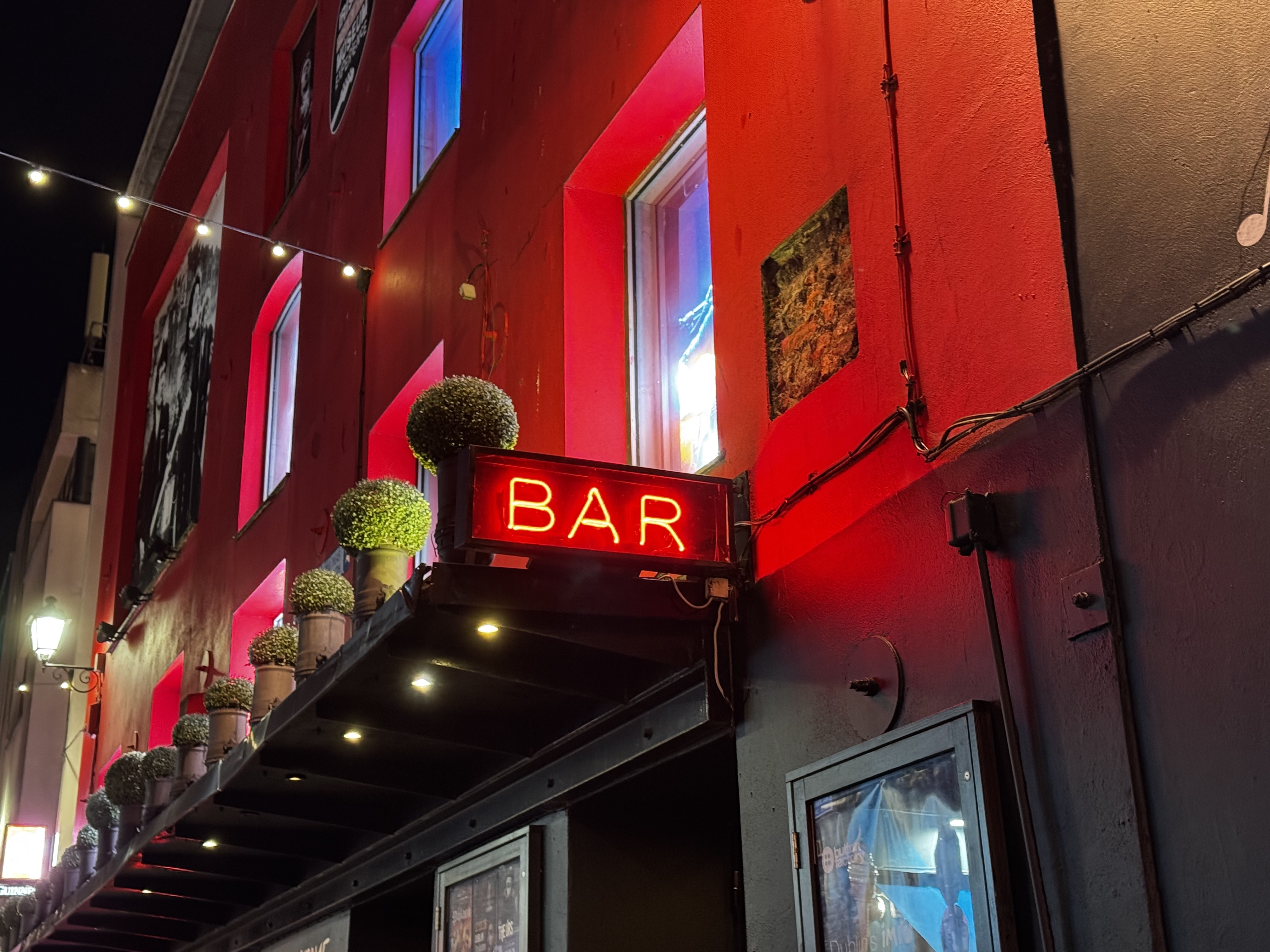
    Office lights switch off, and the glow of pub signs and streetlamps takes over, casting a warm glow that makes the city even more beautiful. 

    The bright neon windows outside The George pub shine colorfully against damp, rainy city streets, drawing in clusters of friends seeking music, warmth, a safe space, and something harder to define: a sense of belonging.  

    “I think it’s so fun,” said Yuri Sousa, a Brazilian healthcare worker, standing just off the dancefloor.

    “The weather is really different, but the mood is similar to Brazil. I feel very welcome here.”  

    In Dublin, nightlife functions as a social glue – a space where people connect after long workdays, where migrants find familiarity, and where LGBTQ+ communities find visibility.  

    “You get somewhere, and there’s just a sense of community,” said Eva Tighe from Bray, Co. Wicklow.

    “Everyone is there for the same reason. No judgement. No prejudice. You feel like you belong.” 

    In Ireland, pubs have long been viewed as communal spaces, places where strangers become acquaintances and acquaintances develop into friends. 

    Pub manager Connor O’Rourke, who has worked in the hospitality industry for over a decade, believes this tradition still defines Irish nightlife. 

    “The pub has always been Ireland’s social living room,” he explained. “People don’t just come here to drink. They come here to talk, celebrate, and decompress after work. That hasn’t really changed.” 

    Temple Bar at night. Photo credit: Peace Okolo

    While Dublin’s pubs remain a central part of Irish nightlife, the experience of a night out is changing.  

    For many, the traditional ‘social living room’ is now being shaped by three practical challenges: rising prices, safety concerns, and the ongoing effort to make the city feel inclusive for everyone. 

    Hospitality worker Maeve Farragher is a proud Dub; from Dún Laoghaire, but even with a lifetime of local knowledge, she says being a woman in the city at night requires vigilance. 

    “I feel safe sometimes because I know Dublin,” said Farragher. “There’s a familiarity there. But I’m also very aware of my position as a woman.”  

    Walking through the city center, even in busy areas, she describes moments of being shouted at, stared at, and sometimes worried about the thought of being followed. 

    “You start asking yourself, is he following me? Is he not?” she said. “I’ve had to ring my boyfriend or my dad before. And I hate that. I hate that I have to rely on a male presence to feel safer, or to be treated with more respect.” 

    For many in the queer community, safety is also a concern.  

    “When I’m with my friends, in a group, in a gay club or a pub, I feel safe,” said the Brazilian healthcare worker. “But alone on the street, not always,” he added. 

    Hospitality workers have also recognised their role in maintaining safe nightlife environments.  

    Bartender Tariq Young says venues have become more conscious of customer wellbeing. 

    “There’s definitely more awareness around safety now,” he said.

    “Staff are trained to watch for situations where someone might be uncomfortable or vulnerable. People expect venues to look out for them, not just serve drinks.” 

    Affordability, however, remains a barrier. 

    “No, absolutely not,” Maeve exclaimed when asked if a good night out in Dublin is affordable. 

    “I work in a pub. I see people spend fifty, sixty, seventy euros in one night, regularly.” 

    But for many, nightlife remains deeply tied to Irish culture, not only as entertainment but as a reflection of community and belonging. 

    Bethany Higgins from Ballybrack captures the pull that keeps people returning.  

    “You just want to let loose,” she said. “It’s great connecting with friends. It makes you feel like you belong somewhere.”  

    Despite its challenges, the feeling of belonging is the quiet heartbeat of Dublin’s nightlife. 

    It is why people endure the cost, the planning, and the vigilance. It is why they step back into the city after dark, again and again. 

    The pleasure of experiencing Dublin at night is not just about drinking or dancing. It is about finding connections in a city that can feel both intimate and intimidating. 

    It is about creating spaces where people feel seen, even if the walk back home still requires caution.  

  • Fears for jobs in Tallaght as retail sales decline 

    Fears for jobs in Tallaght as retail sales decline 

    Cuts to staff hours and lower sales reflect the reality of the retail market in the Square Tallaght, Dublin, post-festive season. 

    By Samuel Adeleke 

    image emphasises the quietness of shops
    As the shops become quieter, the staff find ways to stay busy. Photo credit: Samuel Adeleke

    Business owners in the retail sector in Dublin are experiencing a decline in sales after the holiday season during the January and February slump, when trading activity slows to its lowest. 

    While statistics often focus on the economic impact of this period on business owners and the economy at large, TheCity spoke to retail staff, who are often the first to feel the effects. 

    Tasha Villisca, a full-time staff member at the Vero Moda clothing brand in the Square, Tallaght, who loves working in retail, described the period as being extremely quiet and slow.  

    “When I am here now, I feel like my day gets dragged, unlike during the peak period, where there is always something to do and people to help,” she said. 

    This situation has hit Tasha’s finances, despite putting in the work. “I got my pay-slip last week, and it is literally not making up for the work I put in here,” she said.   

    “I blame it on not getting enough work hours and people shopping online,” she said.  

    Keris Fonory works as a retail staff member with Naming it (a children’s clothing brand).  “Due to the slump in business, the management had to cut down people’s hours; you can only work contracted hours,” said Fonory.  

    “I work with other girls who are in college, and they are struggling financially because they have fewer hours,” she said.  

    One worker from India, who did not wish to be named, said they were let go from their job in Pandora due to the slowdown in business. He has since managed to pick up with A&B Gadgets, “It is not only a bad time for retail businesses but also a bad time for part-time workers,” he said. “This affects me personally, as the hours I can work are reduced,” he said. From his experience, the retail market has become a “click and collect” model, where people just come in to pick up orders, thereby making the retail staff’s role obsolete. 

    Libby Deleon, a manager at Jack & Jones said, “In the next 5 years, I doubt if there will be any more jobs in retail shops because businesses have fallen into a full decline and people are buying stuff more online.” 

    Deleon also mentioned that with the slowdown in the retail business, a lot of small shops in this period lay off their staff, but at Jack and Jones, she said, “We try to make a system where we still try to make things work. Some are great, some are not.” 

    As a way to drive sales during the slowdown, some businesses resort to running sales. “We have reduction sales going on because we are looking to clear the whole winter stocks and build up for the summer stocks,” Steven Abergele, manager of Best at the Square Tallaght, said. 

    Speaking on the impact of this season on other staff, Steven said, “We only employ part-time staff, so it doesn’t affect us really much; but it does affect bigger brands.” 

    January and February mark the transition into the spring and summer season, and this can impact sales in outdoor gear. Gerald, manager at Trespass, a performance outdoor clothing brand, said that they are a weather-dependent shop. 

    Gerald mentioned that in the post-festive season, there is a slowdown in businesses because people are more careful with their money, and it affects everything, including staffing. “It’s like Irish people forget it’s going to rain and it’s going to be cold, so they come in and buy stuff,” he said. 

    There is hope that businesses will pick up in the summer period leading to the Easter season, and there will be more opportunities for staff to work more hours and earn more in the retail sector. 

  • ‘Working just to pay rent’: Dublin’s rising costs leave young people financially stretched 

    ‘Working just to pay rent’: Dublin’s rising costs leave young people financially stretched 

    Rising rents and living costs in Dublin are limiting young people’s ability to save, travel, or plan for their future.  

    /

    By Peace Okolo

    In recent years, Dublin city has witnessed a sustained increase in rent, property prices, and everyday living costs.  

    Recent housing data show that the average rent in Dublin is now significantly higher than before the COVID‑19 pandemic, with the standard rents for new tenancies standing at about €2,186 per month in 2025.  

    According to rental market reports, before the pandemic, rents in many parts of Dublin were around €1,000 per month, much lower than they are today. 

    As a result, many young people find themselves spending more just to maintain a basic standard of living.  

    Dublin, often described as a ‘city of opportunity’, is a place where young people come to study, work, and lay the foundations for their future due to its role as a global economic powerhouse.  

    But as the cost of living continues to rise, many young people living in Dublin are beginning to question if that future is still within reach. 

    by Lukas Kloeppel 

    For many, housing is their biggest concern. 

    Anita, 25, who works in communications, said the cost of renting in Dublin sometimes creates a false sense of financial stability.  

    “You feel like you’re making money in Dublin,” she said “but really, you’re just making it for your landlord. At the start of the month, you think you’re fine, then rent is due, and you remember you actually don’t have anything left.” 

    Research shows that rent takes up a significant portion of many young workers’ incomes, thereby leaving little to no room for savings or long-term financial stability. 

    Martha, 28, works as a marketing assistant and lives in a shared single room in Phibsborough, where she pays €850 a month.  

    “I’m earning what you’d expect for a graduate job, but rent takes a big chunk of my salary, so saving doesn’t feel realistic,” she said. “I don’t live lavishly, I just pay rent, bills, and transport but by the end of the month, there’s only a little left.” 

    Increased rents have become one of the defining features of life in Dublin. Even though there are modest increases in minimum wages, it doesn’t keep up with rising housing costs.  

    Dennis, 27, who works in the hospitality sector, says the idea of long-term stability grows increasingly distant. “I’m spending close to half my income on rent,” he said 

    “People always say to move further out, but then you’re paying more for transport and wasting time. It feels like no matter what you do, you’re stuck.” 

    The pressure seems to start early for students and recent graduates. Emily, 21, a final-year student at Griffith College, says she already feels anxious about what comes next.  

    “Everyone talks about getting a job after college, but no one really talks about how hard it will be to afford to live here on an entry-level salary,” she says.  

    The financial strain has also forced some young people to put personal goals on hold while remaining in the city.  

    Naomi, 26, has lived and worked in Dublin for the past two years and says rising costs have reshaped how she plans for her future.  

    “I really want to travel and see the world,” she said, “but right now, all my money goes on rent and basic expenses. By the time I’ve paid bills and sent money home, there’s nothing left to put aside for travel.”  

    She further explained that beyond day‑to‑day costs, additional travel barriers make her dream of traveling feel even further out of reach.  

    “People don’t always think about things like visa requirements and passport privileges,” Naomi said. “Application fees, proof of savings, and all the extra costs add up when you’re already just trying to survive in Dublin; it’s hard to meet those requirements.” 

    The impact of these rising living costs extends beyond how much one spends a day and is now shaping how young people plan their future.  

    But despite these challenges, many young people still express a strong attachment to the city.  

    Dublin’s vibrant cultural life, creative industries, and sense of community continue to draw people in, even as living costs continue to rise. 

    “I don’t want to leave,” said Khalid, 23, a freelance videographer. “This city is where my work, my community, and friends are. But it’s hard to think of anything long-term when you’re constantly worrying about money.” 

    The experiences shared by these young people living in Dublin reflect the reality facing the vibrant city.  

    Government policies such as increasing housing supply and supporting first-time buyers provide relief.

    But for most young people living in Dublin, the rising cost of living continues to shape their daily life, limit financial freedom, and make building a secure future an ongoing struggle.