The number of people reaching out to sexual abuse services has almost tripled since before the Covid-19 pandemic.
By Aly McGrath
In 2020, WomensAid.ie recorded that they had 29,717 contacts with the organisation. This is a rise of 10,628 from 2018.
WomensAid is an organisation that works to protect women and children from domestic violence. It offers support to those who have been affected by abuse and work towards receiving justice and social change.
The number of contacts dropped slightly since the climax of the pandemic with it currently standing at 26,906 according to the National and International Statistics on WomensAid.ie.
Covid-19 was found to be one of the busiest years for organisations such as WomensAid. In 2020, Safe Ireland found that within the first six months of the pandemic 3,500 women and 600 children contacted the domestic violence service for the first time. This equates to 19 women and 3 new children every day.
In a press release done by WomensAid on February 15th, 2021, the organisation said that “young women experiencing abuse risk are being left behind during the covid-19 pandemic. Reports from other jurisdictions indicate that instances of image-based sexual abuse have surged since last March.”
In the same press release CEO, Sarah Benson talks of the dangers of online and digital sexual abuse. “We need to remember that you do not need to be living with a partner for them to target and abuse you when you can be achieved through digital and online means. This abuse can disproportionately impact young adults.”
Sexual abuse online or in person can have disastrous effects on a person. 84% of young women have reported that they suffer anxiety, depression and low self-esteem whilst being isolated from family and friends as a result of the abuse. Other results have been reported, such as suicide ideation and hospitalisation due to physical injuries.
“We cannot continue to stand over a situation where such a significant number of young women, many minors, are deeply harmed and traumatised at the hands of current and former intimate partners,” Benson explains.
The organisation announced a new campaign early this year called the ‘Too Into You’ campaign. It provides a wide range of tools and resources for young people including a relationship health check quiz. This quiz checks for the signs of abuse in relationships and has information on legal protection and a guide to staying safe online. The organisation hopes that this campaign may help anyone affected by intimate relationship abuse or concerned about a friend or loved one who is at risk.
“We encourage anyone who is anxious or worried about their relationship to reach out for support and remember if it feels wrong, it probably is.” says Benson.
If you have been affected or know anyone at risk of any topic in this article, please call the WomensAid 24hr National Freephone Helpline on 1800 341 900 or contact their private chat rooms to receive support and advice.
In 2021, cocaine was the second most common main problem drug. In 2021, for the first time, the National Drug Treatment Reporting System (NDTRS) recorded more cocaine than heroin cases among those treated for drugs as a main problem. Cannabis was the third most common reported drug problem.
By Nimra Ahmed
There has been an increase in illicit drug use in Ireland in both young people and adults. This could be due to unemployment, high population densities, poor facilities or just for recreational purposes.
According to a Health Research Board (HRB) survey, one in four (23%) of the participants had used an illegal drug at some stage in their life. That means almost 900,000 adults of 15 years and above of the general public have used an illicit drug. Furthermore, one-in-fourteen (7%) revealed that they had used a prohibited drug in July 2021.
The areas with the highest drug use in Ireland are: North Dublin, Southwest Dublin, Wicklow, Kildare, Southwest and East coast Regional Drug and Alcohol Task Force (RDTF) areas.
Looking specifically at opioid use, there are an estimated 11,729 problematic opioid users in Dublin alone while the rest of Ireland has approximately 8,146 users.
Area
Known
Estimate
Rate
Co. Dublin
7,916
11,729
12.72
Rest of Ireland
4,396
8,146
3.97
Total
12,312
19,875
6.68
Estimates of the number of problematic opioid users for Co Dublin and the rest of Ireland, and rates per 1,000 population aged 15 to 64 years (2019). Created by Nimra Ahmed using data sourcedhere.
There has been an overall increase in the total number of reported cases of drug use in 2021. Statistics show that 10,769 cases were reported for treatment out of which 39.1% were new cases while previously treated cases were 56.6%. Moreover, 4.4% of the cases were of unknown status.
In 2020, cannabis was the substance for which treatment was most commonly received, with 1,229 cases. However, in 2021, for the first time in Ireland there were more cases of treatment for cocaine as a main problem drug. The HRB observed for 2021, 34% were treated for opioids, 30% were treated for cocaine, and 21% were treated for cannabis while 11% were treated for benzodiazepines. It was noted that 28% were females who were treated while 72% were males.
In 2020, cannabis was the substance for which treatment was most commonly received, with 1,229 cases. However, in 2021, for the first time in Ireland there were more cases of treatment for cocaine as a main problem drug. The HRB observed for 2021, 34% were treated for opioids, 30% were treated for cocaine, and 21% were treated for cannabis while 11% were treated for benzodiazepines. It was noted that 28% were females who were treated while 72% were males.
Infographics for drug cases and cocaine cases in Ireland. Infographic created. by: Nimra Ahmed using data sourcedhere.
At a glance, statistics show that the median age for drug use is 32 years. 13% are homeless even though 21% are employed and 21% have injected themselves at some stage. When we compare the shocking 3,248 cases of cocaine use to the overall drug use the median age is 31 years. 34% are employed and 25% of them are women.
Infographics for drug cases and cocaine cases in Ireland. Infographic created. by: Nimra Ahmedusing data sourcedhere.
Since illegal drug use has increased overall, it is necessary to also observe Irish youngsters. Another recent study on substance abuse in Irish youngsters showed an increase in cocaine usage amongst 15 to 24-year-olds. This has led to a 170% increase in the treatment of young cocaine users. The Health Research Board’s report, revealed that 26.7% of young adults used illegal drugs in their lifetime, while 18.5% in the last year and 10.5% in the last month.
Over one-half of the sample of third-level students participating in the Drug Use in Higher Education in Ireland (DUHEI) survey (N=11,592), in 2021 reported lifetime use of an illegal drug (55%)
Brian Pennie, author, speaker, PHD candidate, university lecturer, and life-change strategist, was a chronic heroin addict for 15 years. He believes trauma could lead to addiction. In his infancy he had a surgery without anesthesia which he thinks may be the root cause of the uneasiness and anxiety he felt throughout his childhood and adulthood.
These feelings of unrest, anxiety and worry led him to a dark path even though he was at school and held a job. Pennie turned his life around by replacing his addiction of drugs with the addiction of learning.
“I used to think I knew a lot. I didn’t.I believed my own lies, weaving an imaginary world full of delusion, denial, and deceit. Combined with chronic anxiety and an overactive mind, this warped view of reality steered me towards a life of addiction,” said Brian Pennie, author, speaker, PHD candidate, university lecturer, and life-change strategist.
Brian Pennie- Photo Credit: Finne
Philip Byrnes, 44, a General Practitioner (GP), voices his concerns, “substance use is a very real part of Irish society. Youngsters especially females are now using more than ever. 24% of females are lifetime users while males are 29% so, females are not so far behind statistically.”
“Nobody seems to know exactly why substance abuse is on the rise. Drug use affects people’s lives, their health both mental and physical, as well as impacting relationships with family and friends”, he added.
“One solution that Germany contemplates is to legalize the buying and owning of cannabis (up to 30g) for recreational use. The reason for this is to better protect young people who are already using black market cannabis. If this law passes, it could be a model for other European countries. The solution for the Irish nation is still unknown but we need to act fast if we want to save our society.”
Illegal drug use in Ireland had plateaued in 2014/2015 and further decreased in 2016 and 2017. However, since 2018 it has steadily been on an upward trend again. Today in Ireland, cannabis use has stabilised but there is an increase in cocaine use, and the prevalence of polydrug use.
Ecstasy and cocaine usage in Ireland is the second highest in the whole of Europe. It represents a huge challenge for policy makers, social workers and addiction counsellors fighting the issues day in, day out.
As the concerns for the escalating club drug use in Ireland increased, Shay Galon reports on the HSE’s new campaign urging people who choose to take drugs to do it safely.
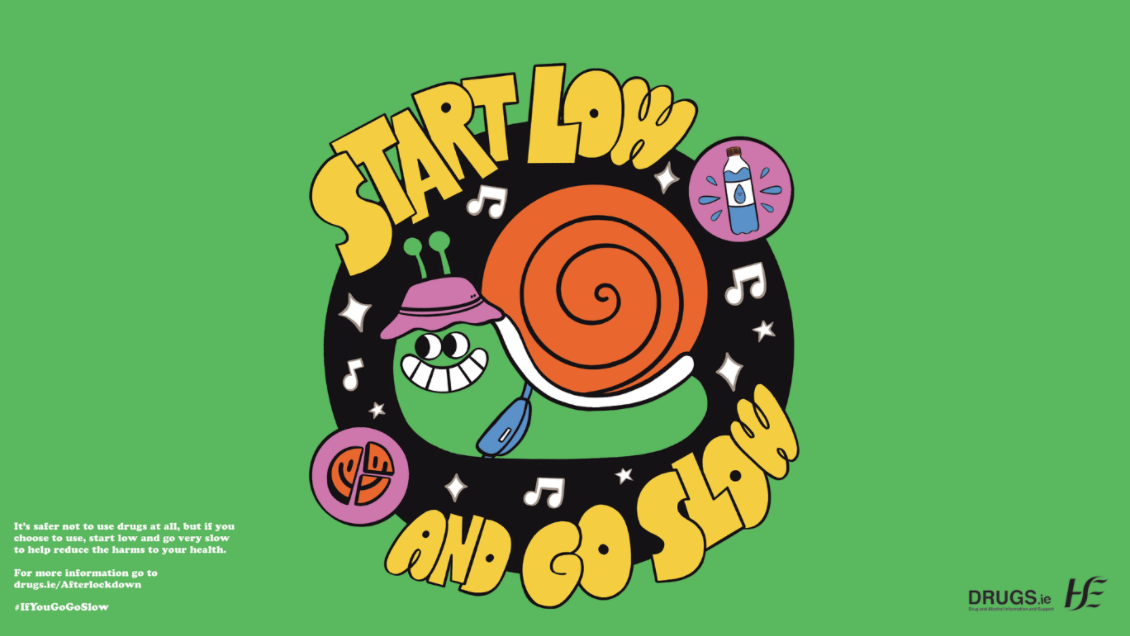
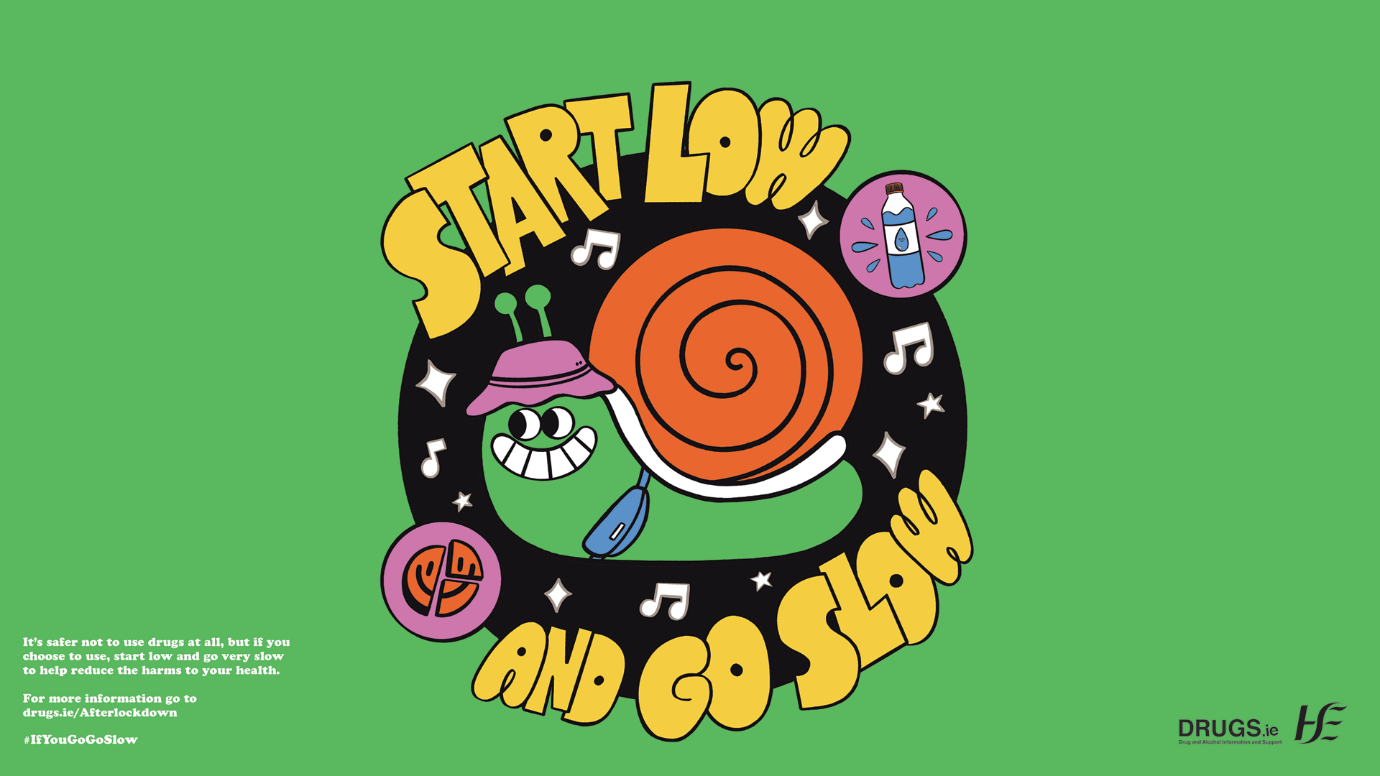
While the HSE says that it is safer not to use drugs at all, it launched a new campaign in attempt to remind those who choose to use drugs to be fully aware of its risks and ‘if you go, go slow’.
The new campaign was introduced when nightclubs were reopening in the country, despite the mandated midnight closing times. After nearly two years of restrictions, some of which are still ongoing with new variants emerging, people are excited to celebrate with their friends and to return to pre-pandemic normality. Although not everyone uses drugs, the HSE aims to remind people who do to do it slowly and safely.
“Not everyone who socialises in nightlife venues uses substances, but we are aware of increasing levels of stimulant use among young people in Ireland,” said Dr Eamon Keenan, HSE National Clinical Lead-Addiction Services.
“We are also seeing use occurring in extra risky ways with people taking multiple substances at a time.”
The campaign also aims to alert the public that drugs such as MDMA and cocaine that are used in clubs are increasing in strength in Europe, boosting the risk of overdosing. Nowadays, new substances can also appear in pills, powders crystals and cannabis products.
With the nightclubs open, ‘If You Go, Go Slow’ intends to remind first time drug users to thoroughly think about their actions as people react differently under the influence, especially in new settings and around new people, while considering the effects on mental health.
According to the Emerging Drug Trends and Drug Checking Report 2021, the HSE recognises that there is an emerging stimulant and poly drug culture among new user groups and there is currently a huge issue of concern across Europe and Ireland.
“While it’s safer not to use drugs at all, we ask people to consider the steps they can take with an aim to minimise the harms to their health.”
The HSE’s objectives include to start a conversation on nightlife risks around stimulant culture in nightlife venues and to raise awareness that drugs.ie is the place to visit for drug safety information. This website by the HSE informs people on how to reduce the harms from stimulants, educate people that drugs may be of higher potency and strength and their tolerance might be lower.
“Based on the reopening of nightlife in the UK earlier this year, we have a number of concerns in relation to overdose and fatalities happening at this time. We are aware that the current drug market trends may lead to the increased likelihood of overdose and people may be at greater risk due to time off from using drugs. Tolerance levels may have changed.”
To initiate new safer nightlife projects, the HSE has launched a new video series ‘View from the Booth’ to showcase Irish artist’s views on the current drug landscape from their position as DJs. Nightlife representatives play an important role in discussing the topic of drug use and health in a way that appeals to their community. The videos feature Aidan Thompson, Robbie Kitt and Kasey Keating Brady who touch on the topic of nightlife returning, reduced drug tolerance, mental health, peer influence and mixing drugs
Frank Feighan, Minister of State with responsibility for Public Health, Well Being and National Drugs Strategy, added: “A key objective of the National Drugs Strategy aims to develop harm reduction interventions targeting at risk groups, and it is crucial we make these interventions available in all settings, including the night-time economy.”
“It is imperative that when people go out to enjoy themselves that they can do so in a safe environment and the provision of these harm reduction messages and services will ensure that.”
Some people may feel they have to ‘make up’ for lost time which could lead to using substances in extra risky ways. Remember to mind yourself and look out for your friends. If you go, go slow.
Image based sexual abuse is the act of sharing and distributing intimate photos or videos without the owner’s consent. Currently in Ireland there’s no legislation or criminal liability associated with sharing images, meaning people are completely unprotected in the eyes of the law.
In recent weeks, a discord server containing what is thought to be tens of thousands of images of Irish women and girls, posted without consent, was discovered. This has created a new surge in the #EndIBSAIreland movement. Erica Carter sat down with Caroline Counihan, a member of the Rape Crisis Network Ireland, to discuss this issue and when we might see legislation take affect.
In recent months, there has been a huge increase in reports of dogs being stolen. The DSPCA believes this is linked to an increase in demand for dogs during the pandemic. But how has this affected pet owners?
Niamh Talbot took to St.Anne’s park to speak with local people about whether or not they feel more anxious when out walking their dogs.
Findings from a recent FOI request, along with news of Ireland’s biggest ever prison drug haul, show Mountjoy Prison is continuing to battle the ongoing issue during the pandemic. Gavin Dalton spoke with Michelle Martyn, a representative from the Irish Penal Reform Trust, about their work within the penal system
Copyright free image sourced from Pixfuel
Findings of a Freedom of Informaion request show the figure and makeups of contraband seized from cells in Mountjoy Prison from January 2020 to the 24th of October 2020. These figures show the number of phones confiscated amassed to 174, the number of weapons seized read 41, followed by 225 drug seizures, the highest of the three.
Speaking to TheCity, a spokesperson from The Irish Prison Services said: “Preventing the access of contraband into prisons remains a high priority for the Irish Prison Service. Concerted efforts are made continuously to prevent the flow of drugs into our prisons, by, for example, the installation of IT anti-drone technology, nets over exercise yards, vigilant observation of prisoners by staff, enhanced CCTV monitoring, stricter control of visits and the use of targeted and random cell searches daily.”
“We have enhanced the fight against contraband entering our prisons by introducing drug swabbing similar to airport-style swabbing for drug residues. The Prison Service is committed to investing in new technology, which will further prevent the access of contraband into prisons.”
Despite the best efforts of prisons to prevent the flow of drugs into their buildings, the cat and mouse game is an omnipresent feature of prisons, and drugs can pass under the strict security measures and gain their way to prisoners for sale and supply. Drug abuse in prisons will likely continue despite the efforts.
Drug addiction is a major issue in Irish prisons and its knock-on effects such as mental health problems and violence mean the life of a prisoner is as complex as ever. With such hostility involved with modern-day prisons, the rights of prisoners often come to attention.
The Irish Penal Reform Trust (IRPT) is a non-government organisation that advocates for the rights of prisoners. Michelle Martyn, the IRPT’s policy and research manager, spoke with TheCity.ie about the current issues surrounding drug use in Irish Prisons and the work they do.
“We advocate for the rights of everyone in the penal systems. I suppose our mission is that, wherein possible, prison is used as a last resort. We’re a small organisation, so we try to effect change through our research and advocacy. We do a lot of work in different areas around prison conditions.”
Speaking of the recent seizure in Mountjoy where it was reported a discovery of cocaine with an estimated value of €140,000, tablets believed to be worth up to €20,000 and €5,000 in suspected cannabis along with a small number of steroids, alcohol, and 30 mobile phones was made, Martyn feels the drug situation in prisons reflects modern-day society.
“I know the prison services have a campaign to try to stop drugs and prevent overdoses from happening but it’s still a huge problem for both prisoners and their families.”
“The latest figure I’ve seen shows that within the prison population, 70% of male prisoners and 85% of the women have addiction issues,” she said
“There needs to be support in the community to prevent the problem in the first place. Trauma is often the root cause of addiction so until services are there and ready to intervene at a very early age in the community, there’s always going to be that issue,” she said. “The harm that it causes for families is immense. Like everywhere in society, once there are drugs available, there’s demand and if there’s demand then there will be a way of supplying.”
In regards to services available to prisoners suffering from addiction, Martyn added how she feels access to services is an issue only worsened by the pandemic. She said: “ During Covid-19 we don’t really know how things have been operating generally, but I would imagine that there have been more issues for people with drugs.”
Before the pandemic, there would’ve been community based organisations that support people with drug use. However, they haven’t been getting in to support people. There are now telephone calls, but we don’t know how well that’s working. It’s a different approach than talking to somebody face to face about issues of addiction.”
Martyn also said there’s a need for more support staff within prisons. “For example, in Clover Hill prison, there was one addiction counselor to 400 prisoners with people who have many addiction issues. These ratios are really poor so there is definitely an issue in access to services for people who want to avail of supports.”
“The services should be there and available for people who are motivated to get support for addictions,” she said.
Albeit a challenging situation with answers hard to produce, it’s apparent, work is yet to be done to aid those in our nation’s penal system battling addiction. Perhaps, as Martyn concluded a more “holistic” approach could be looked at.
An Garda Síochana have reduced the amount of members carrying firearms following a review in 2019 by the Policing Authority Ireland, as the force moves towards a model of having specialist armed response as their main firearm unit. Jonathan Kelly explores the relationship between the Garda and arms.
Photo taken by Sean MacEntee. Sourced from Flickr.
According to figures released by the Garda Ombudsman (Gsoc), armed Gardaí have fired their weapons on only 16 occasions since 2016, with accidental discharge accounting for a third of incidents. Last June, a detective guarding the Israeli embassy in Dublin accidentally shot himself in the leg.
“That could happen in an emergency, a fella taking his gun out and the damned thing going off. Lucky no one was killed,” Mr. Michael Mangan, a recently retired detective said. “For 27 years I carried a gun, I never had to use it though.”
“I withdrew it a couple of times in very dangerous situations but lucky enough I never had to use it” he added.
The 2019 review found more than a quarter of the force, 27% or 3,778 members carried a firearms authorisation card. The Policing Authority found many of them were working desk jobs and non-frontline areas. More than 1,000 cards have been revoked to date, with now 19% or 2,776 of the force armed.
Mr. Mangan said, “I wouldn’t agree with uniform people (Garda) being armed, I think guns should be carried by detectives though,” when asked about a fully armed police force.
When the City spoke to some members of the public, the majority of people revealed they would feel less safe if all Gardai were armed. One of the respondents wrote: “Naturally I’d feel nervous, there’s always a few bad eggs in every bunch.”
However, only half of the respondents agreed with reducing the number of armed Garda. “I’m proud that the Irish are one of the only countries in the world with an unarmed police force,” another replied.
According to Gsoc, Gardaí have used tasers on 125 separate occasions over the last five years. Taser guns are currently only available to specialist units such as the Emergency Response Unit, the Armed Support Units and Special Detective United, although consideration is being given to arm all frontline Gardaí with them. Less than half of the respondents would be in favour of such a move.
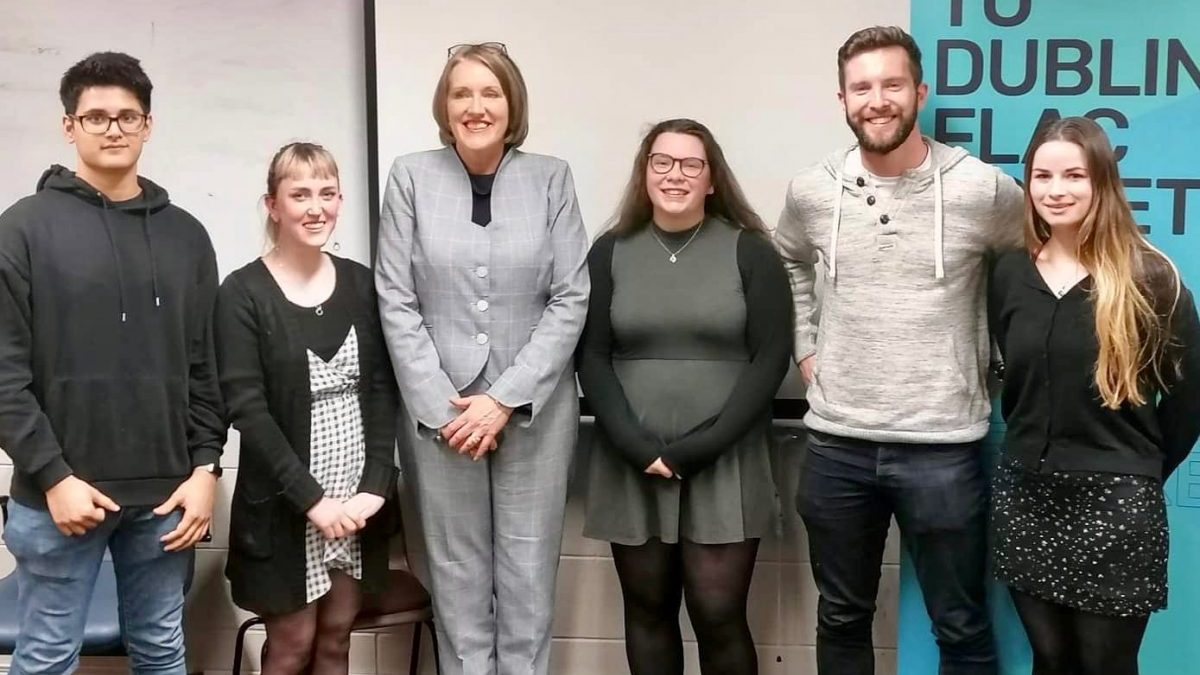
DPP Claire Loftus (third from left) meeting TU Dublin students after her pre-lockdown talk at Aungier Street (Photo: Facebook/TU Dublin FLAC Society)
Claire Loftus, the Director of Public Prosecutions (DPP), gave a rare behind-the-scenes insight into how she operates at a pre-Coronavirus shutdown TU Dublin Free Legal Aid Centres (FLAC) Society event. TheCity.ie’s Paul Caffrey, who attended the talk,describes how she keeps politics out of her decision-making
During a wide-ranging hour-long talk at the Aungier Street campus, the State’s current prosecutor-in-chief explained to students why she chooses not to prosecute in certain cases.
Claire Loftus said that in most cases, “crime should be punished”, but that sometimes her office concludes that “there is a public interest not to prosecute.”
Loftus said this is down to a range of factors including a suspect’s age (“very old or very young”) and whether their alleged offence could be viewed as a “one-off” or an “error of judgment”.
Claire Loftus paid a visit to TU Dublin’s Aungier Street campus last month (Photo: Kim O’Leary for TheCity.ie)
Her job involves deciding who should be put on trial in the law courts on the basis of evidence gathered by gardaí or another investigating authority. In each case, she’s tasked with deciding if there’s a reasonable prospect that the evidence available will lead to a conviction by a jury.
Loftus also revealed how she got “completely hooked” on crime as a young woman in her mid-20s and still finds her work “fascinating”.
Loftus — who became Ireland’s first-ever woman DPP in 2011 — insisted there is “no political interference” in her decisions.
She also vowed to “revolutionise” the courts system before she finishes her 10-year run as DPP next year.
She wants more pre-trial procedures used so that juries and witnesses are not left “hanging around” for weeks on end while lengthy legal arguments hold up major criminal trials, she said.
Former Anglo Irish Bank chairman Seán Fitzpatrick being interviewed by the media outside the Criminal Courts of Justice in Dublin following his May 2017 acquittal. Ms Loftus wants to create a more efficient system in the courts with shorter trials in future (Photo: Twitter)
The 2017 Circuit Criminal Court trial was so dogged by delays that it dragged on over an eight-month period with 126 days in court.
In 2017, Fitzpatrick had faced 27 charges of misleading the now-defunct bank’s auditors and of giving false information about multi-million euro loans between 2002 and 2007. Mr Fitzpatrick was cleared on all counts.
In the end, Judge John Aylmer directed the jury to acquit Fitzpatrick. Outside court afterwards, Fitzpatrick said it was “a wonderful day for me and my family”. In one post-verdict report, RTÉ said the trial “became a shambles”.
Seán Fitzpatrick appealed for his privacy when faced by the media outside the Criminal Courts of Justice straight after his May 2017 acquittal (Video: Independent.ie on YouTube)
Addressing a tightly-packed roomful of about 50 law students at Technological University Dublin last month, Loftus lamented the “huge amount of time lost” during some major criminal trials:
“Juries are being asked to come in and sit around for days or weeks. The issues aren’t crystallised because there is no pre-trial hearing.”
Vowing to change this before she departs as DPP in late 2021, she said: “It would revolutionise the whole system in the courts. Victims wouldn’t be hanging around. The system would be much more efficient. I’d love to see that [in place] before I go.”
The Criminal Courts of Justice in Dublin (Photo: Paul Caffrey)
Loftus said there is “no mathematical formula”, but that in most cases, “crime should be punished”.
The 52-year-old Dubliner said the law must strike a balance “between society’s right to see crime prosecuted and the rights of the defendant.”
She told the law students: “We have to be satisfied there is a prima facie [on its face] case and a reasonable prospect of a conviction…every case is considered on its own merits. There is no mathematical formula. It’s the product of a lot of experience.”
She added: “In most cases, the public interest requires a prosecution. Crime should be punished and people should be prosecuted and brought to justice. Sometimes, we decide there is a public interest not to prosecute.”
Seán Fitzpatrick walked free after a very lengthy court process (Photo: Twitter)
In reaching such decisions, “the office [of the DPP] is entirely independent of government”, Loftus stressed.
“I’m not required to report to the Minister for Justice or the Taoiseach. There is no question of any attempt to influence decisions.”
There is “no political interference in the process,” she added.
Claire Loftus told the students that Leo Varadkar is never involved in the decisions she makes (Photo: Facebook)
Back in the 1990s, after two months working in the Chief State Solicitor’s office as a recently qualified solicitor in her mid-20s, “I was completely hooked,” Loftus said.
“Twenty-seven years later I’m still in crime. I’m a career prosecutor. The work is really rewarding. I didn’t expect to get into crime,” she told the students.
She has worked as a prosecutor since 1993 and started out working on robbery and criminal damage cases and later moved on to murders.
She was also very interested in fraud and “white-collar” crime.
Her work as DPP since 2011 is “extremely varied…no two days are the same. It’s a fascinating job,” she said.
Claire is set to depart the office of DPP in 2021 after a decade in the job (Photo: Twitter)
Her office receives thousands of investigation files from gardaí yearly. Each day, she personally looks at “quite a number of files”, including “a lot of gangland crime cases”, and “every case is different”, she said.
Loftus revealed that gardaí “can phone us 24/7. If there is sufficient evidence, we’ll allow the guards to charge straight away.”
Renewing her commitment to setting up a dedicated sex offences unit in the DPP’s office by the end of 2020, she said: “We think this might help in these very sensitive and complex cases – hopefully by the end of the year, we’ll be in a position to get it up and running. The advantage for victims is of continuity…I’m very pleased, given the focus on sex offences currently.”
During her March 11 visit to the Aungier Street campus, she also wished TU Dublin students well in their exams and future endeavours.
There have been 67 deaths in Irish prisons between 2010 and 2017 according to figures released under the Freedom of Information Act 2014.
A high of 14 people died in 2015 while 2012 and 2016 saw the lowest figure since the turn of the decade with just five fatalities. Last year nine inmates died, which was an increase on the previous year.
In 2010, a total of eleven people died which then dropped by five the following year. Nine people died in 2013.
The most common form of death was misadventure, with sixteen deaths categorised in that way.
Fourteen people died from natural causes, while the same amount of people died from suicide. A high of three people took their own lives 2013, while a record four died from natural causes in 2015.
There was one confirmed unlawful killing in 2015, while there are ongoing inquests in relation to twelve incidents since 2010. There are seven active inquests from last year, while two inquests from 2013 are still ongoing.
In the second of a two-part series, The City’s Keith Horan looks at incidents of anti-social behaviour on Intercity Irish Rail services, using figures obtained under the Freedom of Information Act.
2018 looks set to be the worst year since 2015 for incidents of anti-social behaviour on Intercity Irish Rail services, with 280 incidents reported by October, more than the final year figure for any of the previous three years. Already this year, there have been 100 more incidents reported than in the whole of 2016. And overall, a total of 964 incidents of anti-social behaviour were reported on Intercity Irish Rail services since 2015.
The most common complaint of anti-social behaviour made by Intercity Irish Rail customers is to do with disruptive passengers, with a total of 628 complaints – a whopping 65% of all total reports made. Like the rising total yearly trend, incidents involving disruptive passengers have been on the up since 2016 when 120 reports were recorded, to 153 in 2017, escalating to 186 by October of this year.
According to the figures obtained for disruptive passengers on InterCity services, you are most likely to run into problems on the Galway line, which holds the title for most reports since 2015 with 105. At the other end of the scale, you are least likely to run into a disruptive passenger on the Kildare line, with only 17 reported incidents over four years. The total figure for disruptive passengers on the Kildare line since 2015 is lower than every individual yearly figure of similar reports on the Cork, Galway and Sligo lines.
The next most common complaint around anti-social behaviour centres on reports of intimidation. Since 2015, there have been 164 reported incidents of intimidation, although this figure is skewed somewhat by a totally disproportionate 31 incidents in Longford in 2017, more than treble the yearly complaints of intimidation on every other line.
Unsurprisingly, Longford has the highest number of reports of intimidation since 2015, with 58 made – Dundalk with 20 has seen the second highest number of reported incidents of intimidation, followed by Cork and Sligo with 16 each. Compared to Longford, if you want a care-free train journey free of intimidation, the Rosslare Europort service is ideal, with only two incidents of intimidation being reported on the line in the last four years.
Acts of vandalism are the third most reported incident of anti-social behaviour on Intercity services, with a total of 65 reported since 2015. However, vandalism seems to be a receding problem, with reported incidents since 2016 all lower than a high of 26 in 2015.
Longford again takes the unwanted position of number one for reports of vandalism on InterCity services, with a total of 21 incidents since 2015. Like with incidents of intimidation, Longford has a disproportionate figure in incidents of vandalism – the 11 reported in 2015 being more than double the figure reported in any year on any other line. Dundalk had the second most reports of vandalism with 13, while at the other end of the scale, the Belfast and Westport services have seen no reported incidents of vandalism being made from 2015 to October of this year.
Incidents of theft aboard Intercity services in 2018 look set to be the highest since 2015, with more than double the amount of theft recorded in 2017. There have been 16 reports of theft made by October of this year, compared to a total of six last year. The Longford and Cork services share the position of number one in terms of reports of theft with ten each, while your bags and belongings should be perfectly safe on the Tralee and Belfast lines, with both without a report of theft in that time.
Longford also tops the table for reported assaults on Intercity Rail services, with eight such incidents reported since 2015, closely followed by Dundalk with seven. Again, 2018 looks set to be a bad year for safety on Intercity services, with the eight reports of assault by October of this year equalling the same number for the whole of 2015. The Westport service is closest to Longford and Dundalk, with a total of three reported assaults, while both the Galway and Sligo services have yet to see an incident of assault being reported.
Speaking to The City NRBU General Secretary Dermot O’Leary said that “the situation of anti-social behaviour on Irish Rail services is an escalating problem, with incidents rising year on year.” Mr O’Leary also said that NRBU members have been both physically and verbally assaulted on rail services, and that while issues around anti-social behaviour are a wider societal problem, he appealed to Minister for Transport Shane Ross and Minister for Justice Charlie Flanagan to intervene and deal with the problem on Irish Rail services across the country.












You must be logged in to post a comment.