Tag: Croke Park

  • Croker an insider’s view

    Croker an insider’s view

    10670171_10152402399028733_4673937741540461965_n
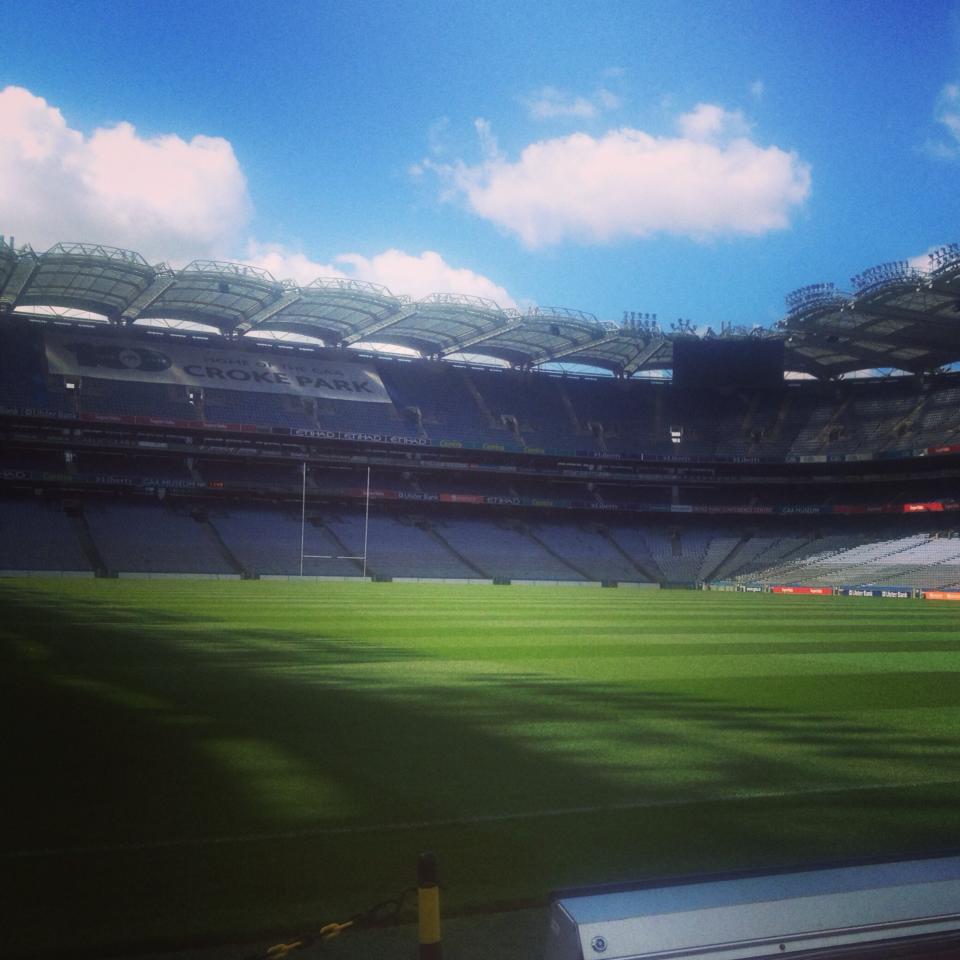
    Croke Park on matchday. Photo: Alison O’Hanlon

    There’s an uncapturable magic that surrounds Croke Park on All-Ireland day.

    As part of my job in the press office at the stadium I get unrivalled access on All-Ireland day.

    It all starts from the minute you wake up and pull on your county colours. It all comes to either a triumphant or turbulent end once the referee blows the final whistle after 70 minutes of play; an indescribable feeling comes over you.

    It’s a sense of pride and Irishness that – if it could be bottled – would be worth millions. It’s the banter on Jones’ Road, the pint in Quinn’s Pub and the pre-match discussion with your match day companion; it’s all these things, but so much more.

    Days like the All-Ireland Final don’t just happen by themselves. It takes a team of 2,200 people to put in weeks of hard work in order for the day to run as smoothly as possible.

    Like all good Irish traditions, All-Ireland day for the GAA staff starts with mass at 9am in the GAA museum. The mood for the day is set as either Liam or Sam (the two coveted GAA trophies) join the priest on the alter for the celebration of the Eucharist. As the mass ends and the match day staff “go in peace”, another great Irish tradition is next to be observed: ‘the Full Irish’.

    Mass being celebrated in Croke Park.

    Bellies full from the big breakfast, attention soon turns to the organisation of the 2,000+ staff that help run the event in different capacities. Last minute team meetings take place to make sure everyone is fully aware of their role. From cooks, stewards and media officers to programme sellers, ticket scanners and An Garda Síochána, everyone is expected to put in an error-free performance.

    Midday hits. Stiles open. It’s lights, camera, action for the workers. Behind the scenes, Croke Park is being watched from every angle through security and TV cameras in the Garda and Event control rooms located above Hill 16.

    View from the control room in Croke Park Picture credit: Ray McManus / SPORTSFILE
    View from the control room in Croke Park.                       Photo: Ray McManus/SPORTSFILE

    As team buses pull in, you can see the focus which surrounds the players. They are zoned in, mentally prepared and are trying to escape into their own little world through their headphones.

    With dressing rooms lined out and pre-match rituals beginning, you can stand in the Hogan tunnel and experience the roar of the 82,000 strong crowd. You start to feel the beat of your heart in your ears as nerves and excitement take over.

    The Kerry Football Team arrives in Croke Park Picture credit: Brendan Moran / SPORTSFILE
    The Kerry Football Team arrives in Croke Park.
    Photo: Brendan Moran / SPORTSFILE

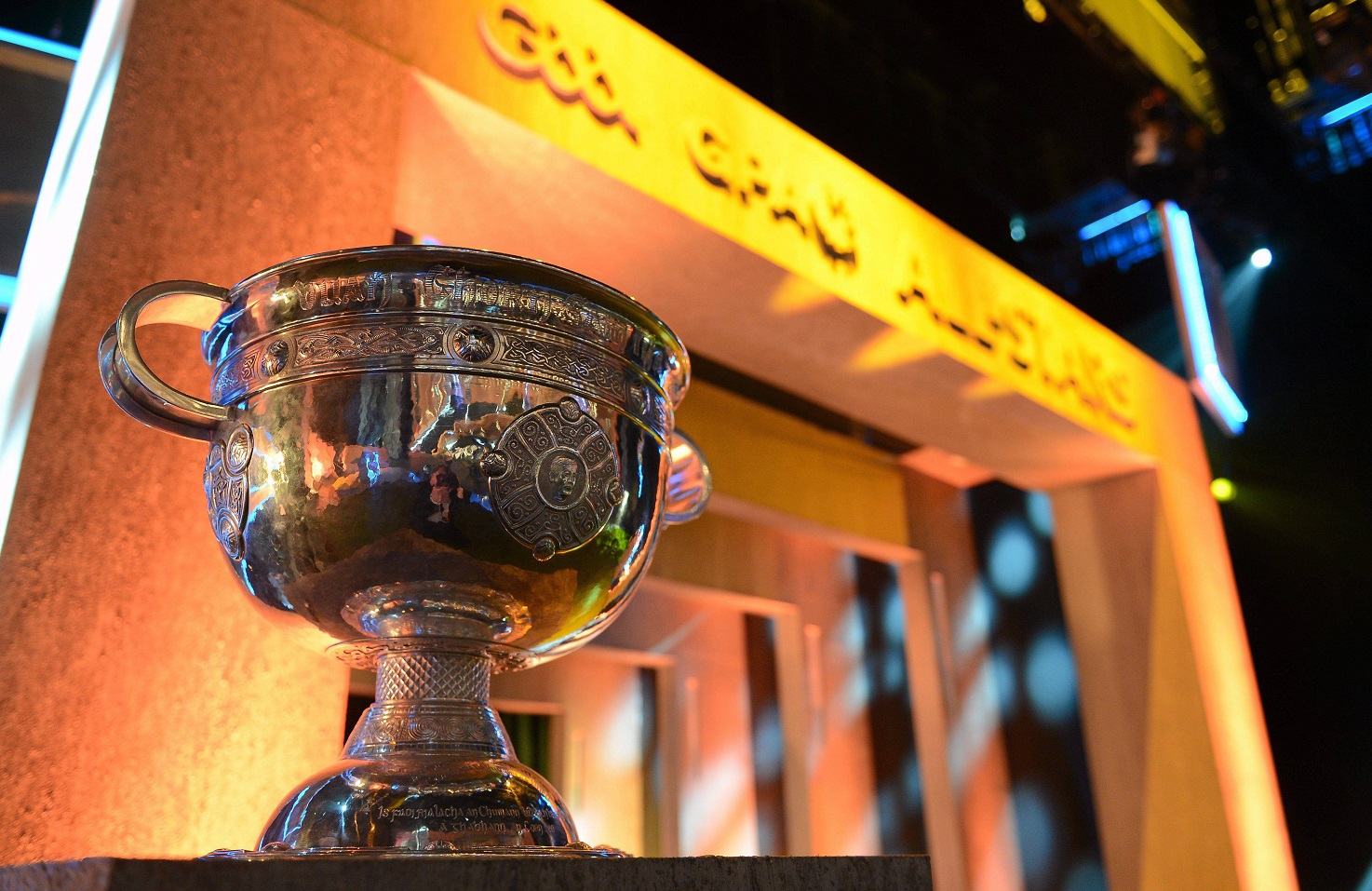
    The Sam Maguire and Liam McCarthy cups are brought to the pitch from their holding place in the GAA museum by two pre-selected school children from the participating counties. Gerry Grogan, who is the match day announcer and principal of Donaghmede National School, then takes the cup up to its resting place in front of the President, Michael D. Higgins and GAA President Liam O’Neill.

    Picture credit: Brendan Moran / SPORTSFILE
    The Liam McCarthy Cup. Photo: Brendan Moran / SPORTSFILE

    The competing teams then take it in turns to run out onto the pitch, with the subs and team management lining the tunnel to hype the players up as they take the famous steps out onto Croke Park.

    1382414_10151688307773733_1806566238_n
    The Cork hurling team take to the field.

    In what feels like a blink of an eye, the 70 minutes of playing time are over and Kerry or Kilkenny or whoever is lucky enough to have been named All-Ireland Champions ascend the steps of the Hogan Stand to collect their silverware.

    At that moment, everyone who has participated in the day’s events feels a sense of pride. You are no longer just a steward, a cook, a member of An Garda Síochána or a ticket-seller; you are a witness to a historical moment in time and you are there to take it all in with the victors.

    Henry Shefflin celebrates his 10th All Ireland medal with his two children
    Henry Shefflin celebrates his 10th All-Ireland medal win in September 2014. Photo: Alison O’Hanlon

    Following the afternoon’s drama, cameras are switched off and another hectic season comes to a close. The staff of the GAA all tumble out of Croke Park in dribs and drabs, woven into the travelling supporters, back to their everyday lives. The players head to a special reception, where each player is allowed to select one person to join them and the team in a lounge beside the dressing rooms.

    This is what is so special about our national game and the GAA. On game day you could play the role of a manager, a player, an official, a spectator or a steward. On the next day, you go back to being a farmer, a teacher, a student or a parent.

    A volunteer steward keeps an eye on the final.    Picture credit: Ray McManus / SPORTSFILE
    A volunteer steward keeps an eye on the final.
    Picture credit: Ray McManus/SPORTSFILE

    It is the sense of pride in the jersey, the commitment of playing unpaid and the fact that all of this is done year after year on a voluntary basis that makes this day so special. That is what makes the GAA.

    1237144_10151688305983733_861481116_n
    The promised land of Croke Park. Photo: Alison O’Hanlon


  • Could Ireland realistically host the Rugby World Cup?

    Could Ireland realistically host the Rugby World Cup?

    It is now common knowledge that the IRFU, as well as the governments of both the Republic and Northern Ireland are working on a plan to submit a bid to host the 2023 Rugby World Cup.

    The two biggest sporting events ever to be hosted in Ireland are the 2003 Special Olympics and the 2006 Ryder Cup.  Both these events were viewed as great successes.  However, the Special Olympics only lasted eight days, while the Ryder Cup lasted for just under a week.

    To host the Rugby World Cup, Ireland would have to take on a task, the likes of which it has never seen before.  To give an example, the next RWC will be held in England in 2015.  Visitors from 20 countries will be landing in 11 cities all across England and Wales, to witness an event lasting a month and a half.  13 state of the art stadia will be used throughout the tournament, ranging in capacity from 16,500 (Kingsholm Stadium, Gloucester) to 90,000 (Wembley Stadium, London).

    The problem for the IRFU is that in order to host the tournament in 2023, solely in Ireland, with no games being played in a joint host country, would be to get full participation from the GAA.

    Nine of the ten biggest stadia in Ireland are owned by the GAA.  The only stadium in the top ten, is the Aviva Stadium, which is part owned by the IRFU.  The only problem with these stadia, is that the majority of their capacity crowds, come from terraced stands.  To host a successful international tournament, all stadiums  would need to be fully seated.

    The stadia which would be recommended in the bid, as well as the infrastructure surrounding them would need to be greatly improved.

    It will not be an easy task by any stretch of the imagination, but with a lot of work put in over the next ten years, it is definitely a possibility.

    This slideshow requires JavaScript.

  • “It’s not amateur anymore”: Colm Begley on Gaelic Football’s increasing professionalism

    “It’s not amateur anymore”: Colm Begley on Gaelic Football’s increasing professionalism

    “An amateur game played at a professional level” was how Colm Begley described Gaelic football this week.

    “The gap has been closed” between GAA and AFL in recent seasons stated the former Brisbane Lions Rookie of the Year, speaking ahead of last weekends second International Rules test.

    Echoing Ireland captain Michael Murphy’s comments last week, Begley believes that the only real difference between football and professional sport is that while GAA players are “focused on work or college, anything like that”, professionals can concentrate on rest and recovery.

    The 2011 Laois senior captain also warned that if the GAA don’t address the problem of burnout in their players, the recent upward trend in physical preparation will result in long-term damage to the game.

    “If they don’t look at it in the next few years, they’ll see a lot of players retiring at a younger age. Players love playing, but it’s just a massive, massive effort, and very mentally draining for those who don’t get a break”.

    Begley, who in addition to Ireland and Laois will also represent DCU and Dublin club Parnells this year, pointed to a recent change in AFL preseason training where players will only be allowed train three days a week to prevent burnout as”something the GAA will maybe have to look into”.

    The rise in strength and fitness levels has aided Ireland in the International Rules series however, Colm pointing to the fact that “we’re not being physically out-matched”, players endurance and speed levels on par with their professional opponents.

    This increase in training has led to a more competitive domestic game as well; “In the past, the top six or seven teams in Ireland would be fitter or stronger, whereas now teams are realising if we cant match them skillfully, we’ll try and surpass them in training, in strength or endurance. We’ll outrun them, out-tackle them. If you can control a players playing ability, skills etc, you can control how fit or strong they are”.

    “Whatever people say, it is professional”, continues Begley, “The game is getting faster and faster, all the small details are being looked at; Body Mass Index, GPS, stats, all the things that really, in an amateur game, you wouldn’t have to look at,  but it’s not amateur anymore, it’s run in a professional way”.

    While he stops short of calling for professionalism in GAA, Begley does admit he would like to see some rewards for inter-county players. “I’m not sure how they’re going to do it, even its just some form of tax benefit or even expenses being increased a little more. Players don’t want alot, just a bit of a benefit for the effort they put in during the year”.

    Begley 2 image INPHQDan Sheridan
    Colm Begley ahead of Saturday’s second test match [image: INPHQ: Dan Sheridan]
    After being nominated for man-of-the-match in the first test match, the Laois man is convinced that the indigenous Australian side will improve in Saturday’s up-coming second round. “They learn very fast. I think they’ll carry the ball, work it into the danger zone and try work off the breaks. I also expect a bit more physicality from them as well”.

    Ireland carry a 57-35 lead into the second test, to be played in Croke Park at 7PM on Saturday.

  • An All-Star popularity contest?

    An All-Star popularity contest?

    The eagerly awaited nominations for the 2013 GAA GPA All-Stars were announced this month, with the awards ceremony to be held, for the first time, in Croke Park on 8th November.

    The awards process has always been subject to criticism, but in recent years have seen enough highly controversial decisions to bring the validity of the process into question.

    This year especially was a vital one for the All-Stars credibility. After a footballing year that saw Monaghan come from nowhere to claim an Ulster title, Cavan shock the country on a run to Croke Park and London appear in their first ever Connacht final (not to mention a resurgent Tyrone team), it was a vintage year for the sport.

    If football enjoyed a good year, it was nothing compared to the renaissance that gripped hurling this season. Clare’s fourth All-Ireland victory was just the tip of an iceberg that included Limerick bridging a 17-year gap to the Munster title, Dublin winning their first Leinster final in 52 years and an overthrowing of the traditional powers that saw Kilkenny, Galway and Tipperary fail to advance past the quarter-finals.

    However, the nomination of Clare hero Shane O’Donnell for a place on the team of the year highlights one of the main problems afflicting the All Stars in previous seasons. While O’Donnell was unarguably the main factor in Clare’s victory over Cork in the All-Ireland replay and deservedly awarded the Man-of-the-Match, this does not warrant an All Star.

    O'Donnell celebrates in the wake of Clare's All-Ireland victory [credit: rte.ie]
    O’Donnell celebrates in the wake of Clare’s All-Ireland victory [credit: rte.ie]
    To be placed on the short-list for the team of the year after 65 minutes of playing time (O’Donnell was replaced by Darach Honan with five minutes remaining) undermines the entire nomination process, not to mention robbing those players who performed consistently over the year the opportunity to be recognised.

    The failure of O’Donnell to be included on the Bord Gais Under-21 team of year, and yet still be nominated for its senior counterpart speaks volumes as to the lack of thought given to his selection.

    This sentimentality and willingness to accommodate big names was also apparent in the football selections with the nominations of Cian O’Sullivan (Dublin) and Sean Cavanagh (Tyrone). Despite both players spending the vast majority of their years at midfield, O’Sullivan received his nomination in the half-backs and Cavanagh in the half-forwards.

    Under the current rules, players are nominated in the positions they lined out in for the majority of the year, with the nominations being grouped into differing lines of the field (e.g. 3 keepers, 9 fullbacks, 9 halfbacks, 6 midfielders, etc.). While O’Sullivan and Cavanagh both had an outstanding year, the performances en route to the All-Ireland final of Aiden O’Shea and Michael Darragh MacAuley make the selection of the two midfield slots a mere formality.

    While both players had stints in their nominated positions, this is more an excuse to shoe-horn O’Sullivan and Cavanagh into the team rather than a legitimate reason.

    Situations such as these have arisen in the past, most notably in 2010. That year several questions were raised over Graham Canty’s inclusion at centre-back over Downs Kevin McKernan, despite the Corkmans year being plagued by injury. Add that to the fact that not one of the All-Ireland winning Cork forwards received an award compared to three from the Down side they defeated and the inconsistencies begin to pile up.

    Last year, Bernard Brogan’s nomination ahead of the likes of Paddy McBrearty and Michael Conroy was seen as an example of the ‘big name bias’ many feel influences the All Star selection committee. Brogan had, by all accounts, a disappointing 2012 season, hampered as it was by injury and bad form, while McBrearty and Conroy were both pivotal in helping their respective side’s advance to the final.

    The announcement of Kerry stalwart Tomas O’Se’s retirement from inter-county football last week threw up a remarkable statistic. Despite redefining the wing-back position, one of the greatest defenders of the modern era received only five All-Star awards during his 15-year career.

    [credit: irishmirror.ie]
    Kerry legend Tomas O’Se in action [credit: irishmirror.ie]
    While the All Stars garner great publicity for the GAA both here and over-seas, as well as affording players from so-called ‘weaker counties’ well-deserved recognition for their accomplishments, steps must be taken to improve the selection process before the scheme becomes a joke or, even worse, descends into Railway Cup levels of non-interest.

  • How Dublin won the treble

    How Dublin won the treble

    Dublin claimed the treble in 2013, the National league, Another Leinster crown and the coveted Sam Ma Guire.

    How and why did the Dubs have such a fine season, after Mayo exposed them in last summer’s All-Ireland semi-final?

    Jim Gavin took over from Pat Gilroy and introduced lots of youth into the metropolitan’s side.  Jack McCaffery, Paul Manion and Ciaran Kilkenny to name but a few.

    Dublin topped the league table and set up a league final meeting with Tyrone.  In a magnificent game of football Dublin won by the minimum, 0-16 to 0-15.

    Five weeks later Gavin’s boys overcame Westmeath quite easily on a score line of 1-22 to 0-09.

    Kildare and Kieran Mc Geeney were next to challenge; a goal from Tomas O Connor inside the first minute gave the Lillywhites a great platform but Dublin hit back with four goals of their own to hammer Kildare by 16 points, 4-16 to 1-09.

    Bernard Brogan is a hero for the Dubs. credit liberty.ie
    Bernard Brogan is a hero for the Dubs. credit liberty.ie

    For the third year in a row Meath were in the Leinster final, having only been outdone by a Bernard Brogan goal in 2012 the Royals were full of confidence.  And after an excellent first half Meath looked to be on their way as they lead by four at the break.

    Second half goals from Paul Manion and Bernard brogan, however, ended Meath hopes as Dublin won their 52nd title.

    In the All-Ireland quarter final Dublin had 85% of the possession, six clear cut goal chances and hit the post on a couple of occasions and still only managed to beat Cork by five points, 1-16 to 0-09.  It was in this game that the Dubs showed their real strength as a force in Gaelic games.

    In the semi-final Colm Cooper showed why he is the greatest player of all time with a virtuoso display.  However the great man’s efforts couldn’t stop the champions elect as they ran out winners by seven points, 3-18 to 3-11.

    Dublin before the All-Ireland final. credit the liberty.ie
    Dublin before the All-Ireland final. credit john mulhollandbookmaker

    In the final, the biggest in history if you believe the hype, Mayo were hoping to bridge a 62 year wait for Sam.  In the first 25 minutes Mayo were sharper, hungrier, fitter and more coherent but their failure to convert their chances in scores coupled with Bernard Brogan’s first goal eight minutes before the break shattered James Horans’ side.

    Another Brogan goal in the second half cancelled out Andy Moran’s earlier strike and the Dub’s were celebrating their second title in three seasons and 24th in total.