Tag: Dublin City Council

  • Dalymount Park renovation faces another roadblock 

    Dalymount Park renovation faces another roadblock 

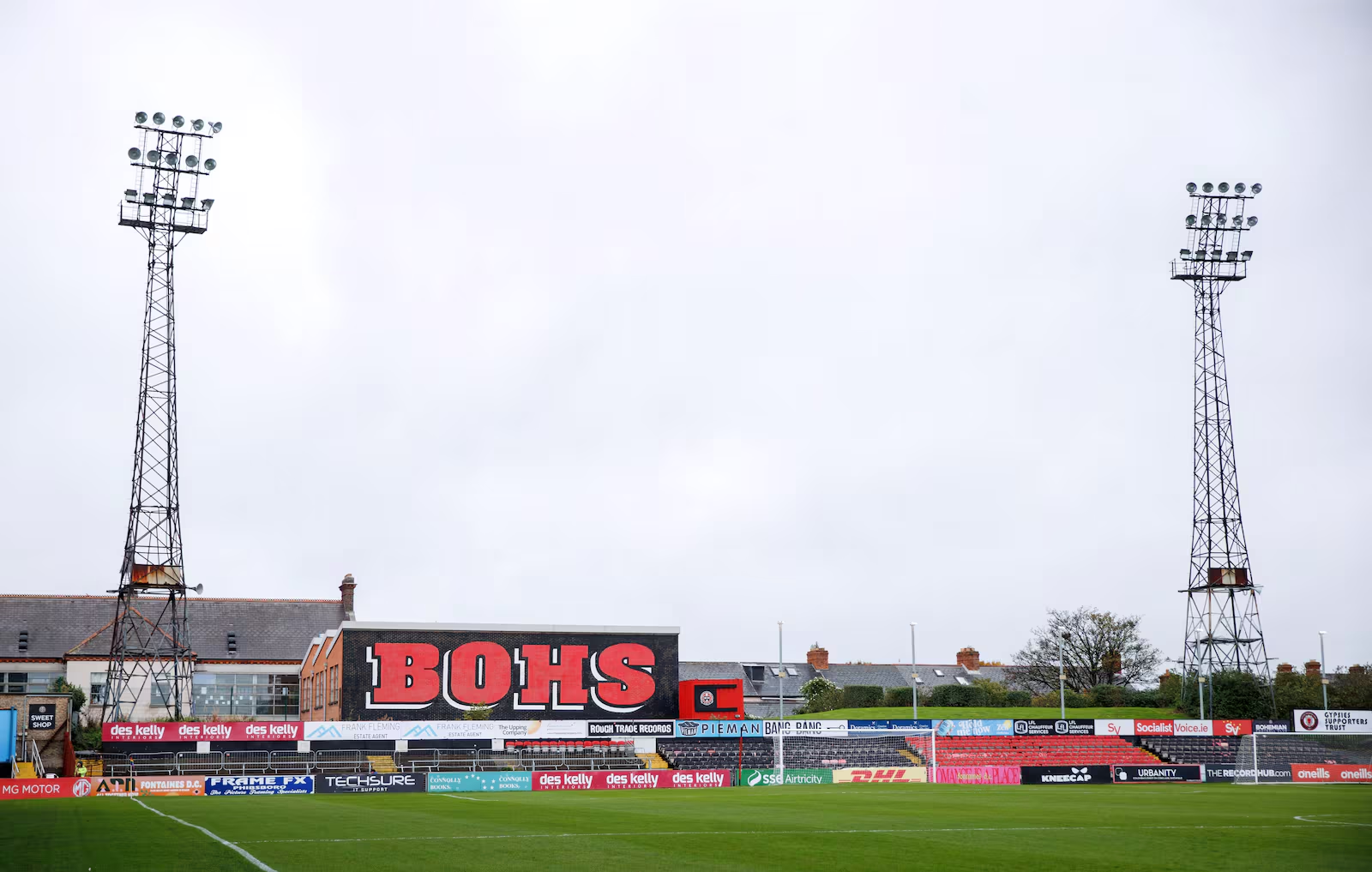
    Dalymount Park football stadium in Phibsborough, home to Bohemian Football Club, faces problems with its redevelopment again. 

    The cost of redeveloping the Dublin pitch has more than trebled since Dublin City Council (DCC) bought the stadium a decade ago, reaching as much as €63 million. On top of that, the construction of the stadium is expected to be delayed by as much as two years. 

    In 2015, the council purchased the sports ground from Bohemians for €3.8 million. The following year, it unveiled plans for a new stadium costing an estimated €20 million. 

    In the same year, DCC purchased Drumcondra’s Tolka Park, home to Shelbourne Football Club, with the goal of selling the property to raise money for Dalymount’s renovation into a facility for both teams. 

    However, following a campaign by Shelbourne supporters to maintain the ground, it subsequently modified its plans regarding Tolka Park. 

    The council agreed in 2022 to abandon plans to rezone Drumcondra’s stadium for housing and to redevelop Dalymount Park as a standalone project. 

    In February 2024, planning permission was granted for Dalymount’s demolition and reconstruction, with a new 8,000-seater stadium the aim for the redevelopment. 

    One of the entrances to Dalymount Park football stadium, home of Bohemian Football Club (picture taken by Patryk Goron)

    At that point, the project’s total cost, which included team facilities, club offices, a bar/function room, and community facilities had increased to over €40 million. The cost had again risen to €56.6 million by the end of the previous year when the council released its capital plans for 2025-2027. 

    New estimates, submitted to municipal councillors last Monday, suggest the cost has reached €63.75 million.  

    The council has received €25.6 million in government funding, an additional €2.6 million from levies paid to the municipality, €1 million from the long-term lease of Tolka Park back to Shelbourne FC, and €500,000 from UEFA. This results in a gap of over €34 million. 

    Around €25 million will come from government funding but Dublin City councillors have now approved the borrowing of €34 million to get the project under way. Repayments will be “partly funded from the annual rental income, match day revenue and non-match day revenue,” the council said. 

    It is expected that work will begin around the end of 2026 or early 2027, with the reconstructed stadium opening in time for the new League of Ireland season in February 2029. 

    Bohemian FC praised the council’s ruling in a statement, calling it “the final step in a process that began with DCC acquiring Dalymount exactly 10 years ago.” 

    The borrowing, along with government funding, “will allow for the historic stadium to be fully redeveloped and serve the people of Dublin and beyond long into the future.” 

    Councillors questioned if the stadium’s capacity could be extended to accommodate European football games, whether there was a business plan for the stadium’s operation, and how the project’s cost could be kept within budget. 

    Don Daly, the Council’s Capital Projects Manager, stated that Bohemian FC’s decision to have terraces for standing was one of the reasons the stadium could not be constructed to category 4 standards, while Richard Shakespeare, CEO of Dublin City Council, stated that it would require “a whole different level of pain financially” to make the stadium eligible for hosting European games. 

    Additionally, Mr. Shakespeare stated that while the stadium’s operational elements are still being worked out, the predicted costs have “a whole range of contingencies built into it” and he expressed confidence that the project will be completed within the allocated budget. 

  • Bleeper – the business behind the bunkers

    Bleeper – the business behind the bunkers

    Cycling is taking over Dublin – everywhere you look there’s commuters whizzing through the streets, young people on rented bike shares, and parents cycling with more children than you could ever have imagined fitting on one bike. Bike share companies have become increasingly popular in recent years, and in Ireland especially, small independent companies dominate the market. Even with the surge in popularity of cycle, it’s harder than ever for small companies to stay afloat. So that begs the question – how do you make yourself stand out?  
    One bike share company is using vibrant marketing and really tapping into the joy of cycling to promote the sustainable lifestyle. And even Dublin City Council has noticed. 

     On Oct 16, the council launched the BikeBunkers scheme, a scheme to install secure bunkers so Dublin City residents can safely store their bikes – making cycling more accessible to people living in apartments or with limited space. The BikeBunkers are being run with the bike share company Bleeper Bikes.  

    Bleeper’s BikeBunker promotional image – drawing by Emma Dutton

    Bleeper’s bikes – the white bikes with the purple Payzone logo on the side – operate in Dublin City, Fingal County and Dun Laoghaire Rathdown. They were the first bike share company to hit the Irish market – the independent company was set up 2017 and the first bikes were available to rent in 2018.  

    Kiernan Ryan, Bleeper’s head of marketing said “Hugh Cooney, our founder and current CEO, he had been living and working in China for a few years in the 2010s and he saw how popular stationless bikes were in China and saw that they were coming.” 

    After returning to Dublin, Cooney was inspired to take introduce stationless bike sharing to the Irish market. He began setting up company. The business plan was simple – they place their bikes all around the city and using the app customers can unlock their electronic locks and pay to rent the bike for a short period of time.  

    Since the bikes hit the streets in 2018, they’ve expanded their business model. “From a business perspective, we also do bike leasing now. It’s kind of a subscription e bike service. So, you sign up for your own e-bike, depending on what model it is, it’s between 20 and 40 euro per week. And then included in that subscription fee is any maintenance or repairs, replacements for that bike. So, if anything happens to your bike, you can just come back to showroom, swap out the bike, or our technicians will fix it,” said Ryan.  

    In the past year, they’ve heavily leaned on their unique marketing to drive business. “Recently we’re really tapping into the fact that cycling is one of the most purely joyful things you can do in your day-to-day life. Everyone knows there are difficulties with cycling, whether it’s infrastructure theft or danger from cars. But fundamentally being able to hop on a bike and cycle around the city, there’s a basic joy to that, and that’s something that we’re emphasising through our brand,” said Ryan. 

    Bleeper has been relying on colourful hand illustrations in their marketing, kicking against grey drab stock images and generative AI. “It is going against the grain, because outside stock imagery, there’s also this rise in generative AI imagery, and we don’t really see that as part of our identity, particularly given the environmental and emissions concerns around AI,” said Ryan.  

    “Our whole business model is about reducing emissions through cycling, and you know how much energy a single AI image can create so it doesn’t make sense for us,” said Ryan. 

    As a small company with only X employees, they are shaped by their employees’ talents. “We have skills within our workforce, and we’re really happy to use them. So we have a great employee who is very good at illustrations and hand drawings, and we’re supporting that,” said Ryan.  

    Bleeper’s promotional images – drawings by Emma Dutton

  • ‘It’s a disgrace at present’ – Dublin Councillor Welcomes Controversial Redevelopment Plan 

    ‘It’s a disgrace at present’ – Dublin Councillor Welcomes Controversial Redevelopment Plan 

    By Liam Murphy 

    Dublin Councillor Nial Ring has welcomed An Bord Pleanála’s decision to approve Hammerson’s controversial redevelopment plan, calling Moore Street’s current state a disgrace.

    This comes days after An Bord Pleanála’s approval of a highly debated plan that will see a €500 million redevelopment undertaken between Moore Street and O’Connell Street. 

    The UK property group first made applications for this redevelopment in summer 2021, with approval following just seven months later in January.

    However, appeals were made to the board and Dublin City Council by a number of Moore Street preservationists, campaign groups, and businesses, which caused for more than two and a half years’ worth of delays.

    “I see huge benefits of this project for the local area,” said Councillor Ring, who, along with being a member on the Moore Street Advisory Group, represents the North Inner City electoral area.

    “Not only in preserving the history and heritage of the street, but also in bringing Moore Street back to life. It is a disgrace at present.”

    The plans, made up of three applications, include the demolition of several buildings, the construction of a nine-storey hotel, the development of a public gallery and café, and the development of a public square – plans which are allowing Hammerson up to 12 years construction on site. 

    A generated image of Moore Street post-Hammerson development – Photo: Dublin Central / Hammerson 

    The An Bord Pleanála decision and announcement coincides with the 10-year anniversary of campaign group ‘Save Moore Street from Demolition’, who have gone on to receive over 380,000 signatures opposing Hammerson’s plans.

    The group started in September 2014, when members Bróna Uí Loing, Vivenne Kelly, Diarmuid Breatnach and Mel Mac Giobúin met to begin a weekly presence on the street with a campaign table, leaflets, and petition sheets.

    “Moore Street is of huge importance, not just to Dublin, or Ireland, but to the world,” Breathnach told The City. “We have been here over 500 Saturdays. We talk to people, we take photographs, we hear stories – sometimes stories from people coming up with their parents when they were children, others tell us of them coming up to Croke Park for matches and coming home with bangers.

    “People have different views as to what we can do with the street,” he said. “Some of us think there should be small shops and stalls here, no chain stores. Any restoration work done should be done piece by piece so that there’s not a huge disruption to the street”.

    “The Hammerson plan envisages destruction of some buildings, a high-end shopping area, a street cut through the terrace and up to 12 years of building,” Breatnach said. “That would just kill any street market here.” 

    Diarmuid Breatnach, co-founder of the ‘Save Moore Street from Demolition’ campaign group – Photo: Liam Murphy 

    The National Monument buildings of 14-17 Moore Street are currently earmarked for a 1916 Rising Commemorative Centre with an estimated cost of €16.25 million.

    The building was originally due to open in 2016 to mark the centenary, before being pushed back to 2023.

    Work, however, has not yet started.

    “The National Monument site has approval for funding, and it is imperative that this be worked on immediately,” Councillor Ring said. “Now that this [An Bord Pleanála’s] decision is out, I think it will give everyone time to reflect and, in memory of the men of women of 1916, make sure that the work starts immediately.”

    “I have an interest in the project, not only as a local councillor, but my grandfather and his four brothers were in the GPO garrison,” Ring said. “It really distresses and depresses me to walk down the street and look at the national monument site, in particular, knowing that some people with their own agenda have managed to delay work on that site for many years.” 

    One of the many stalls on Moore Street – a street currently under threat of demolition – Photo: Liam Murphy

    Hammerson’s plan outlines potential for up to 2,500 jobs after the development, but those currently trading on the street aren’t as optimistic. 

    “The plan means losing my job,” Andrea, a jeweler who has been trading on the street for two years said. “While there may be jobs after the building, it will destroy our jobs during that time. I’m only new here, but there are people here whose family have traded for 100 years. No one will want to come to a market if there’s construction being done nearby.” 

    “Other than what it means to me losing my job, my trade, and my community, it’s also what it means for the people of Dublin,” she said. “Those people care about this street. This street’s history is retail.” 

    “I lived in Spain for quite a while and saw a lot of markets,” she said. “But I have never seen something like Moore Street. Here we have a street full of its background, culture, and history, but also a marketplace. There’s a lot of potential in this street and I don’t think it’s being used.” 

    “In what world does someone think it’s a good idea to erase all this history to put more shopping centres and hotels.” 

  • Cleanup in Ireland’s dirtiest old town

    Cleanup in Ireland’s dirtiest old town

    Watch Colm McGuirk investigate cleaning up the streets in Dublin

    According to work carried out by Irish Business Against Litter and An Taisce, the level of littering in Ireland reached a 13-year high last year. Of the 37 towns and cities inspected, the amount of litter increased in 24.

    With parts of Dublin ranked worst overall for litter volume and illegal dumping, community cleanup groups in the capital are a welcome sight. The City joined one such group as they treated a sports court in The Liberties area to a spring clean.

    “We’re aiming to do cleanups around Dublin within our 5k,” says Kathleen Reilly, referring to the allowed travel limit under Covid restrictions.

    Spurred into action by the state of the stretch of the Royal Canal near her home, Reilly’s friend Ciara Haughney proposed the group’s first cleanup in March.

    “I just got so down and disheartened looking at all the trash in the canal,” she says. “Especially when you see nesting birds and swans trying to make a nest, and they’re picking up litter with their beaks. It’s just really depressing.”

    After being supplied with litter pickers, bags and gloves by Dublin City Council, Haughney put the word out to friends in the area, “and surprisingly loads of them were like, ‘yeah it’s a disgrace, I really want to help.’”

    The success of the first cleanup effort encouraged Kathleen Reilly to set up an Instagram page, and more volunteers signed up.

    “Whenever you actually look,” says Reilly, “it’s very dirty. There’s a lot of litter, there’s a lot of dumping. It’s not pretty to look at. So it’s just kind of encouraging people to be looking after their city.”

    A number of factors connected to the Covid-19 pandemic have contributed to the recent spike in littering. Firstly, restrictions on indoor activities have meant a massive increase in outdoor recreation, where not everyone, it seems, pays the appropriate respect to the surroundings they’re enjoying.

    Another factor is the deluge of disposable containers produced by a shift to a takeaway model for restaurants, bars and cafes, while PPE equipment also featured high up on An Taisce’s list of most common litter items.

    How rubbish! An image of torn bin bags with their content scattered across the pavement. Photo by Colm McGuirk

    Cleaning up the streets during Covid-19 has brought its own unique challenges for councils.

    “We’ve broken our [street cleaning] crews into pods,” says John McPartlan, Dublin City Council public domain officer. “If someone is sick or is a close contact, you lose that person; you can’t take anybody from another pod to make up for it.”

    McPartlan also explained the rationale behind the positioning of bins in the city – many have suggested there aren’t enough around.

    “The rule of thumb for a bin is that the area has to have heavy footfall or else have food outlets like chippers or takeaways, sandwich shops, that type of thing. Where someone comes out and eats their food and then wants a bin. We don’t put bins in housing estates, or quiet streets.

    “A lot of the parks only have bins at the entrance to the park. The workers in the park are there to maintain the park and then the waste management function is to empty the bins. But you won’t have vehicular access into the parks, which is generally how we empty bins; we send the side loader around. But we do try to put as many bins in heavily used areas as we can. We’ve started putting out beach barrels now in these locations [that have recently become popular for outdoor recreation].”

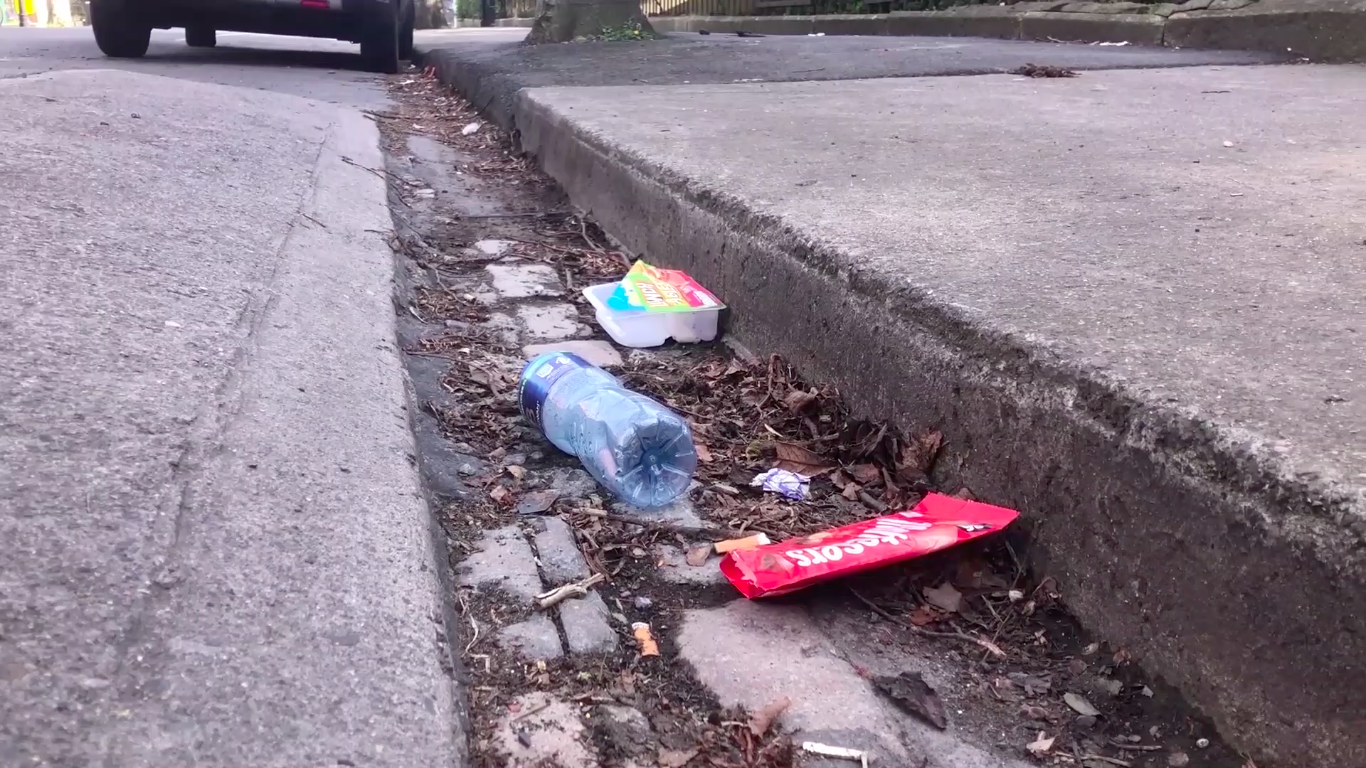
    Today’s snack, tomorrow’s problem? Photo by Colm McGuirk

    To date, Haughney and Reilly’s group have done six cleanups and counting, and anyone can join in; look for Make Our Streets Clean on Instagram if you’d like to get involved. The floor is open to suggestions on where to tidy up next – the scene of today’s mission is beside the home of one of the volunteers.

    Alternatively, search online for a similar group near you, or ask your local council for litter-picking equipment.

  • Roll out the carpet: Dublin city’s cycle lanes get a scale and polish

    Roll out the carpet: Dublin city’s cycle lanes get a scale and polish

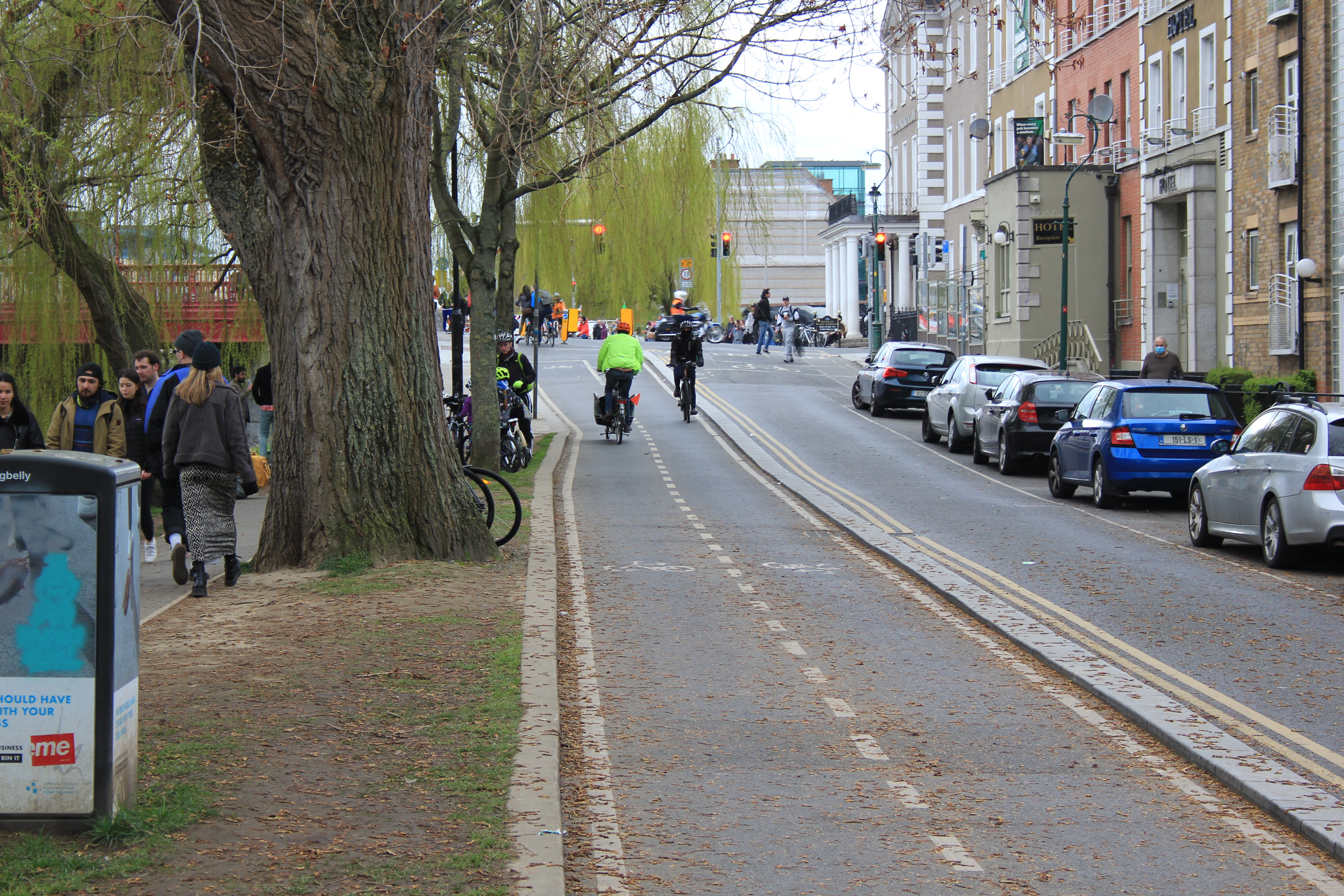
    Double cycle lane along the Grand Canal, photo by Mario Bowden

    Dublin city centre sits still and quiet these days. Traffic is noticeably tamer, with less gridlock traffic at rush-hour. For cyclists, this means less jostling and narrow manoeuvring through buses and cars. A bit of breathing space.

    Certainly there are fewer people cycling in to work too – as people shift to working from home. But the bike is still in-motion. For some it’s a mode of work – takeaway drivers and couriers are still zipping around. For others it’s a form of escapism: people getting out and about in the sunshine, others doing ‘wheelies’.

    Some are opting for the bike in order to avoid public transport too. Indeed, this trend is not unique to the current health crisis – people were encouraged during the 1918 Spanish Flu to get peddling.

    New Cycle Lanes

    With the lack of footfall in the city centre since the first lockdown, space became time. There was time for Dublin City Council (DCC) to implement various new and distinctly designated cycle routes across the city.  

    “I don’t think anyone would say cycling has been well provided for on Dublin city streets”

    Ali Grehan

    Some of the new cycle lanes across the city include the implementation of the the Liffey Cycle Route along the North Quays, contraflow lanes on Nassau Street, and the more recent route up O’Connell Street Upper and North Frederick Street. All of these are provided with bollards and black and white ‘orcas’ to segregate cyclist traffic from cars, buses and trams.

    “The new cycling lanes are still a work in progress,” says Ali Grehan, Dublin City Architect at DCC.

    Grehan continues: “They are much needed. I don’t think anyone would say cycling has been well provided for on Dublin city streets, particularly heavily trafficked ones – so in that sense they are successful in that they’re making necessary improvements.”

    While the quick thinking of DCC has been a positive for the city, it is not without its pitfalls. For instance, the Nassau Street contraflow lane suddenly stops at Dawson Street, forcing cyclists to merge with traffic suddenly – not to mention Luas tracks – at one’s peril, with any false move.

    The implementation of cycle lanes is not exclusive to the city centre either. Griffith Avenue on Dublin’s Northside has seen a fully segregated lane being rolled out across parts of its 4km stretch from Glasnevin to Marino. In May 2020 the Phoenix Park closed off sections of its roads to cars for the summer months – creating more space for people to mill about on their bikes.   

    On the Continent  

    European cities have always been miles ahead of Dublin when it comes to cycling infrastructure. But, we are not alone in terms of cities that took the current opportunity to shift the emphasis to cycling – Paris being the most prominent.

    It’s estimated that Paris’s cycling population grew by 65% in 2020 – significantly decreasing the CO2 emissions normally emitted from traffic.  Paris authorities responded to this increase by constructing more cycle routes, and further expansion of its bike scheme.

    “The problem is, while you can look at Copenhagen or Amsterdam – [which have] great cycling infrastructure – it’s difficult to transpose one city’s approach to another,” Grehan says.

    “Dublin has its own particular physical and cultural context and any initiative has to understand and respect this. It’s a complex issue. An example is Dublinbikes. There was a general expectation among commentators that the system would be vandalised. People were surprised when there was virtually no vandalism and Dublinbikes became very successful, very quickly.”

    The full extent of the success of Dublin’s cycle lanes remains inconclusive as the city remains less active than in normal times, Grehan concedes. But with smarter innovation and progressive steps made by campaign teams and authorities, a change to Dublin’s road culture is being paved.

  • How has the Covid-19 pandemic changed cycling in Dublin City?

    How has the Covid-19 pandemic changed cycling in Dublin City?

    Since the start of the Coronavirus pandemic, people have looked for alternative methods of travelling to avoid busy public transport. Eibhin Kavanagh investigates how the pandemic is affecting cycling in the city.

    Is cycling in Dublin City safe? Photo by Eibhin Kavanagh

    With our movements once again restricted, people in Ireland are limited to travelling within 5km of their homes. Walking and cycling have become a more popular means of exercising as a result of gyms closing and sporting events being cancelled.

    In the last ten years, Dublin has seen an increase in the number of people cycling. A number of bike share schemes have become well established. However, 2020 has seen an exponential increase in cyclists, which Dublin City has had to accommodate. This change, due to social distancing restrictions, means more space is required for both pedestrians and cyclists to make their way around the  city.  

    Councillor Michael Pidgeon talked to The City about the recent changes related to cycling in Dublin City.

    “In some ways I think the people are ahead of where the city is,” Pidgeon said. “We know that outside of peak hours there are now more people cycling than there were at this time of the year last year; there’s been a huge increase.”

    Dublin City Council projected  a 200% increase of cyclists in Dublin City from 2019 to 2020.This would be an increase from 13,131 to 39,000.

     2019 FiguresLikely Future ChangePotential Future Figures
    All Public Transport116,28780% Capacity Reduction30,000
    Car57,985Approx. 30% reduction41,000
    Taxi2,661Assume 30% reduction1,900
    Walk24,691Target 100% increase50,000
    Cycle13,131Target 200% increase39,000
    Goods983No change1,000
    Motorcycles1,485No change1,485
    Total (persons)217,223 164,385
    Source: Dublin City Council 

    Source: Dublin City Council 

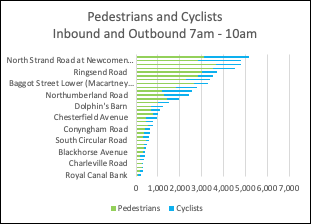
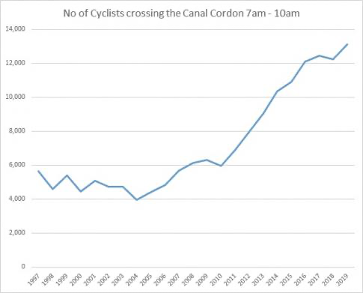
    The Canal Cordon Count was analysed by Dublin City Council to determine where the greatest demand for walking and cycling was recorded. The table below shows the number of people crossing the canal cordon (both directions) during the morning peak period from 7am to 10am in November 2019.

    Source: Dublin City Council 

    From 1997 to 2019, the number of cyclists crossing this cordon heading into the city centre between 7 am and 10 am increased by 133%, from 5,628 to 13,125.

    The number of cyclists remained between  4,000 and 6,000 between 1997 and 2010 before increasing by approximately 15% year on year until 2015 when the increase slowed up until 2017.  There was a small decrease in 2018,  but cycling numbers increased by 7.3% in 2018 and 2019. 

    Source: Dublin City Council 

    According to research conducted by the Road Safety Authority, 4 in 5 cyclists are injured on urban roads. More cyclists are  injured during morning and evening commutes. Of all collisions involving another vehicle – 4 in 5 cyclists are injured by cars. 1,056 cyclists were injured in collisions in 2018.

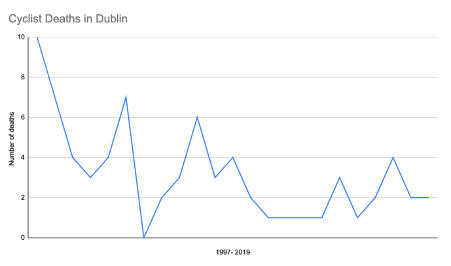
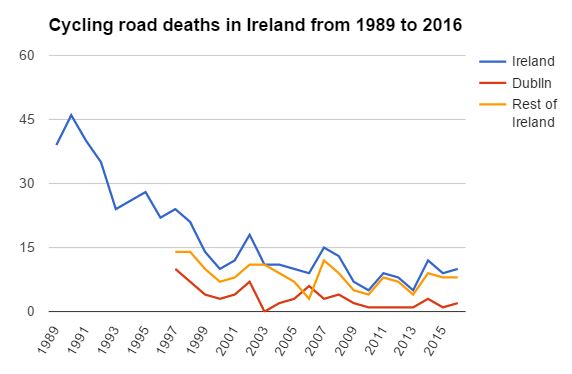
    In Dublin, the number of cyclist deaths since 1997 has remained relatively low with a slight increase in 2017, according to figures collected by the Road Safety Authority.

    Image Source- Irish Cycle.com

    Dublin has over 120 miles of cycle routes. While changes have been ongoing to improve cycling infrastructure in the city, especially since lockdown in the spring, the demand is high for safe and accessible cycling.

    “It felt like at the start of the pandemic there was a real understanding that we needed to take more space for cycling to encourage more people to do it, but it feels like that momentum has dropped a bit,” said Pidgeon. “So, I think that we need to get that going again.

    “In terms of infrastructure, I think the big changes we have seen are some of the temporary measures along the quays, particularly along the northside quays.”

    Some of the Cycle Safety interventions introduced since April include the installation of Nassau Street contra-flow cycle track from Clare Street to Dawson Street, the partial installation of key sections of the Interim Liffey Cycle route, removal of on-street car parking from Inns Quay and Ormond Quay, and a section of work from Church Street to Ha’penny Bridge, according to Dublin City Council.

    Dublin City Council also discussed other plans to ensure safe cycling in the city, including the reduction of the number of traffic lanes to accommodate protected cycling facilities on both sides of the road, while maintaining a balance for other required services. While there have been major changes made within Dublin City Centre to ensure safe cycling, other parts of the city have yet to see changes that will make cycling accessible and safe.

    “One of the things is to start looking at the urban villages, so instead of just focusing on the very core city centre, you would be looking at areas like Inchicore, Rialto, Stoneybatter, Phibsborough, Rathmines,” Pidgeon said in relation to making cycling consistent for everyone.

    “What we seen in the pandemic is that people are happy enough to stay within a few kilometers of where they live, so we shouldn’t just be designing a cycle lane with a view that will just take office workers from the suburbs to the city centre, because that’s not what the demand is right now. That’s important, we should definitely do that, but it will have to also be about making sure that local routes around your home are safe.

    “There’s still a lot to do, but equally I’d like to say that cycling in Dublin City is safe. There’s a perception of danger that I don’t think is entirely there. There’s a lot the city needs to do to feel a lot safer and be safer with segregated lanes, but if anyone’s considering it, I’d say just ask a friend who does cycle regularly and they can show you some good routes give you some tips and you’ll be up and running in no time.”

  • What a waste – A rubbish situation on Dublin streets

    What a waste – A rubbish situation on Dublin streets

    By Mark Donlon

    Dublin City Council have 3,200 bins in operation within its jurisdiction.  Of these bins, there are none which cater for waste other than solid rubbish.

    The figure of 3,200 bins is an approximation based on the number of bins Dublin City Council (DCC) say tend to be in operation at any one time. Of that total number, there is an estimated 1,170 bins situated in either Dublin 1 or Dublin 2, the postal codes which represent Dublin’s North and South inner city respectively.

    According to Simon Brock of DCC’s Waste Management Services, there is no segregated litter bin system in place in these areas.

    Photo Credit: Geograph.ie

    “The number of City Centre facilities for waste disposal other than solid rubbish is around the 100 mark,” explained Brock. “Of those facilities, the vast majority would be bring centres and bottle banks at civic amenity sites.

    “Segregated bins for rubbish disposal of all types were trialed a number of years ago with no success and then last year another trial was carried out with segregated bins placed in locations on Wolfe Tone Square and South King Street, but again it didn’t work.”

    The most damning culprit for the trial system was one which has been running the gauntlet in recent years. “In the case of 2018, coffee cups were the biggest contaminant,” said Brock.

    Photo Credit: Wikimedia Commons

    Despite the unsuccessful attempts to combat inadequate city waste disposal, Dublin City Council plans to make another attempt at solving this problem come 2020. They also plan to tackle the amount of waste from the city going to landfill.

    “Roughly 10% of all waste collected in the City Centre ends up in landfill,” said Brock. “That’s a figure we always want to decrease.”

    So what is the message from Dublin City Council?

    While the council must devise a more simplistic improvement which makes correct waste disposal easier for the urban population, the urban population also must react accordingly and make proper use of improved facilities.

  • Dublin City Council car clamping yields €2.6 million in fines

    Dublin City Council car clamping yields €2.6 million in fines

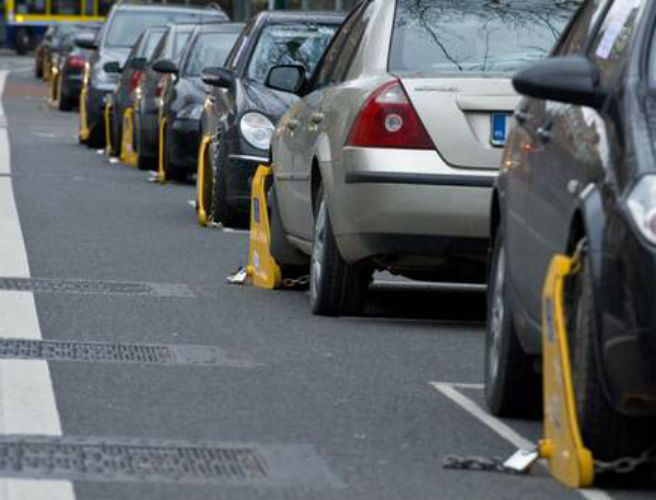
    Dublin City Council (DCC) earned over €2.6 million from clamping release fees during the first nine months of 2018, it has emerged.

    Figures released to thecity.ie show that DCC handed out 33,799 parking fines between January 1st and September 1st, 2018.

    With the standard fine for illegal parking in Dublin City set at €80, the council collected an estimated €2,647,840 but offered refunds or partial refunds on 929 occasions leaving the total sum of fines collected for the period at 2,629,600.

    The southside features more prominently within the top ten clamping hotspots in the capital, with the council keeping a watchful eye on the city’s busiest streets.

    Merrion Square is the city centre location where vehicles are most likely to be clamped, with 1,062 fines issued in this area, totalling to a sum collected of €84,960.

    Fitzwilliam Square proves to be the second most notorious clamping hotspot, with 625 offences committed and €50,000 claimed in fines.

    Mespill Road
    Mespill Road // Google Maps

    Other busy southside spots include Mespil Road (595), South Circular Road (544), Burlington Road (407), Waterloo Road (433) and Hatch Street (376).

    Across the Liffey, Gardiner Street Upper and Lower (426) proved to be the hotbed of northside clamping.

    Ormond Quay (297) and Parnell Square and Street (combined 393) make up the remainder of the top ten.

    Gardiner Street
    Gardiner Street // Google Maps

    Clamping appears to be rare on some of Dublin’s best-known streets, with O’Connell Street (0), Grafton Street (19), Dame Street (12) and Henry Street (5), registering few offences.

    The most common reasons for fines include: no valid paid parking (7,638), pay and display tickets expired by more than ten minutes (6,178), parking in permit-only areas (4,755), loading bay offences (2,440), parking on footpaths (1,874), parking within five metres of a road junction, (1,245), and parking on a double yellow line (1,035).

    Medical emergencies and compassionate cases make up the bulk of successful appeals, many of these in Parnell Square, which is adjacent to the Rotunda Hospital, one of Europe’s busiest maternity hospitals.

    On four occasions, gardaí on duty appealed fines and were successful in three of these appeals. One officer was clamped and fined for not displaying a parking ticket at Seafort Terrace in Sandymount.

    Top ten clamping hotspots in Dublin City – the number of fines

    Merrion Square – 1,062, North (182), South (412), East (86), West (382)

    Fitzwilliam Square – 625, North (317), South (182), East (53), West (73)

    Mespil Road – 595

    South Circular Road – 544

    Waterloo Road – 433

    Gardiner Street Upper (90) and Lower (335) – 426

    Burlington Road – 407

    Parnell Square (288) and Street (105) – 393

    Hatch Street– 376

    Ormond Quay – 297

    Appeals

    Total – 1764                                           Refund (50%) – 456

    Refund (Full) – 473                              Unsuccessful appeals – 835


  • Pyrite remediation works finally begin

    Pyrite remediation works finally begin

    After years of delays and hardship, progress is being made repairing and refurbishing homes in the Carleton House and Belmayne area of Dublin which were found to contain pyrite damage upon completion.

    Buildings in these areas form part of what was a widespread scandal involving the substandard construction of a large number of social housing projects and community facilities in Dublin.

    In a report to Dublin City Council’s (DCC) North Central Area Committee, Derek Farrell, Area Housing manager, stated that pyrite remediation works have just begun on two buildings in the Carleton Hall complex, with negotiations still ongoing for further works to be carried out on a créche and a community hall.

    Peter Finnegan, senior structural engineer at the architects division of DCC, estimated the cost of repairing the two buildings was €140,000. The approximate cost of repairs to the créche will be €400,000. No estimate for repair costs to the community hall were available.

    Seventeen houses in the Belmayne area are owned by DCC and require remediation works for pyrite. Mr. Farrell said that after protracted negotiations with the insurance company that covers these properties, the council has agreed works to begin on seven of the sites. Only one family has been relocated to temporary accommodation in order to facilitate the remediation works.

    Much of the delay, according to Dublin City Council and Derek Farrell, has been due to complex negotiations with insurance companies and the building developers of the affected properties. The council admitted that there was very little hope of recouping any of the cost of repairs from the developers of the property meaning that the council would have to cover these.

    In January of 2016 the estimated cost of the pyrite remediation repairs to properties in nine estates in Dublin was €7 million, this figure by the end of 2016 had jumped to €11 million. It is impossible to know what the total end cost of repairs to all affected properties will be. Many unforeseeable costs can arise over the course of a project of this nature, as well as added costs to known expenses, such as accommodation for families, DCC staff pay, sampling and testing of sites, surveying, the repairs themselves and so on.

    In a memo to DCC regarding recouping costs on the remediation works, Peter Finnegan wrote: “It remains open to DCC in most cases to pursue the original contractor under the contract. These disputes are known to require a lot of resources and time and the outcome is far from certain. I am aware of three disputes that have been pursued through the courts against the quarry that supplied the original stone and that these have been vigorously defended and appealed at great cost to all parties. The only remedial works for DCC currently being funded by an insurance company (Premier Guarantee) are those at Belmayne. DCC still incur some residual costs on these, which are being dealt with on a case by case basis.”

    Pyrite is a mineral more commonly known as fool’s gold. It has had many uses throughout history but now it is mainly used in the paper industry and in the production of sulphuric acid. When pyrite is present in building materials, and over time as these materials are exposed to oxygen, the material strains and weakens considerably, leading to cracks, structural damage and structural weakness.

    pyrite.png
    Pyrite leads to cracks and structural damage. Source Flickr

    Following the pyrite scandal, the Pyrite Resolution Act 2013 was signed into law in December 2013. This sets out the legal basis for the operation for a compensation scheme operated by the Pyrite Resolution Board. This scheme only applies to dwellings, but excludes dwellings owned by a local authority.

    By Chris Kelly

  • Palestinian Flag to Fly Over City Hall in “Gesture of Solidarity”

    Palestinian Flag to Fly Over City Hall in “Gesture of Solidarity”

    Green, white and black with a red triangle – the Palestinian tricolour is not typically seen above Dublin City Hall, however, there is a proposal to fly the flag there next month. Cormac Murphy explores the debate.

    (more…)