Tag: elderly

  • How Communities are Tackling Loneliness in the Elderly

    How Communities are Tackling Loneliness in the Elderly

    By Paul Lee

    A recent study from The Irish Longitudinal Study on Ageing (TILDA) in Ireland shows that about one-third of adults over 50 in the Republic of Ireland have experienced emotional loneliness at some point, with 7% feeling lonely often.  

    The research found that loneliness tends to decrease between the ages of 50 and 67 but rises again after that. 

    People over 75 are more likely to report feeling moderately lonely compared to younger groups. Factors like lower education, living alone, poor self-rated health, physical limitations, and chronic health conditions were linked to higher levels of loneliness. 

    Ireland is currently ranked number one in Europe for people suffering grom loneliness as of last year, with the coronavirus pandemic forcing generations to feel isolated.   

    Source: Institute of Public Health 

    Men above 65 years old saw a 25.1% increase in living alone, while women over 65 saw an 18.4% increase in the last six years. “The numbers are only going to continue rising,” said psychotherapist Maggie Molloy. 

    “I often deal with young people suffering from loneliness, so I know how bad it must be for the elderly who have far more reasons, most of which are out of their hands for feeling lonely.” 

    Last year The World Health Organization (WHO) declared loneliness to be a pressing global health threat, with the US surgeon general saying that its mortality effects are equivalent to smoking 15 cigarettes a day. 

    Anne Butler is a woman who knows the effects of loneliness all too well, inspiring her to commit her life to helping the most vulnerable in her community. 

    “Loneliness is a big issue for older people, and I don’t think the general public realises this enough,” said Mrs. Butler, who is the manager of Walkinstown Social Service Centre. 

    “It is dangerous to the elderly, we are social creatures that need to interact and get out of the house, but for some people that’s just impossible. It is heartbreaking because some of the faces around here were stuck in nightmare cycles of being upset, refusing to eat, or turning to drinking alcohol at home. It’s stories like these that make me so happy that we’re making an impact in the community and the bigger problem,” she says.  

    The centre takes in 60 people daily between lunch and dinner with some walking and others taking the centre’s bus that collects them from their houses. The centre charges €10 for transport, a meal, and bonus activities, whether that is a game of bingo, or a fitness instructor to get them exercising. 

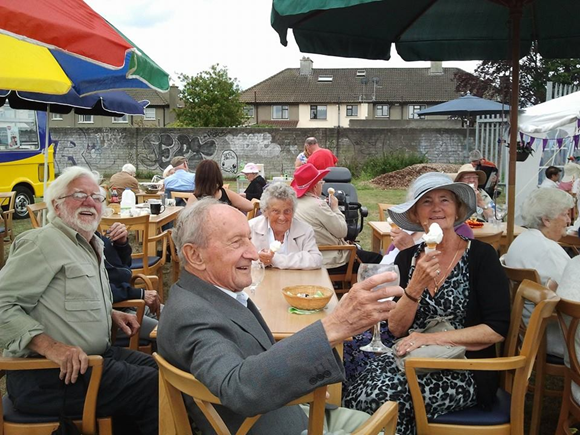
    Members of the centre enjoying the warm summer 
    Source: Facebook – Walkinstown Social Service Centre 

    Group day trips around the country are organised and voted on. Special events happen year-round with ‘Strictly Come Dancing’ watch parties and even live shows with staff members performing dances. 

    “I’ve been coming for the last few years now and it’s just brilliant,” said Monica Walsh, age 72. 

    “I’m not great on my feet any more so going out wasn’t really possible unless I waited for my kids to come and bring me out somewhere. The centre is great because I get a sense of independence back, able to go out on my own. 

    “I feel like a kid again, going out with friends, singing songs. This place has given me some of the best moments I’ve had in years. All the staff are true heroes.” 

    The centre’s staff is made up of half full-time workers and half part-time voluntary workers from the local area such as Amanda Nic Fhannchaidh.  

    “I don’t work on Thursdays or Fridays, and I’d just be watching the Telly all day, so it’s really a no-brainer for me to come here, have a laugh, and feel good about myself for helping out where I can,” said Amanda.   

    Both local schools, the Assumption Secondary School Walkinstown and Drimnagh Castle Secondary School, have included helping out at the centre as a part of the transition year experience. 

    “It’s the right thing to do, so it’s what the lads will do. It gives the school a good name in the community and a chance for the boys to see how far a little help can go,” said Drimnagh Castle Secondary School principal John Haze. 
  • ‘When we ignore the experiences of women, we do so at an enormous cost’ – The link between care and gender inequality

    ‘When we ignore the experiences of women, we do so at an enormous cost’ – The link between care and gender inequality

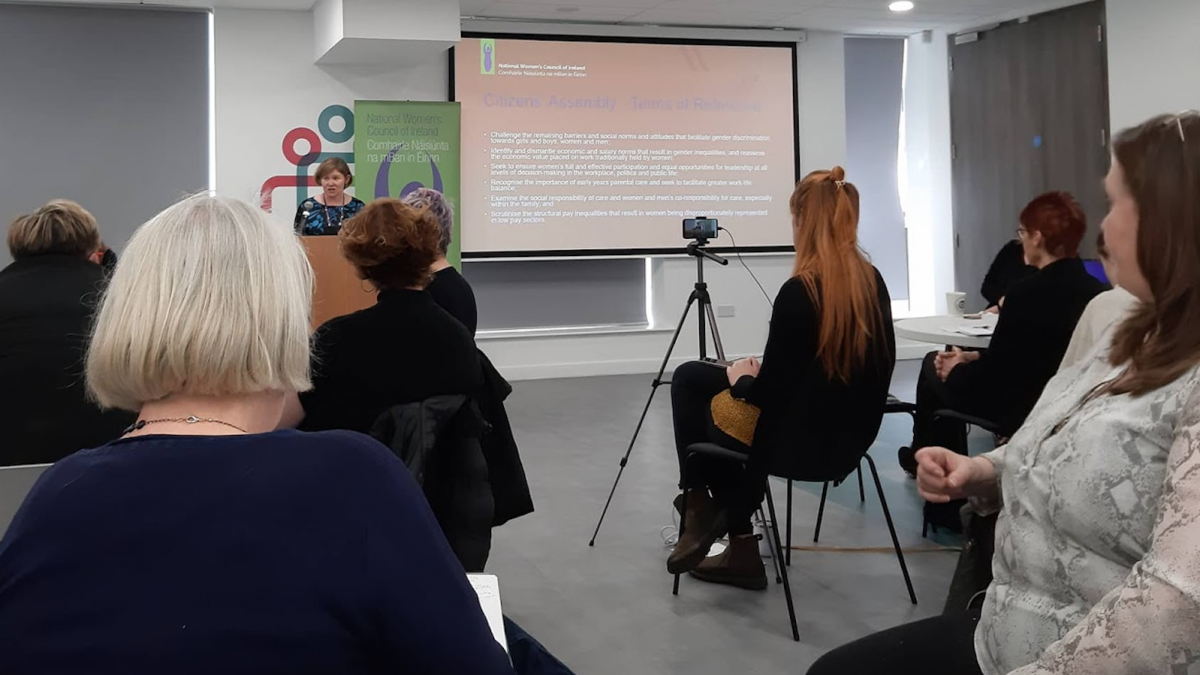
    Photo: Kate Brayden

    Altering Article 41.2 of the Irish Constitution is a crucial opportunity for women, according to the National Women’s Council of Ireland. The City.ie reporter Kate Brayden attended the organisation’s latest consultation on the link between domestic caregiving and discrimination, namely the gender pay gap.

    The National Women’s Council of Ireland held a consultation in preparation for the Citizens’ Assembly on Gender Equality just days before the General Election — with care, economic inequality and leadership proving the dominant themes in the discussion.

    Around 50 members of the NWCI were present at the Irish Human Rights and Equality Commission, including migrant women, people with disabilities and representatives from the Traveller community.

    Sarah Benson and Orla O’Connor, chairperson and director of NWCI respectively, both spoke about the changes that are needed in Bunreacht na hÉireann – which was drafted in 1937.

    Article 41.2.1 states: “In particular, the State recognises that by her life within the home, woman gives to the State a support without which the common good cannot be achieved.”

    Article 41.2.2 states: “The State shall, therefore, endeavour to ensure that mothers shall not be obliged by economic necessity to engage in labour to the neglect of their duties in the home. ”

    In 2015, the Constitutional Convention was asked if Articles 41.2.1 and 2 should be removed from the Irish Constitution.

    According to the NWCI, Article 41.2 is an opportunity to alter the definition of women in Irish society, as well as to revolutionise how care is valued in our society.

    At the 2015 Constitutional Convention, 88 percent of Citizens’ Assembly members favoured deletion of both clauses, but 98 percent stated that they should be replaced by a gender-sensitive text to include other carers in the home. Almost two-thirds said the replacement clause should also include carers outside the home. They also held that carers should not be forced to work outside the home due to economic necessity.

    The need to recognise the power of care in fulfilling essential economic and social functions was stressed by Sarah Benson in her opening remarks of the day. Legislating for a comprehensive, affordable and accessible care infrastructure, supporting people at all stages of the life cycle, is the primary goal, she said.

    “From our consultations, while there’s no argument about the sexist language of Article 41.2, there are a lot more complex issues which emerge which we felt warranted greater consideration,” Benson said.

    “The discussions around Article 41.2 move quickly to those very complex choices and challenges which many of us face every day relating to our understanding of family and home, the roles of women and men, of economic support for parents, work-life balance and the contribution of care and carers.”

    Members highlighted the need to focus on adequate provisions of support for carers and lone-parent families, as well as the goal of increasing investment in early years to one percent of GDP. 

    Developing a model of funding the care sector that ensures proper wages for the workforce, a quality service for children and affordable fees was an added goal for the proposed referendum that would be necessary to change the Constitution, as well as a statutory right for a broad spectrum of paid maternity, paternity, parental leave and carers leave. 

    The NWCI discussed the topic of universal pensions, considering the disruptions which occur once a care provider or parent must leave their original employment. 

    A right to home care and personal assistance for older people and those with disabilities was an added point, with Benson stressing that care work “is essential to women’s equality and the common good” and that men must increase participation in order to balance the workload of care  in Irish society:

    “One of the key challenges, is while there has been significant increase in women’s participation in the labour market, this has not been balanced out by a corresponding increase in the contribution of men to care work. Nor has there been an adequate state response to recognition of and investment in care work.”

    Women continue to carry out significantly higher amounts of unpaid work and care work. About 98% of those looking after the home or family in 2016 were women, according to Census data, and women also complete an average of 20 hours of weekly housework, compared to seven hours of domestic chores by men. 

    The situation is even more dire for lone-parent families. Almost 60% of lone parents  cannot afford to access childcare services, which is three times the rate of two-parent families. 

    Childcare costs in Ireland are the highest in the OECD for lone parents, recent statistics from Saint Vincent de Paul revealed, and 33.5% of lone parent families, the vast majority of which are headed by women, are at risk of poverty.

    “Article 41.2 includes a definition of family which does not reflect the reality of families in Ireland, nor the diversity of family life. It presumes a male breadwinner, a two-parent household where the woman stays at home, and it does not take LGBTQ+ families into account,” Benson added. 

    “We know that gender equality cannot be tackled without including economic inequality and poverty.”

    Sustained investment in public services and social infrastructure is crucial to mitigating the historical ongoing economic inequality, which includes the gender pay gap (currently standing at 14%).

    Roughly 60 to 65% of minimum wage workers are women. Addressing low pay by legislating to implement a Living Wage, benchmarking social welfare payments to a Minimum Essential Standard of Living and ensuring shared public resources are three key points of NWCI’s consultation proposal.

    “CEDAW (Convention on the Elimination of all Forms of Discrimination Against Women) has repeatedly criticised Ireland’s retention of the article in its current form,” explains Orla O’Connor.

    Mother caring for baby. Photo: Unsplash

    “They expressed concern at the persistence of stereotypical views, social roles and responsibilities of women and men in the family and in society at large.”

    The issue of leadership was mentioned numerous times throughout the consultation. To improve the leadership position of women, suggestions included which suggested increased gender quotas, a gender balance on all non-state Irish company boards and an entitlement to maternity/adoptive leave for women county councillors and women TDs. 

    “The nature of paid versus unpaid work has changed. Women need support to move in and out of paid work at different points in the life cycle,” O’Connor stated. 

    “Women are often caught between childcare, elder care and insufficient state support. The issue is impacting women at a far greater rate than men.”

    Orla O’Connor made sure to add that the NWCI hope to hold a specific and separate Citizen’s Assembly on the epidemic of violence against women.

    “We believe that this needs a deliberate, singular process if it’s to achieve real, actionable and deliverable outcomes, which are absolutely needed.”

  • Therapy dogs helping the elderly feel less lonely this Christmas

    Therapy dogs helping the elderly feel less lonely this Christmas

    By Amy Connaughton

    For many people, Christmas is their favourite time of year. It’s a happy time spent with family, friends and loved ones. Sadly though, for many elderly people, Christmas can be a tough time to get through. Nearly a quarter of the elderly do not look forward to Christmas because of loneliness and fears that it will bring back bad memories, according to research carried out by Age UK in 2014.

    The research suggested that the effects of loneliness increase during the winter months with a fifth of elderly people worried about not being able to go outdoors as much because of shorter, darker days and poor weather conditions. Age UK is the UK’s largest charity dedicated to helping everyone make the most of later life.

    One charity that is making a positive impact on the lives of the elderly in Ireland, is Irish Therapy Dogs. Irish Therapy Dogs was founded in 2008 with the aim of using pet therapy to provide comfort and companionship to people in long-term or daily residential care.

    Their mission is to provide physical, therapeutic and educational benefit to people, young and old, fit and frail, alert and impaired, in hospitals, nursing homes, day care centres, and schools.

    Today, more than 270 ‘Volunteer Visiting Teams’ make weekly visits to day care centres across Ireland.

    Owners and their dogs give one hour each week to visit their assigned care centre. Once there, they circulate amongst the residents allowing their dog to be cuddled, petted and played with.

    Research has shown that canine companionship brings a number of health benefits, such as lower blood pressure, lower triglyceride and cholesterol levels, as well as increased production of serotonin and dopamine.

    Humans have a basic need to touch and a dog fulfils this need. Stroking, holding and fussing over a dog helps reduce the sense of isolation and loneliness. The companionship of a dog can help to calm and soothe us, ease anxiety and boost our mood.

    “I get so much more out of it than I put in, it’s great. Ruby is amazing and she doesn’t even realise the joy she brings”

    Irish Therapy Dogs visit care centres and enrich the lives of people there by interacting with them. The dogs do not need any specialised training, but it is important that they are friendly, gentle, confident, patient and at ease in any situation. They must enjoy human company and be happy to be petted and handled. The suitability of both the owner and dog, working as a team, is subject to a formal assessment process.

    Orla Keogh, from Deansgrange in Dublin, has been volunteering for Irish Therapy Dogs for two years now. She visits Belmont Nursing Home for an hour a week with her dog, Ruby. Orla said: “I get so much more out of it than I put in, it’s great. Ruby is amazing and she doesn’t even realise the joy she brings.”

    Orla described how visiting the residents has such a great impact on their day: “Basically, even residents that don’t respond or speak, get so happy when they see Ruby. There’s one who’s deaf and dumb and she hates everyone, but she is obsessed with Ruby and when she sees me coming with the dog her whole face lights up.”

    Jane Connaughton who is the activities coordinator in Belmont Nursing Home sees first-hand the effects that the therapy dogs have on the residents. “The reaction the residents have is just great to see. Straight away when the dogs come in you can see their faces just light up and there’s a nice, happy buzz around the room.

    “Loneliness with old people is such a common problem and it’s very sad. A lot of residents here don’t have much family or don’t see their family very often.

    “Some of the residents love to pet the dogs and hold them but some of them are happy enough to just sit and watch everything that’s going on. Either way, everyone has a smile on their face and it’s really great.”

    Peata is another Irish charity dedicated to helping people reap the benefits of therapy dogs. Peata is a voluntary association established in 1996. Every year, they do a Christmas Carol Service in Christ Church Cathedral where there is a blessing of the therapy dogs.

    Jane said: “The residents really enjoy it. We sit right up at the front and there’s a part of the service where all of the therapy dogs go up to the altar to be blessed. The residents love seeing all the dogs right up close to them.

    “After the service, there is tea and coffee and mince pies and a chance for the residents to mingle with all the dogs.”

    Irish Therapy Dogs is a voluntary registered charity and is completely self-funded. Funds are raised by membership fees, donations, sponsorship, personal gifts and various fundraising events.

    If you would like to become a volunteer you can get in touch with the charity at 01 2189302 or you can visit their website at www.irishtherapydogs.ie