

Tag: elections

  • Studies Find That Media Framing Can Contribute to Online Harassment for Female Politicians 

    Studies Find That Media Framing Can Contribute to Online Harassment for Female Politicians 

    By Jessica Lee 

    In the digital age, politicians and the public have never been more accessible to one another. While social media can make it easier for politicians to reach potential voters, platforms such as ‘X’ and ‘Facebook’ have become breeding grounds for trolling and online harassment.  

    A report by UCD found that 73% of the Oireachtas members are experiencing abuse on social media regularly. 

    While politicians of every gender identity and background receive hate online, female politicians in particular are targeted the most by sexist and derogatory harassment.  

    It has been argued by academics such as Daphne Joanna Van der Pas and Loes Aaldering that the difference in the way male and female politicians are framed in the media is a contributing factor for the harassment women are subjected to online. 

    Research conducted by Utah State University found that media coverage of female politicians is primarily “focused on their background, family life and personality. Media tended to emphasise women candidates’ lack of viability, focusing more attention on the “horse race” or outcome-predicting aspects of their campaigns.”  

    The study also found that of the articles sampled, 13.6% of them contained reference to female candidates’ physical appearance – such as clothing, age, makeup and weight.  

    Source: Utah Women and Leadership Project  

    A 2019 study by Amanda Haraldsson and Lena Wängnerud notes that, “The media agenda follows male candidates’ political agendas more than female candidates and is more likely to question the chances women have of winning. Media frames, including trivialisation framing, and type of media attention – tabloid outlets for women and broadsheets for men – contributed to the media bias against female candidates.” 

    On the type of online abuse female politicians receive, Social Democrat councillor for Leixlip, Nuala Killeen said that “women are targeted about their looks and their age, it generally has nothing to do with our politics and more to do with misogyny.”  

    When it comes to male politicians, Councillor Killeen states that “they [men] are criticised for their politics and policies, not their appearance.” 

    Although she is “thick skinned” and rarely fazed by cruel comments, Killeen notes that negative media coverage as well as the personal nature of online harassment experienced by female politicians has led to women feeling discouraged about getting into politics or rerunning for election. “Women who are confident in their political experience and knowledge, who feel they can make a difference in their communities have seen the abuse other women have been subjected to and second guess if they really want to ensure the same thing.” 

    People Before Profit Councillor for Ballyfermot-Drimnagh, Hazel de Nortúin, has said that the rise in online misinformation and harassment will “make it very difficult for us to find female candidates willing to run in the future, particularly women of colour and from different backgrounds.”  

    De Nortúin added that councillors are “lacking resources when it comes to tackling online abuse” and are often subjected to “harassment about governmental issues which are out of our hand. People are angry at the government, which I understand, but we [councillors] in local politics have no say in what goes on in Leinster House… they are letting their frustration out on us.” 

    The type of political violence faced by Irish politicians based on gender. Source: Chr. Michelsen Institute 

    Research conducted by the Chr. Michelsen Institute found that female politicians are more prone to being subject to degrading talk and false rumours; in fact, they are 2.3 times more likely to experience this than men. Additionally, the false rumours that female politicians face are more likely to be of a sexual nature.  

    While male and female politicians across the political landscape experience trolling and abuse online, there has been a rise in incidents of verbal and physical face-to-face harassment taking place in Ireland. 

    Independent councillor for Fingal, Tania Doyle and her husband, were the victims of a violent attack by a member of the far right whilst out canvassing in their constituency. Doyle was punched in the head whilst trying to shield her husband, who was beaten to the ground and left bloodied and bruised after being kicked repeatedly. 

    Since the incident, Councillor Doyle has stated that she doesn’t know if she will stay in politics after the attack and has been questioning her decision to run.  

    With the increase in online and public abuse faced by politicians, a taskforce chaired by the former Garda Commissioner Nóirín O’Sullivan on safe participation in political life has been established to make recommendations about changes that can be made to ensure the safety of politicians, with a particular focus on protecting female politicians.  

    These recommendations include personalised security training and advice, and an opt-in social media monitoring service for political figures. Additionally, the taskforce also recommends that election candidates should not have to publish their home address due to safety concerns. 
  • ‘Everyone is invited to run, we hope it will pave the way for the future’ – Outgoing president of TU Dublin Students’ Union welcomes nominations for March election

    ‘Everyone is invited to run, we hope it will pave the way for the future’ – Outgoing president of TU Dublin Students’ Union welcomes nominations for March election


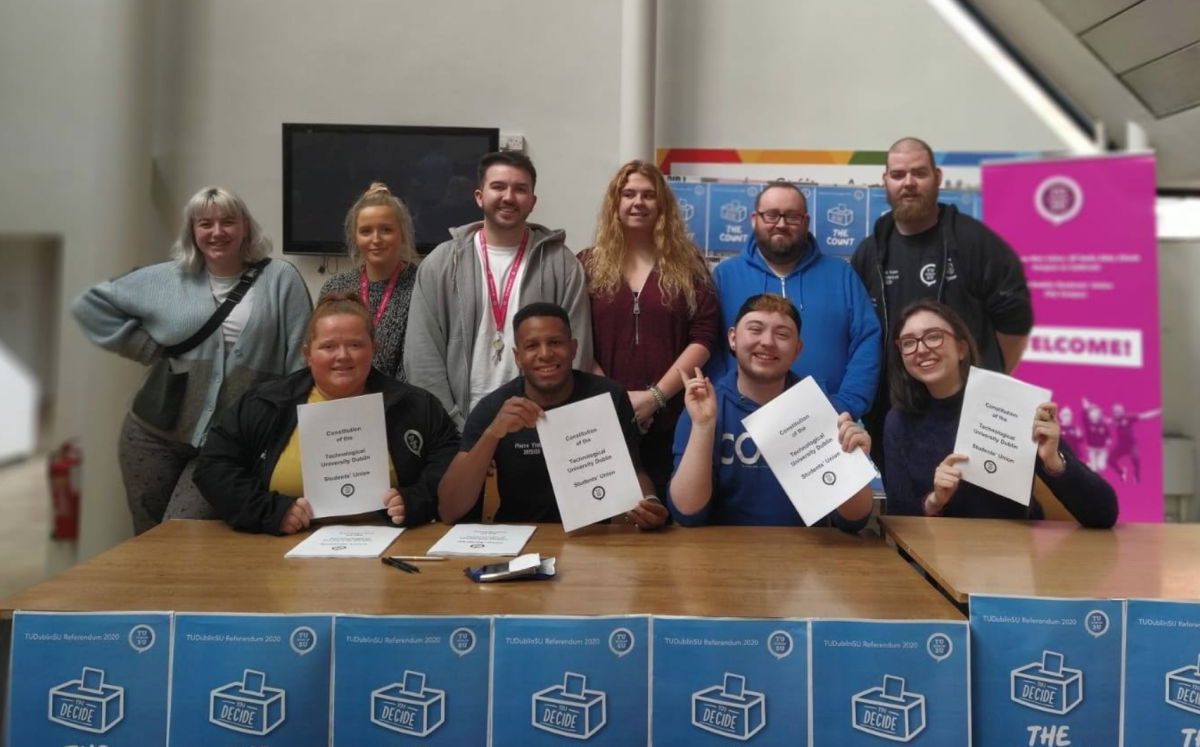
    TU Dublin SU at the count on February 21, 2020, at Grangegorman after the Referendum to amend the Constitution passed. Photo: Kim O’Leary

    Students attending TU Dublin are this March being invited to nominate themselves for full-time or part-time positions with the university’s Students’ Union for the 2020-2021 academic year. TheCity.ie’s Kim O’Leary sits down with outgoing TU Dublin Student Union president Pierre Yimbog to find out what the upcoming election means for the student body and the university itself.

    The last twelve months has seen a time of great change for our university, and on 1 January 2019, TU Dublin was formed by the amalgamation of three existing institutes of technology on the Dublin area- Dublin Institute of Technology (DIT), Institute of Technology Blanchardstown, and Institute of Technology Tallaght (ITT).

    Meanwhile, the Students’ Union was set up a mere eight months ago on 1 July following a referendum in February 2019, which saw the three existing unions merge into one single union.

    The Students’ Union is a representative body democratically elected by students each year, and its responsibilities are to provide representation and support for all students at both academic and non-academic level. 

    There are 23 elected officers in the Students’ Union who are here to represent students within the University and nationally. The officers are directly elected by students every year in the Annual Elections normally held in March. 

    There is the full-time officers, who are paid and full time elected representatives who normally would have graduated from their course upon taking on the role. The part-time officers are still full time students themselves and some have specific roles and campuses to represent. 

    After three years working for the student union at TU Dublin, its outgoing president Pierre Yimbog has seen the successful passing of two Referendums. 


    Pierre Yimbog at the count for the Referendum on 21 February, 2020.
    Photo: Kim O’Leary

    The first referendum last year saw the three existing student unions vote to merge into one union with an overwhelming YES vote of 95% and the second referendum in February saw a proposed amendment to the Student Unions’ Constitution.. Ultimately, the second referendum to amend the Constitution was officially passed on Friday, 21 February and the new Constitution is now in effect.

    In the aftermath of the successful Referendum and prior to the March Elections, Pierre said that the last year has been particularly busy for the Students’ Union.

    “It’s been a good year for us at the TU Dublin Students’ Union, it’s not been without its challenges like any role. Last year saw the three existing unions merge into one and now we are pleased that the Referendum on the amendment to the constitution has now passed so it’s been good overall.

    “The Referendum in February saw a unanimous YES vote from the students who voted with a great turn-out, there was great support and everyone went out campaigning. Now we’re hoping the March elections will ensure everyone has a say in how the Students’ Union operates,” said Pierre.

    A fully-united Students’ Union has been confirmed by a vote. Photo: Twitter

    Explainer: What was the 2020 Referendum?

    On February 19 and 20, the student body went to the polls at the various campuses across Dublin to vote whether or not to approve the amendments to the TU Dublin Students’ Union Constitution. The newly amended Constitution included a number of changes including;

    • Forming a legal entity that will allow funding for the Students’ Union to provide support staff to all officers and students, make services available across all the campuses and to ensure parity of service for all students.
    • The other major change is to reflect the move of 10,000 students to Grangegorman from Cathal Brugha Street, Kevin Street and Rathmines in September 2020. The four new College Officer positions proposed are Central Quad, East Quad, Aungier Street (including BIMM) and Bolton Street.
    • The other amendments were to refine the governance, transparency and accountability in the Students’ Union.

    How did we vote?

    3,501 votes were cast, and the result was a resounding YES for a new Constitution.

    On Friday 21 February, the ballot boxes were opened and counted at Bolton St. The total number of votes cast was 3,501 which exceeded the total required votes of 2,918. It is understood that the total valid poll was 3,489 due to 12 spoilt votes. Ultimately, it was a majority win for YES voters with a total of 3,352 votes while NO votes totalled just 137, making it a landslide victory for those in favour of the new Constitution. 

    As decreed in the new Constitution, the coming year will see the Students’ Union, already unified in principal and intent, create one legal entity as a CLG as TU Dublin prepares for the opening of the new Grangegorman campus.  Approximately 10,000 students will be moving from Cathal Brugha Street, Kevin Street and Rathmines to the new Grangegorman campus from September 2020.

    Pierre is certain that the new Constitution can only be a positive for the Students’ Union and student body.

    “This will ensure that we can work towards equal support services for all elected officers and most importantly an equal service for all students, no matter what campus you are based on,” said Pierre.

    However, Pierre confirmed that he cannot run again in the upcoming March elections as the term for a full-time officer on the Student Union is just one year, and the Constitution states that three years is the maximum in any full-time role. Pierre has already been President and Vice President for Education in DIT Students’ Union and those years are counted so his time is up.

    “The nominations for the elections opened on 27 February and will remain open until March 10, all of the details for those seeking to run for part-time or full-time Officer positions are on the Student Union website. Everyone can run in the elections and we hope it will pave the way for the future of the Students’ Union,” explained Pierre.

    How can candidates apply and what positions are open?

    The following are the positions any registered student can run for on the City Campus: President (Overall, Full-time paid),Postgraduate Officer (Overall, Part-time paid), Deputy President for City Campus (Full-time paid), Vice President for Education (Full-time paid), Vice President for Equality and Citizenship (Full-time paid), College Officer for Aungier St & Bimm (Part-time paid), College Officer for Bolton St (Part-time paid) and College Officer for Grangegorman East (Part-time paid).

    The outgoing Students’ Union Committee. Photo: Instagram

    To run in the elections, candidates must submit and fill out a nomination form, write a manifesto and include in the form, and get 100 signatures (full-time positions) or 50 signatures (part-time positions) from students and present into any SU office. Candidates must also provide a €20 refundable deposit to any SU office before 12pm on Tuesday 10 March.

    In addition, it should be noted that candidates running for election for Grangegorman Central College Officer must attend hustings in Kevin Street and Cathal Brugha Street, while candidates running for election for Grangegorman East College Officer must attend hustings in Grangegorman, Rathmines and Aungier Street.

    According to Pierre, the next important step for the Students’ Union in the wake of the successful Referendum is to negotiate the union’s funding with the University.

    “With such a strong turnout in this Referendum, the University should be in no doubt that students desire a strong and well-funded Union that truly works for them. Also, having a single union makes things easier to arrange funding but next year whoever is elected to the union will have to ensure that is maintained,”explained Pierre.

    So what is next for Pierre after his term ends as president of the Student’s Union? Pierre explained that he all ready has a degree in Law and is considering his options moving forward.

    “My initial plan is to maybe travel this Summer, to have a bit of a rest and see from there if I want to go out into the workforce or pursue further education.”

    Nominations for officer positions on the TU Dublin Students’ Union are now open until 12pm on Tuesday, 10 March. The Annual Elections are happening on 31 March and 1 April 2020.

    Students will find more details on the specifics of the different positions, how to run and how to conduct your campaign on tudublinsu.ie