Tag: emigration

  • Emigrated? How’s yer mammy?

    Emigrated? How’s yer mammy?

    Because I'm leaving on a jet plane, don't know when I'll be back again..
    Because I’m leaving on a jet plane, don’t know when I’ll be back again..

    Irish mothers are more likely to be depressed if their children have emigrated according to a new report by Trinity College’s Irish Longitudinal Study on Ageing (TILDA).

    The new report shows that the mental health of Irish mothers is suffering as a consequence of their children emigrating during the recession.

    It also shows that these mothers experience increased symptoms of depression and greater loneliness than mothers whose children did not emigrate.

    The researchers found, however, that with the exception of fathers aged over 65, fathers did not suffer an equivalent decline in mental health following the emigration of one or more of their children.

    In the year ending April 2006, 36,000 people had emigrated from Ireland, emigration numbers hit 89,000 in 2013 and are still rising.

    These high rates of outflow meant that a large number of TILDA participants saw their children emigrate.

    Dr Irene Mosca of TILDA says that the report shows the effect on those left behind:

    “Emigration is often discussed in terms of the people who leave, but our study shows that there are also real impacts on the people left behind.”

    “There is a narrative out there that this was a recession that impacted on young people, as negative equity and debt primarily affects young people,” said Alan Barrett of the Economic and Social Research Institute, who co-authored the study with Dr Irene Mosca.

    “But we have now identified a group of older people who have suffered a mental health difficulty as a result of the recession, because of the emigration of their kids… Mental health difficulties often develop into physical health difficulties, so the massive increase in emigration in recent years has public health implications.”

    Some Irish mammies who were left behind when their children emigrated spoke to The City about how they are coping.

    Margaret Hennessy saw her son hop the water to London in search of work as did Elaine Keoghan’s daughter, while Kathleen McCormack’s son James went further afield to Brisbane to work on the pipe lines.

    When Kathleen found out her son was moving to the other side of the world in search of work she said she felt “sad and broken-hearted. I knew I was going to be lonely. James and his wife, Ursula, were only supposed to be going to Australia for two years but that soon changed as they found good, well paid jobs and started a new life together over there. They are there almost four years now.”

    “I still miss them so much, especially now that they have just started their family over there. It was heart-breaking not being part of that. As any mother would I wanted to be there for my son on the birth of his first child, but physically I just couldn’t. I Skype them all the time but it’s just not the same as having them home”

    “Whenever I think about the huge distance that’s between us and all that he is missing out on, I just start to cry. I think it’s a maternal thing. Luckily, I have three other children at home, and grandkids too, so I am kept busy. I can only imagine what it would be like for a mother with only one child having emigrated, their whole life torn away.”

    Una Nannery, 53, took a different approach. With two of her sons gone to Australia she was fed up of being lonely and depressed so three years ago Una, her husband Eugene and their youngest son Ciaran packed up their bags and followed their two older sons, Brendan and Declan, to Melbourne.

    “‘The main influencing factor for our move was unemployment, as Eugene had no work for two years previous to our move and had no prospects of getting anything.  Also, the fact that both our eldest sons had already emigrated and were starting families here influenced our decision in a big way, we were stuck at home missing out on the most important time of our son’s lives and we missed them terribly.” So Una upped and left Ireland and hasn’t looked back since.

    “We are living in Melbourne now, in a lovely suburb called Ivanhoe.  There are many Irish over here for the same reasons as us.”

    So how does life on the other side of the world compare to home? “There’s a much better standard of living here in Australia. Eugene is working full time and on a good wage, I’m not working and we still are way better off. The weather is a huge plus also. Life here compared to life in Ireland is similar, in that during the week it’s the usual routine of work, school etc.  The main differences are work and the weather.” Una continues “Living day to day is similar here to Ireland.  Depending on the supermarket you go to and the brands. Meat is dearer here; chicken and lamb are a lot more expensive. However petrol is cheaper. Clothes and footwear are expensive.  Both eating out and alcohol, like home, can range from expensive to fairly reasonable depending on the areas you are in.  A pint of lager is $7.00 that would work out pretty similar to Dublin pub prices.”

    Speaking about the work situation Una says “There is plenty of work in the building, mining, and general outdoor work. Men seem to get work easy enough. It seems harder for women, but yet not as hard as at home. There are good agencies here, so the ladies get sorted after plenty of interviews and that, but can take 3 to 4 weeks.”

    Emigrating is a tough decision to make, no matter what age, says Una “Emigrating is ok if it is for the right reason, but right now it is the only option for many.  But yes, I would tell all young people to travel, as it really is the best experience and learning curve in any person’s life.  Ciaran is living proof, also the older boys. They love it here and have adapted so well. For me, well I’m just happy to have all my family together again.”

     

  • Fairytale in New York

    Fairytale in New York

    This slideshow requires JavaScript.

    With the recent trend of emigration and the resulting need for young people to feel connected to home, GAA can provide a vital and much needed foothold in a new country. Last month, Damien O’Connor was part of the Kerry team that won an unlikely New York championship, and the Laois footballer gives a unique insight into Gaelic Games overseas.

    Damien O'Connor in action for Laois against Mayo in this years Allianz National League
    Damien O’Connor in action for Laois against Mayo in this years Allianz National League

    “It’s a surreal experience going training. We’re living in a kind of Irish street, McClean Avenue it’s called, and around six or half-six in the evening, the street would be full of Irish just standing around with football boots, everyone waiting for a lift to go training.”

    “Where we were training was about 15 minutes away. There could be about 10 of us in the back of the car, and if the traffic was really bad you could be sitting on the highway for an hour or two hours without moving before you got to training.”

    O’Connor was joined at the Kerry New York club by Down senior footballer Keith Quinn, the only other inter-county player on the team. “We had no really big names, but a lot of good, strong footballers; a lot of Kerry boys who played under-age with Kerry and had been on Kerry senior panels before moving to New York but hadn’t made the breakthrough.”

    Down's Keith Quinn shakes hands with the referee before the match
    Down’s Keith Quinn shakes hands with the referee before the match [credit: Peter Marney]
    “We had one Irish-American lad on the team as well, James Huvane at cornerback. He wasn’t bad at all.”

    “The facilities wouldn’t be as good as at home; we trained on an astro-turf field looking into Manhattan, there were 10 or 12 big pitches but all we had was soccer goals which you can’t really play proper football in. Some of the coaching styles would be completely different to what you’d see over here as well.”

    Unfancied Kerry managed to advance to the final where they played Leitrim, who were on course to win their fourth title in a row. “It was like a proper county final day” says O’Connor, “we had a parade and the national anthem, a good crowd; it was a good experience. The game itself was great, it was tough, there were three or four lads sent off in it.”

    Kerry's Paul O'Donoghue, who scored 0-7 in the final
    Kerry’s Paul O’Donoghue, who scored 0-7 in the final [credit: Peter Marney]
    “It wouldn’t compare to winning anything with Timahoe [O’Connor’s home club] or Laois, but at the time it was a great feeling because going into the game, no-one really gave us a chance. Leitrim had about ten inter-county lads, boys on inter-county transfers who had played with their counties this year, everybody just overlooked Kerry.”

    O'Connor competes with Laois team-mate and Leitrim sanction Kevin Meaney.
    O’Connor competes with Laois team-mate and Leitrim sanction Kevin Meaney. [credit: Peter Marney]
    O’Connor, who featured for Laois against Louth in the Leinster Championship earlier this year before moving to New York, is also quick to praise the quality of football on show in the city; “There’s a good standard of players. You don’t see too many lads standing out; the heat is the real killer. During the summer you could be playing in 35/36 degrees, and on an astro-turf pitch where it’s a couple of degrees warmer.”

    “Coming down to the latter stages of the Championship the standard is very high; there are a lot of good footballers. You’d want to be at the top of your game to play well out there.”

    Monaghan forward Rory Woods (Leitrim).
    Monaghan forward Rory Woods (Leitrim). [credit: Peter Marney]
    “It’s something I’ve always wanted to do and it just felt like the right time to do it,” says O’Connor on leaving home and going to America. When asked what advice he’d give to anyone thinking of making the same decision, the 21-year-old has no hesitation; “Make the most of the experience, have the craic and do as much as you can while you can. It really is something to remember and something you can always say you did”.

    Full credit and thanks to Peter Marney for all images.

  • We’re Not Leaving: Young people rally against austerity measures

    We’re Not Leaving: Young people rally against austerity measures

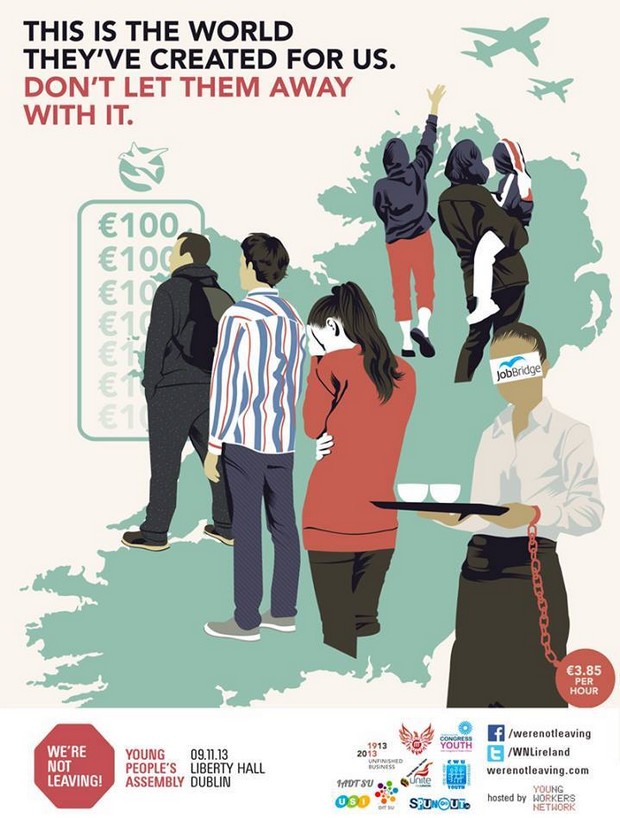
    were-not-leaving-poster

    The ‘Young People’s Assembly’, organised by the We’re Not Leaving initiative and the Young Workers Network, met in Liberty Hall on Saturday to discuss the uncertain future of young people in Ireland.

    The aim of the rally was to draw attention to the plight of those in this country under the age of 25, looking at the impact of fee increases and grant cuts, as well as the problems of housing, mental health and unemployment benefit.

    Nearly 200 people attended the assembly, held between 11am and 5pm and accompanied by the #werenotleaving hashtag, which trended in Dublin and Ireland on Friday and Saturday as word of the event spread.

    Laura McKenna of the Young Workers Network and Shane Fitzgerald from We’re Not Leaving, along with Moira Murphy, opened the debate and called for the youth of Ireland to organise and engage in an attempt to prevent what they see as a concerted attack on young people from those in power.

    “Forced emigration is not a lifestyle choice, it’s a government policy” said Fitzgerald, as letters from the Department of Social Protection advising of jobs abroad were publicly destroyed.

    As well as general debate, there were several helpful talks and inclusive workshops held, the pick of which concentrated on student issues and the raising of third level fees, ran by Joe O’Connor and Patrick Cole.

    The topics of internships and unpaid work-experience were raised, with many of the attendees unhappy with the perceived exploitation of young workers by employers.

    Stronger regulations for landlords were also a main talking point, with those present complaining of exorbitant prices and refusal of rent allowances.

    It remains to be seen what impact, if any, this show of solidarity will have with those who can directly inspire the changes needed.

  • Abandon Ship! Students on emigration

    Abandon Ship! Students on emigration

    University College Cork’s recent study of emigration trends in Ireland last week revealed that nearly two thirds of emigrants had a third-level qualification. It also showed that half of those emigrating were doing so as a matter of choice, leaving a full-time job they had here in Ireland.

    This provided some food for thought for experts and journalists who lamented the ‘brain drain’ as a tragic consequence of our crumbling economy. The claim that people are leaving unwillingly as a matter of necessity is now being called into question.

    Perhaps the mass exodus has more to do with the quality of jobs available as opposed to the quantity. To put it simply, young Irish people don’t want to settle for what they see as menial jobs. But in this climate, the pressure is even greater to take what you’re given and be grateful. I went in search of answers from some final year college students.

    ImageHilary Pidgeon, 22

    “When I graduate I’m probably going to emigrate. Maybe not permanently, I’d probably move away for a couple of years. There’s so much more opportunities in other countries like America and Canada. Some of my friends are doing jobs that are widely available in Ireland, but if they want to go far in their career they’d have to emigrate. I think it’s really bad. You’ve got your family here and your friends here. You’re basically cutting off the life you’ve built up here for twenty something years”

    ImageLouise McLoughlin, 22

    “I think I’m going to head straight to London after I finish. My boyfriend has already emigrated there, so that’s one reason but secondly I think there’s just a lot more opportunity especially for someone studying media. I think the majority of my friends are going to stay for the next few years at least but I think if something better is offered somewhere else they’re going to take it. People should do what’s best for them. It’s not our job to hold the country together. Why should be stick around just to stop a boat from sinking?”

    ImageTessa Flemming, 23

     “When I graduate I know I probably won’t get work in my area of study so I’m just going out with a completely open mind, to experience life rather  than find a career straight away. I really wanted to learn Spanish this year, I was thinking of going to South America or Spain and just live in another country for a year. I see myself as a wanderer, so any opportunities that are presented to me I’ll definitely say yes. I think people don’t really want to leave, but they’re doing crappy jobs at the moment that don’t reflect their skills. I really don’t want to happen to me. ”

    ImageBarry Lennon, 21.

    “Emigration isn’t really on my radar, but I wouldn’t mind moving abroad for a while to grow as person.  I mean if push comes to shove and there is a better offer abroad perhaps, even just to get a different experience. I probably would like to return to Ireland depending on how things go. Maybe when I get my retirement and I can settle down with the wife. I’ll sell the house and buy a nice retirement home somewhere in west Cork. I think it’s bad though, the country is investing in these people only for them to go away.”

    ImageSean Carroll, 21

    “I’ll  head to the west coast of America for a year, hopefully with friends. I’m  getting a degree in marketing, and I don’t have any interest in working in Ireland right now with the recession strangling any chance I have!  We pride ourselves here in Ireland for having such an educated workforce, but people are getting educated here and then they’re leaving. Obviously people don’t want to leave their family and friends behind but if you’ve studied for four or five years in a particular field, it seems like a waste to stay here. If you have a degree in engineering but you have to work full time in Centra you’re not going to stay around.”