There are an estimated 15,000 undocumented people currently living in Ireland. This is one of the most underrepresented and vulnerable groups in the country. Migrants Rights Centre Ireland carried out a survey into the lives of over 1,000 undocumented people in the country. Laura Matjusaityte examined the results of this survey.
Karuna’s youngest daughter is 5 now, her eldest daughter is 11. Both sisters have never met in person.
Karuna has been living in Ireland for the past 10 years. Her youngest daughter was born and spent all her life in Ireland. Nevertheless, both of them are living here as undocumented people.
Karuna hopes that one day she will be able to gain legal status in the country for herself and her daughter. Then both of her daughters could finally meet and she “could breathe easily for the first time in 10 years”.
This is only one example from many heartbreaking stories coming from undocumented people who are living in Ireland.
According to Migrants Rights Centre Ireland (MRCI), an NGO working with migrants, there are some 15,000 to 17,000 undocumented people in the state including 2,000 to 3,000 children.
Chart shows the nationalities of undocumented people living in Ireland.
A recent survey carried out by MRCI into the lives of 1,000 undocumented people living in Ireland showed that one of the biggest threats to undocumented people is a lack of job and salary security.
One of the survey participants, Billy, said that getting his papers “would be a dream come true”.
“I won’t have to worry every time there is a knock at the door. I’ll finally feel safe at my own home,” Billy said in the survey.
The survey revealed that over 90% of undocumented people living in Ireland are employed and more than a quarter of them do not receive even the minimum wage. Almost half of the survey participants reported that their working hours exceed 40 hours per week.
Another participant Zeinab, who has been living undocumented in Ireland for three years, said that there are times when she doesn’t get full pay, and sometimes she doesn’t get paid at all.
“If I had my status I could stand up to this, I could get a better job and give my children a better future,” Zeinab said.
Chart shows division by gender among undocumented people who took part in the survey.
The survey further revealed that 70% of undocumented people in Ireland are aged between 24-44, almost 60% of them are women and 40% men.
More than a quarter of the survey participants are providing care to older people in private home settings. A little less than 20% are working in cleaning and maintenance sectors, 20% in restaurants and catering services, and 10% are employed in the childcare sector.
Chart shows sectors in which undocumented people are employed.
A high percentage of undocumented workers admitted that they have been stuck in the same employment for years because they don’t have legal status.
Three-quarters of respondents have been in the same employment for three years or more. And more than 80% admitted being employed in the same sectors for over three years.
Tjanasi Jack, Chair of Justice for the Undocumented Group, which is part of MRCI, spoke at the launch about fairer solutions for undocumented workers in Ireland.
Tjanasi said that according to the survey over 75% of undocumented workers were living in Ireland for five or more years and more than 90% of them have permanent employment.
“So many of us have stepped up and continue to work providing essential services throughout Covid-19. Unfortunately, the survey also revealed high levels of exploitation, with over a quarter of workers not receiving the minimum wage. This is unacceptable,” Tjanasi said.
The current Immigration Act 1999-2004 allows people to seek immigration permissions in the state. The Department of Justice encourages people to come forward and apply for the humanitarian leave to remain, which would allow non-EEA nationals to stay living in the country.
However, in practice, undocumented people often fear that the application would be unsuccessful and put them on the radar of Irish authorities and choose not to do so.
Carol Sinnott, a solicitor from Sinnott Solicitors closely working with undocumented people, said that undocumented migrants are “living under the radar in constant fear of deportation” and without the ability to lawfully work and pay taxes in the state.
“I have never met an undocumented migrant who would not be willing to work legally and pay taxes in the state,” Sinnott said, adding that “in fact, all of the undocumented migrants whom I have met are desperately trying to find a way to legalise their status”.
The Department of Justice spokesperson Colm Daly said that “the Government is sympathetic to the situation of people who find themselves in an undocumented position here in Ireland”.
According to the Department of Justice, the government is currently committed to creating a programme for Government, which would allow a new pathway for long-term undocumented people and their dependents to legalise their status, if they meet the required criteria.
“I believe that if the Minister for Justice implements a programme to provide a pathway for migrants to legalise/regulate their status in the state, it would be an extremely positive development for those migrants and the state,” Sinnott said.
The Department of Justice stated that the government is “committed to introducing new pathways to status regularisation within 18 months of its formation”.
Major staff shortages have caused issues in nursing homes. Photo: George Arthur Pfleuger
TheCity.ie’s Ruadhan Jones heard from Tom Lordan, administrator with LHP Skillnet – which is looking to meet some the increased demand for nursing home workers with a three-week induction course for healthcare assistants.
The difficulties facing nursing homes as a result of the coronavirus has become a story of increasing importance in the past few weeks. Among the issues facing the homes is a shortage of staff, with up to 158 homes without 427 healthcare assistants.
As part of the grant conditions, many brances of Skillnet Ireland provides a free employment activation program, intended to get people off the live register and into work.
Speaking to TheCity.ie, Tom Lordan explained that, prior to the crisis, one LHP Skillnet’s central tasks was to run a six-month course activation program in healthcare support.
“We were doing that major award as our employment activation program,” Lordan said. “Even prior to the Covid–19 crisis, there was a huge demand for trained and competent healthcare assistants. It was a very productive course, getting hundreds of people into safe and professional work.”
The course is accredited by Quality and Qualifications Ireland (QQI) as a Level 5 major award. It requires participants to take a certain combination of a certain number of modules to get the award, and is, according to Lordan, the industry standard for healthcare assistants.
“The training requirements of a healthcare assistant may be entry-level but it is one of the most time-consuming roles in the healthcare community,” he said. “While they don’t perform any advanced diagnostic or medical functions, they’re the lifeblood of the nursing home. They deal with all of the fundamental aspects of personal care — no nursing home could operate without them.”
“Healthcare assistants are crucial in caring for people who are elderly or have disabilities.”
The course typically last six months, but LHP Skillnet realised that was too long to meet the increased demand.
“The strain on the industry is significant,” Lordan said, “because of the numbers falling sick in nursing homes or in hospitals. There has been an exponential increase in demand. We partnered with Nursing Homes Ireland (NHI) and the public employment agency Intreo to put together a program for dealing with the deficit right now.
“Our nurse tutors took the most important elements from the major award in healthcare support and condensed them into a three-week course. We call it the Healthcare Assistant Induction Programme. It was devised to be delivered online via interactive sessions, though we never used webinar software before.”
The extra workload put a huge burden on LHP Skillnet’s small team. Prior to the crisis, LHP Skillnet had added a new administrator, but this still meant that there were just three administrators and one manager working for the company.
The NHI have started a recruitment campaign. Photo: NHI website.
“It’s been incredibly labour-intensive, but it’s been necessary,” Lordan said. “Everyone agreed that it had to go ahead. We went to Intreo and they gave us a list of about 180 people interested in doing healthcare. We sent out emails to confirm their interest, put them into groups and carried on.
“We were able to use the NHI’s really comprehensive communications network to pass round an online survey which nursing homes could fill out to give us the info we needed. We compiled a database of all nursing homes that have a desperate need of care assistants.”
At the end of each course, the tutors provide participants with a list of nursing homes in their area and prospective students will make the applications themselves, Lordan explained.
Though the course won’t be accredited in the same way as the healthcare support, it will be recognised by the NHI, Lordan said.
“It can’t supplant the major award,” he said, “but it gives individuals the basics they need to go into a healthcare environment and not make mistakes. They’ll know what the key elements of their work will be, and then be trained subsequently.”
Lordan is hopeful that the changes made to the course will help the NHI meet some of the nursing homes’ needs.
“The demand is there, and our efficiency has improved,” he said. “In the first week, no one had used the webinar software before. The tutors and administrators had only a short trial. We kept the number of participants small to begin with, but with each passing week we’re able to expand the classes.”
Anne O’Connor from the HSE confirms that care homes are now being prioritised for PPE. Photo: RTE player
So far, four groups have completed the course, with a further eight groups lined up. In total, LHP Skillnet expect around 300 people to participate.
Due to the newness of the course, LHP’s Skillnet don’t have figures for those entering employment, but Mr Lordan said that “they shouldn’t have any problems” getting into homes. He hopes that many of the participants will avail of the chance to do the healthcare support course once the worst of the crisis has passed.
“Anyone who does the induction programme will be offered the opportunity to progress to the major award,” Mr Lordan said. “Not all will want to, but I hope that a lot of them do come back and do the major award. Given the situation, we will most likely do that online as well.”
TheCity.ie’s Kim O’Leary presents a collection of her own photos from her hometown of Newbridge, Co Kildare, where big and small businesses are fighting to adjust to restrictions – cautiously optimistic that their beloved town will one day flourish again.
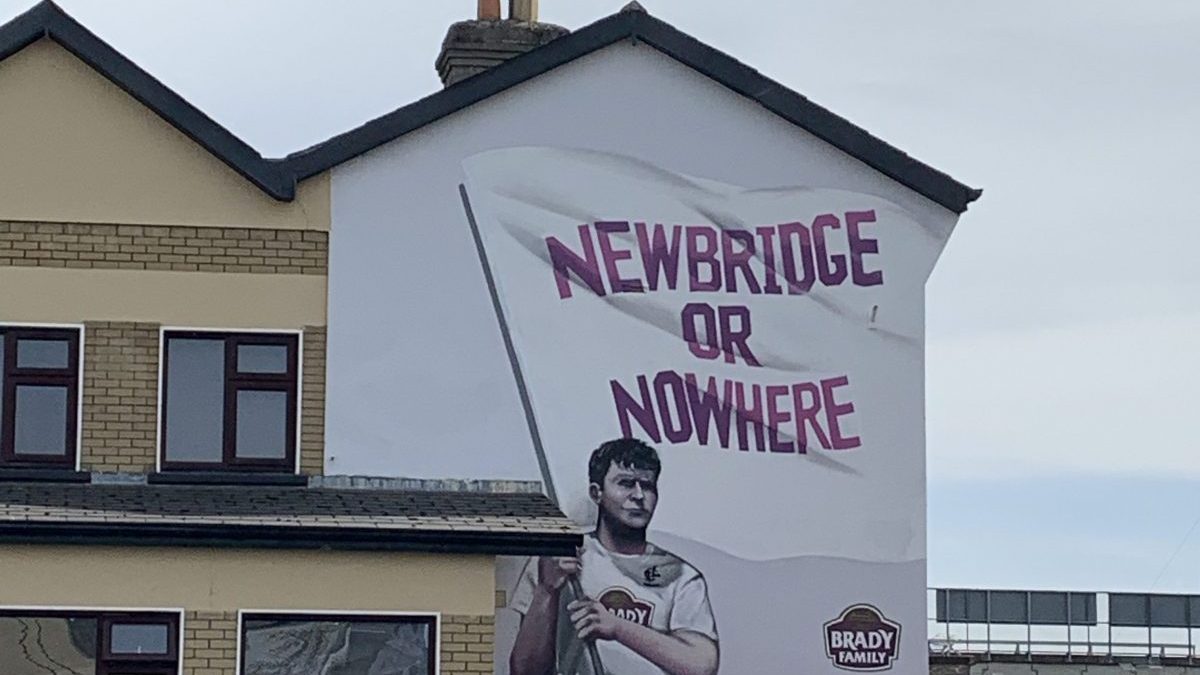
‘Newbridge or Nowhere’ became the town’s unofficial mantra following the summer of 2018 debacle, when Kildare rejected the choice of Croke Park as the venue for their All-Ireland qualifier round 3 match with Mayo. In the end the match was played in Newbridge’s St. Conleth’s Park and saw the Lilywhites emerge victorious over Mayo. This mural was painted to cement the landmark victory. (March, 2020)
The Covid-19 pandemic has changed normal life as we know it, with many local businesses bearing the brunt of changes to the economic climate. And for my small rural town of Newbridge in Co Kildare, the difference between Newbridge before and during Covid-19 is startling; shops are closed, people now wear masks and gloves to the supermarkets and the atmosphere of dread and fear is palpable in the air.
Newbridge Town Hall is located at the very heart of the town and the building has been used as a dance hall, a FÁS training centre, a bingo hall, a storage unit and it was also headquarters to the town commission and the community council. The first stone of the town hall (which is formerly a barracks chapel) was laid in 1859 by Lieutenant General Sir James Chatterton. (March, 2020)
Newbridge, officially known by its Irish name Droichead Nua, is a town in County Kildare, Ireland. While the nearby Great Connell Priory was founded in the 13th century, the town itself formed from the 18th century onwards. The town grew to include a military barracks which opened in the early 19th century, which continues to function.
The back-end streets behind Main Street in Newbridge are lonely during the Covid-19 pandemic, with many of the small shops and businesses closed. (April, 2020)
In the 20th century the town saw great expansion of local business, and Newbridge began acting as a commuter town for Dublin. Over the last twenty years, the town has seen its population soar to 22,742 in the 2016 Census – making it the most populous town in Kildare.
The newly refurbished post office in Newbridge opened earlier in the year, and it remains open during the Covid-19 pandemic to provide essential services to the town’s inhabitants. (April, 2020).
In many ways — with GAA being so popular — you’re either a Moorefield or Sarsfields fan, with downtown considered Sarsfields’s turf.
Like most places still open for business in Newbridge, strict ‘social-distancing’ practices are in operation inside the post office. Make sure to stay two metres apart. (April, 2020)
People wear masks as they queue up outside the post office in Newbridge, adhering to the 2 metres social distancing rule. (April, 2020)It’s not all doom and gloom for local businesses, with SPAR and Life Pharmacy among the essential stores remaining open during the pandemic. (April, 2020)Judge Roy Beans restaurant on Edward Street is a must-see for burger lovers, with the American style restaurant crowned ‘Best Pub Burger’ two years in a row. Currently the restaurant is operating a takeaway service due to Covid-19 and its next door neighbour the EBS building society is open for business as usual. (April, 2020)Whitewater Shopping Centre — located on Main Street in Newbridge — is one of the country’s largest shopping centres, with thousands of visitors flocking to it every year. At the moment, many of its non-essential shops have closed but its outdoor water features are still proving popular with families. (April, 2020)Escalators have been powered down in the Whitewater Shopping Centre, with only a handful of stores open including the Marks & Spencer food hall. (April, 2020)A blind man walking down Main Street in Newbridge during the Covid-19 pandemic over Easter weekend. (April, 2020)
The very top of the town is home to the larger supermarkets of Dunnes Stores and Tesco, as well as the newly opened skate park, and fast-food giants McDonalds and KFC.
For the first time in their history since opening in Newbridge, McDonalds and KFC on Moorefield Road are shut for business with empty carparks over the Easter weekend. McDonalds shut its doors on Monday, April 23 and KFC shut on Wednesday, March 25. (April, 2020)A solitary man eats outside KFC in Newbridge during Covid-19. (April, 2020)The Dunnes Stores carpark in Newbridge is almost full as shoppers flock to gather their much-need food supplies. (April, 2020)A female shopper dressed in mask and gloves for this shopping excursion. (April, 2020)A woman visits the fish monger to collect her order. (April, 2020)The popular skate park in Newbridge opened last April after 20 years of campaigning by skate boarding enthusiasts, but during Covid-19 the park is going mostly unused. (April, 2020) One of the most iconic businesses located in Newbridge is of course Newbridge Silverware, which has spent over 80 years in the town. Its Museum of Style Icons features pop culture memorabilia from Princess Diana’s dresses to suits worn by The Beatles, and much more. (March, 2020)
PRINT TRADE: The vast selection of local newspapers we recently found at John Hyland’s Dún Leary’s Last Corner Shop in Dún Laoghaire (Photo: Paul Caffrey)
As print sales continue to suffer in the era of smartphones, TheCity.ie’sPaul Caffrey reveals what it was like to endure a savage round of newsroom redundancies and examines the current state of the Irish newspaper industry
The newspaper business is in crisis and I’m living proof.
Last year was full of shocks for anyone working in newspapers, with 2019 characterised by one upsetting round of redundancies after another in the trade that was once king.
It was a long time coming. Sales and readership figures of printed papers have been in steady decline since 2007 as digital options — smartphones in particular — have developed more and more.
In the second half of 2018, sales of daily national papers in Ireland plummeted by 10%. The Sunday market fell by 9%. Behind the scenes, the executives trying to keep their ships afloat had to take out their balance sheets and work out how to make cuts. As usual, they went for payroll.
‘The Newspaper King’: A video by TheCity.ie
While investigating the current state of the newspaper business, we paid a visit to ‘Dún Leary’s Last Corner Shop’ in Dún Laoghaire, where newspapers of all kinds are still king. Bucking downward trends, owner John Hyland even sells a good selection of “yesterday’s papers”. He keeps the Sunday papers – and some dailies – in stock for at least a week. (Video: Paul Caffrey)
In March 2019, Ireland’s biggest newspaper group, Independent News & Media — publishers of the Irish Independent, Sunday Independent and The Herald — sought 35 redundancies. This led to the departures of many of its most talented and high-profile journalists.
Just a few months beforehand, in was described by SIPTU as a “massive blow”, INM had also shut down its own printing plant in Citywest, Dublin, with the loss of 84 jobs.
Until April of last year, I had a good job covering the High Court for a national newspaper.
On Friday, March 1st, I’d been in the middle of covering the closing stages of a libel action taken by billionaire Denis O’Brien against the Business Post — a case that could have bankrupted that paper had he won — when I was informed that my own employer was looking to remove about 35 of us from our jobs.
While one newspaper was standing up for its very existence in court with a full defence against O’Brien’s action by respected journalists Tom Lyons and Ian Kehoe, the Irish Daily Mail was about to lay off a large chunk of its loyal staff.
PRESS DEFENDER: Former Business Post journalist Tom Lyons, who now runs business website The Currency, was forced to defend his journalism from the witness box when brought to court by billionaire Denis O’Brien (Photo: YouTube)
I was in shock. My gut reaction was, how can we run a newspaper on that basis? What will become of my colleagues? And will I be staying? I loved working for them. But, with a verdict imminent in the O’Brien case, I had no choice but to get on with the job.
All the while, I was getting a flurry of texts from senior colleagues back at the newsroom, including one that assured us that our paper was not closing down. That statement in itself I found shocking, as my mind hadn’t yet contemplated any such eventuality.
The last thing you want when your own organisation is hit with a crisis like this is to have to discuss it with anyone outside of your number, unless you’ve known them a long time.
You just don’t want their commiserations or polite enquiries before you’ve had even 20 minutes to process it yourself – even if they work in the media.
And with O’Brien seemingly on the verge of yet another victory against a newspaper, it seemed that our industry was under attack from all sides.
The newspaper was vindicated for its journalism and for having dared to publish a story concerning the finances of a number of well-known businessmen including O’Brien.
PRESS VICTORY: Denis O’Brien lost his libel case on March 1, 2019 – the same day that yet another round of redundancies hit the print business (Photo: Paul Caffrey)
It was a genuine victory for press freedom and a boost for all of us working in the media. It temporarily gave us all a lift and a cause for celebration.
Emotions running high in the pouring rain outside the Four Courts. Tom Lyons, the paper’s former business editor, told the media:
“We stood up to him, we fought for a full month, we stuck to our guns, we told the truth, did the right thing and thankfully the jury came down on our side.”
Ian Kehoe, the paper’s former editor, said at the time:
“This is about the right of every media organisation in this country to publish what’s genuinely in the public interest and of public importance.”
That night, there was a sense among us that, even if we were all about to lose our jobs, at least this much had been achieved. O’Brien’s case had been — in the words of the broadsheet newspaper’s lawyer Michael McDowell SC in his closing speech to the jury — “thrown out on its backside”.
How the Business Post reported its court win that Sunday (Photo: Twitter)
Before long, I had to consider my own situation again. Eventually, after much soul-searching and many tears during various meetings with my employer and a few long chats in quiet corners with my colleagues, with a heavy heart, I decided to join the leavers.
I was one of more than 40 editorial staff who left the place by the end of April. Our publisher — DMG Media Ireland — had employed 156 staff in Dublin until last April’s exodus.
It was when I saw excellent journalists like our political editor Senan Molony — to name just one — being let go that I could clearly see that the number one priority for management was reducing the wage bill. There was genuinely no element of judging anyone by how well we did our jobs.
Even though this scenario was being echoed in newsrooms across the world, that makes it no easier to view it objectively when it hits your own workplace.
Leaving was a hugely difficult decision for me because I love newspapers and only ever wanted to work for one since I was 18. I felt at home there.
During the long process of negotiations about which of us might agree to take the bullet, falling newspaper sales and declining advertising revenue were constantly cited to us as the main reasons for the layoffs.
Newspaper-free Zone
TheCity.ie stopped by this Daybreak newsagent on Aston Quay, which has recently stopped selling newspapers altogether. The man behind the counter told me: “We don’t sell newspapers. It’s hard to cover the cost of it. Everyone is using the mobile applications. Some people feel it’s a waste of the trays.” (Photo: Paul Caffrey)
However, I felt the whole process was handled as sensitively as it could have been. I departed wishing those who remained from our fantastic team of exceptional journalists, editors and sub-editors well — including editor-in-chief Sebastian Hamilton and chief executive Paul Henderson, both of whom I’d enjoyed working for.
Over the past year, I’ve felt every inch of what these studies describe. Like the loss of a very close loved one, something I’m also painfully familiar with, it affects every part of your life. As to whether I’ll ever venture to take up permanent employment again, even if it’s offered, I’m still undecided.
Meanwhile, there was further drama in May 2019 when the Rupert Murdoch-owned Times Ireland shut down its print edition less than two years after it had launched.
Most journalists at the title were forced out of their jobs with redundancy pay that was condemned by the National Union of Journalists (NUJ) for being “miserly”.
Many staff were reportedly furious to be told they wouldn’t be entitled to redundancy pay unless they’d worked for that company for more than two years.
Despite all this, about half a million newspapers are sold each day in Ireland, according to Irish Times Circulation Director Fran Walsh. He told TheCity.ie:
“People think print is dead…If you launched any product today into the market and went and said, ‘we can sell half a million of this product on a daily basis’, it would be a phenomenal business.”
However, back in the early Noughties, the Sunday Independent aloneboasted having one million or more readers on its front page, week after week.
The Sunday Independent proudly advertising its 1.1 million readers on its masthead in the pre-smartphones era – October 6, 2002. (Photo: Paul Caffrey)
Despite all the upheaval since those glory days, newspapers remain an essential part of our daily life.
Without them, the Watergate scandal would never have been exposed by Washington Post journalists Bob Woodward and Carl Bernstein. Their comprehensive, investigative exposé led to President Richard Nixon’s resignation in August 1974.
The painstaking investigative work of Woodward and Bernstein was dramatised in the 1976 film All The President’s Men.
PRINT TRADE: TheCity.ie found this pop-up newspaper vending stand in Raheny, north Dublin, that still sets up near a church every Sunday (Photo: Paul Caffrey)
Without newspapers, we’d never have learned the extent to which British MPs were on the take with their expenses claims from the Daily Telegraph in 2009. That newspaper made its own film, The Disk, about its findings.
EXPOSED: How the now-defunct News of The World broke the story that rocked the world of sport in 2010(Photo: Pinterest.ie)
Newspapers also run important campaigns — such as the UK Daily Mirror’s opposition to the Iraq War in 2003, and closer to home, the Irish Daily Mail’s recent campaign to ban smartphones for under-16s.
According to the Project for Excellence in Journalism in the US (now part of the Pew Research Center), most original journalism is still produced by newspaper journalists.
Moreover, newspapers still largely set the broadcast and online news agenda. RTÉ’s Morning Ireland has two paper reviews each morning, while Sky News has two paper reviews each night and a more in-depth look at the day’s papers every morning.
Employment crises in newspapers are nothing new. TheCity.ie recently found this Linotype-style machine, produced by the Intertype Corporation (founded in 1911) sitting in the foyer of the Irish Times printing plant at Citywest, Dublin. Machines like this were used to typeset material for newspapers from the 1880s until the 1980s in some countries. On Fleet Street in the ’80s, there was huge resistance to modernisation by typesetters’ unions anxious to prevent job losses. The so-called ‘Wapping Dispute’ of 1986 saw Rupert Murdoch infamously sack over 5,500 print workers after they went on strike over the impending changeover to new technology (Photo: Paul Caffrey)
The global surge in redundancies also poses a clear threat to journalism itself.
With job security in the newspaper business now harder than ever to come by, many talented journalists I know have left the industry and secured jobs in public relations and communications roles instead, working for political parties, State bodies, charities and NGOs.
And when the poacher turns gamekeeper, surely the quality of the journalism on offer to the public suffers.
CRISIS YEAR: People are still buying newspapers (Photo: YouTube)
“…stories not written, scandals not exposed, government waste not discovered, health dangers not identified in time”.
In my view, the only solution for now is that good journalists keep striving to hold the rich, the powerful, the incompetent and the reckless to account with rigorously researched and verified original content.
In October 2018, the unemployment rate was 5.5 percent for males, down from 6.9 percent in the same month last year, according to the latest seasonally adjusted CSO figures.
The seasonally adjusted number of males unemployed was down from 88,800 to 71,800 from October 2017 to October 2018.
Source // CSO
The largest increases in employment in the second quarter of 2018 took place in construction, the wholesale and retail trade, accommodation and food service activities, and professional, scientific and technical activities, according to the latest Labour Force Survey figures.
In comparison, the seasonally adjusted unemployment rate for the entire population of the United Kingdom in September 2018 was at 4.1 percent, according to figures released in November by the U.K.’s Office for National Statistics.
In August 2018, the Department for Business, Enterprise and Innovation announced the Future Jobs program, which will be introduced in 2019 to succeed the Action Plan for jobs and to maintain the momentum in employment growth.
Earlier this year, the Minister for Business, Enterprise and Innovation Heather Humphreys supported the continued efforts to tackle unemployment and believes the Government’s successful annual Action Plans for Jobs has played a key role in the continued improvement in the job figures.
The Action Plan for Jobs was created in 2012 – when unemployment was at its peak of 16 percent across everyone in the country. Since the first quarter of 2016, 174,200 jobs were created, with 65 percent of these coming outside of Dublin.
More than 15,000 people in the Irish labour force over the age of 15 have had no formal education, according to the 2016 census.
12,827 of these are Irish Nationals, which equates to 84% of the total figure.
Of those who have had ‘no formal education’ (meaning that they never completed Primary School) the top five industries they find work in are:
Overall, 210 workers classed as ‘Corporate Managers and Directors’ fall into this category of ‘no formal education’, and 215 are considered to be ‘Other Managers and Proprietors’. A total of 55 are employed in the Science, Research, Engineering and Technology sector, and seven are working in the teaching and education professions.
Unfortunately 5,885 of the workers in this category of having ‘no formal education’ have fallen into the ‘other/unstated’ category for their occupational industry, and so their professions can’t be included in this data.
This figure of 15,155 in the 2016 census has gone up by 1,671 people since the 2011 census, and so going by this trend, lack of a primary education may actually be an issue on the rise, contrary to popular belief.
For 97,409 of the workers in the country over 15, completing primary school has been the highest form of education they’ve received, and for 260,960 the highest education they’ve completed is ‘Lower Secondary’ (Junior Certificate).
The figures were not broken down by age, and so it can’t be determined if this figure is predominantly made up of older residents or not. There was also no indication of gender to break it down into male and female figures.
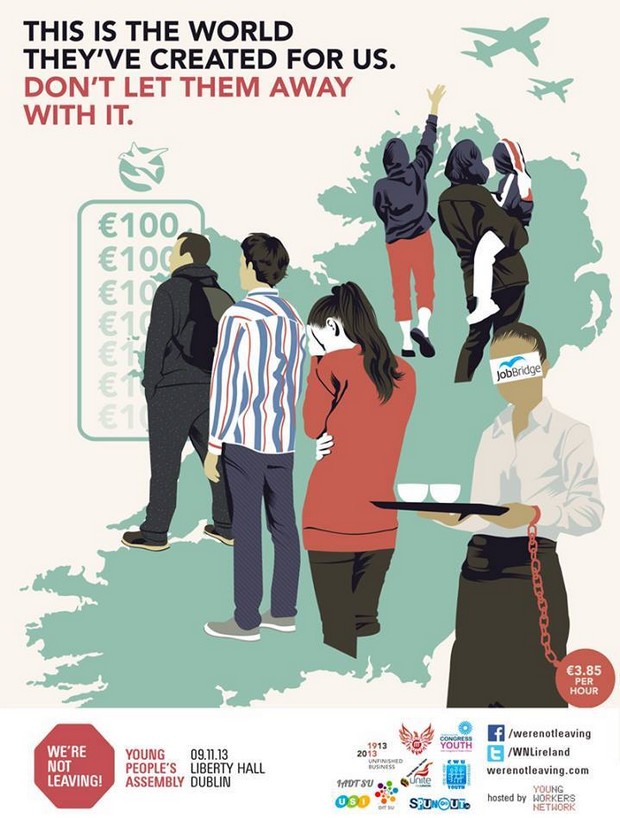
The ‘Young People’s Assembly’, organised by the We’re Not Leaving initiative and the Young Workers Network, met in Liberty Hall on Saturday to discuss the uncertain future of young people in Ireland.
The aim of the rally was to draw attention to the plight of those in this country under the age of 25, looking at the impact of fee increases and grant cuts, as well as the problems of housing, mental health and unemployment benefit.
Nearly 200 people attended the assembly, held between 11am and 5pm and accompanied by the #werenotleaving hashtag, which trended in Dublin and Ireland on Friday and Saturday as word of the event spread.
Laura McKenna of the Young Workers Network and Shane Fitzgerald from We’re Not Leaving, along with Moira Murphy, opened the debate and called for the youth of Ireland to organise and engage in an attempt to prevent what they see as a concerted attack on young people from those in power.
“Forced emigration is not a lifestyle choice, it’s a government policy” said Fitzgerald, as letters from the Department of Social Protection advising of jobs abroad were publicly destroyed.
As well as general debate, there were several helpful talks and inclusive workshops held, the pick of which concentrated on student issues and the raising of third level fees, ran by Joe O’Connor and Patrick Cole.
The topics of internships and unpaid work-experience were raised, with many of the attendees unhappy with the perceived exploitation of young workers by employers.
Stronger regulations for landlords were also a main talking point, with those present complaining of exorbitant prices and refusal of rent allowances.
It remains to be seen what impact, if any, this show of solidarity will have with those who can directly inspire the changes needed.
By Greg Synnott, Michael Coleman and Saoirse Ivory
A series of tax adjustments and cuts were announced by Minister Michael Noonan in yesterday’s budget. The City were outside government buildings when the announcement was made.
The €2.5 billion plan included €900 million in additional revenue and €1.6 billion in cuts.
Members of the Independent Workers Union protesting
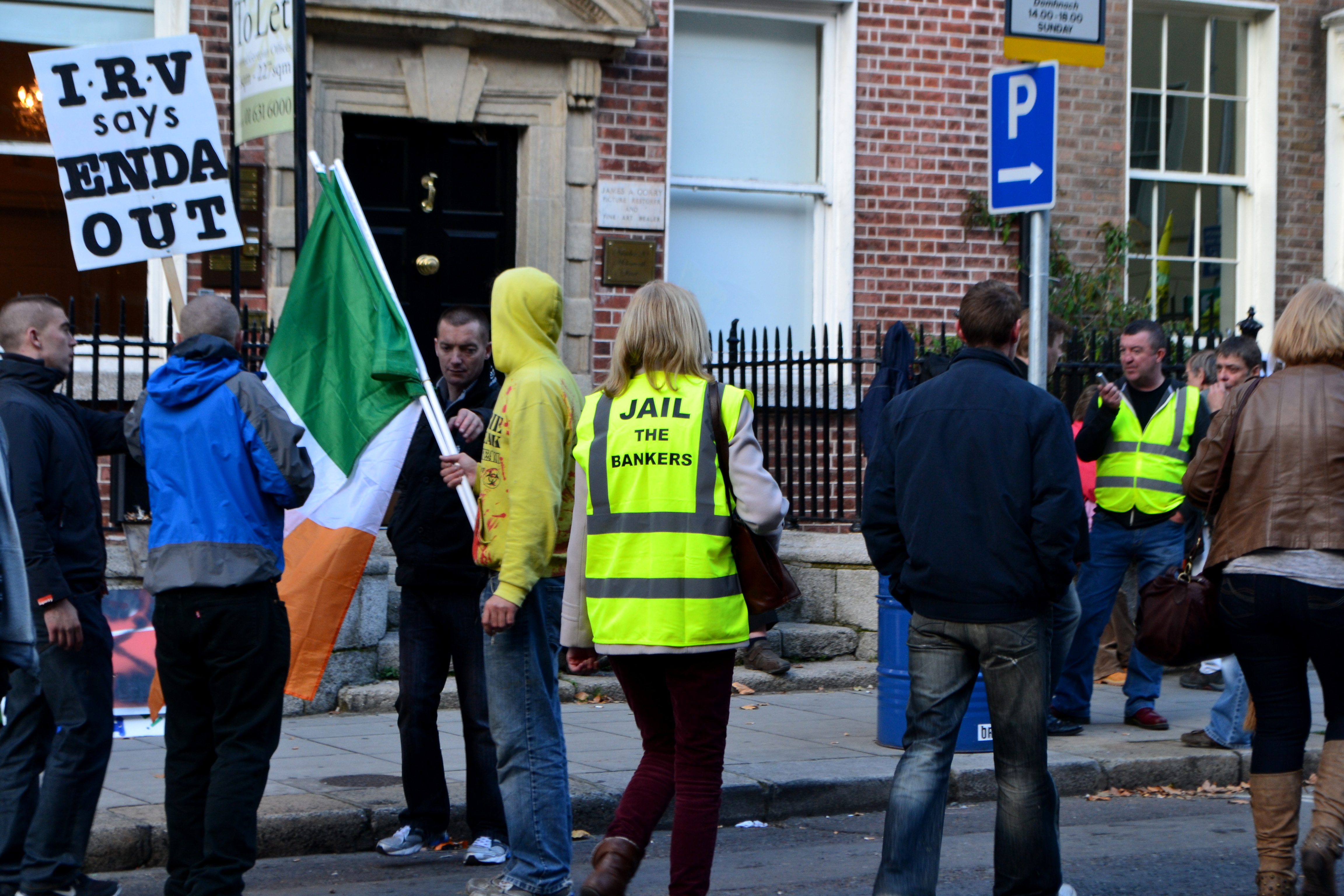
IRV protesters outside the Dáil
Some of the measures announced by Minister Noonan and Minister Brendan Howlin include:
A reduction in jobseekers allowance to €100 per week for under 25s
An increase to the price of beers, spirits and cigarettes of 10 cent, and an increase to the price of wine of 50 cent
Funding to third level institutions will be cut by €25 million
The abolishment of the phone allowance for pensioners
The banking sector will now pay €150 million to the exchequer annually
Free GP care will be provided for all children under five
Additional jobs will be added in hospitals, schools and An Garda Síochána starting next year, but overall pay will be reduced by €500 million
Prescription charges on individual items is to increase to €2.50
Tax relief for single parents (who could previously both claim the credit) will be changed to a Single Person Child Carer credit, which only the primary carer will claim
A new unified DIRT rate of 42% was introduced
Tax relief for medical insurance will be capped at €500 for children and €1000 for adults
Minister Noonan concluded his speech by saying that Ireland is still facing some tough times, but is on the road to recovery.
Meanwhile, outside the Dáil, a surprisingly small number of protesters turned out despite an enormous Garda presence.
Many protesters, who felt the government were targeting the weakest in society, were disappointed by the turnout.
Protester Pamela Hackett gives her view on the Budget
“I’m very disappointed,” said Pamela Hackett, “I thought there’d be a load of people out here.”














You must be logged in to post a comment.