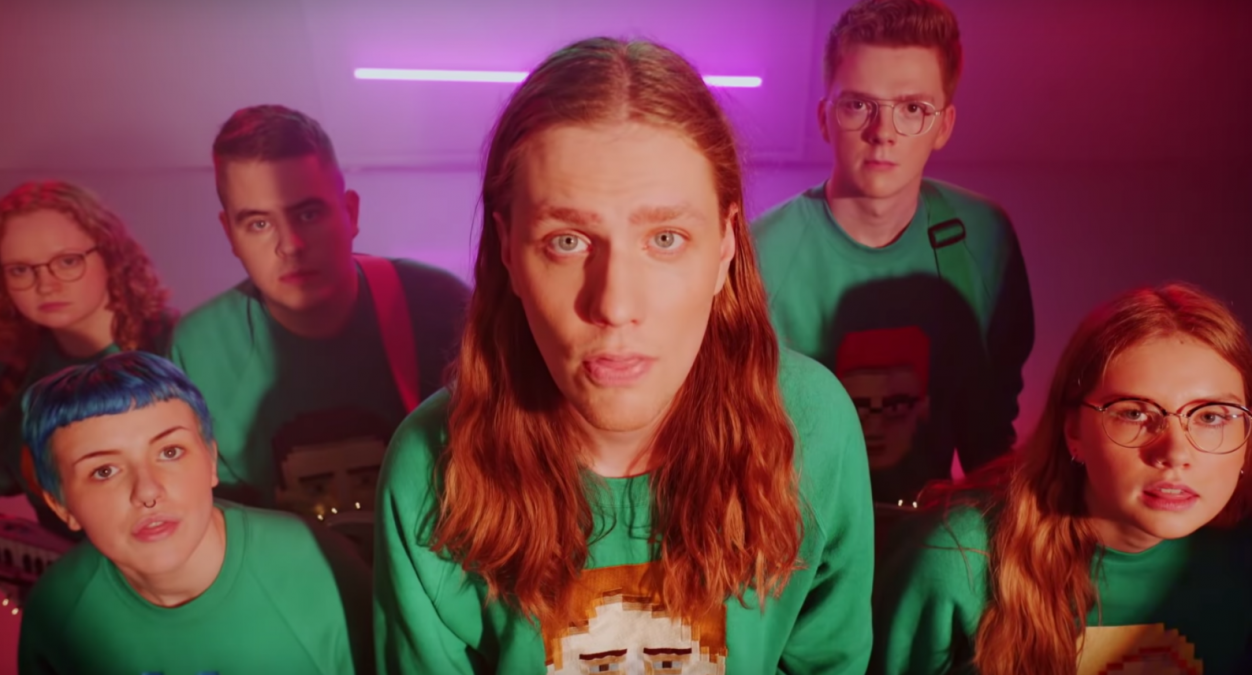

Photo: Instagram
Kate Brayden delves deep into the weird and wonderful world of Eurovision, following the news of its cancellation due to the Covid-19 pandemic. Patriotism comes in many shapes and sizes, but the song contest is exactly what this continent currently needs: fun.
Eurovision, from an Irish perspective, is usually an excuse to inflict the most intense mockery humanly possible towards other nations, but in a politically acceptable way. Ever since Ireland stopped winning the flamboyant competition, we decided that it couldn’t be taken seriously. As audience viewers, our sole role was to gather in packs and create drinking games for the occasion, all from the comfort of our sitting rooms.
From the highs (Dana, Riverdance, Johnny Logan) and lows (Jedward, Dustin the Turkey) to our failure to even make the final, Ireland has had a bumpy road. Remember when Dustin’s puppeteer John Morrison, dressed in all black and crouching behind Dustin, couldn’t even hide from the cameras? Lord knows how many roastings we got abroad for that turkey.
Instead of committing actual talent to the infamous competition, the Emerald Isle realised that our strongest card in the deck is our scathing sense of humour – with Bandon native Graham Norton’s unparalleled commentary stealing the show on our patriotic behalf. His primary targets are usually the main presenters from the host country, who could easily have been chosen from the realm of children’s television shows with their manic levels of enthusiasm.
Some of his best quotes include; “I like the bit where she stopped the music”, “He has one contact lens in because I think he likes to look like an Australian sheepdog” and “If you’re just joining us, Middle Earth hasn’t joined Eurovision. That was Albania.” For all the witticisms, I’m sure he rakes in the cash from the BBC for the gig. Many audiences tune in just to hear his iconic put-downs. Nobody is safe from Graham.
For once, Ireland’s entry stood a chance at not embarrassing the country. Classic Covid-19 bitterness, showing up when our song was not chronically wince-worthy to ruin our chance at a reputation reprisal. Leslie Roy’s ‘Story of My Life’ was essentially a subpar and lyrically cringy version of a Lady Gaga x Katy Perry x Christina Aguilera mash-up, but isn’t the antiviral concoction the competition needed?
“I want people to feel that once we speak our truth we can have an epic dance party to celebrate,” Roy recently told Wiwiblogs, the official Eurovision news website. No truth can now be spoken, courtesy of Ms ‘Rona of Haus Virus. She may have stopped a whole musical continent from enjoying an epic dance party, but Europe will have a glorious 2021 comeback in the quaint city of Rotterdam.
Following the announcement that Eurovision 2020 was cancelled, it didn’t take fans long to start a petition – not to have the show broadcast, but to crown Iceland as the winner. If you’re unfamiliar with the…niche…cultural importance of the winning song, fans will happily inform the internet of their favourite while energetically arguing with anyone who disagrees with them.
There was no question this time around that anyone other than Iceland deserved the prize, purely for the music video. The clip features Iceland’s entry (Daði Freyr) wearing identical bright green jumpers and staring into the camera in a manner similar to that of hostage videos. The intensity is a lot. Oh, and the setting is in a sitting room, where the band are performing the song to elderly relatives as if they’ve been forced to take part in the family Christmas talent show. That’s relatable content at its finest, especially for Irish families.
Daði Freyr pretty much thought their tune, ‘Think About Things’, had it in the bag. And they did. It was catchier than, well, a contagious virus. You can also tell that they’re the type of people who take handwashing seriously, which is endearing. They were robbed, though, much like every toilet roll Europe has stocked in supermarkets in 2020.
The country with a population of just 364,000 people has never won Eurovision, and now Covid-19 has snatched the crown right out of Iceland’s (germ-free) hands. The virus would turn right around at Reykjavik airport once it heard such a bangin’ tune, it’s a cure in itself.
Arguably, each country could have streamed their performances from a studio in their own country, but alas – the curtain has fallen. The same artists can apply for the 2021 competition, but they cannot enter the same song. This means ‘Think About Things’ will never see the main stage, so it’s time for the internet to give Daði Freyr the accolade virtually. Rumour has it that the song’s lyrics (“We were bound together, then and forever, and I could never let you go”) are about Covid-19.
Reeling in the years
In 1955, then-director of the European Broadcasting Union, Marcel Bezençon, shared with his colleagues an idea. The plan was inspired by the popular Italian song contest, the Sanremo Music Festival. In the midst of the Cold War, Bezençon convinced himself that Europe needed cross-unity through the power of song, or something along those hazy lines.
In May 1956, the first Eurovision Song Contest was held in Switzerland, the nation of neutrality. Believe it or not, the contest used to have a pretty good reputation for talent. ABBA and Celine Dion went on to have stellar pop careers after their respective wins, but things have meandered quite a bit since then, to say the least. I’m not sure Marcel was envisioning Finnish death metal bands with facial prosthetics could win over a continent, even with their terrifying appearance. ‘Hard Rock Allelujah’ combines the most intense rock music known to man with Christianity, and it’s apparently really popular in Scandinavia. To each their own.
Things have gotten progressively weirder since that 2006 Lordi performance in Athens, but we lived for it. Eurovision 2020 was our chance to achieve EU unity after the implosion of Brexit, rising climate breakdown fears and the horrific treatment of refugees attempting to cross the Mediterranean. What else can blur the boundaries of our continent like screeching at the television when a country just unethically hands over 12 points to its neighbour? (Eastern Europe, we’re looking at you.) How else can we feel our pride in the EU than watching flamethrowers, unicycles and even Russian grannies making cookies live on stage to a rabid audience and demented presenters landing poorly timed “jokes”?
Above all, Europe needed the memes. The social media hashtags. The slagging of each country’s presenter when the time came to announce the points allocation. We needed it more than oxygen, and now we are deprived of spandex, glitter and cultural confusion.
The one form of consistency Europe has is the guarantee that Eurovision is going to be just as comically strange year-by-year, no matter what drastic political incidents have occurred in the meantime. That’s all we had going for us, really. We’re nothing without an absurd caricature of our country singing a ballad with way too much emotion, or a pop song with acrobatic, semi-clothed dancers seemingly making up choreography as they go along. Patriotism at its peculiar finest will have to wait until 2021.
You must be logged in to post a comment.