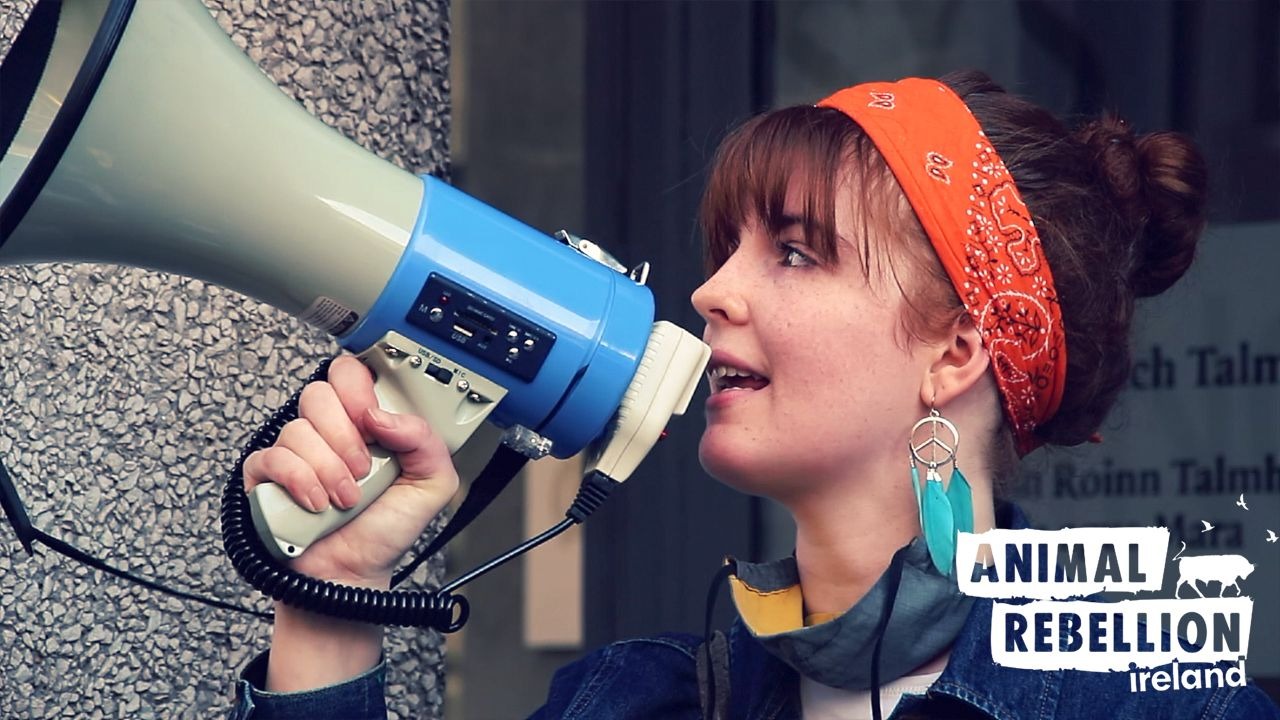
Ceara Carney protesting at the Department of Agriculture with Animal Rebellion – a subgroup of Extinction Rebellion. Photo courtesy of Animal Rebellion Ireland
Prior to the pandemic, Extinction Rebellion were one of the biggest groups at the forefront of climate activism, making headlines worldwide. But ongoing lockdowns saw them forced to take a step back and rethink their plans.
“We are very much on the way back with some new tactics and we can’t wait to get back to the streets in huge numbers again”
Ceara Carney
Actress, podcast host, and activist Ceara Carney wants to make it clear that the group hasn’t gone anywhere.
“Our main tactic of mass mobilisation was taken away from us,” she explains. “But we’ve had some activists and rebels throughout the pandemic and lockdowns constantly meet to figure out our strategy going forward.
“We had our People’s Assembly meeting a few weeks ago where there were 116 people on a Zoom call and we came out with some visions of where to go next. We are very much on the way back with some new tactics and we can’t wait to get back to the streets in huge numbers again.”
Carney attending a protest with Extinction Rebellion and Irish Wildlife Trust to highlight overfishing in Irish waters. Photo courtesy of Ceara Carney
For the past year, activism hasn’t quite looked like it used to – large scale protests have been replaced with smaller actions and social media posts.
After dousing the building with red paint, the two spray painted phrases such as “no more empty promises” along the exterior.
The activists explained that the purpose was to highlight the lack of action from the government in response to the global climate crisis.
Carney portrays a sea goddess at Killiney Bay as part of a campaign to raise awareness for rising sea levels. Photo courtesy of Ceara Carney.
Following the live stream, many people took to social media to express their disgust at the act of vandalism.
“People were just really upset that this historical building had been destroyed, and the irony of that just gets to me,” Carney says.
“If we don’t change, and the government doesn’t change, that building could be subject to water damage from rising sea levels because Dublin is a coastal city. So if people really cared about that building they would be putting pressure on their government too to act now and fight the climate crisis. Nothing like that will matter if we keep going the way we are going.”
If you are interested in getting involved with Extinction Rebellion, email welcomexri@protonmail.com
In a year where climate crisis was named the official Oxford English Dictionary
word of 2019, a solution to the environmental emergency is needed more than
ever. But with phrases like single-use plastic and carbon emissions now
entering mainstream conversation, it can be difficult to know exactly what
steps to take and what advice to follow when it comes to saving the planet.
Enter Luke Eastwood.
In his latest book How To Save The Planet, author and environmental activist Luke
Eastwood attempts to outline how we’ve gotten to the current environmental
state we are in and how we can attempt to control the effect our lifestyle has
on the planet, all in 10
simple steps.
“The earth is in a lot of danger at the
moment from humanity and you know everyone kind of knows that but it doesn’t
seem to stop people just getting on with their lives,” said Eastwood. “It’s
like everyone is waiting for someone else to make the first move and do
something.
“You know when you go to a dance and nobody dances, and then eventually someone is brave enough to get up and go and dance, and then everybody else gets up. It’s kind of like that,” said Eastwood. “I think humanity is standing around a dance floor and waiting for someone to actually get up and start doing it. In the meantime, the place is on fire and it’s just getting worse.”
Author and activist Luke Eastwood Source: lukeeastwood.ccom
In his new book, Eastwood sets out 10 simple
steps to be followed in order to live a more environmentally friendly life,
some of which include: stop buying stuff you don’t need; become flexitarian,
vegetarian or vegan, and have zero, one or two children. Sounds simple, right?
In reality, a fear of failure holds many people back from even attempting to
change their ways when it comes to being more sustainable.
“It’s really not that hard,” said Eastwood.
“All these things are things that we can change straight away, we could all
change them tomorrow if we wanted to. It’s just a matter of saying that’s a
good idea I’ll do that.
“I first got involved with Greenpeace when
I was 19 or 20 and I was going out and volunteering for things and people sort
of knew a bit about stuff then, but when Greenpeace started we were all
perceived as weirdos and now it’s a lot more respected. But I still don’t think
it has changed what people actually do in their everyday lives.
“People think ‘aren’t Greenpeace great’ but
then when it comes to their own actual lives it may not have changed anything
that they actually do. And my argument is that sitting there waiting for the Government
or Greenpeace or whoever else to fix everything is not going to work. We all
have to actually do stuff ourselves.”
Extintion Rebeliion protestors Credit: Paula Bowden
Following on from their week of rebellion
in October, climate action/agitation group, Extinction Rebellion have been
garnering more and more support in Ireland and around the globe. Their brash
style of protest and use of non-violent civil disobedience certainly makes
headlines, but some critics worry that their disruptive approach risks
alienating the average climate concerned citizen.
Eastwood is the regional coordinator for
Extinction Rebellion Kerry. As well as taking part in last month’s week of
rebellion, the Kerry-based group are also focused on protesting the government’s
support of a proposed Liquified Natural Gas (LNG) import terminal to be based
in Kerry. Eastwood says the group is now focused on moving away from disruption
and inconvenience, in favour of education.
“Some people are very violently opposed to Extinction Rebellion’s type of protest and then some people seem to be a bit more sympathetic. I think the danger is that if you inconvenience people too much they will turn against it. I think there are maybe better ways of protesting that don’t have to involve huge levels of inconvenience,” he said.
“Having now established itself, I think a
less adversarial approach would be something that would get people on-side
rather than alienate them.
“It was necessary at the beginning to put Extinction Rebellion on the map, to get people to wake up and listen and to notice because people have been talking about this since the 80s when I was a kid,” he continued. “They were saying ‘oh the Amazon is going to get destroyed’ and ‘if we don’t do something about emissions then it’s all going to be a disaster’, but here we are 40 years later and it’s still the bloody same, nobody listens and nobody cares.”
Source: Luke Eastwood
Half of all the proceeds from Eastwood’s book will go to Greenpeace, an organisation which he champions for tackling climate issues head-on.
“Extinction Rebellion is, from what I can see, quite well-funded, and what Greenpeace are doing all over the world is actually specifically targeting world problems, rather than the actual idea of it,” said Eastwood. “Greenpeace will target whaling or pollution in China, the actual causes that are happening right this minute.
“I think they’re fantastic because they do
achieve results with the pressure they apply. So I’m very happy to give them
some money towards that and I think it’s important for me. I don’t want to feel
like this hypocrite that’s done this wordy book and then keeps all the money
for himself.”
How
To Save The Planet is also printed on 100% Recycled
paper.
How To Save The Planet by Luke Eastwood
“The printing industry is so polluting and
so wasteful, people would be shocked at how wasteful it is,” said Eastwood. “If
I want to stick to my principles then it has to be done the right way and not
just a quick fix. It actually cost a lot more but I don’t want to be a
hypocrite.”
Eastwood hopes that people who buy the book
will share it or give their copy to others when they’re finished to continue
spreading his message of sustainability.
“My main thing is to encourage people to do
something,” said Eastwood. “I‘ve said in the book that if you finish this book
and then just put it down and carry on the same, then I’ve failed my mission.
“What I’m trying to do is to convince people,
even if it’s just a small bit, to improve the way they live, to be more mindful
of the planet and the effects we’re having. What we do now will probably affect
the next millennium. So I’d just like people to be more mindful about their
choices because we can’t really afford to get this wrong.
“If we mess this up there might not be
another century after this one with people in it.”
How
To Save The Planet is available to purchase in both
paperback and eBook. For more information head to http://www.lukeeastwood.com/





You must be logged in to post a comment.