Last month, marked the 170th birthday of Oscar Wilde. The City.ie took a visit to the famous poet’s childhood house where the event Oscariana was taking place, while also going to see key locations around Dublin associated with the poet’s life.
Some of the key items in Oscar’s life were on display in the home where he grew up. Many people attended the open house tour at 1 Merrion Square, which occurred over the weekend.
A walk on the Wilde side showed off aspects of his life, from where he was baptised to when he studied at Trinity College at the old library. Each stop showed a vital part of the poet’s life from early places to memories of his later life.
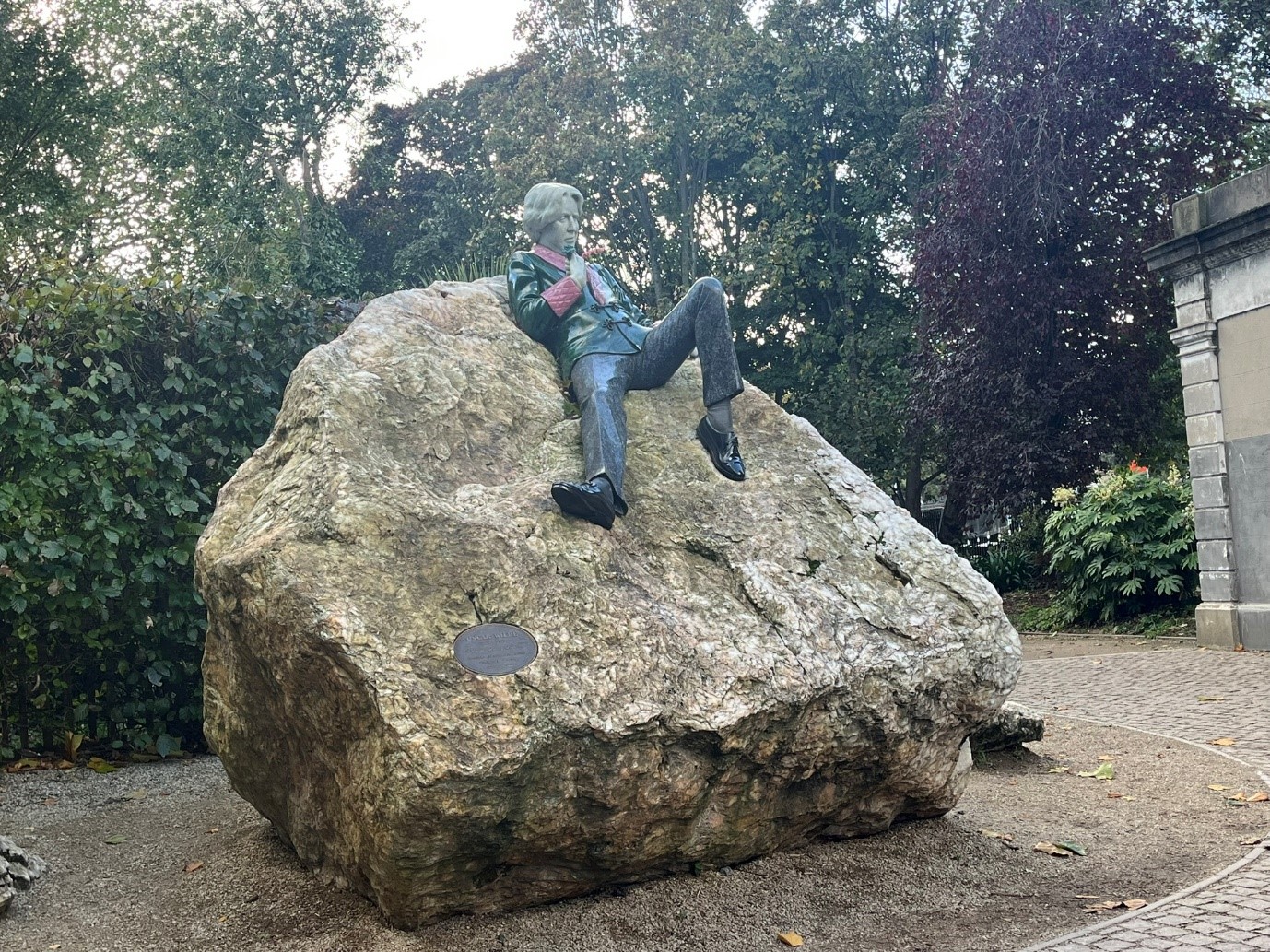
The Oscar Wilde statue in Merrion Square opposite the Oscar Wilde house. A statue of Oscar Wilde by Melaine lo Brecquy The outside of Wilde’s family home from 1855 to 1879An image published in Harper’s Bazaar during Oscar Wilde’s tour of America. A portrait of Oscar Wilde in his childhood bedroom A portrait of a young Oscar Wilde in a dress hung in his childhood bedroomOscar Wilde’s birth and baptism certificate and a copy of his parent’s marriage certificate. Some books that were written by Oscar Wilde and an Oscar Wilde action figure A portrait of Oscar Wilde hanging at his house. Some of Oscar Wilde’s published worksThe outside of Oscar Wilde‘s house at 1 Merrion Square The outside of the Old Library at Trinity College, Dublin, where a young Oscar Wilde studied.
More than 22,000 fathers have taken paternity leave in 2017 so far.
Figures released by the Department of Employment Affairs and Social Protection show that 22,375 fathers have received paternity leave in the first ten months of the year.
The payment for paternity benefit is €235 per week and it allows fathers to take two weeks off work within the first six months of their child’s birth or adoption placement.
New parents (other than the mother of the child) are entitled to paternity leave from employment or self-employment following the birth or adoption of a child.
The scheme entitles a “relevant parent” to paternity leave, which can either include the father of the child, the spouse, civil partner or cohabitant of the mother of the child or the parent of a donor-conceived child.
The above map shows a county by county breakdown of how many fathers received paternity benefit since January 2017.
Dublin, Cork, Galway and Kildare all saw over one thousand people receiving paternity benefit.
The chart below shows how many people in each county received paternity benefit in 2017 so far
Source: Department of Employment Affairs and Social Protection
The chart also shows an aggregate figure of how many people received paternity benefit in total in 2016 in each county.
As of 31 October 2017, 27,307 paternity benefit claims have been awarded since the commencement of the scheme on 1 September 2016.
According to a spokesperson for the department, the ‘other’ category represents “anyone claiming paternity benefit who does not have a RoI (Republic of Ireland) address. Mostly resident in NI (Northern Ireland), some UK (United Kingdom) but could include any EU (European Union) and EEA (European Econimic Area) national who are also entitled to paternity benefit – if they satisfy the qualifying conditions – even if not resident here.”
When asked if the Department thought the uptake of paternity benefit had been higher or lower than expected, a spokesperson said: “It was envisaged that the take up for paternity benefit would be lower than that for maternity benefit. This was attributed to a number of factors including parental choice, whether the father or relevant parent has sufficient PRSI contributions and whether or not their employer would top up their wages or, if self-employed, could they afford to take the time away from their business.
“Given the flexibility afforded to fathers and the scheme cycle it will be eighteen months from the commencement of the scheme before the Department will have an accurate figure for the take-up of paternity benefit in a full calendar year.”
Similarly, David Joyce, Equality and International Development Officer for the Irish Congress of Trade Unions said it is no real surprise that uptake of Paternity Benefit is low.
“This is the first time that men in Ireland have been granted any paid leave from work for family responsibilities and it is no surprise that such a major change in culture should take some time to bed in. Up to now, men didn’t have conversations with their bosses about the possibility of taking such leave while watching their female counterparts being disadvantaged by repeated absences from the workplace to look after family responsibilities,” said Mr Joyce.
Mr Joyce also said that the level of pay offered was very low. “Unless it is topped up by employers (highly unlikely unless there is a collective agreement between an employer and a trade union) – [it] is very low and a young family struggling to survive, pay rent/mortgage plus all of the costs associated with a new baby would have to think twice before deciding to take the two weeks,” said Mr.Joyce.
He also said that the introduction of paternity leave is a very welcome step towards changing our family leave system.
“It is important for fathers to develop a strong connection and attachment with their babies and the introduction of paternity leave helps in this regard. [The] reality is that we are moving from a sole breadwinner model to one that recognises the need for parents – not just mothers – to reconcile work and family life and it will take time to get there,” said Mr Joyce.
Paternity Benefit initiative was introduced in September 2016 under the Paternity Leave and Benefit and Act 2016.





You must be logged in to post a comment.