As restrictions to tackle Coronavirus are in place, some people choose to show their frustration in a form of protest. Many have condemned such protests not only for posing a greater risk to public health, but also for their possible links with far-right groups. Laura Matjusaityte talked with counter protesters and the people supporting them.
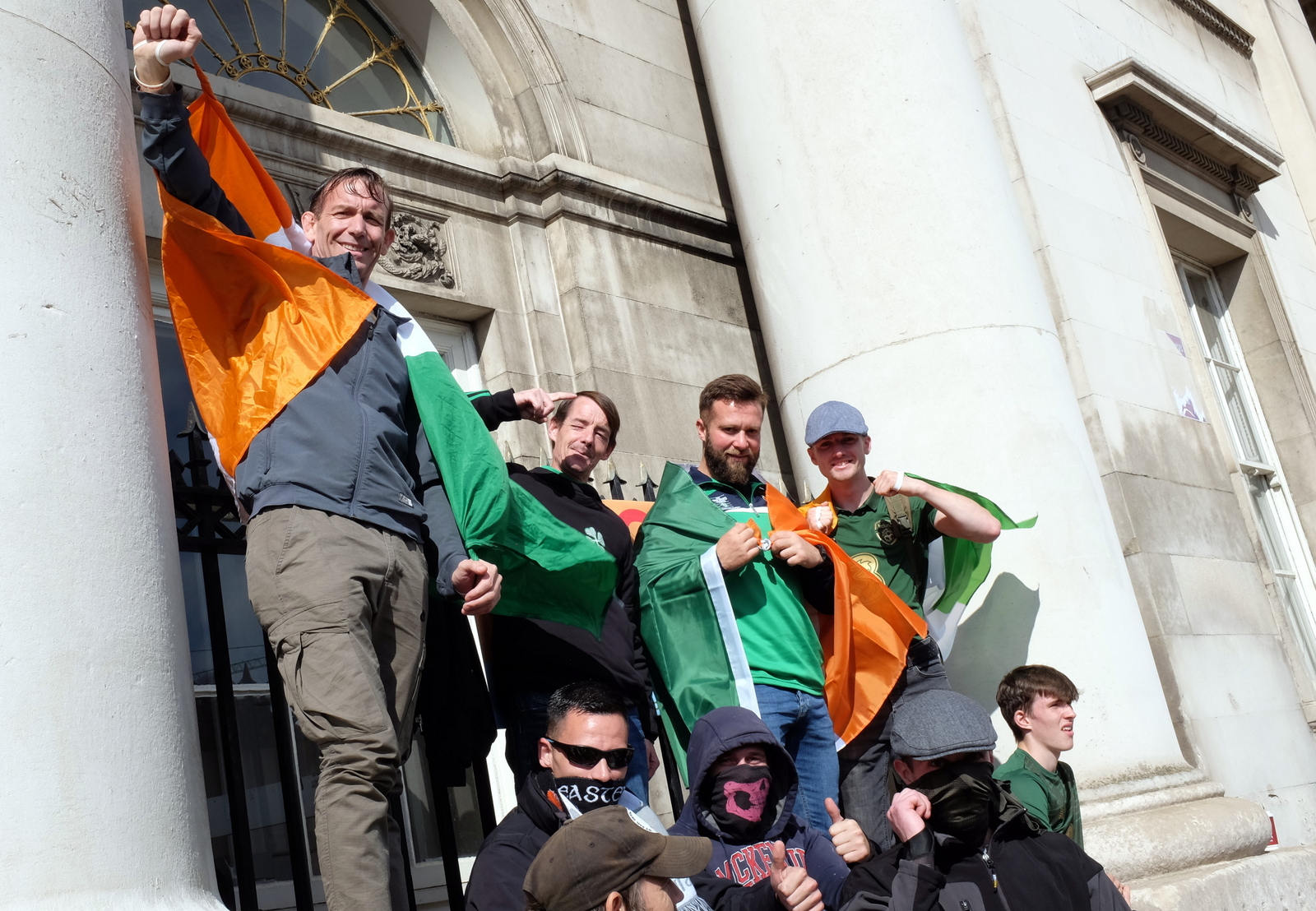
Anti-lockdown protesters. Photo by Barry Delaney.
Protests organised by such groups as Yellow Vests Ireland, which claims to be an independent citizens movement, and Health Freedom Ireland have been taking place in Dublin City Centre on the weekends since the start of autumn.
Within a short time the protests seemed to attract even more attention not only from like-minded, but also from opposing groups, which in some occasions ended up in clashes among the demonstrators.
It was reported that up to 100 Gardaí were called in to patrol a protest which took place near the Dail on the 10th of October. There were two instances where Garda intervention was necessary in order to break out clashes among protesters and counter protesters.
During the protest two men, one in his 30s and one in his 40s, were arrested due to the public order offences.
Garda reported that further investigations being carried into the organisers of both the anti-lockdown protests and the counter protests.
The current situation of the pandemic and public anger over government’s decisions has sparked an increase in various conspiracy theories, which are said to be being exploited by far-right leaders in order to gain influence.
The anti-lockdown, anti-mask protests are often being linked with the far-right political parties, the National Party, and the Irish Freedom Party.
Tommy Hamzat, an activist for the Black Lives Matter, said that allowing the far-right activists to organise such events is dangerous.
“Giving them a platform extends their reach and potential to recruit people who are completely unaware of how really dangerous they are,” Hamzat said, on the subject of an incident where an LGBTQ+ activist was assaulted in one of the first clashes against protesters and counter protesters.
The incident happened during an anti-lockdown protest on the 12th of September when a confrontation between the opposing groups started in front of Leinster House. During the clashes LGBTQ+ rights and Repeal the Eighth activist Izzy Kamikaze was struck in the head with a large wooden object and sustained a serious head injury.
Hamzat, talking about clashes among protesters and counter protesters, said that it was expected but “it was a massive disgrace that the Garda didn’t clamp down on the protest even happening”.
Antifa Ireland, an anti-fascist organisation operating in Ireland, is believed to be the organisation behind the counter protests. When asked about the anti-lockdown protesters, a spokesperson from the organisation said that their “only concern are fascists”.
Counter protesters gathered in Dublin City Centre. Photo by Barry Delaney.
“The National Party led by Justin Barrett has links to the German National Democratic Party and Italian Forza Nuova, ” they claimed.
The National Party leader Justin Barrett, known to the public for his strong nationalistic rhetorics, was seen giving speeches to the crowd of cheering protesters outside Leinster House during one of the protests.
The National Party leader is well known for his anti-abortion activism.
Back in 2002, Barrett admitted to the Irish Times that he did speak in the meeting of the far-right Forza Nuova party and participated in the meetings of the far-right German National Democratic party. Back then Barrett claimed that he wasn’t aware that both of these parties were regarded as neo-fascist organisations.
“Anti lockdown protesters, whatever we may think of their ideas, are not our opponents,” the Antifa spokesperson said.
In the midst of the clashes, the existence of the pandemic was completely forgotten. Many recordings circulating on social media show that while counter protesters wore face masks to cover their faces, the original group of protesters did not and the guidelines for social distancing were not being followed.
Hamzat said that the reasons why the safety measures and the threat of coronavirus was forgotten was because “the far right doesn’t care about anyone but themselves”.
“They used the lockdown aspect to get people to come,” he said.
On May 3, 2020, Japan celebrated the 73rd anniversary of its constitution coming into force. TheCity.ie’s Ayumi Miyano spoke with Kenneth Mori McElwain of the Institute of Social Science at the University of Tokyoabout PM Shinzo Abe’s push to amend Japan’s famously pacifist document.
The empty street of Marunouchi Nakadōri Street in Tokyo, Japan. Photo: Wikimedia Commons
During his seven-year tenure, Japan’s Prime Minister Shinzo Abe has been consistently expressing his ambition to pass a constitutional amendment in 2020. He may take advantage of any situation, even the coronavirus pandemic, to fulfil this ambition.
On May 3rd, 2020, the 73rd anniversary of the constitution, Abe took the opportunity to emphasise the importance and urgency of amending the supreme law of the land.
His streamed public address on YouTube was originally directed at the members of the public constitution forum, an organisation which consists of scholars, journalists, and members of Nippon-Kaigi, the largest right-wing organisation in Japan. This public forum is a pro-amendment group and has carried out several events to promote its views.
In the video message on May 3rd, Abe emphasised that the current constitution does not establish how the government can act under a state of emergency, except for article 54, which allows the convocation of the House of Councillors during an emergency session.
Japan’s pacifist constitution
On May 3rd, 1947, the Japanese constitution was enacted. In the aftermath of the Second World War, during the Allied occupation of Japan, the constitution was drafted by US General Douglas MacArthur, the ‘Supreme Commander for the Allied Powers’.
The Allied occupation of Japan lasted from September 1945 until April 1952. Under MacArthur, the Allied powers aimed at the demilitarisation of Japan – which had been officially recognised as the Empire of Japan under the military government of that period. One of the primary goals of the Allied powers was to transform the imperial Japanese socio-political system into a Western-style democracy.
“For everybody to agree, there was I think the description at the time to make Japan ‘the Switzerland of Asia’ – a good trading partner, but with a non-aggressive military force. That also combined with the very deep fear and threat of communism in eastern Asia,” Kenneth Mori McElwain, professor of political science at the Institute of Social Science, University of Tokyo, said.
“Their goal was democratic, specifically anti-communist, in order to make Japan like a democratic peaceful country,” he added. The constitution has been accepted by Japanese people as pacifist in nature.
In contrast, the Liberal Democratic Party (LDP), from its formation in 1955, set its mission to amend the American-drafted peacetime constitution and establish Japan’s own version of the document.
The LDP did not, however, draft a revised plan until 2012, which was then followed by its submission of four main points for discussion in 2018. One of the four points was a proposal to add a new constitutional clause that would give the Cabinet more power in a state of national emergency.
The pandemic has added urgency to the debate
The discussion of whether to add the emergency clause in the constitution has been complicated by the current decision to declare a state of emergency as a result of the pandemic. The state of emergency announced on April 8th to cover seven prefectures was extended nationwide eight days later, and led the governors of each prefecture to request that citizens refrain from leaving their homes. Despite this, whether or not to stay at home could not be enforced by the government.
Some supporters of the constitutional revision view the proposed emergency clause as necessary for the government to have the power to order citizens to stay home — the so-called lockdown. On January 29th, Gen Nakatani, a member of the LDP and former minister of defence, said a discussion about the constitutional amendment was necessary if the current Japanese laws were not sufficient to deal with the pandemic. On January 30, Bunmei Ibuki, a member of the LDP, said that the coronavirus pandemic is “one of the biggest experiments for the constitutional amendment.”
The LDP insisted that it was appropriate to add the emergency clause in the constitution to maintain the function of the Diet – the equivalent of the Dáil – during an emergency, such as a large-scale disaster. In case the Diet lost its capacity to function due to disaster, the party said the clause could be used to temporarily strengthen the authority of the administration, to allow for for swift governmental response. The drafted clause would enable the government to announce an emergency cabinet order, and the Diet to extend its members’ term with a two-thirds majority of the attending members.
Asahi survey: 72% say no rush for Diet to revise Constitution : The Asahi Shimbun https://t.co/3MNvbY4JOm
Under the current constitution, nevertheless, there appear to be ways to deal with an emergency like the coronavirus pandemic. To some extent, the government moved to bring the country as close as possible to a shutdown state. The New Influenza Special Measures Act was passed on March 13th and it enabled the government to declare a state of emergency and limited activities and public gatherings.
“Under this act, it is possible for the government to require certain companies to sell face masks and medicines to the government,” McElwain said.
“Most of the constitutional scholars say that on the one hand, individual rights need to be respected, and the government should not limit their rights unfairly. The constitution provides this concept by its 26th article. But at the same time, the government has a duty to secure the happiness and safety of the individual. When these two concepts are in the balance, can the government actually push for a new law that requires them to shut down businesses? It’s possible,” he continued.
What is at stake
Having an emergency clause is not unusual in the world. Indeed, the LDP’s original draft submitted in 2012 was based on Germany’s emergency clause. However, according to McElwain, the LDP’s plan lacks “clear criteria” for the process of declaring a state of emergency.
“It is very hard to intervene in the private sphere under the current constitution. However, if the specific law is enacted, that concept could be overwritten,” he said.
May3rd2019 is 72nd Constitution day in #Japan. Much more than last year,65thousands people were gathered in #Tokyo. The sight wasn't broadcasted. All we want is to cherish Constitution of JP. We won't allow PM to revise the constitution for militarism and fascism.#0503憲法集会https://t.co/pJajP1AAc9
Most countries state-of-emergency provisions “are very strict on the duration of the debate, mandate documents, or set the rule that the government has to report something every few weeks,” he said.
In the LDP’s draft, there are still many aspects of how a state of emergency would be enacted that are unclear – and might give excessive powers to a government.
“For example, the drafted clause only says that a state of emergency could be declared ‘by the process established by law’, and the timing of the declaration ‘needed to be established by law’,” McElwain said.
“The fundamental function of the constitution is it cannot be revised by a simple majority vote of the Diet. But if it says an immense authority will be given to the Cabinet ‘by the process established by law’, that lowers the hurdle back down to a simple majority vote. In principal, the government itself is formed with support by a majority of the Diet. What you are basically saying is if the Diet whose majority consists of the LDP members says yes to the government, the LDP’s administration can do anything. That’s a very weak check.
“If an authority were given to the Cabinet to cross the line which usually can’t be crossed, the process and the range of power would have to be carefully considered. There are many risks to let the person who already possesses power to decide freely when it is an emergency state. This is how dictators seize power,” he said.
“There are risks in allowing the person who already possesses power to decide when it is an emergency state. This is how dictators seize power.”
To add any new clause to the constitution, it needs to be approved by two-thirds in both the lower and upper houses of the Diet. It then needs to gain a simple majority vote in a national referendum. According to an April opinion poll conducted by the Mainichi, Japan’s national daily newspaper, 45 percent of people were supportive of establishing the emergency clause in the constitution, while 14 percent were against, and 41 percent were either “don’t know” or “no answer”.
“Japanese people tend to answer ‘neither’ or ‘no answer’ in surveys. It is true in social surveys and it is true in political surveys. It might mean Japanese people have neutral opinions. But the percentages of these two are significantly different from other countries,” McElwain said.
What those of a neutral opinion decide in due course could possibly be the key to whether Japan sees a revision of its constitution.
The Japan Federation of Bar Associations said that the procedure of amending the constitution needs to be discussed more. They emphasised there was a significant lack of regulations on advertisement and expenses of a referendum campaign, and this unfairly created a risk of promoting big-party preferences.
“Giving authority to the government weakens citizens’ rights. You should be very careful about it. And certainly it is not good to think about the emergency clause during an emergency like now – because everyone is emotionally unstable,” McElwain said.
While PM Abe’s strategy has often been labeled as a “thief at a fire” by politicians or scholars, constructive discussion regarding his mission to add emergency powers to the constitution has been consistently postponed. His tenure as prime minister will finish in September 2020; we have yet to see if this unexpected coronavirus emergency has made his dream come true or not.
TheCity.ie’s latest series, ‘An Island of Refuge?’ tackles the immigration policies of seven political parties, highlighting their views on asylum seekers, the Direct Provision system, migrants, climate refugees and open borders. Editor Kate Brayden gives an overview of the findings.
While Ireland’s recent General Election was undeniably focused on issues based at home, we have turned our focus to the increasingly unstable global landscape and its influence on our nation’s attitude towards migration and foreign affairs.
Éire may be known as a welcoming place, but the strain of climate breakdown is impacting far-right rhetoric worldwide – examining whether our politicians are succumbing to this issue is a key concern.
In the aftermath of the election, the parties must now organise a government that will withstand the tests of the international stage. This includes policies relating to justice and climate breakdown.
Photo: Pixabay
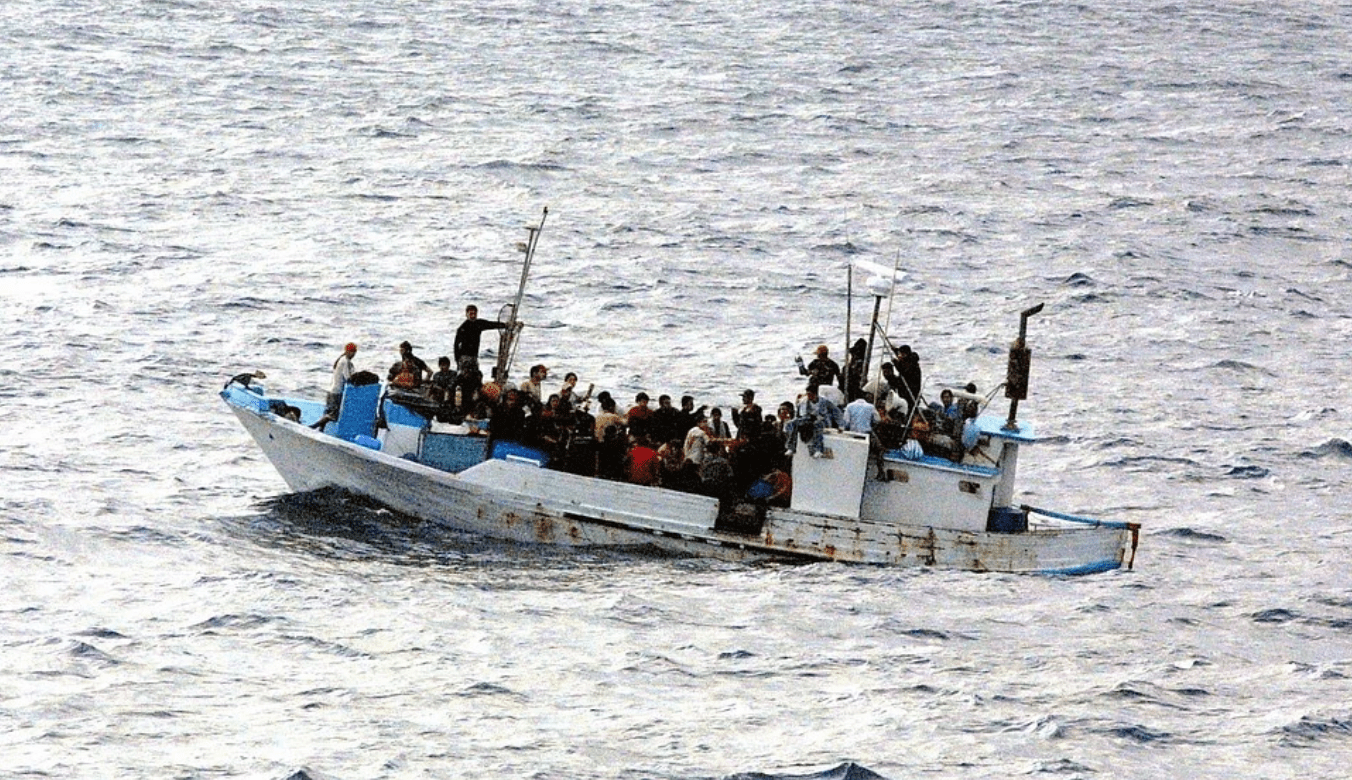
Refugees are a core part of this, with thousands risking their lives to cross the Mediterranean every year, and some losing their lives in the fight to escape war. The policies of ‘Fortress Europe’ aim to keep people from nations specifically outside of this continent out, the very people who are affected by the planet’s destruction despite having the lowest carbon footprint. How do Ireland’s political parties hope to treat them?
Sinn Féin, possibly writing the most intriguing manifesto in terms of economic promises, have claimed that they are against open borders, but also hope to end Direct Provision. What they would replace the system with, however, is a mystery. Should they find themselves in power, they intend to avoid a situation of mass climate-related migration – not solely for the difficulty it will pose to recipient nations, but because people deserve to live in their own nations and communities. Their stance certainly needs more explanation.
Mary Lou McDonald celebrates Sinn Féin victory. Photo: Instagram/africaworld_news
People Before Profit and the Green Party have socialist and left-wing policies embedded in their manifestos, with PBP acting as fierce critics of imperialism and of tyranny abroad. References are also made to the UN Security Council seat Ireland is hoping to win, as well as US military presence in Shannon Airport. The party condemn the murderous regime of Bashar al-Assad – someone largely responsible for the flight of Syrians towards Europe
The progressive stance of the Greens is reflected in their emphasis on freedom of movement, open borders and refugee housing, and they are highly aware of climate breakdown’s role in the displacement of innocent communities in developing countries.
Labour’s political director Nat O’Connor has taken an arguably weak stance, admitting that Ireland is not playing the part of a wealthy country, accepting a low number of refugees, but “we can’t promise to do something that we cannot do”. Housing and health are first on the priority list for the party, which are worryingly diminished following the election.
As the party competes for control of the Dáil, Fianna Fáil is proposing long overdue complete reform of the asylum system and to improve refugee accommodation. Their manifesto has figures and policies backed up by plans, which is a (welcome) change from some of the other vague manifestos. However, it could be all talk rather than action. Pledging to speed up the asylum process, they take a leaf out of the Greens book by promising an integration plan as well as allowing asylum seekers to access driving licences.
In 2015, the Fine Gael-led government pledged to take 4,000 programme refugees fleeing war-torn countries like Syria by the end of 2017. Even now, we’re still well short of that quota – having resettled only 3,206 such refugees. The government has faced fierce criticism over their handling of Direct Provision, with Fine Gael ministers exhibiting resistance to change. Former Minister for Justice Charlie Flanagan promised to improve the party’s numbers when it comes to refugee placements, but are they to be believed?
“The Irish of #Fingal have voted once again for their own extinction,” O’Doherty posted on Twitter following the result.
Interestingly, only 1 per cent of respondents cited immigration as a main voting concern of GE2020 in the Ipsos MRBI exit poll for The Irish Times/RTÉ/TG4/UCD. Within this umbrella topic, climate refugees, asylum seekers as well as migrants are all grouped.
Desolate refugee camps. Photo: Pixabay
There are important distinctions to be drawn between asylum seekers, migrants and refugees – but these terms often get mixed up in the course of public debate on what is a complex topic. The issue will only become more onerous as CO2 emissions cause further destruction in the Global South, South-East Asia, Australia, Canada and the US.
An asylum seeker is someone seeking refugee status – but whose application has not yet been approved. In the meantime, as long as they’ve made an application for asylum to the country they’ve landed up in – usually on the basis they were forced to flee their home country – they are entitled to remain in the destination country while their request is being processed. If it’s ultimately approved, then they have permission to remain. If it’s rejected, then they’ll be deported.
Though some, who fail to qualify as refugees, are granted subsidiary protection to remain. Migrants are not fleeing persecution; instead they choose to move country – often for economic reasons.
Those defined as refugees have been recognised as such under the 1951 Refugee Convention of the UN, while programme refugees have their claims formally assessed in refugee camps overseas – and are invited to the destination country under a resettlement programme.
With populist politicians gaining support in Europe and the United States, Gary Ibbotson asks why the Irish people haven’t welcomed the far-right. (more…)




You must be logged in to post a comment.