Tag: female artists

  • Pandemic as muse? Artists on their art in a year of lockdowns

    Pandemic as muse? Artists on their art in a year of lockdowns

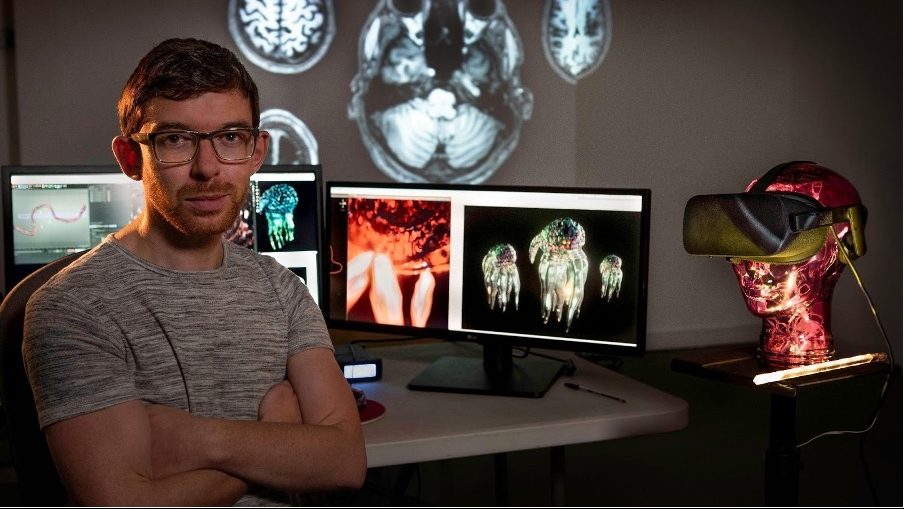
    Alan James Burns in his studio. Photo courtesy of Trevor Whelan

    Alan James Burns

    “I’ve had to move a lot of work online, which is quite interesting because it’s something that I never thought would be possible,” says Cavan-born visual artist Alan James Burns. “I usually create large events with up to 50 people attending, so that went completely out the window. Moving online has opened me up to be able to work from my bedroom, or work with international partners because you kind of break down the idea of having to be in the studio together.”

    Burns says he “can’t work now without putting in the context of the pandemic somehow.”

    “When I’m writing up my ideas and developing new works, it’s all with the context and background of this last year.

    “Everyone’s gone a lot more digital now, and the idea of the human machine – the digital world and our interconnectedness with that – has started feeding into a lot of new works I’m creating. I’m working with brain computer interfaces – looking at the idea of the human machine and what possible futures are like when we become more integrated with technology, which the pandemic has forced us all into.”

    Along with Sinead McCann, Burns is currently collaborating with users of intellectual disability services at St John of God Hospital in Dublin, as part of an artist in the community project. Participants are receiving training in audio recording and editing, and the piece they’ll create together will be exhibited on Culture Night in September.

    “That came about because of the pandemic. With everyone being at home, we decided to create a work, and the one medium we could think of that people would have access to tools, like a phone and stuff, was sound. So we’re all recording sounds and editing them together remotely online.”

    Tonally, Burns says his latest output has been “actually more hopeful than what it probably had been before the pandemic. The works that I’m creating have more joy within the production and also within what they’re trying to achieve for an audience when they do engage with it. So rather than looking negatively outward, they’re looking positively outward.”

    Burns says the Irish government’s Pandemic Unemployment Payment (PUP) has been a lifeline in compensating for cancelled projects.

    “Actually, I’m better off [than before the pandemic] thanks to the PUP. As an artist, you have no regular income, you live on minimal amounts of money, so the PUP was the first time many of us got a living wage that you could rely on.”

    Upcoming work: “Open Mind, Closed System”, Carlow Arts Festival, Co Carlow (June 2021)

    Ella Bertilsson

    Ella Bertilsson. Photo by Ella Bertilsson

    For Swedish multidisciplinary artist Ella Bertilsson, the initial lockdown last March was a case of life imitating art.

    “In the month before lockdown,” she tells The City, “I was working on a piece where I did a performance from inside a cardboard box, which was all about being trapped in a domestic space. That opening was I think two weeks before [the first] lockdown. So that was a super-odd coincidence.”

    In terms of concepts, Bertilsson feels the pandemic “will probably feed into my art at some point, but I think at the moment I find it hard to tell.”

    In terms of practice, however, her studio’s closure forced a rethink, as her workspace became “a tiny sewing machine table in a tiny room” at home.

    “I was like, ‘What do I do now?’ So, that was nice because it really brought me back into drawing a lot. I ended up illustrating a book cover and went back and sold a lot of prints, and I did a lot of photography. So the circumstances had an impact on my practice. It definitely had a creative impact. I’m now working with 35mm photographs I took around my neighbourhood every day for six months, and I’m turning them into digital collages with written text. That will be in my solo exhibition in Ballina next year.

    LOOPING SQUIRREL by Ella Bertilsson, music by Economusic

    “I hadn’t been doing drawings since my BA really,” continues Bertilsson, who’s been based in Ireland for the better part of two decades. “Now I’m drawing, and I’m printing and I’m doing things that I would have done a long time ago, so I think that’s kind of nice because I’ve done a bit of a circle and now it’s part of my practice again.”

    Bertilsson says she has “really enjoyed” the slower pace of the last year, in which she’s had “time to reflect on the work, and not have the pressure of exhibitions”.

    She counts herself fortunate to have been funded by the Arts Council for a number of projects in the lead up to and during the pandemic.

    “I think I was kind of lucky that I had that time to apply for awards,” she says, “and didn’t really have to use the PUP at all.”

    Upcoming works: Solo Exhibition, Ballina Art Centre, Co Mayo (2022),  Solo Exhibition, The Complex, Co Dublin (2022)

    Marcel Vidal

    Marcel Vidal. Photo by Marta Faye

    Sculptor and painter Marcel Vidal came into 2020 having picked up three prestigious awards in the previous year and landed a partnership with a commercial gallery.

    “I was in the midst of making work for a solo show,” Vidal says, “so that work had been established and the ideas were in place of how that might manifest itself. In a way, the work, as it’s developed, it’s changed in terms of what the overall show might have or potentially could have appeared like. It has a lighter tone. 

    “Some of my work would be large-scale cultural installations that are predominantly black, with paintings hung around the sculptural objects, whereas now the show is going to take on a lighter tone. The weight of [the work he is known for], its energy, is at this time unnecessary. So that all left my brain, and then it became about being in the studio [to focus on painting].

    “But it’s also maybe just that, as an artist,” continues the Wicklow native, “you find a way to manage the work. So for me, painting has been the easiest form to work in, in terms of just the practicalities of getting into the studio and being motivated. So in that way, [the pandemic] has influenced my art, in that I haven’t thought about sculpture, or that overall idea of making sculpture. But in conceptual or thematic elements, it wouldn’t play in that way. The type of art I make is never trying to speak on current or topical issues in that way.”

    The possibility of exhibiting Vidal’s show online was mooted, which he found “quite difficult, because it’s imagery that has a materiality, a physicality and a present. If it goes digital, the viewer is not having their own personal experience with it in a space. 

    “You come to a gallery or exhibition space with a set of criteria or a set of expectations as a viewer. And for me, the image and how it’s displayed and how you navigate that space – that brings out something else and that’s personal to that viewer. But if it goes into a digital format, you lose that context and it becomes something that could be viewed in distraction while doing something else. The subtlety of the work would be diminished and it could be misrepresented too.”
  • New York Times’ documentary Framing Britney Spears shines a spotlight on sexism

    New York Times’ documentary Framing Britney Spears shines a spotlight on sexism

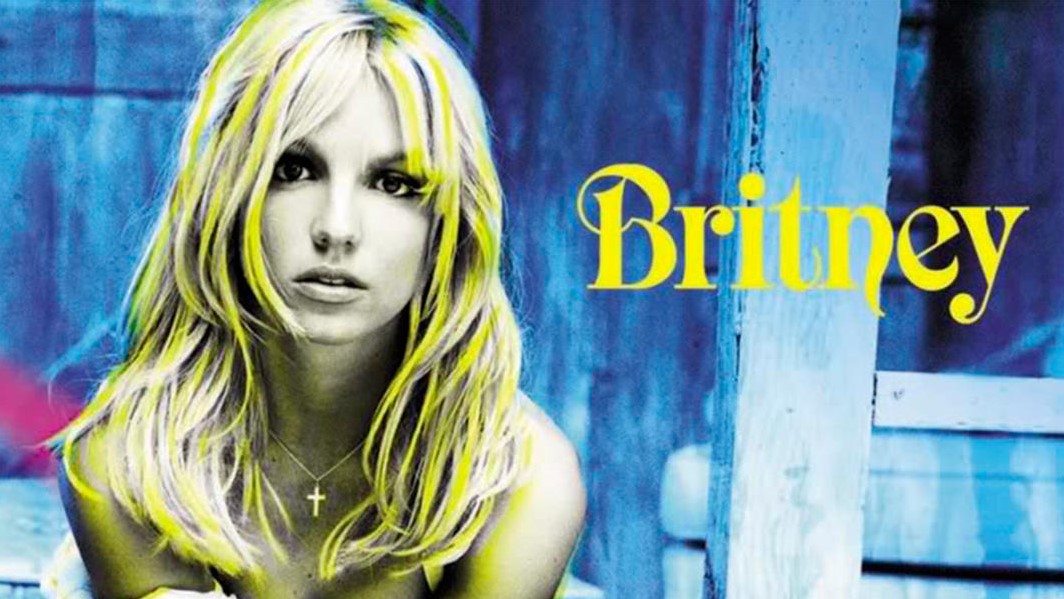
    Album artwork of Spears’ third studio album, Britney

    It was 1998 when a 16-year-old Britney Spears hit our TV screens with the music video for her debut single Hit Me Baby One More Time – a song that would propel her to superstardom.

    Twenty-three years later, society’s fascination with the pop star’s life is still going strong. 

    With six number one albums, 10 world tours, highly publicised mental health struggles, and now the #FreeBritney movement that focuses on her unusual conservatorship case, Spears’ name has never left the media – and tabloid culture has eaten up her every move. These are all things Framing Britney Spears explores as it documents the rise and fall of the global sensation.  

    Much of the documentary focuses on the media’s treatment of Spears, and how the blatant sexism and misogyny directed towards the singer, along with the lack of respect for her privacy, acted as a catalyst to cause the deterioration of her mental health and subsequent loss of control over her own life. 

    Throughout the documentary, we are presented with archive interview footage where media figures frequently ask inappropriate questions or make remarks centred around the singer’s sexuality. Spears is constantly asked about her clothing, breast implants, relationships, and her virginity – but rarely about her actual music. 

    This is something Spears has had to endure throughout the entirety of her career, and something she highlighted as a double-standard from the get-go. 

    The documentary focuses on Spears, but it’s also a look at the treatment of young women in the industry as a whole. Spears was not alone in her constant experience of casual misogyny. 

    “It’s hard enough being a woman in a male dominated industry”

    Soulé

    Many people have taken to social media to highlight examples of these misogynistic behaviours that took place right before our eyes.

    For example, the following clip from The Ellen Show, where singer Taylor Swift is relentlessly probed about the number of romantic partners she has had and is so humiliated that she is reduced to tears. 

    Swift is no stranger to the criticism surrounding her sexual life, and has often remarked on how her male counterparts do not go through the same levels of scrutiny.

    As more and more examples popped up online, I wondered to what extent this type of  casual misogyny exists here, in the Irish entertainment industry. The experiences of massive public figures like Spears and Swift are magnified, but similar occurrences are all too relatable for young women in the industry worldwide. 

    “As far as I’m concerned [sexism and misogyny] has been and still is a major issue, not only here in Ireland but all over the world”

    Katerina Chrysopoulou

    In October last year, Dublin drummer Emmanual ‘Smiley’ Osungboun made a number of sexist comments on a now deleted podcast referring to artist Soulé by name and implying women’s musical skills or abilities are influenced by their menstrual cycle. His comments were not surprisingly met with much outrage and disappointment. 

    “It’s hard enough being a woman in a male dominated industry – it’s another thing having fought and succeeded in obtaining a seat at the table to have our skills undermined based on our ‘periods’,” Soulé wrote on twitter. 

    This is just one example of the exhausting misogynistic behaviours female artists must endure.

    “As far as I’m concerned [sexism and misogyny] has been and still is a major issue, not only here in Ireland but all over the world. I’m from Greece and before I moved to Dublin I was an active musician there and can honestly say I have experienced similar behaviours in both countries.” Says Katerina Chrysopoulou, a Greek musician and performer based in Dublin.

    Katerina Chrysopoulou playing in Whelans. Photo courtesy of Katerina Chrysopoulou. Instagram page @_katerinachrys

    Chrysopoulou adds that she wants to be clear about one thing – the problem of sexism is not a men vs women problem, as is commonly thought. Although 99% of her experience with sexism has come from men, she has also been subjected to sexism by women.

    Katerina Chrysopoulou in Dun Laoghaire pier. Photo courtesy of Katerina Chrysopoulou. Instagram page @_katerinachrys

    “One example, which I’ve experienced myself, is the way men – and sometimes women – treat females who are in a position of power. Female band leaders, conductors, music teachers, and many more, have such a hard time doing their job because they are not taken seriously only because they are women. And when they finally try to make people take them seriously, they will be called bossy, crazy, hysterical, and asked if they are on their period,” she says.

    The unfortunate truth is that sexism and misogyny are extremely deep-rooted in our society and double standards remain prevalent. But Chrysopoulou believes there are many things one can do in order to better cope with these issues in the industry – or any workplace for that matter.

    “Surrounding yourself with people who love and support you is a big one, as they will create a support ‘system’, if you like, that will protect and uplift you at all times.

    “Facing sexism is not an easy thing and the more confident we are in ourselves and our skills, the easier it will be to stand up for ourselves, face those issues and even attempt to stop them from happening to us once and for all.”

  • Eve Belle finds harmony in lockdown

    Eve Belle finds harmony in lockdown

    The virtual ‘new normal’, a screenshot of Eve Belle over Zoom. Photo by Izzy Rowley

    Although Eve Belle and I live in the same city, we do not live within the same five-kilometre distance, and lockdown restrictions have demanded a Zoom call. Thankfully, Belle’s charm easily translates through a WiFi connection.

    There’s been a tangible shift in the artist’s career – she released her debut album, In Between Moments, last October to great critical acclaim, she has been named as one of Hot Press’ Hot for 2021 artists, and has been a part of the Other Voices #Courage series.

    Releasing her debut album during a global pandemic cannot have been an easy choice – with touring off the table, it’s harder than ever to promote your music.

    “If I had waited for the right moment, four months on, I’d still be waiting, so I just decided to make the right moment,” she tells me.

    Luckily, there was an upside: “It’s an unusually good time to release music because there are people who are really reliant on having a new thing to focus on and a new thing to listen to.”

    In-lieu of the stage, Belle diligently performed over Instagram live – a platform many musicians have relied on during the pandemic. When I tell her I once heard another musician describe it as the fat-free version of gigging, she laughs and says “that sounds about right”.

    “I saw a boy I liked. He didn’t want to talk to me, so I went home and wrote a song about it as if it was the end of the world”

    Eve Belle

    Performing as part of the Other Voices #Courage series alongside Neil Hannon and Cathy Davey gave her a chance to escape the virtual world. “It was the first time I’d gotten to do anything resembling a gig since March. So, I was literally beside myself to be at anything even remotely in the shape of a gig,” she says.  

    She’s just released this performance as an EP of paired-back, acoustic versions of three songs on her album.

    Other Voices has been a constant in Belle’s career – performing on the Other Voices stage at Electric Picnic when she was 16, and then playing the musical trail in Dingle later. “It was a lovely way to continue the trajectory of that, so it was definitely close to my heart to be back,” she says. 

    How did Belle see herself as an artist when she first started out?

    “I wanted to be in emo bands in school, but my mum said no. I’m very glad she said no – I would’ve absolutely wrecked my voice, but at the time I was like ‘oh my god, why are you doing this to me?!’” She laughs.

    Belle’s lyric-driven songwriting style comes naturally to her – holding on to her emo roots by writing what she calls “sad bops”.

    “I remember, I was like 13, and went to some event where I saw a boy I liked. He didn’t want to talk to me, so I went home and wrote a song about it as if it was the end of the world.

    “I’ve changed in no way – everything that happens to me I write a song about… But it was cringier and worse back then,” she laughs.

    Coming back to the present, I ask Belle how she made the move from acoustic guitar to a fully produced, popified album.

    “I was just lucky enough to have somebody in the studio who, when I would say ‘this might sound really weird, but I want to try this’ he was saying ‘I’m already there, I’m already doing it.’”

    “It was a lovely way to continue the trajectory of that, so it was definitely close to my heart to be back”

    Belle

    This “somebody” is Fred Cox, who has also worked with Rag‘n’Bone Man and Grace Carter. Belle credits her confidence in the studio to their creative relationship – one built on trust and sonic experimentation. This, she says, was all part of the creative journey she was on at the time – and the album is a snapshot of that journey.

    “There is a distinct difference between what I’m writing now and what I was writing before, because there is such a distinct difference in how I exist now,” she says, referring to her life in lockdown.

    “It’s just had an effect on how I view the world, myself, and the things that are happening. In the same way I have grown and changed, my music has also grown and changed.

    “In the past six months I’ve started writing more with the piano, which definitely feeds into a more lyrical style.

    “With guitar, you’ve got it in your hands, which is grand, but you’re driving the process completely along on lyrics. I feel like with piano, it’s more atmospheric, which feeds back into writing.”

    Unfortunately, we’ll have to wait until the world opens back up to hear this exciting new material, and Belle can’t wait for that to happen, “I keep telling everyone, I’ll even go to the opening of an envelope.”

    Catch Eve Belle at her gig in Whelan’s in April and stream In Between Moments and Other Voices Courage (Live Acoustic Sessions) on Spotify now.