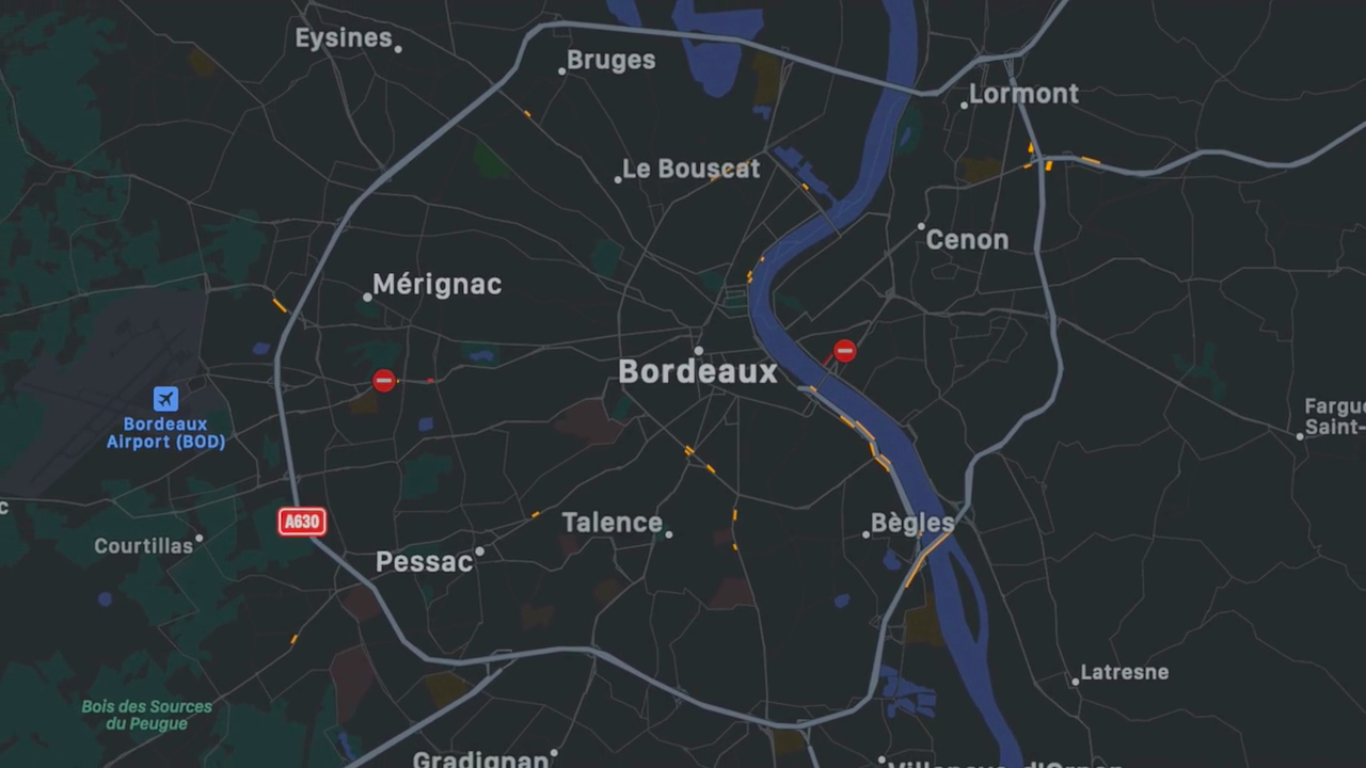
Map of Bordeaux from Google Maps. Screenshot by David Doyle
On 24 January 2020, the first European case of Covid-19 was confirmed in the French city of Bordeaux. This marked the starting point of an on-going pandemic, that still affects the country today. Due to a high population with leading touristic figures throughout the world, cases began to surge across France.
In early March, Amandine Verbiese returned to her native home of France, after living in Ireland for 5 years. Upon making her homecoming, France was on the cusp of becoming one of Europe’s worst affected countries, as there are over 3.4 million positive Covid-19 cases recorded today.
France officially went into a national lockdown on 16 March, as President Emmanuel Macron announced in a televised address that only essential services would remain open and a stay-at-home quarantine would be implemented.
“I just don’t know when this is going to end’’
Amandine Verbiese
‘’The first [lockdown] was particularly tough. When we left our house, we had to fill out a document giving our reasons for travel, whether it was going to work or walking the dog’’, said Verbiese.
She tells me how important it was to provide documentation during the first lockdown, as those who didn’t may receive a large fine or potential imprisonment if breached multiple times.
Verbiese has turned to gaming online as a coping mechanism during the pandemic. She is involved in numerous online communities and keeps in contact with her friends and family through video calls.
The coming weeks will prove vital for France as the existing health minister Oliver Veran is assessing the country’s current situation, as another lockdown may potentially be on the cards – due to the daily hospital admission figures of 1,500 over the past few weeks.
Léa Pelard reports on the French government’s position on the repatriation of French nationals who have travelled to fight with Isis in Syria and Iraq.
Ireland’s hopes of hosting the 2023 Rugby World Cup have been dealt a major blow after World Rugby have decided not to endorse their bid, choosing 1995 host South Africa instead.
World Rugby have selected their preferred candidate to host the 2023 World Cup after months of technical appraisals. South Africa came out on top with 78.97%, France second with 75.88% and Ireland last with only 72.25%.
Each country was assessed on five categories: finance and tournament guarantees, venues and host cities, tournament infrastructure, vision and concept, and tournament organisation and schedule.
Ireland didn’t top any of these categories and came last or joint last in all but one as shown on the table below.
World Rugby Chairman Bill Beaumont said: “The comprehensive and independently scrutinised evaluation reaffirmed that we have three exceptional bids but it also identified South Africa as a clear leader based on performance against the key criteria, which is supported by the board in the recommendation.”
This news, which came in the form of a 220-page document from World Rugby, is devastating for Irish rugby who received strong government backing, unlike France and South Africa.
Over €4 million has already been spent on Ireland’s bid to host the tournament by the IRFU and while it is not impossible for Ireland to be chosen as hosts, it now seems highly unlikely.
No. No it won’t. Your life will be pretty much be the same as it was before, except that you will be able to marry whoever you love, without worrying about what is between his or her legs. And that’s great.
A referendum to chose between equality and inequality.
Ireland will hold a referendum on May 22nd. Voters will decide if the Constitution should be modified in order to grant access to civil marriage for same-sex couples.
“Marriage may be contracted in accordance with law by two persons without distinction as to their sex.”
This small modification to Article 41 is very important as same-sex couples will finally have access to the same protection that the Constitution gives to families composed of heterosexual couples. Everyone should be able to marry the person he or she loves. It is all about equality.
Ipsos MRBI did a survey for The Irish Times, in order to figure out the voters’ intentions. Even if the results seem very encouraging – estimating 74% of the voters will choose YES whereas only 26% will choose NO – the survey only included voters who were sure about their decision. In other words, undecided voters were left aside. Nothing is done yet: organisations still have to fight for equality.
The way to same-sex marriage is never simple.
In Europe, only twelve countries have voted for same-sex marriage. (Click on the map to see the date when it came or will come into effect.)
In France, for instance, the question of same-sex marriage resulted in several demonstrations from both sides of the cause. But frankly, nothing changed for the lives of the ‘Pro No’ campaign, because the law does not force you to marry someone from the same-sex. It just enables you to do so. People are just afraid of change, unreasonably afraid of change.
The case of France.
Same-sex marriage was one of François Hollande’s promises during his presidential campaign in 2012. A law was then presented to the members of the government on November 7th, 2012. On May 17th, 2013, the law was voted and finally applied the next day. The first same-sex marriage took place on May 29th, making Vincent Autin and Bruno Boileau France’s first same-sex married couple.
I was in Paris when all the talks and demonstrations were going on about same-sex marriage. Demonstrations were made by both sides, and organised as if they were answering to each other’s. When the pros did one, you could be sure that the contras would organise a demonstration a week or two later, and vice-versa.
Marriage Pour Tous, Photo by Pierre-Selim on Flickr
I remember being in the pro same-sex marriage demonstration. It was a very colourful crowd, people were waving rainbow flags, dancing, singing and holding funny signs to express their point of view. The crowd was composed of various types of people, young and old, male and female, homosexual and heterosexual, from all ethnicities and religions. Those people were supporting and fighting for equality.
The only thing I remember about the other side is seeing families in the subway, with their flags saying “La Manif’ Pour Tous” ; which can be translated as “The demonstration for all”. Their colour code was blue and pink. I guess that blue was supposed to represent the idea of masculinity and that the pink was supposed to represent that of femininity. Sweet clichés.
Photo by Nils Hamerlinck
One of their arguments was that a family had to be composed of a mother and father, and that legalising same-sex marriage and adoption might cause great damage to kids. Those kinds of arguments were used by a man who decided to put children in front of the riot police so that they would not push them, during one of the demonstration.
Those kinds of incidents shocked me, but I was even more shocked that those people were basically protesting against more rights for the community. In my opinion, protests should be used if individuals need their rights to be considered – not in order to prevent part of the population from finally having access to equal rights.



You must be logged in to post a comment.