Over the last 15 years, the number of daily Irish speakers has fallen by 13%, from 83,000 to 72,000. With the government investing only 0.1% of state expenditure into the Department of the Gaeltacht, it’s not difficult to see why numbers are dropping so drastically. On Saturday, September 20, thousands of people took to the streets to protest and campaign for the Irish Language and Gaeltacht investment plan 2024-2029. We spoke to attendees and two top level members of Conradh na Gaeilge about their demands.
Tag: Gaeilge
-

An Ghaeilge: Exploring the Revival of Ireland’s Native Language
By Liam Murphy
“Why would you bother learning that? Sure, it’s a dead language” – the words many Irish speakers have heard while growing up.
However, in 2024, that could not be further from the truth.
Today, TheCity.ie speaks with Mícheál Ó Nualláin, director of Baile Átha Cliath le Gaeilge and Ola Majekodunmi, Irish language programme co-ordinator with Fighting Words, about all things Irish, and in particular, their own journeys with the language.
From schooling to job opportunities, to what they believe the Government needs to do to further progress the language, the Gaelgóirí tells all.
-
Fewer Irish speakers according to Census 2016
Recent figures released by the Central Statistics Office (CSO) in November this year show that the number of people speaking Irish is declining.
Information gathered during the 2016 census revealed that as of April 2016, 1,761,420 people (39.8% of the population), aged 3 and over, said that they could speak Irish.

Out of the total amount of Irish speakers recorded, 968,777 were female and 792,643 were men. Compared to 2011, there has been a drop of 0.7% (-13,017 people).

However, of the 39.8% of people who stated they are able to speak in Irish, one in four (23.8%) of them admitted to never using it, while a further 558,608 (31.7%) expressed that they haven’t used in daily conversation or for any other reason, since leaving school.
Of the percentages of people able to speak Irish, the highest numbers were recorded in Galway County at 49%. Clare closely followed with 45.9%, with Corky County (44.9%) and Mayo (43.9%) shortly behind.
The lowest percentages were found in Dublin City at 29.2%, followed by Louth and South Dublin, both at 34.1% and Cavan at 34.6%.
The number of those who say they speak Irish less often than weekly stood at 586,535 people (33.3%) compared to the lesser percent of people who attest to speaking the language on a weekly basis, (6.3%) or 111,473 people.
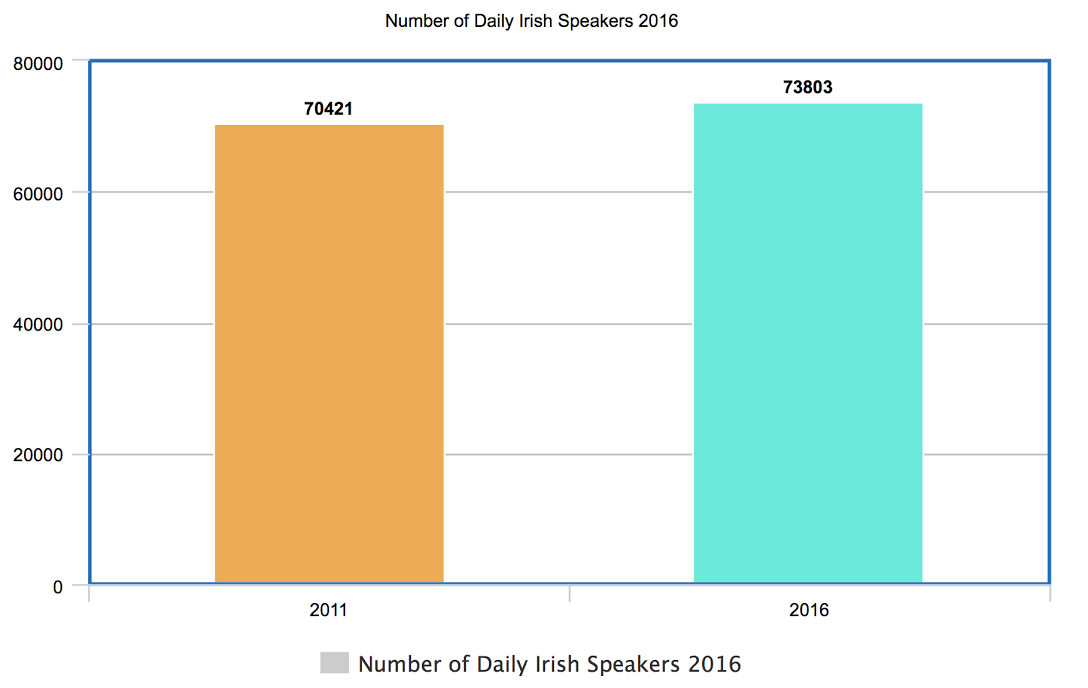
While the number of daily Irish speakers stood at 73,803, representing 1.7% of the population. This was a decline of 3,382 (4.4%) on 2011.

20.2% of the total 73,803 lived in Dublin City and suburbs. This was an increase of 674 people (4.7%) since 2011. Cork, Galway and Limerick together accounted for 6,034 daily Irish speakers (8.2%).
Outside of these cities, the largest absolute numbers of daily speakers were living in An Bun Beag-Doirí Beaga (771), followed by Letterkenny (525) and Swords (487).
Daily Irish speakers in the Gaeltacht areas of Galway County and Donegal made up almost three quarters of all daily Irish speakers in Gaeltacht areas, with 9,445 (45.9%) in Galway and 5,929 (28.8%) in Donegal.
By Megan Walsh
-
Tír gan teanga, tír gan craic
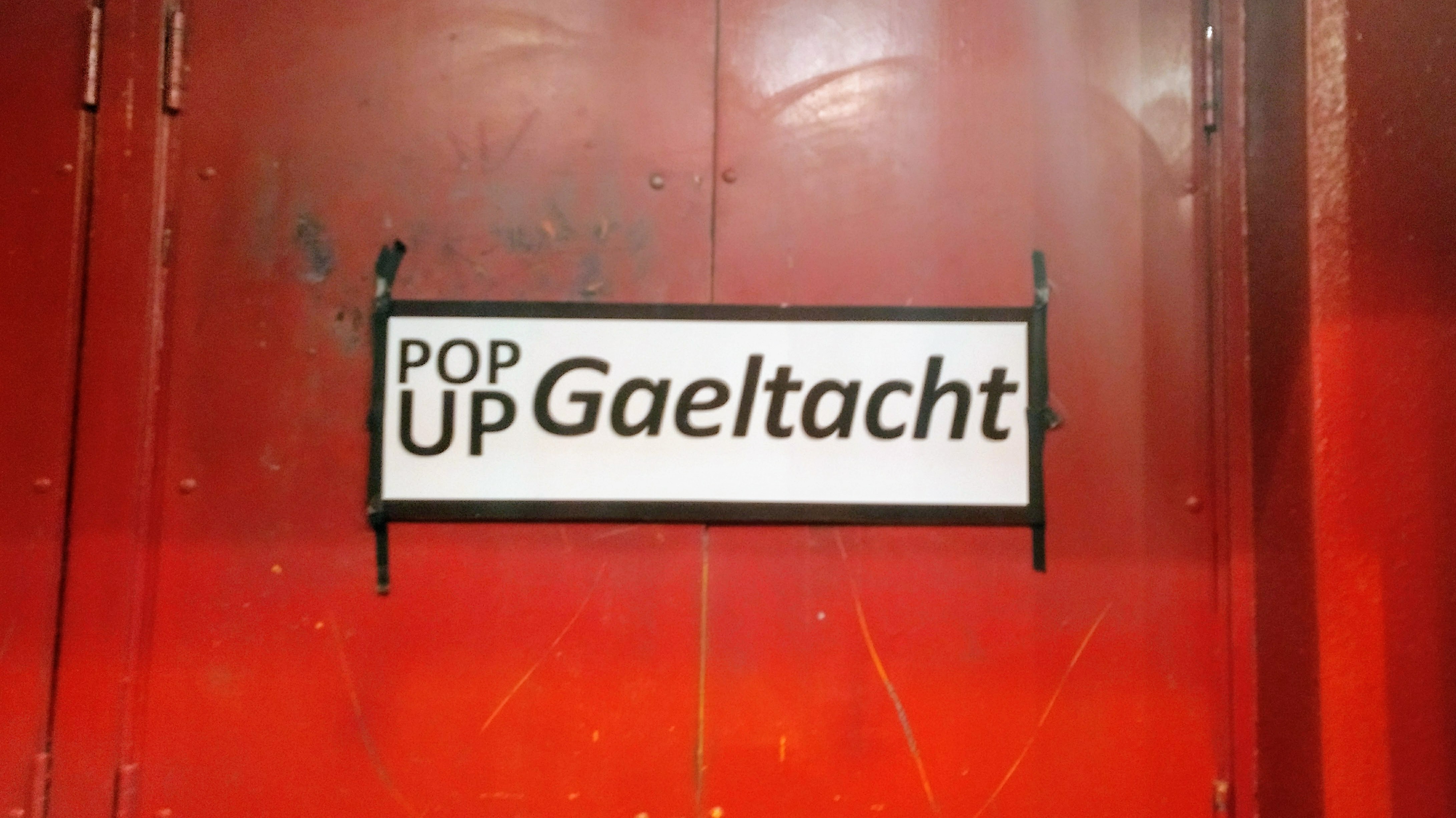
As Seachtain na Gaeilge draws to a close for another year, Sarah Harford pays a visit to Dublin’s Pop Up Gaeltacht.
A cold March evening in Dublin. The streets are bustling. It’s the night before St Patrick’s Day, and the city is filled with revellers wearing green leprechaun hats and shamrock-adorned clothing.
Turning the corner onto Dame Lane, I hear laughter and exclamations of “conas atá” and “oh mo dhia”. The well-known stretch of pubs between the Bankers and Dame Tavern is packed full of people doing something slightly out of the ordinary – speaking in Irish.
‘Bat signal’
“We wanted to prove that the language was alive and well so we decided to send up a ‘Bat Signal’ to ask Irish speakers to get together in one place,” said Peadar Ó Caomhánaigh – one of the organisers of Pop Up Gaeltacht.
“Bhíomar ag iarraidh cruthú gur teanga bheo í an Ghaeilge, agus mar sin bheartaíomar sórt ‘Bat Signal’ a chur in airde chun lucht labhartha na teanga a mhealladh le teacht le chéile.”
Ó Caomhánaigh, along with Osgur Ó Ciardha, put this event together as a reaction to the current perception of the Irish language.
“Both of us noticed a lot of negative coverage of the Irish language in the media late last year, saying it was a dead, worthless language, and that no one in the city was speaking Irish,” says Peadar.
A group playing traditional Irish music entertained crowds outside the Mercantile pub. Video by Sarah Harford
Speaking to The City, as Gaeilge of course (his answers have been translated into English), he explained that the idea behind this event was very simple.
“Pop Up Gaeltacht is a social event for Irish speakers. We get together just to be together, and to speak Irish in places the language wouldn’t normally be heard.”
“All sorts of people go along. Young and old, fluent and the ‘cúpla focal’. We’d recommend, if you have any worries about your own level of Irish, to bring along a friend and just try to use whatever Irish you have.”
“Bíonn gach chineál duine ann, idir óg agus aosta, idir lucht na líofachta agus dream an chúpla focal.”
Pop Up Gaeltacht started small, with an event in Bar Rua on Clarendon Street back in November 2016. Since then they’ve held monthly gatherings which have grown in size as the word has spread. But for Seachtain na Gaeilge, Peadar and Osgur decided to be more ambitious.
“Up until now we’ve packed out bar after bar in Dublin. As part of Seachtain na Gaeilge and the St Patrick’s Festival, we decided to choose a whole district of the city. We want to fill the whole of Dame Lane with Irish on the night of the 16th,” said Peadar.

“Talk, kiss, laugh, travel, dance, fly, eat, drink, listen”, sign outside Bar Rua, Dublin. Photo by Sarah Harford Caint agus craic
Personally, I was a little nervous entering this guerilla-style Gaeltacht. Although I’d spent 14 years learning the language at school, like most other people on this island, my Irish is a little rusty.
I thought that everyone in attendance would be hardcore Gaeilgóirs, spouting words and phrases that sounded only vaguely familiar to me. But, just like riding a bicycle, these things return to you pretty quickly.
The atmosphere was welcoming, the Irish was flowing, and there was even spontaneous traditional music and céilí dancing.
From the crowds of people I encountered there, it is clear that Pop Up Gaeltacht has really caught on. It may be a simple concept, but it’s an effective way of bringing people together to speak the language in a casual setting. Mostly, however, it’s just a good bit of craic.

Crowds gather outside the Stag’s Head, Dame Lane. Image by Sarah Harford The organisers are making no money from the event, using it only as a way to spread the Irish language. They hope that this will encourage more people to get involved.
“Pop Up Gaeltacht is an open source, so anyone in the world can organise one. There have been Pop Up Gaeltachtaí in Cork, Derry, Belfast, Limerick, New York, Washington DC, Perth…The list goes on,” said Peadar.
https://twitter.com/_thebradyman/status/842675699345489920
https://twitter.com/RdeBuitlear/status/842524093274624000
Speaking in tongues
It seems strange that Pop Up Gaeltacht should be such a novelty when Irish is still the official language of the country.
According to the 2011 census, 1.77 million people in Ireland, approximately 40% of the population, said that they could speak Irish. However, only 82,000 people claimed to speak the language on a daily basis outside of the education system.
This makes it only the third most spoken language in the country after English and Polish, but it certainly does not imply that Irish is in decline. Long-term census data shows an increase in the number of people speaking the language in recent years.
St Patrick’s weekend saw a deluge of tourists descending on Dublin and so the city was awash with languages from all over the world, plus the ubiquitous American accents. However, it was great to hear Irish also being spoken so widely in the middle of the festivities.
With an impressive turnout and an enthusiastic response, Pop Up Gaeltacht seems to have confirmed that the Irish language is still alive and well.

Featured image by Sarah Harford
-

2013 – the year for celebrating the Irish language
By Fionnuala Holohan
2013 is fast becoming the year of everything Irish. The diaspora abroad are being invited back to Ireland as part of The Gathering 2013 and also, closer to home, organizations dedicated to preserving and promoting Irish as a living language are rowing in behind Bliain na Gaelige 2013 – the Year of the Irish Language.
Over 80 organizations have signed up to-date – universities, teacher groups, student groups from all levels, radio, television and print media, local and national community groups, training organizations, governmental supports and the usual list of national agencies that promote the language, such as Conradh na Gaeilge (CnaG).
Síne Nic an Ailí, a development officer in CnaG, spoke to theCity.ie about the plans for the year, and theCity.ie reporters Fionnuala Holohan and Patrick Gormley went in search on the streets of Dublin of some of the reported 1.7 million Irish residents who say they can speak the language:
Le haighaidh níos mó eolais, téigh go dtí http://gaeilge2013.ie/
You must be logged in to post a comment.