
Tag: gender equality

  • Lost in the Sy-Stem

    Lost in the Sy-Stem

    Niamh Cullen pictured with some male engineering students in UCD

    In 2019, the Understanding Gender Differences in Stem study found that the Leaving Certificate subject choice of girls strongly influences whether they will study science, technology, engineering and mathematics (Stem) at the third level.

    It was recorded in 2016 that less than 1% of girls studied higher level engineering as a Leaving Cert subject in Ireland, in comparison to one in six boys. 

    One of the biggest issues connected to the lack of women studying engineering and other Stem subjects is how difficult these subjects are to access in all-girls secondary schools because the classes are not provided for them. 

    In 2019, 55.7% of all-girls secondary schools offered Stem related subjects, other than maths or science, compared to 95% of all-boys secondary schools offering the same subjects for the state exams.

    “We’re not encouraged to study the subjects that you encounter for the course,” says Niamh Cullen, a masters engineering student at University College Dublin, who previously attended an all-girls secondary school.  

    “We’re not encouraged to study the subjects that you encounter for the course”

    Niamh Cullen

    “Personally, I feel that my secondary school did absolutely nothing to encourage girls to do engineering or barely even science,” Cullen states. 

    “Boy schools get offered technical graphics engineering, which is a Leaving Cert subject, or even woodwork, but, I haven’t come across a single girls school in my area that offers that,” Cullen continues.

    A representative from the Department of Education also adds, “Generally, subjects such as engineering, technology, graphics subjects and materials and construction subjects are optional. Other science-based subjects including chemistry, biology and physics may also be optional, depending on a particular school’s curriculum at senior cycle.”

    A Leaving Cert student, who chose to remain anonymous when talking to The City, said that her class had to specifically request her all-girls school to provide applied maths classes for the students. 

    Cullen’s experience reflects this. “I remember myself and some other classmates had to go up and ask the school counsellor about studying it in the school. I don’t know why applied maths isn’t more heavily encouraged.”

    “The opportunity to choose science and technology subjects in school is something that we feel very passionate about,” says Jennnifer Keenahan. 

    Jennifer Keenahan picture with some of her research team and collaborators

    Keenahan is an assistant professor in engineering at UCD and on the Executive Committee for Women in Technology and Science (Wits). The goal of Wits is to promote girls, ladies, and women in the fields of technology and science so they can be encouraged to have a career in Stem. 

    “We would like to support and see more of that [Leaving Cert science and technology subjects] and then build on that at third level, and encourage girls and ladies into those subjects at third level. We would like to see more ladies stay in Stem,” Keenahan states. 

    “We would like to see more ladies stay in STEM”

    Jennifer Keenahan

    In 2019, only 77% of all-girls schools offered physics, chemistry and biology for the Leaving Cert whereas, 92% of all-boys schools across the country supply all three classes.

    Keenahan also comments on the matter saying that the lack of science classes in all girl’s schools, “historically, has been a challenge.

    “Even still, in some schools, some subjects, like applied maths, may not be available on offer in all schools. That certainly is a barrier and can be a factor, which is something that we would like to see addressed,” she adds. 

    Although the number of girls sitting applied maths for the Leaving Cert is increasing, it still remains under 35% in total, graph obtained from the STEM Education Policy Statement 2017–2026

    A representative from the Department of Education states, “The Stem Education Policy Statement acknowledges the need achieve gender balance in Stem education and careers. It acknowledges that there is a need to increase the uptake of Stem subjects and increase the number of females taking Stem subjects for Leaving Certificate.”

    The lack of guidance in all-girls schools for sciences and other related subjects can also discourage girls from choosing a career related to Stem, as their school counsellors and families have little knowledge about the subject and career path. 

    “At career fairs, they don’t really talk about it. We got loads of talks in different colleges about business, commerce and law courses but never one about engineering,” Cullen tells me. 

    A prototype of a rotating disk electrodeposition device with ultrasonic agitation, photo by Niamh Cullen

    This issue is further acknowledged by The Department of Education, “A key pillar of the Stem policy is to nurture learner engagement and participation; it also includes a commitment to monitor uptake by all students, and to increase female participation in Stem. “

    The Department is “committed to increasing awareness around Stem, it is not just awareness for young people but also for teachers and parents. This work has included awareness campaigns with Science Foundation Ireland targeting students in the run up to CAO deadline (#IGetPaidToDoThis, ‘This is STEM’), information flyer for schools and parents on the Department’s approach to Stem education, how to promote STEM and where to look for more information on Stem education.”

    “Starting [Stem subjects] at a really young age is always a good thing to do,” advises Kennahan.

    “Increasing awareness around Stem, it is not just awareness for young people but also for teachers and parents”

    Department of Education

    “Primary school science and the BT Young Scientist are opportunities where kids in primary school and secondary school can get involved in science and technology projects,” Kennahan

    In 2017, the Irish government created a plan to have the best education quality and training service in Europe by 2026. A part of this initiative is to have a 40% growth in girls studying Stem subjects at Leaving Certificate level. With only five years left to reach this target, can Ireland succeed in its goal?
  • Irish women weightlifters snatch the spotlight

    Irish women weightlifters snatch the spotlight

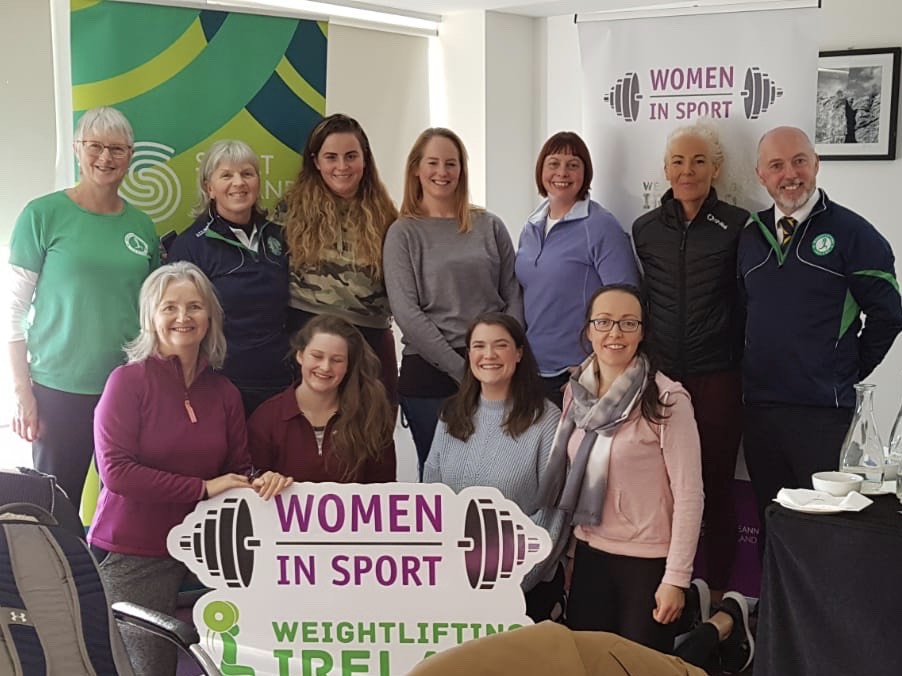
    The Women in Sport Initiative by Sport Ireland was supported by Weightlifting Ireland. Change is afoot? Front row: Ruth Deasy, Isla Hoe, Aoife Bradley, Sinead Ryan. Back row: Lucy Moore, Phil Brown, Freya Hammer, Kathy Boylan, Shauna Kane, Kate Meenan, Peter Carroll (General Secretary, Weightlifting Ireland). Photo courtesy of Harry Leech

    There’s no doubt about it – weightlifting is a traditionally male dominated sport.

    Women’s weightlifting didn’t even make it into the Olympics until 2000, while their male counterparts had been there since 1896.

    Thankfully, times are changing. 

    “We have a very high representation of women within the sport in Ireland. There are instances of people being sexist – there’s that underlying bias that exists in people, but I don’t think that’s inherent to the sport,” says Isla Hoe, an amateur weightlifter and self-described ‘casual competitor’.

    “Within weightlifting in Ireland, the issues are wider systemic issues that have to be addressed by society as a whole, rather than just the sport,” Hoe explains. “Where I would see sexism appear is in how non-weight-training people perceive females within weight training sports.”

    There are undoubtedly stereotypes held about women weightlifters – one only has to go to the more misogynistic corners of the internet to find people babbling about how weightlifting makes women ‘look like men’ – apparently a fate worse than death.

    The instagram account You Look Like A Man is a wild read – each post chronicling typical sexist comments made to women in sports, including weightlifting.

    “Certainly, for an older generation of women, there’s been a misconception that lifting weights is dangerous or it’s not feminine – all of these are very outdated ideas,” says Harry Leech, the head coach and co-founder of the Dublin-based weightlifting club, Capital Strength.

    “There’s no reason why women shouldn’t do weightlifting, so we thought: what are the potential barriers going to be to them? It’s important that you have that welcoming environment and ethos, then the only other barrier is investing in equipment that’s suitable for men and for women,” he says.  

    “Where I would see sexism appear is in how non-weight-training people perceive females within weight training sports”

    Isla Hoe

    Traditionally, 20-kilo bars were the standard in weightlifting clubs and gyms. These best suited men’s, on average, larger hands. Women are, on average, smaller, and have smaller hands than men, which required the introduction of the 15-kilo bar. It weighs less simply because it’s narrower – making it easier to grip for female weightlifters.

    From left to right: Isla Hoe, Aoife Bradley, and Sorcha Brady at Capital Strength gym. Image courtesy of Harry Leech

    Initially, these bars were very expensive and as the sport was so small in Ireland, clubs didn’t have enough money to invest in much equipment. As the sport was male dominated, it was more common for clubs to purchase 20-kilo bars than 15-kilo ones. However, now the market has opened up and the equipment is more affordable.

    Currently, Leech reckons that Capital Strength owns more 15-kilo bars than 20-kilo ones.

    “It’s always been important to have a very equal, very welcoming, very gender-neutral aspect to our club,” Leech says.

    “I think some people have an image of a weightlifting gym in their head, and it’s guys in leotards, making crude, offensive jokes, and lifting heavy weights – but that couldn’t be further from the truth,” he tells me.  

    Clubs like Capital are a fantastic addition to weightlifting in Ireland, however, there are still issues that have to be dealt with.

    “The sport needs to encourage more women’s coaches and women’s officials now. They are coming through, but it’s probably something that’s going to take time to get to the point where it should be,” Leech says.  

    “If you can’t see it, you can’t be it,” says Dr Lucy Moore, a masters athlete, and athletics and weightlifting coach who feels that positive representation for women is an important factor in creating equality.

    “There are very few women coaches at senior level, and if you want to be it, you have to see it. It’s the same issues in the professional world, why don’t women go forward for promotion? Why are women underrepresented on boards?

    “Women tend to hold themselves back – and that’s not just in weightlifting,” Dr Moore explains, suggesting that issues of imposter syndrome and a lack of confidence plague women in sport.

    “I think some people have an image of a weightlifting gym in their head, and it’s guys in leotards, making crude, offensive jokes and lifting heavy weights – but that couldn’t be further from the truth”

    Harry Leech

    “Sport also tends to operate at very un-family friendly hours,” she continues.

    “You’re expected to do things at weekends and the evenings, and to travel. That’s grand when you have a partner at home who will do anything that needs to be done, but traditionally, it’s the man who is going out while his [female] partner stays at home. You only have to look at the pressures people are under at the moment with Covid – who’s doing the lion’s share of the home schooling, trying to keep the house running, and working from home?” Dr Moore explains.

    Fortunately, things are taking a turn for the better.

    “It’s very recently in weightlifting that women came to be referees in any significant numbers, but it is improving, there has been a specific drive to get more women involved in these roles,” Dr Moore says, who has been involved in programs specifically intended to train female weightlifting referees.

    “It’s going in the right direction, but it just needs to push on.”

  • This is why everyone hates feminists

    This is why everyone hates feminists

    In a recent article entitled  ‘Sigh: So Kill Me’ in the University Times, Leanna Byrne commented on the popular Irish fashion and beauty blog So Sue Me, decrying it as a mark of shallow consumerism and an affront to womankind. Says she:

    What the So Sue Me blog is giving us is a woman who eats, breathes and lives as a consumer. She is nothing more than the value her clothes or her beauty regime holds. A Barbie doll that is quite content living in the isolated confinement of the Dream House. With so few women as opinion leaders in the media, it is disappointing to see that one of the most influential female bloggers is one who conforms to a predetermined concept of ‘female’.”

    The writer is, of course, completely entitled to dislike beauty blogs and even entitled to write an article about it. The problems begin when she starts linking her opinion to a feminist perspective. A single blog can’t define the boundaries of what it means to be a woman, regardless of its popularity. So Sue Me is designed to cater to the needs of people who are interested in fashion and beauty, the same way Gibbon’s Stamp Monthly is designed to cater to the interests of stamp collectors.

    The hateful language in which Byrne describes the blog, its creator and its readers betrays a writer with a serious axe to grind and little of value to say. It serves only to fuel the stereotype that all feminists are bitter, angry and childish and it forces women who identify with feminist values to distance themselves from the word itself for fear of being linked to these qualities.

    The real question is why the writer felt the need to direct her anger at an innocuous fashion blog, when there are countless other examples of insidious sexism in Irish society and the media. Unfortunately few people are willing to speak up about it. This is why it’s so disappointing to see a strong female voice go to waste on an issue that shouldn’t even be an issue.

    By attacking the lifestyle that Suzanne Jackson champions on her site, the author is (ironically) setting boundaries for what is ‘acceptable’ for women to be interested in. Suzanne Jackson doesn’t (at least publicly) shame other women for not caring about makeup and clothes, where Byrne openly slates women who are. I’m a woman and a feminist and I also like reading makeup reviews, but by Byrne’s standards, that simply isn’t possible. Gender equality should be about opening doors, not closing them.