

“The fact that this unit was close to TU Dublin was a huge factor in the decision to go ahead with it.” Sarah Boland, owner of V-Face, is talking about her vegan fast-food restaurant’s proximity to the impressive new home of Technological University (TU) Dublin.
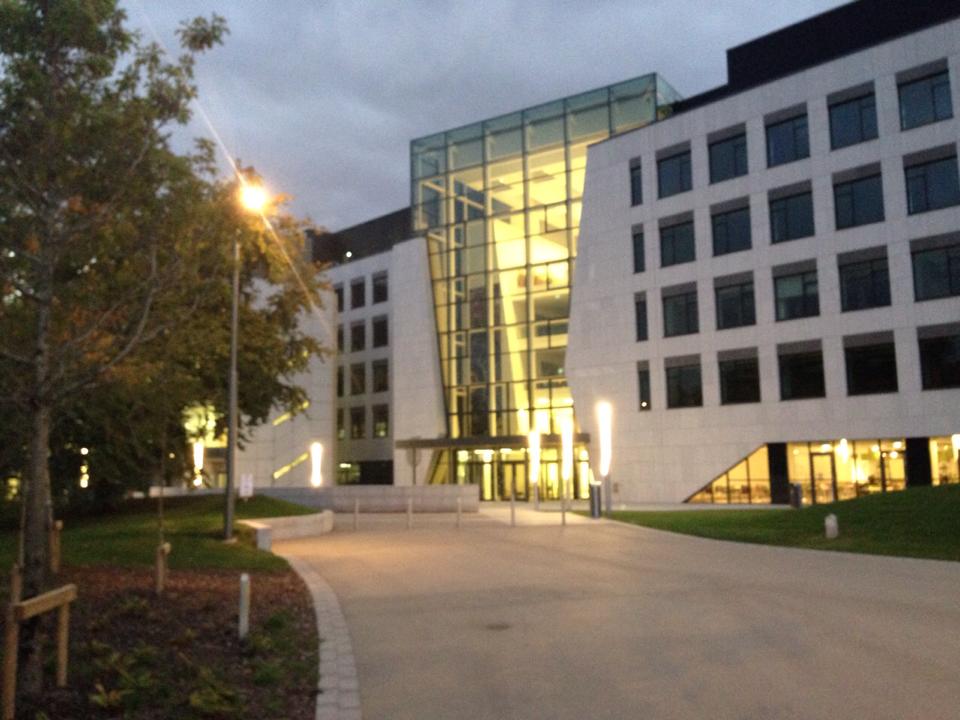
The city campus of what used to be called DIT, built as the centrepiece of a major regeneration programme for Grangegorman in north Dublin city, is ready to welcome around 10,000 students plus staff – once Covid restrictions are no longer necessary.
Boland’s is among a number of independent businesses on the Lower Grangegorman Road that had factored those numbers into their plans.
“It’s going to be a huge campus, so obviously footfall will increase massively,” Boland says.
In the turbulent 10 months since it opened, V-Face has had to make some think-on-your-feet adjustments to compensate for lost bums on its 40 seats. Among them is the outdoor eating area installed on the opposite corner, in cooperation with Dublin City Council, and the window hatch through which Boland speaks to The City.
“Coffee and sandwiches were never in the business model,” Boland says, “but we said ‘let’s bring out a lunch offering.’ The burgers were doing really well, but were more for the evening offering. [The hatch and coffee counter] have been designed in a way that, once the pandemic is gone, you can also swing around and serve people that come in.”

While V-Face benefitted from a model partly geared towards takeaway from the off, former Mediterranean restaurant Lavanda on the opposite corner has had to reset completely in the last year.
“We tried to do takeaway Mediterranean food during the first wave,” says Croatian owner Robert Velic, “but it didn’t work very well.”
Lavanda’s enforced rebirth was planned with the new TU Dublin campus in mind – it now sells toasties, slices of pizza and sweet treats.
“We’ll see when the students come back if we made the right choice”
Robert Velic
“The second wave came and then we completely changed. We were expecting those students. We adapted the prices to four or five euro,” Velic says.
“When the lockdown ends,” he continues, “it’s going to be a proper takeaway and we can add a few more things to the menu when business picks up and the colleges are back. We’ll continue to target students and walk-ins. We’ll see when the students come back if we made the right choice.”
A few doors up, Russia native Alexander Yegorov’s print and copy shop should be bustling.
His unit is next door to one of two new student apartment complexes on this stretch of road built in the controversial ‘co-living’ mould (and, in the ultimate symbol of the area’s gentrification, on the site of the former ‘Squat City’).
“We opened our shop three months ago,” Yegorov tells us. “They move the lockdown every two months. I expected the students would be here from the new year. But now, it won’t be until summer time.
“But it’s OK,” Yegorov adds. “We can survive until summer.”
“We knew it was a long game, but it’s been a lot longer than anticipated”
Rebecca Feely
On the next corner, Rebecca Feely of Kale+Coco tells The City that when she chose the location for her plant-based healthy food cafe in 2019, “it was under the assumption that there’d be lots of students.”
“We knew it was a bit of a long game,” Feely says, “because they were moving students bit by bit. But it’s been a lot longer than anticipated.”
While noting that her prices might be a little above the average student’s range, she tells us, “it’s always been in my head to focus more on marketing to students, but I haven’t had the chance yet because we haven’t had the students there yet.”
Kale+Coco has leaned more towards retail of food products to help stay afloat in what has been a difficult year.

“We were never actually told to close, so you feel almost obligated to keep trading because you have bills to pay,” Feely says.
“You have rent due. If you’re not ordered by the government to close, you’re not covered by any insurance, your landlords aren’t going to give you a break,” she adds.
While the eventual arrival of students should help jump-start these Lower Grangegorman businesses, it could well signal the end for Happy Days Coffee Van on the new campus a little further up the road.
The mobile cafe was set up by local resident Olivia O’Flanagan in response to the “inertia and isolation” her neighbours were faced with during the first lockdown last spring.
O’Flanagan, a former lecturer with no background in business, was given the green light to operate on TU Dublin’s campus for as long as its own catering services were closed.
“It’s a lockdown project to keep us all busy and connected and give some kind of focus for the local community,” she tells The City.

Hiring only locals helped her secure the temporary contract – staff can return to their own homes for the mandatory bathroom access.
“For me, it’s not a business endeavour,” O’Flanagan says, “though it has made money and is paying eight people’s wages on 20 hours a week. They’re all delighted and their parents are saying they were all sitting in their bedrooms cracking up.”


You must be logged in to post a comment.