
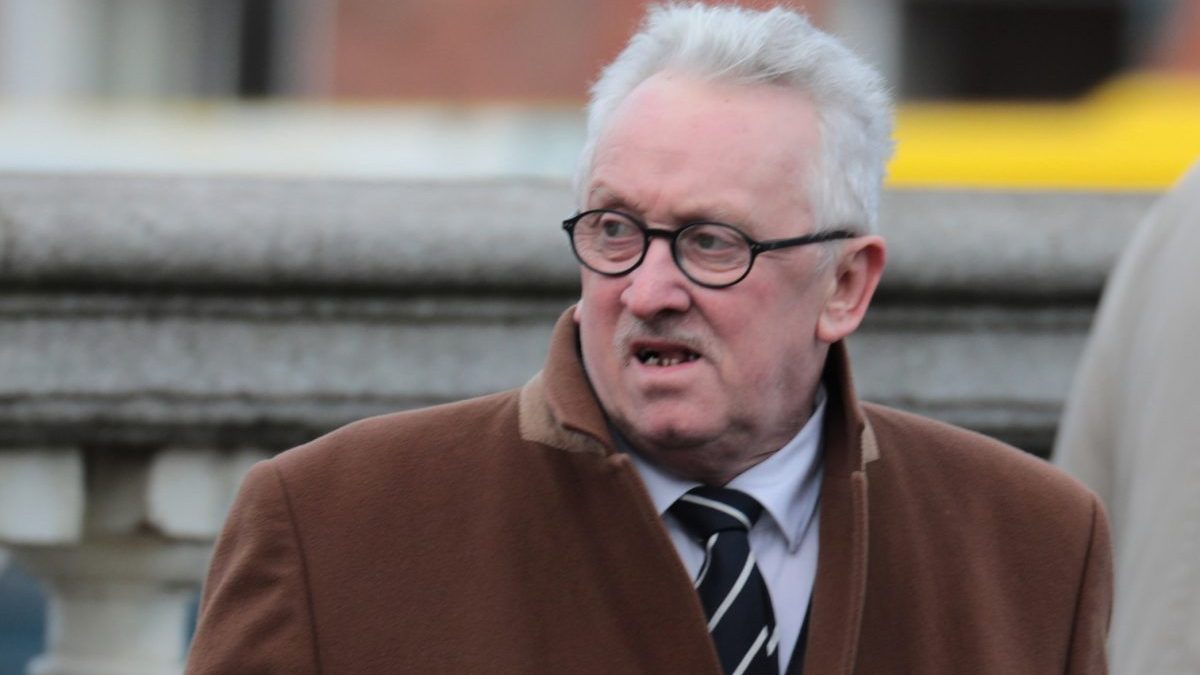

John Joseph Murphy recently suffered a heart attack 24 hours after being questioned in court about his unpaid €3.5million bank loans. TheCity.ie’s Paul Caffrey, who’s been in court covering this extraordinary case as it’s developed since February, profiles this Wexford businessman and explores his rise and fall over the past two decades.
As a co-owner of the landmark Gresham Hotel in Dublin during the boom years, property developer John Joseph Murphy was riding high.
Brimming with hope and confidence when interviewed by The Irish Times in July 2004, having just won control of Ireland’s oldest hotel, he brushed aside fears that he might turn it into one big apartment block.
“The Gresham will always be the Gresham. There will be no change there. It’s business as usual,” he told the newspaper.

Irish Times business journalist Jane O’Sullivan reported that Murphy told her with a laugh: “We are not going to knock anything down and build apartments. We do believe in the underlying business and the value it can deliver.”
Perhaps at the time, he could afford to be light-hearted. It was the height of the Celtic Tiger era and he was one of a consortium of three investors who’d just won control of the Gresham Hotel Group.
This included its flagship, 200-year-old, 323-bedroom hotel that dominates Upper O’Connell Street in the capital, along with Cork’s Gresham Metropole, London’s Gresham Hyde Park and the Gresham Memphis in Amsterdam.
The group also controlled the Gresham Belson in Brussels, the Gresham Carat in Hamburg and the Royal Marine Hotel back home in Dún Laoghaire.
Sounding like a man who was ready for anything when interviewed 16 years ago, Murphy told The Irish Times about his apparent plans for world domination – in the hotel domain, at least.
“We are not afraid to invest where we see fit. We are not afraid to acquire more hotels. But where we see any particular asset that can’t deliver, we won’t be afraid, if necessary, to dispose of it.”
John Joseph Murphy speaking in 2004
Back in the early to mid-Noughties, the easy availability of credit created endless temptation for those with any stake in the booming property sector.
This all came to a shuddering halt with the September 2008 global economic crash that was exacerbated in Ireland by the collapse of our then-bloated property market.
Known as JJ to his friends, Murphy was a seasoned developer with a solid pedigree in the property industry. He appeared to be set up for life as he embarked on a range of projects.
Between 2000 and 2007, he drew down loans totalling €6.2million from Bank of Scotland (Ireland) with a business partner to buy and develop Castle Oaks Hotel that overlooks the Shannon in Castleconnell, Limerick, the High Court heard.

Resulting from the December 2018 sale of that hotel property, that dates back to the 19th Century, the father-of-three managed to reduce his debt by nearly €3million, the High Court heard.
After signing a deal to purchase the 64-bedroom hotel in December 2018, Supermac’s owner Pat McDonagh told the Limerick Leader: “It is going to be business as normal.”
But it’s Murphy’s failure to repay the remaining €3.45million that has led him to the High Court where he’s now being sued for the full return of his bank borrowings.
Bank of Scotland having pulled out of Ireland in 2010, his loans were later purchased by finance fund Feniton Property Finance. It was Feniton that took the legal proceedings against him.
The High Court’s commercial wing first ordered him to pay back the €3.45million to Feniton in April 2019.
When he didn’t pay the debt, the fund looked for other ways to pursue him.

On February 18 last, Feniton’s lawyers cross-examined Murphy in court about what assets he may have at his disposal to satisfy the unpaid judgment.
In robust exchanges, Feniton’s barrister Micheál O’Connell SC told him:
“You are going to have to answer these questions.”

But Murphy’s lawyers later claimed in court that on the following day, February 19, the father-of-three suffered a heart attack after getting an email from Feniton’s legal team that was “of concern in terms of its content”.
The exact contents of the email was not outlined in court.
Murphy, of Stony Park, Wexford, was rushed to the Mater Hospital in Dublin and underwent quadruple bypass surgery for his “very serious condition”, the High Court was told.
When his lawyers announced this in court on March 5, Feniton’s lawyers argued it was “extraordinary” to suggest an email from their side had brought on his heart condition.
But Mr Justice David Barniville, who was presented with a GP’s report detailing Murphy’s condition, agreed to put the case on hold for at least a month.

TheCity.ie was in court in February for Murphy’s testimony 24 hours before his health scare. We returned on March 5 when the court was told of his health condition.
Dressed in a three-piece grey suit with white shirt, black and white striped tie and bronze-coloured cufflinks, he was questioned for almost three hours about what assets (any property or cash) he may have to satisfy the debt.
From the witness box, the waistcoated Wexford developer claimed he had “no assets” to pay back the millions.
Under questioning by Micheál O’Connell SC, for Feniton, Murphy claimed he was “kept” by his three adult children who paid his bills for a decade after he fell on “hard times”.
His three offspring “supported me for many years when I was on hard times,” the developer told the court, adding:
“I had no money. Over a period of ten years, these people kept me.”
Murphy explained:
“They’d have paid my bills, my ESB insurance. I had no income during that period.”
Murphy has a 41-year-old son who’s a chef and two daughters in their 30s, one who works for a US tech company, it was heard.

Asked by Mr O’Connell SC if the children helped “out of the goodness of their hearts”, Murphy replied: “Completely out of family…This was a family matter.”
Murphy later “decided to reimburse” them by giving them €250,000 collectively, it was heard.
But Feniton struggled to find any record of that payment, it was heard.
Later, Murphy told the court:
“I don’t have any assets. This is the whole point here.”
Asked if his attitude was that his creditors “can wait”, Murphy said the outstanding €3.45million debt related to a partnership with a man he hasn’t seen nor spoken to “in eight to ten years.”
And he added:
“I don’t even know what this [€3.45million] debt is for – it’s ten years old.”

Before he left court on February 18, Murphy was ordered to provide further information and/or documents to Feniton about his assets by 5.30pm on Tuesday, March 3.
He was due to appear in court again on Thursday, March 5. Instead on that day, his lawyers brought news of his February 19 heart attack.
The case is currently on hold as the courts are dealing only with urgent cases during the Covid-19 lockdown. Chief Justice Frank Clarke recently made a statement on the matter.
According to official Companies Registration Office (CRO) records seen by this website, Murphy hasn’t been a director of the Gresham Hotel Company Ltd since December 2006 when he resigned from that position.
His December 7, 2006 resignation was recorded in documents filed with the CRO in February 2007.


You must be logged in to post a comment.