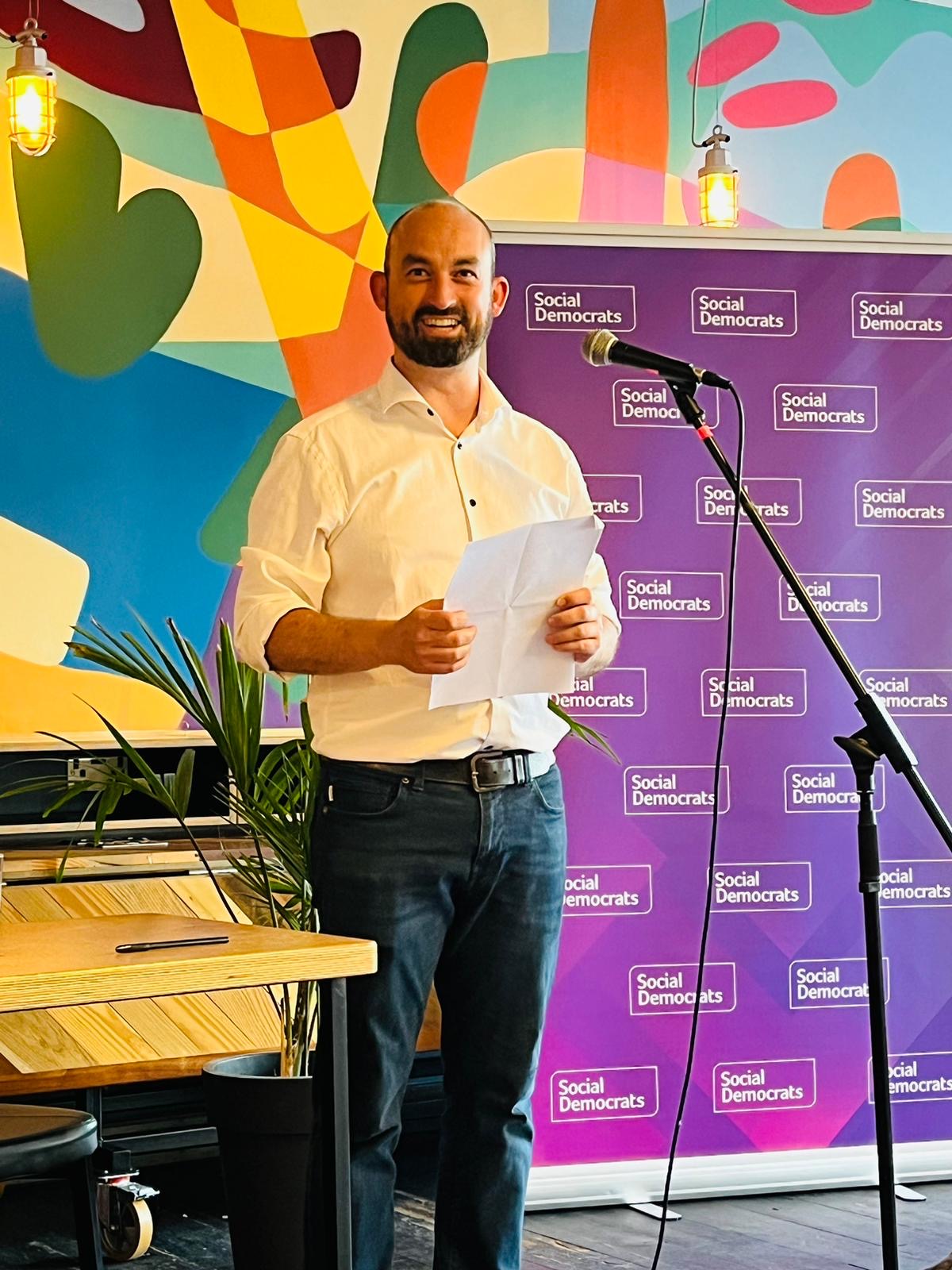
Social Democrats TD Eoin Hayes will remain a party member following the revelation of his use of blackface in 2009, party leader Holly Cairns announced on Sept. 16.
The controversy became public on the morning of Sept. 15 when the Dublin Bay South TD released a statement on X apologising for his actions after a news outlet contacted him the evening prior to confirm that they would be releasing pictures of the event.
“At a Halloween party 16 years ago, while President of the Student’ Union in University College Cork, I dressed up as someone I greatly admired at the time, US President Barack Obama — whose re-election campaign I went on to work for in 2012. As part of this costume, I wore brown makeup on my face and hands,” Hayes said in his statement.
Dressing in blackface is considered by many to be deeply offensive as it has historically been used to promote racist stereotypes.
“Blackface is part of a very, very long tradition of white performance which by and large ridicules blackness From around the 1830’s, across the 19th and well into the 20th century, white people have dressed up as black people to ridicule them, but also to mobilise different kinds of stereotypes,” Anna-Maria Mullaly, a member of both TU Dublin’s race equity group and the Social Democrats, said.
“For instance, black people would be displayed as stupid, as sexually aggressive [and] as lazy in these types of performances.”
Mullaly added.
Hayes’ stated that he “didn’t have an understanding of how hurtful [blackface] was at the time” and reiterated that he takes “full responsibility” for his actions and apologises to “any and all hurt” caused by what he did.
Mullaly, however, is sceptical of Hayes’s excuse that he did not understand the offensive nature of blackface.
“An argument has been made in some quarters that it was a different time, or that it was youthful student folly, I really don’t buy that,” Mullaly said.
“Tropic Thunder, the movie, came out the year before Eoin Hayes dressed up like this on his way to a party, and there was quite a bit of discussion about Tropic Thunder’s satirical take on blackface, so it was certainly in the news, and he would have been aware of those discussions,” she said.
Social Democrats Party leader, Holly Cairns, responded to Hayes’ statement in an interview with RTÉ on September 16th saying she was “hugely disappointed and annoyed about this situation.”
Cairns later confirmed that Hayes would not face any disciplinary action from the Social Democrat Party as the incident occurred before he joined the organisation.
“I want to be clear that it’s not an excuse, but the context of it being 16 years ago is something that I have to consider and I am taking it into consideration,” Cairns said.
Cairns also stated that Hayes “deserves an opportunity to work hard now and to try to regain people’s trust.”
This decision riled some members of the Social Democrat Party with the chairman of the party’s Dublin West branch and local election candidate, Luke Daly, citing the decision as one of the reasons that he and his secretary, Jack O’Reilly, would be leaving the party.
Mullaly seconded Cairns’ sentiment and said that Hayes “should be given the opportunity to follow through now and demonstrate, via action, his actual commitment to anti-racism.”
Altering Article 41.2 of the Irish Constitution is a crucial opportunity for women, according to the National Women’s Council of Ireland. The City.ie reporter Kate Brayden attended the organisation’s latest consultation on the link between domestic caregiving and discrimination, namely the gender pay gap.
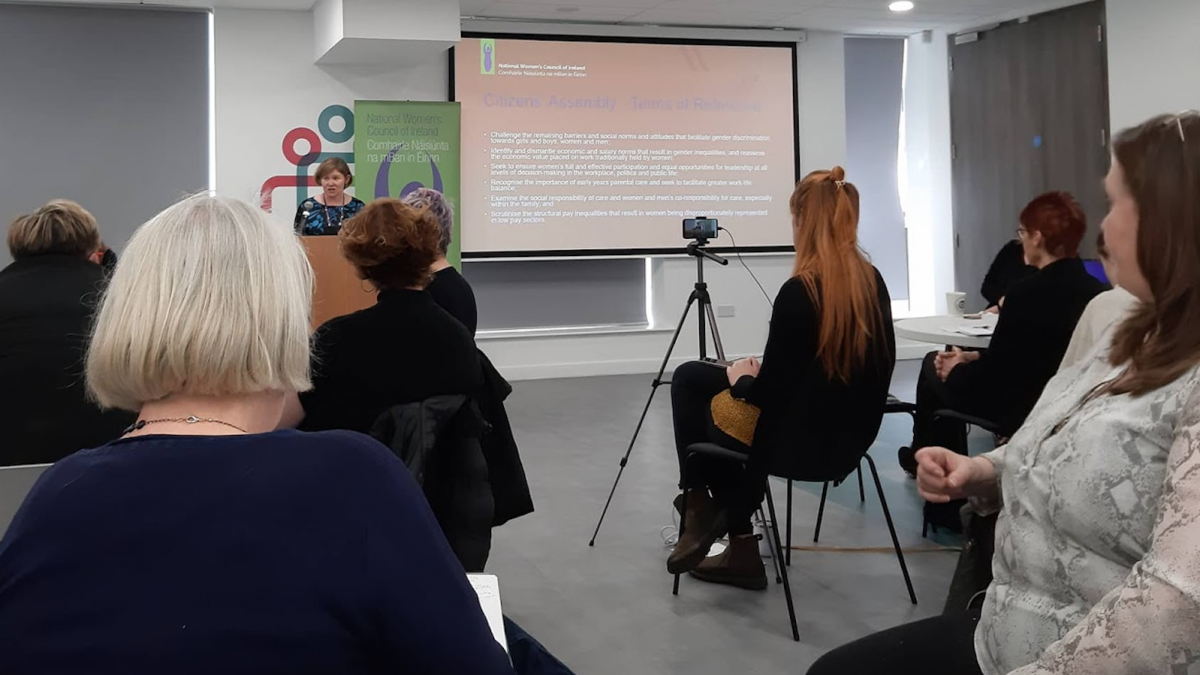
The National Women’s Council of Ireland held a consultation in preparation for the Citizens’ Assembly on Gender Equality just days before the General Election — with care, economic inequality and leadership proving the dominant themes in the discussion.
Around 50 members of the NWCI were present at the Irish Human Rights and Equality Commission, including migrant women, people with disabilities and representatives from the Traveller community.
Sarah Benson and Orla O’Connor, chairperson and director of NWCI respectively, both spoke about the changes that are needed in Bunreacht na hÉireann – which was drafted in 1937.
Article 41.2.1 states: “In particular, the State recognises that by her life within the home, woman gives to the State a support without which the common good cannot be achieved.”
Article 41.2.2 states: “The State shall, therefore, endeavour to ensure that mothers shall not be obliged by economic necessity to engage in labour to the neglect of their duties in the home. ”
In 2015, the Constitutional Convention was asked if Articles 41.2.1 and 2 should be removed from the Irish Constitution.
„Members of the Citizens’ Assembly have overwhelmingly backed a call for the controversial “women in the home” article in the constitution to be deleted and/or replaced.“#CitizensAssemblyhttps://t.co/IdoxVqD40o
According to the NWCI, Article 41.2 is an opportunity to alter the definition of women in Irish society, as well as to revolutionise how care is valued in our society.
At the 2015 Constitutional Convention, 88 percent of Citizens’ Assembly members favoured deletion of both clauses, but 98 percent stated that they should be replaced by a gender-sensitive text to include other carers in the home. Almost two-thirds said the replacement clause should also include carers outside the home. They also held that carers should not be forced to work outside the home due to economic necessity.
The need to recognise the power of care in fulfilling essential economic and social functions was stressed by Sarah Benson in her opening remarks of the day. Legislating for a comprehensive, affordable and accessible care infrastructure, supporting people at all stages of the life cycle, is the primary goal, she said.
“From our consultations, while there’s no argument about the sexist language of Article 41.2, there are a lot more complex issues which emerge which we felt warranted greater consideration,” Benson said.
“The discussions around Article 41.2 move quickly to those very complex choices and challenges which many of us face every day relating to our understanding of family and home, the roles of women and men, of economic support for parents, work-life balance and the contribution of care and carers.”
Members highlighted the need to focus on adequate provisions of support for carers and lone-parent families, as well as the goal of increasing investment in early years to one percent of GDP.
Developing a model of funding the care sector that ensures proper wages for the workforce, a quality service for children and affordable fees was an added goal for the proposed referendum that would be necessary to change the Constitution, as well as a statutory right for a broad spectrum of paid maternity, paternity, parental leave and carers leave.
The NWCI discussed the topic of universal pensions, considering the disruptions which occur once a care provider or parent must leave their original employment.
A right to home care and personal assistance for older people and those with disabilities was an added point, with Benson stressing that care work “is essential to women’s equality and the common good” and that men must increase participation in order to balance the workload of care in Irish society:
“One of the key challenges, is while there has been significant increase in women’s participation in the labour market, this has not been balanced out by a corresponding increase in the contribution of men to care work. Nor has there been an adequate state response to recognition of and investment in care work.”
“Article 41.2 includes a definition of family which does not reflect the reality of families in Ireland, nor the diversity of family life. It presumes a male breadwinner, a two-parent household where the woman stays at home, and it does not take LGBTQ+ families into account,” Benson added.
“We know that gender equality cannot be tackled without including economic inequality and poverty.”
Sustained investment in public services and social infrastructure is crucial to mitigating the historical ongoing economic inequality, which includes the gender pay gap (currently standing at 14%).
“They expressed concern at the persistence of stereotypical views, social roles and responsibilities of women and men in the family and in society at large.”
The issue of leadership was mentioned numerous times throughout the consultation. To improve the leadership position of women, suggestions included which suggested increased gender quotas, a gender balance on all non-state Irish company boards and an entitlement to maternity/adoptive leave for women county councillors and women TDs.
“The nature of paid versus unpaid work has changed. Women need support to move in and out of paid work at different points in the life cycle,” O’Connor stated.
“Women are often caught between childcare, elder care and insufficient state support. The issue is impacting women at a far greater rate than men.”
Orla O’Connor made sure to add that the NWCI hope to hold a specific and separate Citizen’s Assembly on the epidemic of violence against women.
“We believe that this needs a deliberate, singular process if it’s to achieve real, actionable and deliverable outcomes, which are absolutely needed.”



You must be logged in to post a comment.