
Tag: International rules football

  • “It’s not amateur anymore”: Colm Begley on Gaelic Football’s increasing professionalism

    “It’s not amateur anymore”: Colm Begley on Gaelic Football’s increasing professionalism

    “An amateur game played at a professional level” was how Colm Begley described Gaelic football this week.

    “The gap has been closed” between GAA and AFL in recent seasons stated the former Brisbane Lions Rookie of the Year, speaking ahead of last weekends second International Rules test.

    Echoing Ireland captain Michael Murphy’s comments last week, Begley believes that the only real difference between football and professional sport is that while GAA players are “focused on work or college, anything like that”, professionals can concentrate on rest and recovery.

    The 2011 Laois senior captain also warned that if the GAA don’t address the problem of burnout in their players, the recent upward trend in physical preparation will result in long-term damage to the game.

    “If they don’t look at it in the next few years, they’ll see a lot of players retiring at a younger age. Players love playing, but it’s just a massive, massive effort, and very mentally draining for those who don’t get a break”.

    Begley, who in addition to Ireland and Laois will also represent DCU and Dublin club Parnells this year, pointed to a recent change in AFL preseason training where players will only be allowed train three days a week to prevent burnout as”something the GAA will maybe have to look into”.

    The rise in strength and fitness levels has aided Ireland in the International Rules series however, Colm pointing to the fact that “we’re not being physically out-matched”, players endurance and speed levels on par with their professional opponents.

    This increase in training has led to a more competitive domestic game as well; “In the past, the top six or seven teams in Ireland would be fitter or stronger, whereas now teams are realising if we cant match them skillfully, we’ll try and surpass them in training, in strength or endurance. We’ll outrun them, out-tackle them. If you can control a players playing ability, skills etc, you can control how fit or strong they are”.

    “Whatever people say, it is professional”, continues Begley, “The game is getting faster and faster, all the small details are being looked at; Body Mass Index, GPS, stats, all the things that really, in an amateur game, you wouldn’t have to look at,  but it’s not amateur anymore, it’s run in a professional way”.

    While he stops short of calling for professionalism in GAA, Begley does admit he would like to see some rewards for inter-county players. “I’m not sure how they’re going to do it, even its just some form of tax benefit or even expenses being increased a little more. Players don’t want alot, just a bit of a benefit for the effort they put in during the year”.

    Begley 2 image INPHQDan Sheridan
    Colm Begley ahead of Saturday’s second test match [image: INPHQ: Dan Sheridan]
    After being nominated for man-of-the-match in the first test match, the Laois man is convinced that the indigenous Australian side will improve in Saturday’s up-coming second round. “They learn very fast. I think they’ll carry the ball, work it into the danger zone and try work off the breaks. I also expect a bit more physicality from them as well”.

    Ireland carry a 57-35 lead into the second test, to be played in Croke Park at 7PM on Saturday.

  • International Rules at the crossroads

    International Rules at the crossroads

    With the latest set of International Rules tests between Ireland and Australia now in full swing, many people are wondering whether or not the compromise rules concept has a viable future.

    Given its former reputation of being a hard-hitting and fiercely-contested battle between two proud sporting cultures, the appetite for future installments of the hybrid game between Gaelic and Australian rules football appears to be waning.

    Growing Apathy

    Although Ireland’s 57-35 victory over the Australian select was regarded as an enthralling spectacle by some, there appears to be a growing apathy amongst the sporting public in both countries which is beginning to be reflected in the attitude of the associations involved.

    By and large the mass brawls of earlier years have been confined to the history books (Photo credit Jimmy Harris on Flickr)
    By and large the mass brawls of earlier years have been confined to the history books (Photo credit Jimmy Harris on Flickr)

    Australia caused controversy this year with the announcement of an all-indigenous selection for the first time in series history. Labelled by some as ‘reverse racism’, the Australian Football League wanted to honour the contribution of Aboriginal players to the country’s national sport, and picked what they believed to be a more agile and skilful selection in the process.

    However, despite the best intentions in the world, the fact remains that not one member of Australia’s 33-man panel was part of this year’s All-Australian team lineup. Ireland, in stark contrast, had five members of last year’s equivalent All-Star side included in the home squad, with many more set to be named in the 2013 selection later this month.

    Declining player standards on one side at least has led to a predictable fall-off in support.

    From capacity crowds in both countries during the series’ reinstatement during the late ’90s and early 2000s, the average attendance figure of just 17’000 recorded during the 2011 test series in Australia was compounded by the sight of a half-full Breffni Park for Ireland’s victory at the weekend.

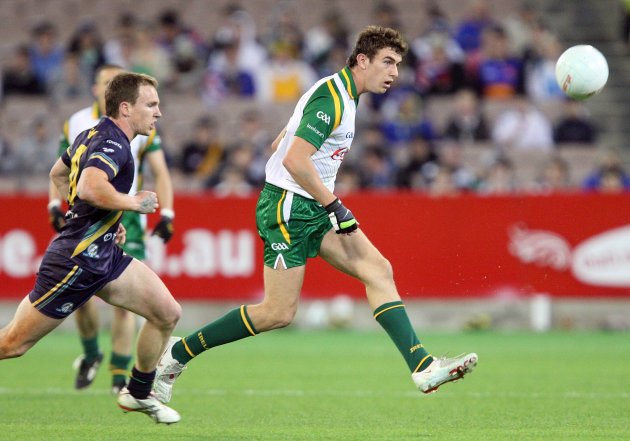
    Attendances for the rules matches have been dwindling Down Under (Photo credit Michael Spencer on Flickr)
    Attendances for the rules matches have been dwindling Down Under (Photo credit Michael Spencer on Flickr)

    Indicative of this decline was the Australian media’s complete lack of interest in the event. With not one major national broadcaster providing coverage of this latest series, the press Down Under generally seems to have gotten fed up with the sanitised version of what was once regarded as all-out warfare with a ball (merely incidental, of course) involved.

    Hope Remains

    However far it’s fallen from grace, the International Rules series does still retain some of its merits.

    From what started as a tenuous association during the two sports at the time of the series’ inauguration in 1984, relations have blossomed between the AFL and GAA in recent times, with intercounty luminaries such as Jim Stynes, Tadhg Kennelly and Marty Clarke swapping the round ball for an oval version in their quest to make it big in the Aussies’ premier indigenous sport.

    With many school and college teams from both codes now traipsing around the planet to test their skills against their compromise rules counterparts, it’s also initiated a valuable cultural exchange between the young peoples of two countries with a lot in common.

    But the fact remains that at its highest level, the series is plagued by a diverse set of problems. Speaking in Melbourne in 2011, GAA Árd Stiúrthór Páraic Duffy stated that unless series interest and attendances picked up in Australia, the Irish audience wouldn’t maintain a reciprocal interest.

    It appears that, following a sad and gradual decline, we’ve finally reached that crossroads. It’s now down to the GAA and AFL to pull their formerly proud combined sporting tradition back from the brink, or risk losing it forever.

    (Featured image credit Michael Spencer on Flickr)

    SOCIAL MEDIA NOTE

    @officialgaa

    @irfsofficial

    @gaaclub