
Tag: irish heart foundation

  • Give an artificial heart this Valentine’s Day

    Give an artificial heart this Valentine’s Day

    A human heart used in the spelling of “LOVE”. Although the hearts won’t be available by Valentine’s day, Carmat hopes to have them on the market by the end of 2021. Photo and design by Dolapo Agunbiade

    The month of February is a month designed to remind people of matters of the heart. That’s right, Heart Awareness Month is currently being celebrated across the globe. It is a time when people can reflect on their lifestyle choices, bring awareness and raise money for those who suffer from heart disease.

    “Heart disease is the number one killer of men and women across the United States and also worldwide and a lot of that is highly preventable,” said cardiologist Dr. Alex Harrison to KEYT News. 

    According to the Irish Heart Foundation, heart failure is one of Ireland’s leading causes of death. They stated that, in Ireland, there are approximately 10,000 new cases each year. The best remedy for severe heart failure is a transplant. However, thousands die each year waiting for their operation. 

    “The idea behind this heart was to create a device which would replace heart transplants”

    Stéphane Piat

    French company Carmat received their CE marking on 22 December from European regulators. This mark gives them the permission to sell their total artificial heart system. Their product, Aeson – named after a character in Greek mythology who drank a potion that added more years to his life – is designed to impersonate real hearts by using biological sensors and materials. The artificial heart is able to regulate blood flow by using its mechanical pump. 

    “The idea behind this heart, which was born nearly 30 years ago, was to create a device which would replace heart transplants, a device that works physiologically like a human heart, one that’s pulsating, self-regulated and compatible with blood,” Stéphane Piat, Carmat’s CEO, told Reuters. 

    For now, the three-part device will be used as a stopgap until a transplant is available for those suffering from severe, incurable heart disease. This will give patients who may not have received an organ in time a chance to wait patiently for donations. Even though the battery operated piece of technology is a temporary solution, it has been recorded that the hearts can last up to five years, allowing patients to live comfortably in the meantime. 

    In the company statement they say, “Carmat aims to provide a lasting solution to the treatment of terminal heart failure, a disease for which there are very few effective options today, the main one being heart transplants.”

    However, this device may not be available to everyone. It has been recorded that Aeson will be sold at the price range of €150,000 and upwards. This extravagant price-point is not suitable for lower-income patients who are in dire need of support.

    Another possible disadvantage of Carmat’s artificial heart is its weight. The device weighs in at 900g, which is three times more than the average heart – the average ranging from 250 to 300g. This size also alienates children in need from receiving the company’s temporary heart. 

    I spoke with former senior cardiology specialist Dr. Oye Akindele to understand the possible negative outcomes of artificial hearts.

    Dr. Akindele said, “the implications of an artificial heart are numerous. Due to its mechanical nature, parts can wear out or the electrical motor system could fail causing the blood passing through the system to form clots and cause strokes.” 

    He continued, “also, some patients are prone to severe bleeding. Their blood may be too thin from previous medications used to support the artificial heart.”

    Dr. Akindele then stressed the importance of heart donors and how the right donor should improve and prolong the recipient’s quality of life.

    A 3D demonstration of Carmat’s hear at work

    The three-part device might not be ready just in time for 14 February, but Piat estimates there will be “a smooth commercial launch during the second quarter of 2021”. The introductory launch will be focused on France and Germany and then subsequent distribution across Europe will follow. 

    What are the signs of heart failure? According to the Mayo Clinic, signs of heart failure include but aren’t limited to; shortness in breath, fatigue, rapid or irregular heartbeats and lack of appetite. 

    If you believe that you or a loved one is suffering from heart disease, please contact your local doctor.  
  • Can calorie information tackle Ireland’s growing obesity crisis?

    Can calorie information tackle Ireland’s growing obesity crisis?

    Obesity #1

    Photo by Ingo Bernhardt, Flickr.

    Most of us don’t question how many calories are in a steaming plate of creamy tagliatelle when out for a meal or while ordering our favourite takeaway, but very soon we will not be able to avoid this. In February this year, Ireland’s health minister Leo Varadkar announced that by 2016 all menus from restaurants, takeaways and any establishments serving food must include the calorie information on the menu.

    While statistics show that obesity is a growing crisis in Ireland and something that must be tackled – according to the Irish Heart Foundation (IHF) obesity has increased by 67% between 1990 and 2000  –  do we really need to know the calorie count for our meals when we’re eating out? What once in Ireland may have been a monthly treat has now turned into a regular occurrence and with so many people eating a number of their meals outside of the home, will calorie information positively impact on Ireland’s obesity crisis?

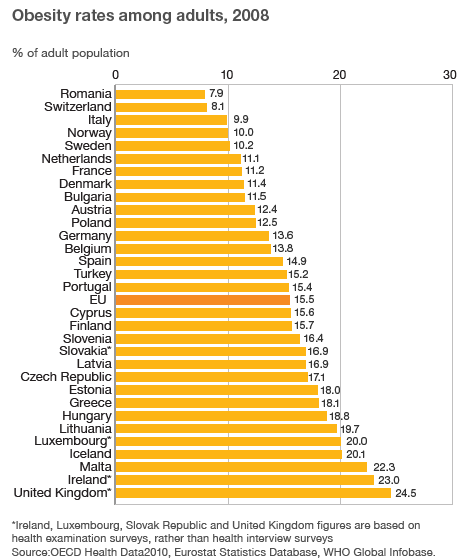
    Irish Obesity rates are now the second highest in Europe at 23 percent according to the Organisation for Economic Co-operation and Development. European obesity levels map

    2 out of 5 adults are overweight and 1 in 5 children aged between 5 and 12 are overweight or obese.Irish obesity level statistics

    “I think there is an issue with passive eating,” says Sinead Shanley a dietician from the Irish Heart Foundation. “There are studies showing after 20 minutes of sitting, there is a massive change in hormones, in your resting metabolic rate, in the calories you burn, in the fat you burn. We are sitting down for much longer, with sedentary lifestyles people are sitting down for at least eight hours a day, and this affects our bodies.”

    Obesity may not just be a matter of calories, but of appetites fuelled by the content of our food. Calorie information alone without details of fat, sugar and salt may be missing a big part of the problem. “The overriding message is we are eating too many convenience foods and whether we like it or not, they tend to be high in fat or high in sugar and/or salt,” Shanley says.”Anything that is high in energy and low in nutrition and is eaten on a regular basis makes it really, really difficult to try to control and manage your weight.”

    Stacey Machesney, from Glenville Nutrition, agrees that there are many factors contributing to the massive increase in obesity rates in Ireland. “We must look at the overall picture, the increase in fast foods, the accessibility and convenience of cheap processed foods, the increase in the variety of high sugar foods, the cost of the ‘bad’ food compared to the healthy options, taste, increase in sedentary lifestyle, the list goes on,” she says.

    While Ireland continues to lose the obesity battle, is it only governments that have a responsibility to keep up the fight? If our changed lifestyles are the main culprit for obesity, then the health sector, the food industry and the education system, among others, need to work together to ensure the problem is dealt with.

    “The onus is on the wider community and government to fund and allow charities to go in and implement initiatives and give support,” Shanley says. “It is the responsibility of society, the community and the food industry to try and regulate and make the healthier choices the easier choices. We need to support the individual making the choices.”

    People still choose foods based on factors other than health. Machesney recalls: “The Irish Universities Nutrition Alliance carried out a nutrition survey of 1,500 adults between 18 and 90 years of age in 2011 to see what adults are eating. They were given six food choice motives, including taste, cost, health and nutrition, convenience, ‘feel good’ (i.e. mood), and weight control. What do you think was the number one? Taste. Even when adults know about food health they still choose taste over health.”

    Rachael from TheCity, spoke with the managers of Joe Burger Jo’Burger on Castle Market Street and Urban Picnic Urban Picnic in George’s Street Arcade about the calorie information on menus and the effects this will have on their business.

    Calorie information in restaurants will no doubt help the public on better educating themselves on rough guidelines when eating out, and it is a step in the right direction, but, as Shanley says, “just a step”.  She says the Irish Heart Foundation would particularly like to see an emphasis on informing eaters about salt content: “Overeating and excess calories is a real problem in Irish obesity but this information doesn’t highlight the salt, so that would be a huge difficulty we would have with it. If we reduce our salt intake by half a teaspoon per day it would prevent 900 deaths per year from stroke or heart attack.”

    The IHF also recommends a traffic light system which looks at fats and the quality of fats along with calories. “We are looking at what type of fats are in the food. From our point of view the quality of fats is really important and that is missed completely.”

    Again, Machesney agrees. “I think it is never too late to make a change. As a society we are getting bigger in numbers and in waist sizes. We need to educate ourselves on what we are eating. It is great adding calorie information to menus but then let us also teach people how to read calories properly. It is not enough to count calories but we need to know what portion is being given to protein, carbohydrates and fat. If we could help people to help themselves we will have a better chance than trying to force change.”

    There is also the argument that the implementation of calorie information on the culinary industry will have grave repercussions for small businesses due to cost. The Food Safety Authority of Ireland (FSAI) have an online tool for businesses but Shanley suggests there needs to be more support.

    Shanley is, in the end, optimistic. “When calories are displayed, restaurants will make more of an effort to actually change and opt for healthier options because they are exposed,” she says. “The government have said calorie posting was one of a range of measures on obesity planning for 2015 and other measures will be revised like healthy eating guidelines a new obesity policy action plan such as the Health and Wellbeing Operational Plan 2015.”

    Looking at calories alone is not enough to ensure a healthy balanced diet but it can help people avoid meals that are extremely high in calories – which will more likely be high in fat, sugar and salt. But the focus needs to be more on overall health. The onus is on everyone from the schools to businesses and everyone in between to make the effort to provide healthy foods and to educate people on healthy eating, which in turn will lead to society making better choices with food.

    Experts’ Top 3 tips for a healthy lifestyle

    Sinead Shanley, dietician from the Irish Heart Foundation, recommends:

    • Reducing consumption of processed foods. We know now that they are generally the types of foods that are high in the unhealthier fats and also can be high in sugar and salt. Some 65 to 70% of our salt intake comes from processed foods. Freshly prepared food would be number one. That goes from breakfast to lunch boxes to dinners.
    • Keeping fats to a minimum. Keep high-quality fats in your diet, particularly polyunsaturated, which is in line with the Mediterranean style diet and the diet we advocate.
    • Prioritising fibre is key as it reduces your bad cholesterol, makes you feel fuller for longer. It is almost a negative calorie, as the body does not absorb any of the calories from fibre as it simply pushes through the body.

    Stacey Machesney from Glenville Nutrition recommends:

    • Eating the Rainbow – ensure you are eating a colourful range of fruits and vegetables.
    • Eating a little protein with every meal to help balance insulin levels and keep you fuller for longer.
    • Measuring your portion size. Many people are overeating without even knowing. The recommended meat portion is the size of a deck of cards.

    Links to more information and articles on obesity and the growing crisis in Ireland Storify Irish Obesity and Calorie Info

    By Rachael Hussey