Tag: Israel

  • Herzog Park renaming shelved as campaigners reject claims of antisemitism  

    Herzog Park renaming shelved as campaigners reject claims of antisemitism  

    By Seán Kavanagh  

    A vote to rename Herzog Park in Rathgar was withdrawn from the Dublin City Council’s agenda on Monday Dec. 1 as it was deemed not “legally sound”.  

    Chaim Herzog was an Irish-born Israeli soldier, lawyer and politician who served as President of Israel from 1983 until 1993, and the Dublin park was renamed in his honour in 1995.   

    The campaign to remove his name from the park was launched in early 2024 by Irish Sport for Palestine as they believed that “the legacies of Chaim Herzog and his family should not be associated with a public park in Dublin.” 

    “After consultation with Dublin City Councillors, we submitted a motion to the Council to ‘Remove the name Herzog Park, located in Rathgar, Dublin 6 and rename the park to Gaza Park’,” Rebecca O’Keeffe, a spokesperson for Irish Sport for Palestine, said. 

    The proposed renaming of the park caused great controversy amongst Jewish leaders around the world and many deemed the proposal to be “antisemitic”. 

    “The attempt to erase the name of a Jewish person from a public space is something that happened thousands of times in Nazi Germany,” Rabbi Elchanan Poupko, host of The Jewish World Podcast, said.  

    “In the broader context of the war being waged on the Jewish people today around the world, removing Herzog’s name is deeply unsettling,” Poupko added.  

    Taoiseach Michéal Martin echoed Poupko’s sentiments in a press release and urged Dublin City Council to reconsider their “divisive” proposal. 

    Irish Sport for Palestine strongly rejects the idea that the name change is antisemitic and says that many Jewish communities support their proposal, including Irish Jews for Palestine. 

    “We would like to point out the claims and accusations that have been made as part of the backlash are false and dangerous. Anti-Zionism is not antisemitism and equating the two is wrong. We reject this conflation and refute these accusations in the strongest manner,” O’Keeffe said.  

    Irish Sport for Palestine also claim that the backlash from Irish, Israeli and US governments were a “blatant and coordinated attempt to undermine due process” by interfering with the Councils vote.  

    “Renaming the park is not erasing history, rather it is refusing to honour and commemorate the violent colonial legacy of Chaim Herzog and his family. We believe our motion is a chance to promote a much more inclusive, representative and accurate view of history,” O’Keeffe said.  

    Members of Dublin City Council’s Commemorations and Naming Committee agreed to the removal of Herzog’s name in July and Dublin City Councillors were set to vote to confirm or reject the name removal on Monday. 

    The process of approving name changes in public parks was amended following a legislation change in 2019, and Councillors must now agree to all name changes via a ballot. 

    According to Minister for Housing and Local Government, James Browne, the regulations that govern this ballot have not yet been implemented and thus Dublin City Council currently does not hold the authority to authorise name changes 

    Despite this setback, Irish Sport for Palestine said that they will continue to fight to have Herzog Park renamed.  

    “We will absolutely continue our campaign to Rename Herzog Park. We maintain that a park in Dublin being named after a man who engaged in a campaign of colonisation as a part of the creation of the Zionist state is wholly wrong and inappropriate,” O’Keeffe said.  
  • In Photos: Thousands take to the streets for Dublin’s largest Palestine protest to date 

    In Photos: Thousands take to the streets for Dublin’s largest Palestine protest to date 

    By Liam Murphy

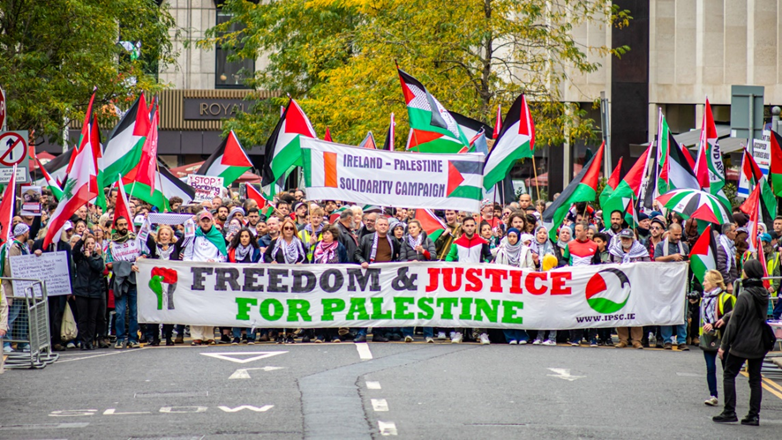
    On Saturday, October 5, thousands of people took to the streets of Dublin to mark one year of Israeli escalation in Gaza. 

    The march, the biggest of its kind to date in Ireland, called for an end to Israel’s occupation, an end to the use of Irish airspace for transporting weapons, and for the Irish Government to act in holding Israel accountable.  

    Several chants were also heard supporting Lebanon, following recent attacks there, also by Israel. 

    The national march, titled ‘GAZA: One Year of Israel’s Genocide’, began at the Garden of Remembrance and made its way to Molesworth Street, where a stage had been set up. 

    Speakers on the stage included Oscar-nominated and BAFTA-winning Palestinian filmmaker Farah Nabulsi, Palestinian photojournalist Eman Mohammed, Zak Hania, who recently returned home from Gaza after seven months, and Ireland Palestine Solidarity Campaign’s chairperson Zoë Lawlor. 

    Music on the day came from renowned Irish singer-songwriter John Spillane, Palestinian-Irish singer Roisin El Cherif, and Palestinian rapper Talha Alali.   

    All photos taken by Liam Murphy

    Protestors gather at Dublin’s Garden of Remembrance with signs and banners. 
    A group gathers with signs; Some with donation QR codes, others with song lyrics, others with art – Each with meaning. 
    Supporters gather around a 30ft Palestinian flag, as the crowd prepares to march. 
    A young girl wearing a keffiyeh poses as the march makes its way down O’Connell Street. 
    ‘From the River to the Sea, Palestine will be free’ – chants are heard across the capital city. 
    Protestors feel the heat as one bloc light up flares as the march moves down O’Connell Street 
    A masked up keffiyeh-wearing group stand roadside on O’Connell Bridge holding a red Hezbollah flag. 
    A woman holds up a scarf, branded with the Keffiyeh pattern and the Palestinian flag and Irish tricolour flag. 
    ‘You’d care if it was Cork!’ – A protestor holds up a sign on Molesworth Street, calling out the Irish Government 
    The march makes its way around the corner from Dawson Street, now heading up towards Leinster House. 
    Cork singer songwriter John Spillane tuning up before taking to the stage to perform his song ‘Palestinian Sunbird’ 
    Zak Hania smiles as crowds applaud his entrance. Hania spent seven months in Gaza unable to return home. 
    Palestinian rapper Talha AlAli (known as Wise Wolf) performs his newest single ‘Inshallah’ with Irish artist Blue Niall 

  • Focus on peace: Ireland’s pro-Palestine demonstrations  

    Focus on peace: Ireland’s pro-Palestine demonstrations  

    By Leon Thompson

    Ireland’s support during the Gaza crisis has extended following the announcement of €13 million in aid being sent to Palestine.

    Tánaiste Micheál Martin announced the aid in Dáil Éireann as an acknowledgement of the escalated violence in the Middle East. 

    Mr Martin hopes “a lasting and sustainable peace” can be achieved following Israel’s declaration of war on Hamas when Israeli citizens were attacked two weeks ago. Mr Martin has also said the Irish government unequivocally condemns the attacks made by Hamas and expresses their deepest condolences for the Israeli people affected.  

    The Ireland-Palestine Support Campaign (IPSC) is supporting demonstrations nationwide, while the national demonstration to end the slaughters in Gaza will take place in Dublin tomorrow afternoon. 

    Cork, Cavan, Clare, Kerry and Belfast will also see demonstrations tomorrow. 

    The Garden of Remembrance in Dublin 1 should expect demonstrators at 1pm on the 21st of October following IPSC’s announcement saying, “As Apartheid Israel continues pounding the captive and besieged people of Gaza with indiscriminate bombing and gets ready for a full-scale invasion, all with the blessing of Western powers, we ask you to join us at an emergency solidarity rally in support of the Palestinian people.” 

    Crowds are expected to attend while TD Mr Paul Murphy has announced his support and attendance saying, “When does Palestine get the right to defend itself? 75 years of ethnic cleansing and apartheid…17 years of a brutal siege on Gaza…10,000 Palestinians killed in the last 15 years. Stop the slaughter!”

    Demonstrators at a protest. Image: unsplash.ie

    Other counties such as Tipperary and Antrim saw protests yesterday, October 19th while counties such as Louth, Longford, Cork, Down and Armagh will hold more demonstrations throughout the month of October. 

    The last demonstration supported by the IPSC is anticipated for Co.Mayo on the 25th of October. 

    Campaigners were outside of the Dáil on October 18th with Diarmuid Breatnach in attendance calling it “a duty and a pleasure” as he anticipated the outcome of the debate happening inside.  

    In Cork, one demonstrator Patrick Hobbart said: “…it’s deeply distressing to witness the enduring hardships faced by the Palestinian people who have carried the heavy burden of apartheid and colonialism for generations. It’s imperative to acknowledge that Hamas doesn’t speak for all Palestinians. The Israeli government must heed this plea and halt their relentless assault on innocent civilians. In this conflict, there are no victors…the international community must unite to demand an immediate ceasefire.” 

    Kevin Callinan, General Secretary of Fórsa Trade Union echoed Mr Martin’s sentiments, “The killing of Israeli civilians by Hamas and the collective punishment of the people of Gaza by the Israeli government will do nothing to end the occupation and bring about peace,” he said. 

    President of the EU Commission Ursula von der Leyen’s statement declaring “Europe stands with Israel” has led to a lot of pushback from members of the European Parliament (MEP) especially  

    MEP Clare Daly commended protesters that occupied the European Commission’s Office in Dublin saying: “So proud of friends and comrades…currently occupying the European Commission offices in Dublin as we here in Strasbourg go in to vote on a shameful Parliament motion that fails to condemn Israel for its ongoing crimes against humanity in Gaza.”

    Protesters outside of Dublin’s European Commission’s Office. Image: X

    The office was occupied by concerned citizens organised into a group called Dublin for Gaza, with one member Lamia Tadjine saying: “Let us be clear—blood is on the hands, not just of the Israeli military and leadership, but on the hands of those states and institutions who have provided cover for these atrocities, such as the European Union.”

  • The Human Rights Violations Seen From Space

    The Human Rights Violations Seen From Space

    The City’s Cameron Weymes compares historical Google Earth imagery to illustrate human rights violations committed by various governments in the Middle East.

    Human rights have been defined as “norms that aspire to protect all people everywhere from severe political, legal, and social abuses.”

    Each event shown below has been documented by rights organizations to be contrary to these principles.

    Slide the bar left and right to reveal differences

    The Iraqi government assault on the Marsh Arabs

    [twentytwenty]

    marshhawizah121984

    marshhawizah122002

    [/twentytwenty]

    What Human Rights Watch said:

    “HRW believe that many of the acts of the Iraqi government’s systematic repression of the Marsh Arabs constitute a crime against humanity”

    The Background

    In March 1991, in the aftermath of the Gulf War, uncoordinated uprisings against Baath Party rule broke out in Iraq, one in the Kurdish majority north and another in the Shia south. The revolts were in response to George H.W. Bush’s appeal for the Iraqi people to “Take matters in to their own hands and force Saddam Hussein to step aside.”

    While the Kurds achieved success by establishing an autonomous zone in the north, the Shia rebellion had been put down by Saddam by early April.

    During the conflict many rebels had sought refuge in Iraq’s marshlands, home to 200,000 people who relied on the area for fishing and agriculture. In response to the perceived disloyalty of the Marsh Arabs, Saddam executed hundreds of locals, forcibly transferred its population to the cities and began draining the wetlands.

    The Satellite Photos

    The tragic environmental and humanitarian effects of these actions can be seen from the above satellite photos. The ‘Hawizeh Marshes’ were left almost entirely devoid of water, halting a way of life that had existed for centuries.

    Systematic destruction of Kurdish towns in southeastern Turkey

    [twentytwenty]

    nusaybin782015

    nusaybin9132016

    [/twentytwenty]

    What the UN said:

    “The UN Human Rights Office published a report detailing allegations of massive destruction, killings and numerous other serious human rights violations committed between July 2015 and December 2016 in southeast Turkey, during Government security operations that have affected more than 30 towns and neighbourhoods and displaced between 355,000 and half a million people, mostly of Kurdish origin.”

    The Background

    Nusaybin is a city of 80,000 people in southeastern Turkey, a region with an ethnic Kurdish majority. In late 2015, fighting broke out between the Turkish army and Kurdish militants. By the summer of 2016, Turkish government forces had put down the insurrection and began demolishing thousands of homes, leading to accusations of collective punishment against Nusaybin’s residents.

    The Satellite Photos

    The above images show houses destroyed by the Turkish government in Nusaybin.

    [twentytwenty]

    sur2014

    sur2017

    [/twentytwenty]

    The Satellite Photos

    Similarly to Nusaybin, large parts of Diyarbakir, the largest Kurdish majority city in Turkey, were flattened after fighting broke out in 2016 between Kurdish militants and the Turkish army.

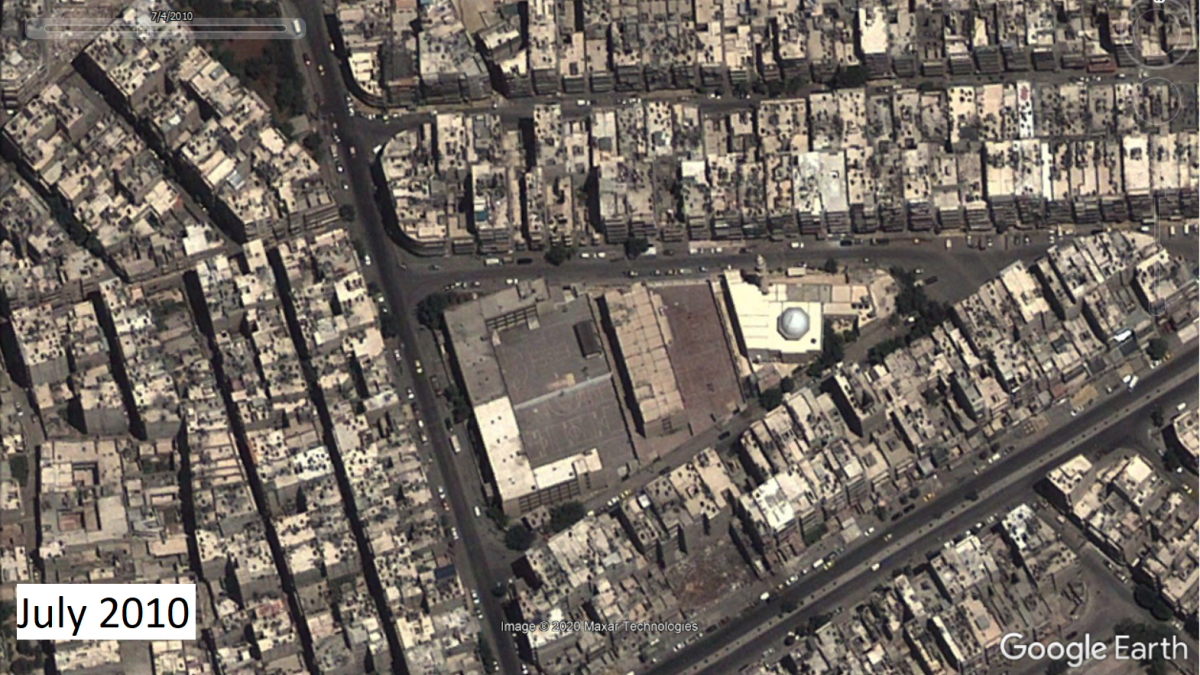
    The indiscriminate aerial bombardment of rebel-held Aleppo

    [twentytwenty]

    eastaleppojuly2010

    eastaleppofeb2017

    [/twentytwenty]

    What Human Rights Watch said:

    “The Syrian military has dropped barrel bombs, sometimes dozens in one day, on opposition-held neighborhoods in Aleppo, Idlib, Dara’a and other cities and towns. They have pulverized markets, schools, hospitals and countless residences. Syrians have described to me the sheer terror of waiting the 30 seconds or so for the barrel bomb to tumble to earth from a helicopter hovering overhead, not knowing until near the very end where its deadly point of impact will be.”

    The Background

    In 2012, Syrian rebels fighting Bashar al-Assad began taking control of large swaths of Aleppo, Syria’s largest city. The rebels would eventually take the eastern half of the city, before a regime offensive backed by Russian airpower regained control in late 2016.

    The conduct of the Syrian regime and its Russian allies during the battle led to widespread allegations of war crimes, as highly inaccurate barrel bombs (barrels full of scrap metal and explosives) were dropped on densely populated rebel-held areas.

    The Satellite Photos

    The above images show the effect of regime and Russian airstrikes on buildings in eastern Aleppo.

    The expansion of Illegal Israeli settlements in the West Bank

    [twentytwenty]

    westbanksettlements2

    westbanksettlements1

    [/twentytwenty]

    What Amnesty International says:

    “Israel’s policy of settling its civilians in occupied Palestinian territory and displacing the local population contravenes fundamental rules of international humanitarian law.”

    The Background

    Israel took control of the West Bank following a Six-Day War with its Arab neighbours in 1967. The territory has subsequently undergone a process of colonisation as over half a million Israeli settlers have moved into the West Bank and East Jerusalem, an act illegal under international law.

    The Satellite Photos

    The above image shows the illegal expansion of the Nofei HaSela settlement in the occupied West Bank.

  • Palestinian Flag to Fly Over City Hall in “Gesture of Solidarity”

    Palestinian Flag to Fly Over City Hall in “Gesture of Solidarity”

    Green, white and black with a red triangle – the Palestinian tricolour is not typically seen above Dublin City Hall, however, there is a proposal to fly the flag there next month. Cormac Murphy explores the debate.

    (more…)

  • Student activists demonstrate solidarity with Palestine

    10750092_580495992062558_6322970258785945062_o
    Photo by Ciarán O’Rourke, Trinity College Apartheid Free Campus Campaign.

    The conflict between Israel and Palestine was brought to the forefront of public consciousness again last summer when Israel launched an offensive on the 8th of July. Increased rocket fire into Israeli territory by Hamas sparked the reaction, which in turn was due to a crackdown on Hamas by Israel, after the disappearances and deaths of three Israeli teenagers.

    The scenes of destruction and high civilian casualty rates saw strong reactions worldwide. For founders of the Trinity College Apartheid Free Campus Campaign, this has meant highlighting and protesting what they see as a compliance of Irish academic institutions in the academic oppression of Palestinians. Ciarán O’Rourke, a founder of the movement adds that the issue goes beyond the subject of the occupation itself, saying, ‘The point is to get as large a number and as wide a cross-section of staff and students on-board as possible – whether it is through the petition, through events like the poetry reading, or on social media. The whole idea is to make some noise and speak our minds about the standards that Irish universities should respect and adhere to, so the more people involved, the more people adding their voices to the campaign, the better.’

    The group object in particular to associations between Trinity College and Elbit Systems, The Israeli Security and Counter Terrorism Academy, as well as between the college and the Weizmann Institute of Science. An online petition to the Board of TCD has 450 of the intended 500 signatures and before Christmas the Graduate Student’s Union passed a majority vote supporting the campaign.

    In response to my question about whether the group has connected with other university opposition groups, O’Rourke says that ‘Lots of groups have been in touch, and have been stating their support for the TCD Campaign, which is great. The TCD Campaign is distinct from other similar campaigns, however, in not calling for boycott, divestment, and sanctions of Israel per se. We’ve kept this in mind when thinking about direct collaboration with pro-Palestinian groups elsewhere in Ireland, whose work we admire and in many ways follow from.

    The ‘Apartheid-Free’ theme, though, is precise in advocating for a condemnation of apartheid crimes, and for a severance of research ties with institutions that contribute to their continuance. Under the terms of the TCD Campaign, Trinity could still collaborate with an institution in Israel such as the human rights organisation B’Tselem without breaking its standards of ‘apartheid-free’ research.’
    TCD Apartheid Free Campus campaign is organising a Poetry for Peace reading on March 12th and on Tuesday March 10th, in a non-related event, TCD academic Elaine Bradley will give an eyewitness account of the eight months she spent in Gaza and the West Bank at 7pm in Cassidy’s Hotel on Parnell Square.

    By Sinéad Fitzgerald