Tag: Izzy Rowley

  • Irish women weightlifters snatch the spotlight

    Irish women weightlifters snatch the spotlight

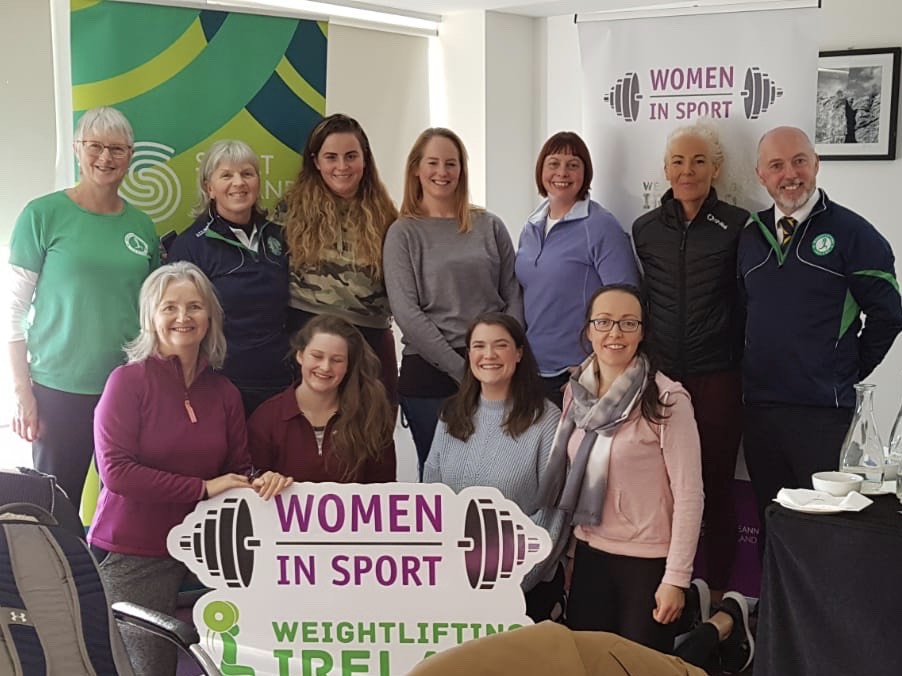
    The Women in Sport Initiative by Sport Ireland was supported by Weightlifting Ireland. Change is afoot? Front row: Ruth Deasy, Isla Hoe, Aoife Bradley, Sinead Ryan. Back row: Lucy Moore, Phil Brown, Freya Hammer, Kathy Boylan, Shauna Kane, Kate Meenan, Peter Carroll (General Secretary, Weightlifting Ireland). Photo courtesy of Harry Leech

    There’s no doubt about it – weightlifting is a traditionally male dominated sport.

    Women’s weightlifting didn’t even make it into the Olympics until 2000, while their male counterparts had been there since 1896.

    Thankfully, times are changing. 

    “We have a very high representation of women within the sport in Ireland. There are instances of people being sexist – there’s that underlying bias that exists in people, but I don’t think that’s inherent to the sport,” says Isla Hoe, an amateur weightlifter and self-described ‘casual competitor’.

    “Within weightlifting in Ireland, the issues are wider systemic issues that have to be addressed by society as a whole, rather than just the sport,” Hoe explains. “Where I would see sexism appear is in how non-weight-training people perceive females within weight training sports.”

    There are undoubtedly stereotypes held about women weightlifters – one only has to go to the more misogynistic corners of the internet to find people babbling about how weightlifting makes women ‘look like men’ – apparently a fate worse than death.

    The instagram account You Look Like A Man is a wild read – each post chronicling typical sexist comments made to women in sports, including weightlifting.

    “Certainly, for an older generation of women, there’s been a misconception that lifting weights is dangerous or it’s not feminine – all of these are very outdated ideas,” says Harry Leech, the head coach and co-founder of the Dublin-based weightlifting club, Capital Strength.

    “There’s no reason why women shouldn’t do weightlifting, so we thought: what are the potential barriers going to be to them? It’s important that you have that welcoming environment and ethos, then the only other barrier is investing in equipment that’s suitable for men and for women,” he says.  

    “Where I would see sexism appear is in how non-weight-training people perceive females within weight training sports”

    Isla Hoe

    Traditionally, 20-kilo bars were the standard in weightlifting clubs and gyms. These best suited men’s, on average, larger hands. Women are, on average, smaller, and have smaller hands than men, which required the introduction of the 15-kilo bar. It weighs less simply because it’s narrower – making it easier to grip for female weightlifters.

    From left to right: Isla Hoe, Aoife Bradley, and Sorcha Brady at Capital Strength gym. Image courtesy of Harry Leech

    Initially, these bars were very expensive and as the sport was so small in Ireland, clubs didn’t have enough money to invest in much equipment. As the sport was male dominated, it was more common for clubs to purchase 20-kilo bars than 15-kilo ones. However, now the market has opened up and the equipment is more affordable.

    Currently, Leech reckons that Capital Strength owns more 15-kilo bars than 20-kilo ones.

    “It’s always been important to have a very equal, very welcoming, very gender-neutral aspect to our club,” Leech says.

    “I think some people have an image of a weightlifting gym in their head, and it’s guys in leotards, making crude, offensive jokes, and lifting heavy weights – but that couldn’t be further from the truth,” he tells me.  

    Clubs like Capital are a fantastic addition to weightlifting in Ireland, however, there are still issues that have to be dealt with.

    “The sport needs to encourage more women’s coaches and women’s officials now. They are coming through, but it’s probably something that’s going to take time to get to the point where it should be,” Leech says.  

    “If you can’t see it, you can’t be it,” says Dr Lucy Moore, a masters athlete, and athletics and weightlifting coach who feels that positive representation for women is an important factor in creating equality.

    “There are very few women coaches at senior level, and if you want to be it, you have to see it. It’s the same issues in the professional world, why don’t women go forward for promotion? Why are women underrepresented on boards?

    “Women tend to hold themselves back – and that’s not just in weightlifting,” Dr Moore explains, suggesting that issues of imposter syndrome and a lack of confidence plague women in sport.

    “I think some people have an image of a weightlifting gym in their head, and it’s guys in leotards, making crude, offensive jokes and lifting heavy weights – but that couldn’t be further from the truth”

    Harry Leech

    “Sport also tends to operate at very un-family friendly hours,” she continues.

    “You’re expected to do things at weekends and the evenings, and to travel. That’s grand when you have a partner at home who will do anything that needs to be done, but traditionally, it’s the man who is going out while his [female] partner stays at home. You only have to look at the pressures people are under at the moment with Covid – who’s doing the lion’s share of the home schooling, trying to keep the house running, and working from home?” Dr Moore explains.

    Fortunately, things are taking a turn for the better.

    “It’s very recently in weightlifting that women came to be referees in any significant numbers, but it is improving, there has been a specific drive to get more women involved in these roles,” Dr Moore says, who has been involved in programs specifically intended to train female weightlifting referees.

    “It’s going in the right direction, but it just needs to push on.”

  • Eve Belle finds harmony in lockdown

    Eve Belle finds harmony in lockdown

    The virtual ‘new normal’, a screenshot of Eve Belle over Zoom. Photo by Izzy Rowley

    Although Eve Belle and I live in the same city, we do not live within the same five-kilometre distance, and lockdown restrictions have demanded a Zoom call. Thankfully, Belle’s charm easily translates through a WiFi connection.

    There’s been a tangible shift in the artist’s career – she released her debut album, In Between Moments, last October to great critical acclaim, she has been named as one of Hot Press’ Hot for 2021 artists, and has been a part of the Other Voices #Courage series.

    Releasing her debut album during a global pandemic cannot have been an easy choice – with touring off the table, it’s harder than ever to promote your music.

    “If I had waited for the right moment, four months on, I’d still be waiting, so I just decided to make the right moment,” she tells me.

    Luckily, there was an upside: “It’s an unusually good time to release music because there are people who are really reliant on having a new thing to focus on and a new thing to listen to.”

    In-lieu of the stage, Belle diligently performed over Instagram live – a platform many musicians have relied on during the pandemic. When I tell her I once heard another musician describe it as the fat-free version of gigging, she laughs and says “that sounds about right”.

    “I saw a boy I liked. He didn’t want to talk to me, so I went home and wrote a song about it as if it was the end of the world”

    Eve Belle

    Performing as part of the Other Voices #Courage series alongside Neil Hannon and Cathy Davey gave her a chance to escape the virtual world. “It was the first time I’d gotten to do anything resembling a gig since March. So, I was literally beside myself to be at anything even remotely in the shape of a gig,” she says.  

    She’s just released this performance as an EP of paired-back, acoustic versions of three songs on her album.

    Other Voices has been a constant in Belle’s career – performing on the Other Voices stage at Electric Picnic when she was 16, and then playing the musical trail in Dingle later. “It was a lovely way to continue the trajectory of that, so it was definitely close to my heart to be back,” she says. 

    How did Belle see herself as an artist when she first started out?

    “I wanted to be in emo bands in school, but my mum said no. I’m very glad she said no – I would’ve absolutely wrecked my voice, but at the time I was like ‘oh my god, why are you doing this to me?!’” She laughs.

    Belle’s lyric-driven songwriting style comes naturally to her – holding on to her emo roots by writing what she calls “sad bops”.

    “I remember, I was like 13, and went to some event where I saw a boy I liked. He didn’t want to talk to me, so I went home and wrote a song about it as if it was the end of the world.

    “I’ve changed in no way – everything that happens to me I write a song about… But it was cringier and worse back then,” she laughs.

    Coming back to the present, I ask Belle how she made the move from acoustic guitar to a fully produced, popified album.

    “I was just lucky enough to have somebody in the studio who, when I would say ‘this might sound really weird, but I want to try this’ he was saying ‘I’m already there, I’m already doing it.’”

    “It was a lovely way to continue the trajectory of that, so it was definitely close to my heart to be back”

    Belle

    This “somebody” is Fred Cox, who has also worked with Rag‘n’Bone Man and Grace Carter. Belle credits her confidence in the studio to their creative relationship – one built on trust and sonic experimentation. This, she says, was all part of the creative journey she was on at the time – and the album is a snapshot of that journey.

    “There is a distinct difference between what I’m writing now and what I was writing before, because there is such a distinct difference in how I exist now,” she says, referring to her life in lockdown.

    “It’s just had an effect on how I view the world, myself, and the things that are happening. In the same way I have grown and changed, my music has also grown and changed.

    “In the past six months I’ve started writing more with the piano, which definitely feeds into a more lyrical style.

    “With guitar, you’ve got it in your hands, which is grand, but you’re driving the process completely along on lyrics. I feel like with piano, it’s more atmospheric, which feeds back into writing.”

    Unfortunately, we’ll have to wait until the world opens back up to hear this exciting new material, and Belle can’t wait for that to happen, “I keep telling everyone, I’ll even go to the opening of an envelope.”

    Catch Eve Belle at her gig in Whelan’s in April and stream In Between Moments and Other Voices Courage (Live Acoustic Sessions) on Spotify now.

  • Bloody buses

    Bloody buses

    The 33A bus pulling into Lusk village. Photo by Izzy Rowley

    Public transport can change the shape of someone’s day entirely. For health care workers, it can add hours onto their already lengthy days, as they battle long wait times and social distancing issues. 

    “Transport, as stupid as it might sound to most people, makes such a difference if you can get home quicker because you are so tired,” says student nurse Sarah Reid who is currently working in St. James’s Hospital in Dublin.

    Reid lives in Swords, north county Dublin. To get to work, she has to take two buses or a bus and a Luas regularly.

    Her journey usually starts around 5:00am and ends at 6:30am, when she arrives into work an hour early for her shift. She could get a later bus, but according to Reid, it doesn’t leave her with enough time to get ready for her shift. 

    “Because of the pandemic, when we get to hospital, we have to change, and we have to PPE up before, because I’m on a Covid ward,” Reid explains.

    Getting home presents its own problems. After her 13 hour shift, she could often be waiting up to 35 minutes for a bus home.

    The 33 bus driving down Station Road in Lusk, north county Dublin. Photo by Izzy Rowley

    Dublin Bus services are currently running at a reduced capacity and regularity, operating on a Saturday schedule, leaving fewer buses with less room for passengers.

    In an email statement to The City, Dublin Bus said that the Saturday schedules are “augmented by additional services, especially in the early morning peak” and “the schedules reflect the current demand for services.”

    The reduction in both the frequency and the capacity of the buses can lead to issues with social distancing.

    “Especially in the level five situation, I know the service is reduced to a Saturday service, and that just doesn’t make sense to me. 

    “It would make more sense if the services still ran as normal – people would be given the opportunity to keep their distance more,” says a social care worker based in Fingal, who has chosen to remain anonymous to protect her privacy.

    The accessibility of transport is also an issue, this social care worker notes that recently, real time displays in train stations have often been broken: “If you’re an older person that doesn’t have a phone, or people with disabilities like the ones I work with, it makes it difficult.”

    “If the services still ran as normal, people would be given the opportunity to keep their distance more”

    Anonymous

    However, the health and safety of bus drivers can’t be ignored either.

    Dublin Bus said that these reductions are in place to protect the health and safety of passengers and staff, which is their “first priority”.

    “We’re just like everybody else, we don’t want to bring it home,” says Dublin Bus driver Joe O’Dwyer.

    O’Dwyer feels lucky to still be working during the pandemic and notes that “the company is supplying PPE stuff” including masks and hand sanitiser.

    “We’re just like everybody else, we don’t want to bring it home”

    Joe O’Dwyer

    “One of the things we’re trying to do with the Saturday timetable, it’s called an enhanced [timetable], so there’s an extra couple of buses that go out on certain routes that are busy – they’re trying to do their best with it,” O’Dwyer says.

    “It’s all about health and safety, isn’t it? Keeping the staff safe and the public safe,” O’Dwyer adds.

    Public transport has been an issue in Fingal before the pandemic, and the reduced services have worsened the situation.

    “With ongoing and increasing development in Lusk, Skerries, and Rush, it’s obviously putting more strain on the public transport system,” says Councillor Robert O’Donoghue, the Labour Party local area representative for Rush and Lusk in Fingal, who is working with a local action group to increase public transport in the area.

    The action group has asked Fingal County Council to assess public transport services in the area in relation to population and housing development. 

    “Any assessment that goes on, I can’t see the possibility of services being pulled back,” O’Donoghue says. “There’s just too much housing development going on in the north county.”

    “Fingal, I think, is being used almost as a relief valve for the housing crisis to some degree.

    “That can either be a good thing or a bad thing, depending on your way of looking at it. They’ll serve where the people are, and with more and more people moving out our way, I do believe the services will come,” he adds.