
Tag: Jake Hurley

  • Get behind me seitan: Viral TikToker Futurelettuce on his vegan journey and his recipes for success

    Get behind me seitan: Viral TikToker Futurelettuce on his vegan journey and his recipes for success

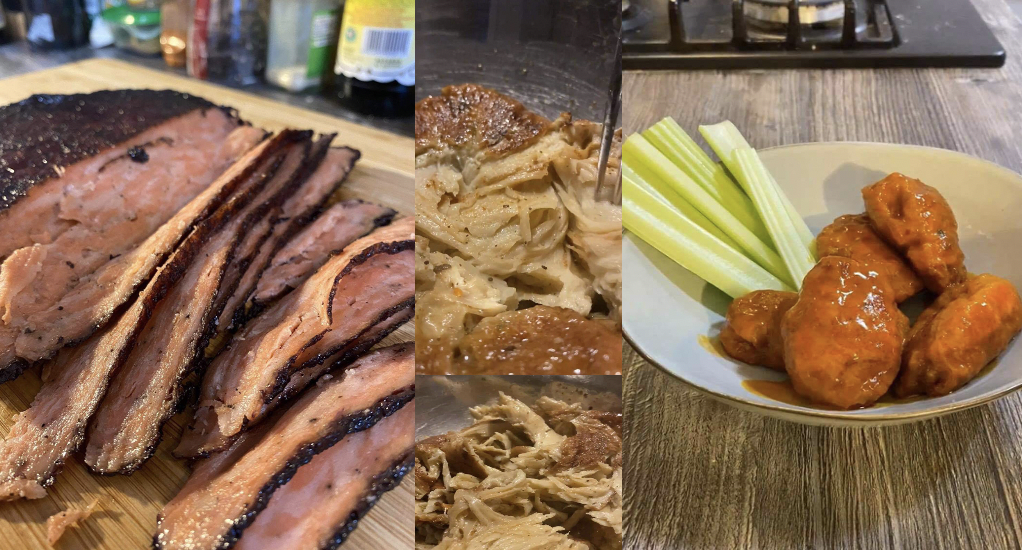
    Futurelettuce creates delicious vegan recipes from chicken wings to washed pastrami. Photo provided by Futurelettuce

    It’s difficult to predict what TikTok trend will be next to go viral – and for an Irish college student who prefers to go by the pseudonym Futurelettuce, it was a surprise when one of his vegan cooking videos joined sea shanties and maid costumes as one of the app’s unexpected crazes.

    “I first became vegan after writing a paper on veganism for a college philosophy class,” Futurelettuce tells me, “I couldn’t argue against it and that stuck with me after the assignment was done.” 

    While it was initially a struggle to adjust to a plant-based diet, Futurelettuce began to enjoy researching nutrition and experimenting with vegan dishes – a particular favourite was the “two-ingredient vegan chicken” that he decided to share to TikTok on 20 February.

    “I think it got popular because people like to be shocked and the unexpected outcome of what began as flour looking like chicken got people to share it around.”

    Futurelettuce

    The video features a step-by-step tutorial on how to make a meat substitute based on the Chinese dish seitan, and became an instant hit on the app – it has since been viewed over 10 million times and gained the Futurelettuce account nearly 70,000 new followers over the course of three weeks. 

    “I first saw it done in a Facebook group and thought I’d give it a try,” Futurelettuce says about the process of his seitan recipe.

    “You make a ball of flour and water, keep kneading it and rest it for a few hours ideally. Then you wash it underwater, and you’ll be left with a lot of starch water. Finally, you can add your seasoning, cook it up and it will resemble something like meat.

    “I think it got popular because people like to be shocked and the unexpected outcome of what began as flour looking like chicken got people to share it around.

    “It was very strange when it began to get popular, especially watching people make reaction videos to it. Watching people watch me is the weirdest feeling for sure,” he continues. 

    The success of the video has since extended its reach beyond the confines of TikTok – Google Trends shows a notable uptick in searches related to seitan starting from the video’s February release. 

    Off the back of his newfound virality, Futurelettuce was asked to make a video on Buzzfeed’s massively popular Tasty Facebook page – where he made sure to acknowledge the East Asian cultural origins of seitan. 

    “When there’s a TikTok trend going around people aren’t going to want to explore the history of the trend, so I felt a bit uncomfortable that I didn’t mention its origins in the original video,” Futurelettuce states. 

    “I do think there is a problem with people taking these ideas and not crediting them, so I felt it was necessary,” he adds.

    “I didn’t want to use the usual talking points, I wanted to let it be known that veganism shouldn’t be restricted to just saving animals”

    Futurelettuce

    “I’ve seen a lot of comments saying I was virtue signaling, but anything right-wingers disagree with they’re going to be outraged, they’re just an attempt to distract from the conversation.”

    An avowed leftist and union organiser when not in the kitchen, Futurelettuce is committed to the idea that veganism must go hand and hand with a wider commitment to social justice and the human rights of marginalised groups.

    “I didn’t want to use the usual talking points, I wanted to let it be known that veganism shouldn’t be restricted to just saving animals,” he says.

    “It’s hypocritical if you’re a vegan and you’re also racist. Intersectional veganism is the way forward.”

    “Both veganism and socialism are grounded in the idea of liberation. One is for the working class, one is for animals. It’s about decommodifying animals and treating them as living things,” he says.

    With EU Green Week just around the corner, our conversation then turns to the environmentalist element of veganism.  

    “There was a UN report a couple of years ago that said eating a plant-based diet is the most effective thing an individual can do to prevent climate change and one of the biggest contributors to Irish CO2 emissions is animal agriculture,” he tells me. 

    So, if you’re looking for a greener meal this week, head over to TikTok and take inspiration from one of Futurelettuce’s creations.

  • Reject modernity, embrace tradition: could Bebo be back for good?

    Reject modernity, embrace tradition: could Bebo be back for good?

    The classic Bebo logo, via Wikipedia Commons

    When the homepage of the once beloved social media site displayed a coming-soon message, rumors began to swirl online of Bebo’s highly anticipated return, which has since been confirmed by co-founder Michael Birch. 

    Before Facebook’s uncontested dominance through the 2010s, Bebo was a strong contender in the then emerging field of social media, gaining a considerable foothold in Ireland, Britain, Australia and New Zealand. 

    The site was sold to AOL in 2008 for $850m but was later bought back by Birch and his wife Xochi for $1m. 

    “I feel like it allowed for the creative side of the individual to be expressed a lot better than current social media sites”

    Veronica Lee

    During the height of its popularity, Bebo seemed to exert an outsized influence on the Irish cultural landscape – mullets were dyed and straightened to achieve the “spicer” style popularised on the site, friendships were forged or torn asunder at the hands of its top 16 function – even Love/Hate crime boss Nigel ‘Nidge’ Delaney was depicted as a Bebo devotee. 

    In 2006, it was described by the Irish Independent as “officially the most popular site in Ireland”, boasting over 500,000 Irish users at the time. 

    While a cynic may view the site’s return as yet another extension of the nostalgia industrial complex that has all but defined millennial cultural output, it’s not hard not to see the appeal of a return to Bebo’s simplistic interface and apolitical landscape in the Q-anon era. 

    Late last year Myspace, a comparable relic of the pre-Zuckerberg internet was revived by an 18-year-old coder named An, capturing the imagination of Gen-z who missed out on the site’s original run. 

    The Author in His Bebo Days, taken by Jake Hurley

    Bebo differs from the social media sites that outlasted it mainly because of the large scope of customisation available to users, including skins (profile themes and layouts), flashboxes (videos which would autoplay upon loading a Bebo page) and a variety of apps and widgets that could be embedded into your personal site. 

    “I used to make custom Bebo skins using an early version of photoshop. They were terrible and embarrassing but the skills I learned from that set the foundation for a lot of what I do today,” said Zak Milofsky, 26, who now works as a photo editor. 

    Veronica Lee, also 26, recalls being drawn to this element of Bebo when she first made an account.

    “I loved that aspect of Bebo, being able to have control over the complete layout of the page,” she told me. “I feel like it allowed for the creative side of the individual to be expressed a lot better than current social media sites.”

    This element of customisation made Bebo the perfect space for Irish teenagers to develop their own sense of identity, as well as divide themselves into subcultural groups. 

    Two prominent but ideologically opposed factions reigned supreme amongst mid-noughties Dublin-area teenagers – both vying for dominance of the coveted, now redeveloped space outside Dublin’s Central Bank. 

    First were the scene kids, a less brooding emo offshoot focused on brightly dyed hair, clothes from the American chain Hot Topic and an affinity for the kinds of Warped Tour bands who now sport extensive “controversies” sections on their Wikipedia pages. 

    The spicers, a uniquely Irish phenomenon, were more inward facing then their globalist scenester cousins and sported a unique aesthetic built around elaborate mullets, extensive Adidas wardrobes and a penchant for “shuffling” to hardcore techno.

    “I would have liked to think I was a spicer, I had a white Adidas jumper that was washed once a month because I only had one and needed to wear it at all times,” Invisible Friends podcast host Aoife Doran, 23, tells me. “I also had a side fringe so severe that it actually worsened my lazy eye and resulted in me having to wear an eye patch at 13. Not a look.” 

    As a facilitator of unbridled and often downright confusing youth expression, Bebo was predictably met with moral panic amongst parents – the flames of which were stoked in no small part by media outlets which tended to suggest a link between the site and a rise in binge drinking amongst Irish teens. 

    “Selecting your top 16 could make or break a friendship”

    Zak Milofsky

    “Happiest when: I’m locked at Wez! Drinks: Hino! Dutch Gold! I swear to god it’s actually nice! Cans are mingin’, bottles all the way,” wrote an unnamed bebo user quoted in a 2006 Irish Independent article.

    To circumvent the watchful eyes of concerned parents, many mid-2000s teens were forced to take matters into their own hands.

    “I surreptitiously made an account in my neighbours office with my friend. My mam walked in, saw what was happening and took away my Gameboy for two weeks because she believed Bebo was the most dangerous thing to youths of the day,” 22-year-old Matt Corrigan admits. 

    The risk of a confiscated Gameboy was a risk worth taking, as the stigma of being left out of the Bebo craze and the social politics built around the top 16 friends ranking was too great to endure. 

    “Selecting your top 16 could make or break a friendship. I think the ability to share so much about yourself online was new to the Bebo teens and created a competitive atmosphere where there was pressure to keep updating,” Milofsky says.

    Despite Bebo’s ultimate fall from grace at the hands of social media behemoth Facebook, it’s clear that the site holds a particular place in the hearts of Irish millennials. What remains to be seen however, is if nostalgia is enough to get Bebo’s planned relaunch off the ground. 

  • Immaterial Girl: How SOPHIE expanded the horizons of pop music

    Immaterial Girl: How SOPHIE expanded the horizons of pop music

    The iconic producer on the Oil of Every Pearl’s Un-Insides cover. Cover Art Credit to Soapworld

    The music industry and trans community lost a pioneer on 30 January. The 34-year-old critically acclaimed producer SOPHIE died following an accidental fall in Athens, Greece – leaving behind a legacy of adoration from fans, friends and collaborators. 

    It’s difficult to forget hearing SOPHIE’s music for the first time. When BIPP first appeared on the radar of music listeners in 2013, it sounded like a dystopian future filtered through a nostalgic past, garnering widespread acclaim and speculation as to the identity of the reclusive artist. Rising to prominence alongside London’s PC Music collective, the acclaim would only grow more unanimous as SOPHIE’s elevated artistic and sonic vision cemented the Scottish producer’s place as one of the most forward-thinking musicians of the 2010s.

    For Dublin based experimental-electronic producer Dark Mavis, the unforgettable introduction into the world of SOPHIE came initially through the song Hard, as it played in the Boiler Room set of label mate GFOTY and subsequently in the unlikeliest of places, the stockroom at his former workplace. 

    “After I heard that SOPHIE track at work, I became obsessed. I listened to every release, every set, everything I could get my hands on,” says Dark Mavis. “I think that was back in 2017 so I was a bit late getting into the music, but I’ve been a huge fan ever since,” he continues.

    “It’s something that’s so difficult to emulate because SOPHIE had a truly unique talent for manipulating sound”

    Dark Mavis

    Kilkenny’s self-described purveyor of ‘occult digital hardcore’ Fomorian Vein too recalls a memorable first encounter with SOPHIE’s track Lemonade whilst reading a blog article in 2014. 

    “The overt influences from Eurodance, hardcore techno and noise music stood out immediately along with SOPHIE’s own distinct production, tracks like this were unheard of at the time and it was a much-needed breath of fresh air,” says Vein.

    An uncompromisingly singular beatmaker, it’s difficult to pinpoint the exact influences from which SOPHIE crafted the sound.

    Where genre descriptors fall short, SOPHIE’s music is most often likened jokingly or otherwise, to the physical materials such as metal and elastic that the producer meticulously sought to recreate through software synthesis and digital manipulation. 

    For Dark Mavis, this was a particular source of inspiration: “Both the found sound element of the music and how SOPHIE imagined and designed sounds that may not necessarily be real is hugely inspirational,” he says. “It’s something that’s so difficult to emulate because SOPHIE had a truly unique talent for manipulating sound in that way, but it’s something I would love to incorporate into my own music.”

    SOPHIE was also adept at expanding the sonic world of collaborators, pushing them into realms they may have been initially reluctant to explore. SOPHIE played a crucial role in the musical development of close collaborator Charli XCX, who traded in the radio-friendly pop-rock of 2014’s Sucker for the ambitious soundscapes of the Vroom Vroom EP. 

    “The kicks, the snares and the acid bassline come together with Charli’s vocals to make perfect pop music,” says Mavis. “You hadn’t really seen anything like it in mainstream pop music, I still don’t think people are ready for it to cross over into the charts,” Mavis continues.

    On Yeah Right, SOPHIE adorned the voices of west coast rapper Vince Staples and superstar feature Kendrick Lamar with booming bass and harsh percussion.

    SOPHIE even collaborated with personal hero Madonna on the critically divisive but endlessly memed 2015 track Bitch I’m Madonna.

    With the release of official debut Oil of Every Pearl’s Un-Insides, the once reclusive SOPHIE (who preferred not to be addressed by any pronouns when discussed by media outlets) presented extremely personal and deeply emotive work which revealed and explored the artist’s trans identity. 

    SOPHIE presented an extremely personal and deeply emotive work which revealed and explored the artist’s trans identity

    The success of the record and its accompanying videos secured SOPHIE a well-deserved spot in the pantheon of queer icons and its exploration of gender identity remains a major inspiration for LGBTQ+ artists across a variety of mediums. 

    “Oil as an album is a massively empowering statement on personal identity and sincerity that shakes a lot of people’s perceptions on what even seems possible within music,” says Fomorian Vein.

    “The opening track It’s Okay To Cry had such an immediate, enormous and much needed impact on not just electronic music or pop music, but also how musicians in the public eye could learn to present themselves,” Vein continues.

    SOPHIE’s life and career as a hugely innovative transgender music producer stands as testament to the empowerment and liberation of casting off restrictive gender and sonic constraints. The refrain of one of SOPHIE’s most beloved songs Immaterial reassures the listener that “you can be anything you want” – a fitting chorus for a song that will continue to soundtrack the self-discovery of young queer people for decades to come.