
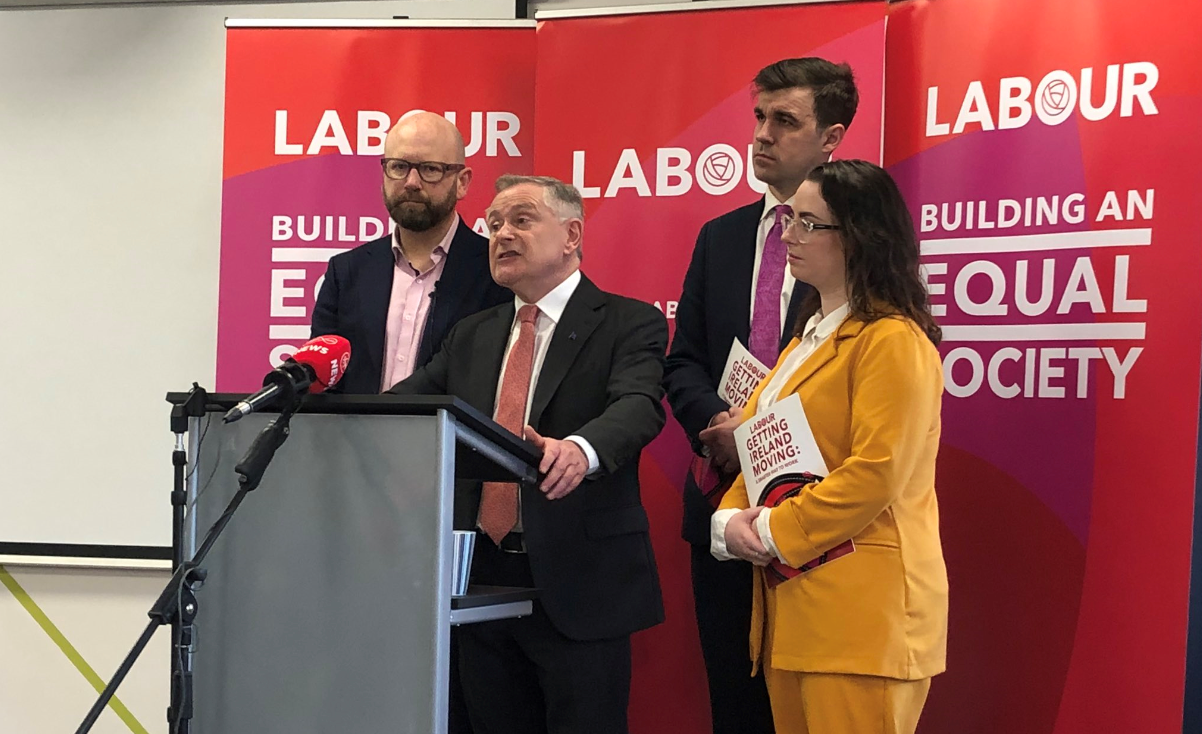

As Labour unveils plan for Ireland to make ‘distinctive contribution’ on the world stage, the party’s Political Director tells TheCity.ie that our domestic struggles must come first
By Ayumi Miyano
Ireland should accept its “fair share” of refugees – but avoid making promises to the world that we can’t keep, a Labour Party boss has said.
In an interview with TheCity.ie ahead of Saturday’s General Election, Labour’s Political Director Nat O’Connor said: “Obviously, there is a limit. We can’t take all refugees.
But we have a capacity where as a wealthy country we certainly need to take more than we currently have.”
Justice Minister Charlie Flanagan has pledged to give shelter to 2,900 more refugees in Ireland between now and 2023. Over 3,200 have been resettled here since 2015.
O’Connor said Labour would start by reforming the controversial Direct Provision system.
Labour would also take the management of Direct Provision – which it describes as “the most controversial part” of the immigration system currently – out of the hands of the Department of Justice.
The party proposes moving it to a different government department such as Rural and Community Development.
Speaking to this website, O’Connor acknowledged Ireland has a relatively low number of refugees compared to other European countries.
However, “we can’t promise to do something that we can’t do,” he added.
And he feels that Ireland has to prioritise resolving the current housing crisis before we could consider taking any more refugees in addition to the extra 2,900 we’ve already vowed to welcome here in the next four years.
O’Connor said:
“If the housing crisis is resolved, we will have a greater capacity to take refugees, and we could take some more.”
Indeed, housing and health have been highlighted as the most contentious areas ahead of Vote 2020.
But immigration is another important – and sometimes divisive – area for the various political parties to address.
This includes the difficult task of devising an approach to the management of refugees and asylum seekers looking to make Ireland their home.
Over the past two decades, Ireland has experienced a large increase in the numbers of foreign workers setting themselves up here – and these numbers continue to increase.
The movement of migrants is becoming more and more fluid due to the large number of people fleeing countries ravaged by extreme climate change – as well as those fleeing war and persecution.
This trend has been accompanied by an increase in right-wing rhetoric evidenced in many European elections. The UK’s withdrawal from the EU last Friday was further evidence of these trends.
So it seems that now, more than ever, Ireland needs to ensure a stable connection with the rest of the world.
In the light of Ireland’s efforts to secure a seat on the United Nations Security Council (UNSC) in 2021, foreign policy will be a crucial factor for the new government that could be in place as early as next week.

In their election manifesto, Labour sets out their so-called “distinctive foreign policy”.
Ireland should be “a positive influence in the world” and Labour would aim to offer a ‘distinctive Irish contribution’ if we gain membership of the UNSC, the document says.
This was further emphasised by Labour leader Brendan Howlin last month.
In an interview with TheJournal.ie on January 29, Howlin said the campaign for a seat on the UNSC for the 2021-2022 term had to be “for a purpose”.
In the same interview, he asserted that Ireland should not be a “nodding duck” on the UNSC – but should be more assertive.
From my own close examination of the Labour manifesto, it contains no clear statements on the management of refugees – a clear weakness if the party is looking to govern and get a seat on the UNSC. Surely, a more focused policy stance will be required to win support.

Asked if Ireland should take more refugees in the years ahead, O’Connor said yes in principle.
He explained: “Ireland should take our fair share…Ireland has the capacity to take refugees and we should do so.
“Obviously, we have a housing crisis, where we simply have an insufficient supply of housing.
“We do need to solve the housing crisis – but that’s a bigger crisis.
“We need to do that anyway and Labour has plans obviously to do that.
“But we should also – as we have more housing – be prepared to take a larger proportion of refugees certainly.”
O’Connor continued: “The most important part at the moment – and the most controversial part – is the direct provision system.”
Instead of putting refugees and asylum seekers into accommodation units, they could be more integrated into the local community by living within the neighbourhood in houses or apartments, Labour feels.
The party also aims to speed up the processing of asylum claims because those ‘stuck waiting’ are left “in sort of a limbo system”, O’Connor explained.
Howlin’s party proposes the government that’s yet to be selected by the electorate should aim for Ireland to have a distinctive status in the world. However, perhaps the reality is that we need to resolve our domestic problems first.

You must be logged in to post a comment.