“Why would you bother learning that? Sure, it’s a dead language” – the words many Irish speakers have heard while growing up.
However, in 2024, that could not be further from the truth.
Today, TheCity.ie speaks with Mícheál Ó Nualláin, director of Baile Átha Cliath le Gaeilge and Ola Majekodunmi, Irish language programme co-ordinator with Fighting Words, about all things Irish, and in particular, their own journeys with the language.
From schooling to job opportunities, to what they believe the Government needs to do to further progress the language, the Gaelgóirí tells all.
Tá an Pop Up Gaeltacht ag dul ó neart go neart, sé bhliana ónár thosaigh sé.
Six years on from its first event in Bar Rua on Clarendon Street, the Pop Up Gaeltacht is still bringing people together to speak their ‘cúpla focail’.
On the last Thursday of every month, the Pop Up Gaeltacht occurs in a different bar in Dublin. This month, Gaelgeoirí from as far as Kerry, Galway, Donegal and Belfast travelled to the Foggy Dew in Temple Bar.
Loretta Ní Ghabháin got the train from Galway to Dublin at 7:30 on Thursday morning. Ní Ghabháin speaks Irish daily, either at home with her twin daughters while reading them bedtime stories, with her friends in WhatsApp groups or at her work office. Ní Ghabháin said that speaking Irish is important to her because it is a big part of our identity and culture as a country. She said: “We can understand ourselves better as Irish people when we understand our language.”
Robert Brennan is a primary school teacher from Dundalk, he attended his first Pop Up Gaeltacht last July and it has become the place for him and his friend from home to meet once a month. “It is a great opportunity to meet and speak Irish. I’m very proud to be Irish and I know that the Irish language is an important part of our culture,” he said.
New York, Hollywood and Brussels are just a few of the other well-known cities the Pop Up Gaeltacht has taken place. It has become an international success. Conor MaCaba from the United States was accompanied by his Italian friend Maria whom he is currently teaching Irish. Although last night was their first time at the Pop-Up Gaeltacht, MaCaba started learning Irish in college and he’s still studying it now.
“The Irish language is a significant part of Irish culture. I grew up in the States but most of my family is Irish. The laboratory I work in is bilingual so we speak Irish and English together each week,” he said.
Hugh Cerr first heard about the Pop Up Gaeltacht when its organisers, Osgur Ó Ciardha & Peadar Ó Caomhánaigh spoke to his college class about it in 2016. He says it’s been an integral part of his life in Dublin ever since. Cerr has been attending the Pop Up Gaeltacht since its very beginning. Cerr explained in his lovely Donegal accent, “Without Irish, I wouldn’t have my career, my friends or my passion for stand-up comedy. It is without a doubt, the most important part of my life.”
All standards of Irish are welcome and at October’s Pop Up Ghaeltacht, comedian Michael Fry was there filming with his latest show ‘Creidim Ionat’ with RTÉ. In this show, three Irish celebrities including Marty Morrissey and Merissa Carter are supported by Irish speaking mentors in their journey toward regaining their confidence in speaking Irish.
The ‘Creidim Ionat’ campaign will run until the 11th of November 2022. If you would like to learn more Irish or support someone else to reach an Irish language goal, set a target by the end of the campaign.
You can find the time and place for the next Pop Up Gaeltacht on their Facebook page.
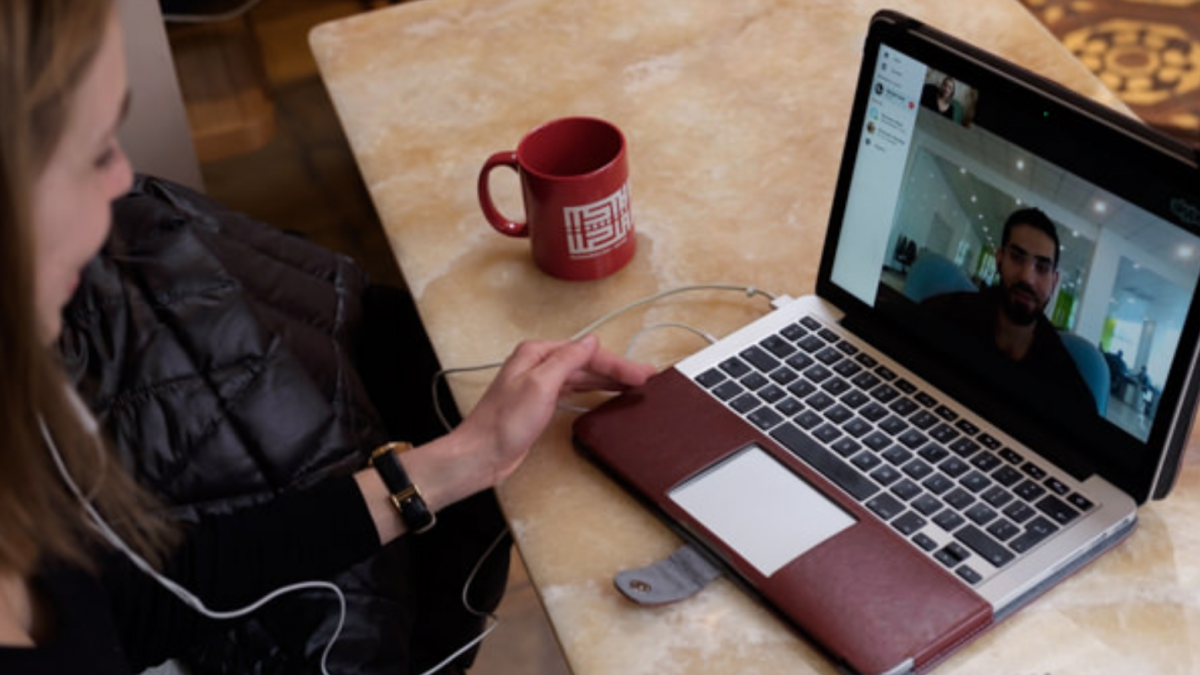
Learners and conversation partners connect online (Photo: NaTakallam)
The City’s Cameron Weymes examines the work of NaTakallam, a businessthat hires displaced people as language teachers online.
NaTakallam, which means “We Speak” in Arabic, was launched in 2016 by Aline Sara, a Lebanese-American woman who was looking for an affordable way to improve her native Levantine dialect of Arabic while living in New York.
Sara saw an opportunity to provide an income to displaced people through an online teaching service that would connect Syrians with learners from around the world, and decided to establish NaTakallam.
NaTakallam has subsequently expanded to include Persian, Spanish and French, hiring displaced people from Iran, Afghanistan, Venezuela and Central America.
Shadi Khaled is one of NaTakallam’s dozens of refugee employees.
Shadi was a music teacher in northern Syria when the war forced him and his family to seek refuge in neighbouring Iraq in 2013.
Despite this, Shadi found his teaching qualifications were not recognized by authorities in northern Iraq.
Shadi Khaled at his home in northern Iraq Photo: Shadi Khaled
After almost four years of working in a variety of jobs, including carpentry, he was hired by NaTakallam in 2017 as a language teacher.
Shadi now conducts online conversation classes in Arabic to students around the world from his home in a refugee camp near the Iraqi-Kurdish city of Erbil.
“The best thing about the programme is that it gives students an opportunity to practice their language skills and allows teachers to provide for themselves and their families,” he said.
“At the moment I currently have ten students, some of who are now fluent in Arabic. We do grammar and vocabulary along with discussions about various topics like politics, economics and history.”
Many displaced Syrians in the Middle East are unable to work due to a lack of work permits and other impediments.
As a result, millions of people, often highly educated, are reduced to handouts and cash in hand labour jobs.
NaTakallam allows displaced Syrians to overcome some of these obstacles by providing them with an income.
For example, Shadi is unable to send and receive bank transfers due to his refugee status in Iraq, but can now get paid by NaTakallam through the local Western Union.
According to Shadi, the coronavirus crisis has increased demand for classes, as learners seek to make use of their free time.
“The situation here in Northern Iraq is the same as other countries, we’ve been partially on lockdown, giving us more free time.
“Since the coronavirus crisis began many of my students are calling me from around the world and saying ‘we have extra time now, it’s a good opportunity for us to do extra practice’,” he added.
NaTakallam founder Aline Sara Photo: NaTakallam
Shadi uses his income from NaTakallam to provide for his wife and two children, who have also gotten to know some of the Arabic learners.
“My students speak with my family and I with theirs. Our lessons are an exchange in cultures and traditions,” Shadi added.
“We are not just teachers and students, our bond is greater than that. I tell my students not to be shy in asking anything from me, we are like family and it’s common to keep in touch after a course has come to an end.
“Natakallam has been my window to the world, each program allows me to travel the globe.”
Dublin
will ensure you’ll discover amazing homemade scones, caffeine shots in hidden
cafés and the perfect vintage clothes in a second-hand shop. To a historic
landmark with an inspiring back story or a chance to chat with a Dublin
character, this city is layered, unique and full of treasures waiting to be
found.
However,
it is not only the welcome that brings people into this country. Some people
come to look for a better life, and it’s here where they think that their
dreams will come true.
Like many Brazilian people living in Ireland, Luz Mauricio followed her dreams to Dublin where she came to learn English
Luz Mauricio Photo Credit: Ana Novais
“I came to Ireland in 2016 and have now
attained a proficient level of English which is excellent,” said Luz.
But
for Luz, one of her biggest struggles was finding somewhere to live
“When
I arrived, I ended up living in a house in Dublin 1, with eight other people
and for seven long months, I shared a room with one other girl and two guys,”
she continued.
“I
got depressed,” said Luz, “but I kept going because my goal was to find a job
and to learn a new language.”
Living
in overcrowded places is the norm for many Brazilians and other international
students living in Dublin and people are regularly evicted with short or no
notice.
“Eventually,
I found a less crowded place to live, but I never got my deposit back from the
previous landlord,” she added. “But, everything I have been
through was worth it and at least in Ireland, I have a better life.”
“Coming to Ireland has been a great experience, but it is so tough to find a suitable place to live,” said Luz.
According
to the Immigration in Ireland Statistics 2018, Ireland granted permission to
22,414
Brazilians to remain in the State last year.
“Ireland granted permission to 22,414 Brazilians to remain in the State last year”
Colm Daly, Executive Officer at the Department of Justice and Equality.
“There
were 12,618 Brazilians with a permission to remain on Study grounds (Stamp 2
and 2a) in 2018,” said Colm Daly, Executive Officer at the Department of
Justice and Equality.
The
biggest motivation among all these people is the desire to be in contact with
different cultures and the chance to learn a new language.
Recent figures released by the Central Statistics Office (CSO) in November this year show that the number of people speaking Irish is declining.
Information gathered during the 2016 census revealed that as of April 2016, 1,761,420 people (39.8% of the population), aged 3 and over, said that they could speak Irish.
Out of the total amount of Irish speakers recorded, 968,777 were female and 792,643 were men. Compared to 2011, there has been a drop of 0.7% (-13,017 people).
However, of the 39.8% of people who stated they are able to speak in Irish, one in four (23.8%) of them admitted to never using it, while a further 558,608 (31.7%) expressed that they haven’t used in daily conversation or for any other reason, since leaving school.
Of the percentages of people able to speak Irish, the highest numbers were recorded in Galway County at 49%. Clare closely followed with 45.9%, with Corky County (44.9%) and Mayo (43.9%) shortly behind.
The lowest percentages were found in Dublin City at 29.2%, followed by Louth and South Dublin, both at 34.1% and Cavan at 34.6%.
The number of those who say they speak Irish less often than weekly stood at 586,535 people (33.3%) compared to the lesser percent of people who attest to speaking the language on a weekly basis, (6.3%) or 111,473 people.
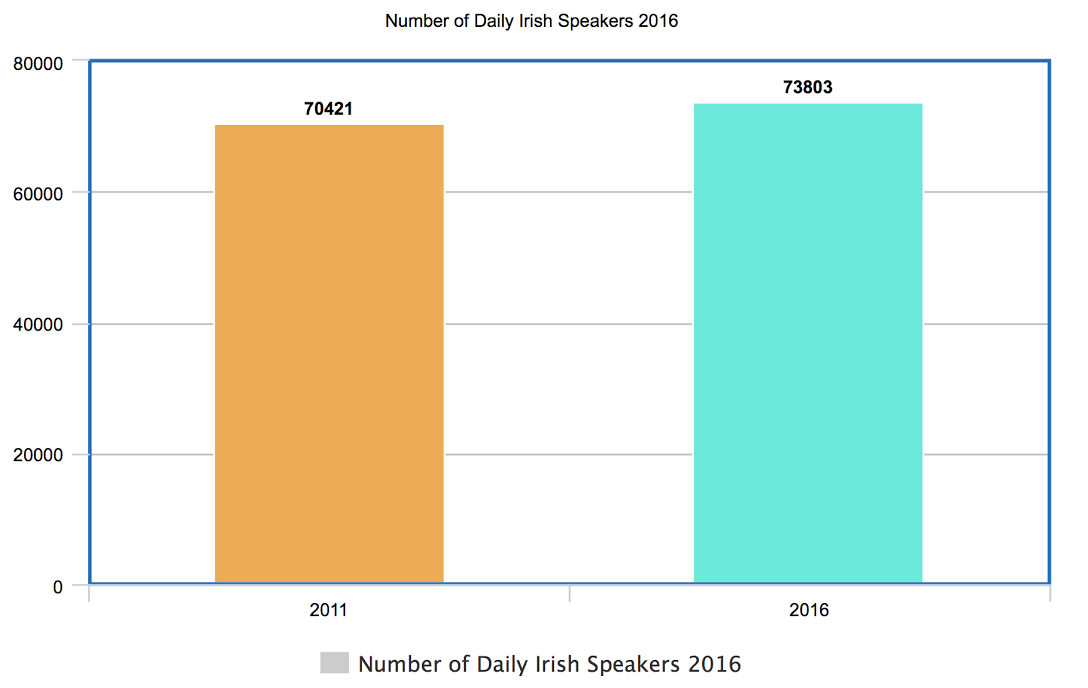
While the number of daily Irish speakers stood at 73,803, representing 1.7% of the population. This was a decline of 3,382 (4.4%) on 2011.
20.2% of the total 73,803 lived in Dublin City and suburbs. This was an increase of 674 people (4.7%) since 2011. Cork, Galway and Limerick together accounted for 6,034 daily Irish speakers (8.2%).
Outside of these cities, the largest absolute numbers of daily speakers were living in An Bun Beag-Doirí Beaga (771), followed by Letterkenny (525) and Swords (487).
Daily Irish speakers in the Gaeltacht areas of Galway County and Donegal made up almost three quarters of all daily Irish speakers in Gaeltacht areas, with 9,445 (45.9%) in Galway and 5,929 (28.8%) in Donegal.









You must be logged in to post a comment.