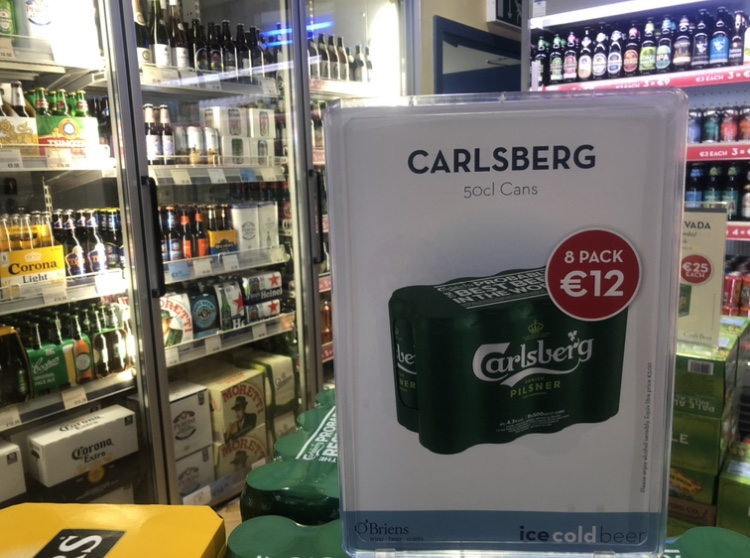
Carlsberg advertisement in O’Briens Wines Glasnevin. Photo by Mario Bowden
On Tuesday 4 May 2021, the government revealed plans to implement a minimum pricing on the sale of alcoholic products in of January 2022.
In a nutshell, the price of alcohol sold in off-licences will be determined by the strength of the product – priced at 10 cents per gram of alcohol. The higher the alcohol content, the higher the price.
This policy is based on the 2018 Public Health Alcohol Act that the previous government decided not to put into action before the last election.
Minimum pricing will not apply to bars and pubs, only to the off-licence sector.
At the press conference to announce this policy, Minister for Health Stephen Donnelly and Tániaste Leo Varadkar spoke about the proposal’s aim to reduce the health harms of excessive drinking. The hope is that minimum pricing will curtail alcohol-related death and disease rates in Ireland.
Data shows that alcohol misuse is responsible for 2,700 deaths each year in Ireland.
Data released by the health research board (HRB) revealed that during the pandemic in 2020, the average Irish person consumed 10.1 litres of pure alcohol – the equivalent of 116 bottles of wine and 445 pints of beer per person each year. This is a slight reduction from the 2019 average of 10.8 litres.
The HRB noted this was a “relatively small decline, considering pubs have been closed for the majority of the year”.
It’s also pretty far off the government’s goal to reduce the average per person alcohol consumption to 9.1 litres in 2020.
Beer fridge in O’Briens Glasnevin. Photo by Mario Bowden
“It’s understandable that people are drinking more at home,” said Varadkar at the press conference. “I’m doing so myself. To most drinkers, I want to say this: minimum pricing is not targeted at you. But, rather at the heaviest drinkers, those who attempt to seek out the cheapest alcohol. And particularly children, experimenting with alcohol for the first time.”
There is sufficient evidence to back the government’s plans. In 2018, Scotland introduced a similar minimum pricing system. Since its introduction, alcohol related deaths have fallen significantly. Canada has also had minimum pricing in place since 2010.
So, what will minimum pricing look like?
Minimum pricing will vary depending on the product being sold and its alcohol content.
For instance, a 500ml can of lager will start at €1.70, whereas a 500ml can of cider will begin at €1.78. A bottle of wine’s minimum price will be €7.40, while 700ml bottles of vodka start at €20.71 and gins and whiskeys at €22.09.
As the price is decided per gram of alcohol, it significantly increases as the percentage of alcohol increases – designed to impact on the strongest alcohol most.
In shops like Lidl and Aldi, a number of good wines come in underneath this threshold – the shelves will be transformed.
For those of us who enjoy a craft beer, you won’t be able to get a relatively strong IPA (6.5% ABV) in a 500ml can or bottle for €2.56 per can/bottle. We can wave goodbye to any four for €10 deals.
Minimum unit pricing of alcohol will not affect restaurants or pubs and will apply to off-licences and supermarkets only.
It will target cheap, high-alcohol products — for example, own brand drinks sold by retailers. pic.twitter.com/Vsiz7KIcCJ
To little surprise, the new pricing scheme has come under scrutiny from both retailers and consumers alike. For consumers, the proposal mostly targets those with lower-incomes who will now be spending a bigger proportion of their income on drink.
Ireland’s alcohol prices already remain the second-highest in Europe – 88.9% higher than the EU average, only lower than Finland.
In Italy, for instance, a country closer to the EU average, a 660ml bottle of beer costs as little as 90 cents in a supermarket and imported German beer only around €1.60.
Beer fridge in O’Briens Glasnevin. Photo by Mario Bowden
For retailers like Pearse Greally, the manager of O’Brien’s Wines of Glasnevin branch, the lack of clarity communicated by the government has been frustrating.
“There’s not been that much information [given] to retailers yet. For example, how it will work with the smaller brands? We sell Tennents for €1. If the minimum price of that is going to be at €1.72, what does that mean for more premium beers like Heineken? Will Heineken then increase their price to €2.50 or three euro a can to keep its premium headline? Because this increase [in price] isn’t a tax, where is that increase coming from or going to?” asks Greally.
The government in the Republic of Ireland is also calling on Northern Ireland’s government to implement its plans for minimum pricing at the same time as the south. Especially around Christmas time, when cross-border shopping is most active. Northern Ireland is set to introduce minimum pricing in 2023, a year after the Republic.
“We have high competition with the North because drink is much cheaper there.” says Greally. “And if their minimum pricing doesn’t come into effect until January 2023, why are we doing it a year early? We’ve already increased the tax on drink as well and now we get this? So no one really understands from a retail point of view.”
While a number of unanswered questions remain, not least how off-licences will compete with pubs and restaurants, one thing is for sure: students can wave goodbye to cheap cans.
The Green Party is set to hold a teleconference to evaluate their official response to Fianna Fail and Fine Gael’s letter, which answers the 17 questions posed by the Greens regarding policy promises. TheCity.ie’s Kate Brayden speaks to County Clare Green Party councillor Roisin Garvey and Futureproof Clare about the vital Shannon LNG concession, and the 7% emissions target urged by the United Nations.
In a letter published this week inviting the Greens into further governmental talks, FF and FG wrote that they “welcome the desire of the Green Party to be involved in recovering, rebuilding and renewing Ireland in the aftermath of the COVID-19 Emergency” and respect the “strong policy platform” outlined by the Greens, led by Eamon Ryan.
Crucially, the two parties stopped short of promising a 7% emissions reduction target by 2030 – despite the fact that the EU have said the minimum reduction needed is 8% to remain outside of the 1.5C temperature increase. The target is based on the 2019 “Emissions Gap” Report from the UN Environment Programme.
In the document, it was written that FF and FG “would like to understand and tease out with you through talks, the specific actions that would have to be taken to achieve” the 7% reduction.
“We all need to understand the impact it would have on employment, poverty, agricultural practice, public transport, regional development and on the different sections of society.
“Considerable work will have to be done to outline where and when further carbon reductions could or should come from given that we will have to significantly reboot and revive the economy,” they wrote.
Chair of the State’s Climate Advisory Council, Professor John FitzGerald recently commented that achieving a 7 per cent reduction in annual emissions would be extremely difficult but said: “If you do the groundwork…you could get to it in the second half of the decade.”
The Greens emphasised the need for a just transition in their 17 point plan, which advocated for a Universal Basic Income, retrofitted public housing, affordable public transport and a significantly improved healthcare system, among others. Major changes in agriculture, public transport and energy would provide the means for the reduction in emissions.
Despite the estimated €30 billion cost of the Covid-19 pandemic, the chair of the National Advisory Council on Climate Change has affirmed that Ireland needs to prioritise investment in climate action going forward. New research undertaken by University College Cork’s MaREI Centre for Energy, Climate and Marine states that the party’s 7% emissions reduction goal would require “transformative changes” and huge costs, but is a feasible challenge.
‘Is the new Green Party emissions reduction target feasible and what would it mean for the energy system?’, written by Hannah Daly, James Glynn & Brian Ó Gallachóir, asserts that the changes could bring significant health, wellbeing, economic and employment benefits to society.
“While there are real costs associated with greening Irish economy, these ignore fact that we already pay massive subsidies to some of our dirtiest industries”
The Fianna Fáil and Fine Gael leaders committed to enacting climate legislation within 100 days of forming a government, but this legislation could fail to be implemented. The Greens are seeking concrete answers for their detailed questions on exactly how their policies would be enacted should they enter into Government with FF and FG.
“If they want the Greens in power, they’re going to have to do a lot more than greenwashing us – there’s going to have to be proper commitment,” said Roisín Garvey, Green Party councillor in County Clare.
“We’re not tied to five years: Fine Fael and Fianna Fail really need us, because they know that if there’s an election now, they’d be crucified. Now is time to try and get policies we want, not just the promises that we want,” Garvey added.
“I think Fianna Fail and Fine Gael know that, and they also know that there’s going to be huge fines from Europe if we don’t meet our targets. So I think now is a very good time for us to be in negotiations. We have a much better chance now than when we went in with Fianna Fail in 2008, when there were only six TDs. The climate crisis wasn’t being taken seriously by anybody.
“The fact that we have 12 TDs now since the General Election shows that it is an issue – that’s an unprecedented amount. However, FF and FG are just agreeing things in principle to get us into negotiations. But Eamon Ryan’s been around the block before, he’s not naive about it. Those 12 TDs have been in politics for a long time: they’re definitely going to be committed to getting proper timelines.”
It’s important to note that in 2007, six Green TDs entered Government as the junior party in coalition with Fianna Fail. The party were later decimated four years later, suffering a wipeout in the General Election and losing all six of its seats. The party returned to the Dail in 2016, receiving just over one percent of the vote in local election.
"If an Irish party ever wants to truly dethrone the two royal families who've presided over us since birth, it needs to aim for more than simply mitigating their worst decisions" https://t.co/LR3rYKdr5T
Today’s Green Party are heavily split over whether to prop up a FF/FG Government, which younger voters categorically don’t want. Younger members and outliers believe that the radical change needed simply cannot happen with FF and FG. The dramatic 2020 General Election, which saw Sinn Féin emerge with 33% of the overall vote, proved that real change is desired following years of homelessness, housing and rent crises and a deeply worrying healthcare system. The Greens are now between a rock and a hard place, facing strife for entering a FF/FG coalition and political backlash if they refuse to. What they choose now could decide the future of the party by turning their youth vote away (possibly to Sinn Féin) – but the climate is on a timer. Could they pass climate action policies with two parties who are notorious for their abysmal apathy on climate justice.
Shannon LNG: concrete concessionor vague promise?
Stating that both parties are “committed to a pathway to phase out all fossil fuel exploration licenses”, FG and FF also claim to be open to introducing a moratorium on exploration licences for offshore gas exploration. Referring to the controversial Shannon LNG project, which would import dangerous fracked gas from Pennsylvania, the letter states:
“Both of our parties accept that as we move towards carbon neutrality, it does not make sense to build new large-scale fossil fuel infrastructure such as liquid natural gas import terminals.”
FF and FG mention that economic activity must be stimulated in the areas which were expecting local development plans, and exploring how strategic investment in the Shannon estuary and port infrastructure could support renewable energy.
William Hederman of Futureproof Clare, speaking to TheCity.ie, mentioned that zero room for loopholes must be allowed by the Green Party if they want to ensure that no LNG terminals or fracked gas imports will go ahead in future:
“A crucial first step is for the new government to tell the European Commission that Ireland wants Shannon LNG taken off the EU’s projects of common interest (PCI) list.
“For Fine Gael and Fianna Fáil to accept that it does not make sense to build LNG import terminals is a huge milestone. It is the result of years of grassroots campaigning, particularly in Kerry, and also here in Clare, that has grown into an international coalition against Shannon LNG,” Hederman continued.
“However, the language used by Leo Varadkar and Micheál Martin is vague and looks like they are trying to leave wriggle room. We must keep pressure on them to translate this statement into a firm commitment. Building new infrastructure such as this would lock Ireland and the EU into fossil fuels for decades, when we need to be rapidly transitioning to renewables in order to avoid catastrophic climate breakdown.”
Fianna Fail and Fine Gael wrote that they “would need to have a shared understanding of what is meant by new fossil fuel infrastructure, what type scale does this relate to, and whether this proposed ban would apply to State infrastructure or to private sector infrastructure as well.”
Stating that they would need a “clear understanding” of the State’s powers in this area and the limitations of European law, as well as international treaties, but removing Shannon LNG from the EU’s Projects of Common Interest list is very much possible.
Extinction Rebellion poster during the 2020 General Election (Photo: Instagram)
Speaking on the list, Roisín Garvey chastised the two parties on their unwillingness to face the realistic possibilities of climate action policies.
“Fianna Fail and Fine Gael act like we can’t do that – but sure we all know that’s not true. They shouldn’t play us as fools. FF/FG need us more than ever, because we can bring back jobs, we can save people money in how they run their houses through retrofitting, we can put money into transport instead of cars; this is now a really good time for them to hear us out.
“We’ve seen it happen in other countries. There have been hugely successful policies in Denmark and Scandinavia and Germany – lots of places have figured out their education, their housing, their transport: we don’t have to come out with these ideas all by ourselves. They’ve been around for years, that’s why the Greens exist, because we’ve all seen it done.”
The 12 Green Party TDs and two Green Senators will hold a second teleconference meeting this week to evaluate their response to the joint Fianna Fáil and Fine Gael letter inviting the party into formal talks.
STRICT: Currently, queueing outside supermarkets is the new normal, with many outlets only allowing in one shopper at a time and banning children in some cases as Coronavirus continues to spread (Photo: Paul Caffrey)
During the month of March, the population went on a €363million panic-buying spree. The shops are much calmer now, but queuing outside supermarkets — with stricter controls on how many customers can enter a store at any one time —has become the new normal. In words, pictures and video, TheCity.ie’s Paul Caffreyhas been keeping track of the “shopageddon” phenomenon since March 13
“No sausages. No teabags. No potatoes,” the senior security guard at a north Dublin supermarket boomed with a wry grin to a colleague over his two-way radio.
The weary-looking herds of shoppers rushing from one aisle to another — just trying to grab what they can — didn’t seem to have registered a word of his worrying summary.
But that was only the start: there was no bread left and most of the fruit, vegetables and frozen food were gone, too – even though there was a full delivery to this store at eight o’clock this morning.
Meanwhile, queues for the checkouts — one family after another with an overflowing full-size shopping trolley — were snaking back into the aisles.
It was nearly 6pm on the evening of Friday, March 13 at Tesco Kilbarrack in north Dublin — 31 hours since Leo Varadkar announced a virtual shutdown of the country on account of the global Covid-19 outbreak — and the place was full of people completely ignoring Government pleas not to panic buy.
Throughout this large store, which acts as a lifeline to thousands of families and elderly people in the long-established north Dublin areas of Raheny, Kilbarrack, Coolock, Artane and Donaghmede, there was an air of quiet panic.
Even though people here were keeping calm and being respectful to others, many seemed grimly determined to buy up everything in sight.
However, this “emergency” buying wasn’t quite what you might put at the top of your essentials list for what was then expected to be a fortnight of being housebound. At one checkout, a man was hurriedly purchasing exactly 20 Easter eggs and not much else.
NEW ORDER: Local councils were quick to create new markings on walkways to reflect the social distancing rules intended to combat the spread of Covid-19 (Photo: Paul Caffrey)
At 11am on Thursday, March 12, the Taoiseach announced from Washington that all colleges, schools and various other public facilities would close for at least two weeks.
Up until that moment, students at TU Dublin Aungier Street had been assured by college officials it was largely “business as usual”, with classes proceeding as normal.
Everything changed on that Thursday morning, when students were suddenly told to leave the building by 6pm and not return until further notice.
Similar to the situation in supermarkets, the college library was gripped by a sense of panic as students anxiously rushed to get the books and other materials they’d need to complete their assignments (not due for months).
“If people go out and buy products that they don’t need to stockpile, they are going to cause a problem,” Minister Humphreys warned on Thursday, March 12. And she tweeted the following day: “Shop as normal.”
But her advice, echoed by Health Minister Simon Harris, was largely ignored. In scenes that have been echoed the world over, throngs of eager shoppers descended on supermarkets and chemists, even leading to some forced store closures.
Tesco in Clarehall on Dublin’s Malahide Road was forced to close temporarily on Thursday, March 12 for restocking, while Tesco Liffey Valley reportedly shut down for 30 minutes that day after a big influx of customers. Lidl and Aldi then introduced “product purchasing limits” on selected items.
Gardaí were placed on alert, with officers told to “patrol the environs of supermarkets and chemists, with a view to providing comfort and reassurance” to shoppers, according to a memo sent by Assistant Garda Commissioner Pat Leahy to rank-and-file members on the night of Thursday, March 12.
SLICED PANIC: This north Dublin Tesco was fully sold out of bread by midday on Friday, March 13 – but these shelves had been full only three hours earlier (Photo: Paul Caffrey)
On Friday March 13, my first visit to Tesco Kilbarrack is at 9.30am, when stocks are at healthy levels thanks to an 8am delivery.
I recognise a friendly local taxi driver who wisely makes straight for a well-stocked bread aisle. By midday, every last sliced pan here will be gone.
Normally stationed at the Dublin Airport rank, he’s decided that his normal place of work is a no-go zone due to the Coronavirus outbreak.
The self-employed middle-aged Dubliner will be out of pocket as a result, but he’s accepting of the situation and even appears relaxed about it.
“There’s no way I could work the airport today. They’ll all be coming back from Cheltenham, full of booze and all over each other, then jumping into my car.
“Not to speak of the people who could be flying in from anywhere in the world. I’ll sit tight for a few days — it’s for the good of our health, after all,” he tells me.
At a café opposite the Tesco, a cautious barista is very short on customers. Wearing a standard-issue facemask, he’s trying to offload his best fresh pastries for the knockdown price of €2 each.
This Tesco store nearly ran out of all fruit and veg by the afternoon of Friday March 13, with bananas, cucumbers, lettuce and potatoes all sold out by 4.30pm (Photo: Paul Caffrey)
When I return to the Tesco itself some hours later, at about 4.30pm, a team of three senior staff is standing near the frozen food section looking suitably grave in a huddle with their arms folded.
The bread section is completely cleared out; I’m told all sliced pans were gone by midday — while most of the fruit, vegetables and frozen food has also disappeared.
It took only four days before that extreme weather eased off and life was largely back to normal.
The managerial team walk around surveying the empty and near-empty shelves, making notes on their clipboards. Pointing to one well-raided cosmetics shelf, one of the executives remarks: “Those will all be gone by tomorrow.”
How one newspaper reported the disquiet in our shops in its Friday, March 13 edition (Photo: Twitter/Irish Daily Star)
At the checkouts, an elderly woman queuing just ahead of me with a modest number of purchases in her black and red tartan wheelie bag is bemused by the slightly frenzied atmosphere and crowds of customers surrounding her.
“I don’t know what all the fuss is about,” she calmly tells me.
“Though, I’m just buying for myself. At least this has made them open a few more checkouts than they normally do, but it’s still not enough, is it?”
Reflecting on the public health emergency at hand, she tells me: “I’m 89, so I’m supposed be in the ‘at-risk’ category, aren’t I?
“But I’m not letting it worry me. I don’t see why we can’t go about our business as normal — as long as we don’t travel.”
Later that afternoon, I call round to my 101-year-old neighbour. She’s exceptionally fit and alert and still leads an active life. I’ve known her since I was a small child and she’s never seemed afraid of anything before.
Despite no official guidelines having yet been issued for the over-70s, she already intends to stay indoors at all times and is resigned to miss Mass, regular coffee mornings with her friends or any other activities involving the outdoors or groups of people for at least a fortnight.
Gesturing towards her television that’s switched to standby while we chat, she insists: “I won’t be going anywhere until this is all over. It’s out there somewhere, so I could catch it.”
DESERTED: Dún Laoghaire town centre at 5pm on the dot on a weekday in March 2020. For decades, this key intersection has been chock-a-block without fail during evening rush hour (Photo: Paul Caffrey)
By the night of Sunday, March 15, this north Dublin Catholic church was in shutdown, with a typed notice on the main doors advising parishioners: “Mass in this church is suspended until further notice.” (Photo: Paul Caffrey)
At midday on Saturday, March 14, I returned to Tesco to find the shelves well stocked again. But, pointing to the bread shelves, the head security guard told me: “If you need any bread, I would get it now.”
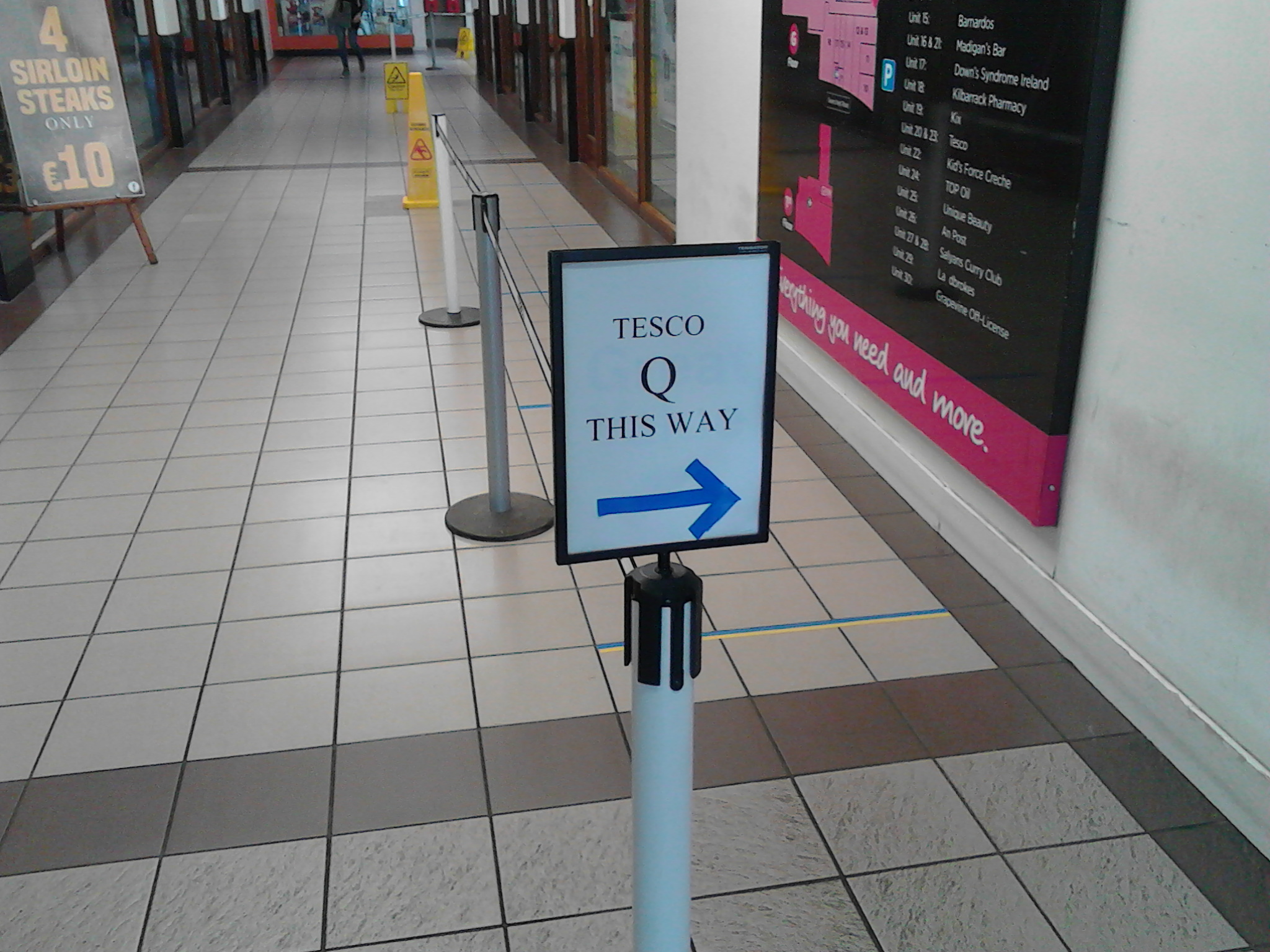
Present-day at the same supermarket, the numbers entering the premises are being more tightly controlled with customers made to queue outside — and only being allowed in one at a time. This is enforced by in-store security.
On Sunday March 15, all pubs were asked to close until March 29 at the earliest — but not all publicans immediately complied.
TheCity.ie called to three Dublin public houses on that Sunday evening and while two were closed completely, one was still defiantly doing a brisk trade.
How one popular north Dublin neighbourhood pub announced its closure on Sunday, March 15 on foot of Government advice (Photo: Paul Caffrey)
You can catch up with how “shopageddon” had eased off by March 26 — only for panic-buying to make a return on March 28, the morning after lockdown was announced — in this follow-up video.
WATCH: ‘The calm before the storm’
This video made by Paul Caffrey for TheCity.ie documents events of March 26-28 in the supermarkets and on the streets of Dublin
During a €363million nationwide panic-buying spree in the second half of March, €3.5million was spent on loo rolls alone, according to consumer habits researchers Nielsen.
Since then, Tesco.ie has asked its customers to shop in store if possible because home-delivery slots have become a “precious resource” that should be set aside for those who need it. The grocery giant has been experiencing high demand for its home-delivery service, with a message on its homepage for registered customers this week warning of low stocks.
This warning to would-be home-delivery service users appeared on Tesco.ie’s homepage for registered customers this week (Photo: Tesco.ie)
As of April 28, there are 19,877 confirmed cases of Covid-19 in the Republic of Ireland. There have been a total of 1,159 deaths related to the virus here.
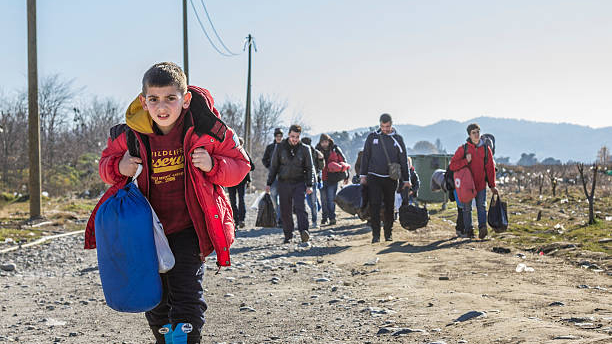
Refugees arriving at the refugee camp of Vinojug in Gevgelija, Macedonia, after having crossed the border with Greece at Eidomeni on December 23, 2015
By Paul Caffrey
Ireland must continue to provide homes to vulnerable refugees in 2020 even though our own housing crisis makes the issue “specifically pointed”, a Fine Gael Senator has said.
Former housing minister Paudie Coffey spoke exclusively to TheCity.ie after this website established that his ruling party has been falling short of its stated targets for refugee resettlement since 2015.
Stressing that he was expressing his personal views and not those of his party, the ex-TD said Ireland must stay committed to helping those forced out of their own countries – despite us facing a “housing challenge” on the domestic front.
Former Housing Minister for Fine Gael, Paudie Coffey
Locals in Waterford, where the Senator is based, have played a crucial role in welcoming refugees to Ireland.
This was despite initial controversy in the county about turning a popular three-star Dungarvan seaside hotel into a refugee centre.
Senator Coffey said there had been “a lot of unrest” in his political backyard at first in 2015 – but that the scheme ultimately became a success in terms of integrating the new families into the community.
In 2015, the FG-led government pledged to take 4,000 programme refugees fleeing war-torn countries like Syria by the end of 2017.
But even now, we’re still well short of that quota — having resettled only 3,206 such refugees here since 2015, according to figures supplied to TheCity.ie by a Fine Gael spokesperson.
And Justice Minister Charlie Flanagan has vowed to home 2,900 more in Ireland between now and 2023.
International development policy features prominently in Fine Gael’s election manifesto that promises to “continue to play our part in the EU’s response to meeting the needs of asylum seekers and refugees”.
Welcoming 50 Syrian refugees to Mosney, Co. Meath — once Ireland’s most popular holiday camp — at the end of last year, Minister Flanagan said it was “only right and proper that Ireland plays its part and offers a helping hand to those less fortunate than ourselves.”
Ireland is currently the only EU country in the running for a non-permanent seat on the United Nations security council in 2021.
Certainly, a solid track record on the international assistance front would be a prerequisite for impressing the New York-based bigwigs.
In Dungarvan, Co. Waterford, over 100 refugees have been housed in the picturesque Clonea Strand Hotel.
Housing crisis. Credit: Unsplash
But the original implementation of that plan wasn’t all plain sailing.
Like Mosney once had been, it was a popular destination for tourists and Irish families on staycations alike.
At that time, several local business people, county councillors and locals in Dungarvan reportedly complained that the tourist spot was “inappropriate” for refugees.
They claimed that placing the Syrian families in the Clonea Strand would have a negative impact on local business.
One man reportedly told an emergency meeting that he did not “like them being housed on my doorstep”.
But ultimately, the scheme became a success and a further 40 refugees were homed in Waterford in 2016.
Speaking ahead of Saturday’s General Election, Senator Coffey said he fully supports the continuation of the Irish Refugee Resettlement Programme during 2020 and beyond.
Previously, he served as junior minister in charge of housing under Enda Kenny’s leadership.
The senior Fine Gael politician told TheCity.ie last night:
“I think if Ireland considers itself a modern, developed society, then we do have a responsibility to care for those that do seek refuge.”
Recalling some strong opposition to the resettlement scheme being rolled out in his constituency five years ago, he said: “I wasn’t against it.
“There was a lot of unrest.
“I think we should continue the programme.
“It is specifically pointed because we have a housing challenge.
“But we have a responsibility to assist those seeking refuge.
“I understand they have a good quality of life in Dungarvan.
“And from my experience, they’ve been integrating into the community quite a bit.”
Indeed, ordinary Waterford locals set up the Déise Refugee Response Group in 2017 saying the refugee families deserved “at the very least, our compassion, patience and kindness – but most of all action to help.”
Their group collects food, toys and supplies — including clothes, dolls, colouring pencils and soccer boots — for the Syrian families.
Over the past decade, Ireland has also welcomed Somalian, Sudanese and Rohingya refugees.
However, the Childrens’ Rights Alliance (CRA) last year expressed concerns about how good a life Ireland can offer refugee families — particularly the children.
About 1,200 of the first 2,500 refugees admitted to Ireland following the 2015 pledge were children.
In a report last September, the CRA pointed to language barriers in education and recreational activities as well as mental health issues among the youngsters.
The CRA also highlighted instability in accommodation and a lack of interpreters available to help refugee children.
Meanwhile, if returned to Government this weekend, Fine Gael is also vowing to meet the “huge challenge” of increasing the Overseas Development Assistance (ODA) programme to 0.7% of gross national income by 2030.
The party’s manifesto says: “This will be a huge challenge – a trebling of our current commitment. It will require cross-party commitment across the Dáil.”
Taoiseach Leo Varadkar spent €877.83 on twelve gifts since his inauguration in June this year.
This is a substantial increase from the same period in 2016 when Enda Kenny was Taoiseach and spent only €98.59 on just four gifts for the Lord Mayor of Liverpool, the governor of Georgia, the mayor of Atlanta and the President of Cyprus Nicos Anastasiades.
Varadkar spent €518.67 alone on the Trudeau family with gifts ranging from €14.99 to €198.78. The most expensive gift was a framed photograph of Skellig Michael given to Canadian Prime Minister Justin Trudeau who also received a rare copy of a book of W.B. Yeats poems along with a pair of Book of Kells socks.
Madame Sophie Gregoire Trudeau received a Salmon of Knowledge brooch and a green wool scarf, which together cost €109.95. The Prime Minister’s youngest son wasn’t forgotten. Hadrien received a W.B. Yeats book for children – The Moon Spun Round.
Varadkar also spent €189.16 on four pairs of spiral cuff links for Philippe Couillard, Premier of Quebec, and the mayors of Montreal, Seattle and San Francisco.
While Varadkar spent much more in the second half of the year in 2017 compared to 2016, the Department of the Taoiseach as a whole spent more than double the amount on gifts in 2017.
St. Patrick’s Day gifts were the main contributors to this increase with over €1,200 being spent on gifts for that day, a significant jump from the previous year where only €382 was spent. Although that was partly because the Shamrock Bowl provided by House of Waterford Crystal didn’t cost the Department of the Taoiseach anything in 2016 when it was given to then President Barack Obama.
However, the Shamrock Bowl designed by Criostal na Rinne in Waterford for President Donald Trump did cost the department €300.







You must be logged in to post a comment.