Last month, marked the 170th birthday of Oscar Wilde. The City.ie took a visit to the famous poet’s childhood house where the event Oscariana was taking place, while also going to see key locations around Dublin associated with the poet’s life.
Some of the key items in Oscar’s life were on display in the home where he grew up. Many people attended the open house tour at 1 Merrion Square, which occurred over the weekend.
A walk on the Wilde side showed off aspects of his life, from where he was baptised to when he studied at Trinity College at the old library. Each stop showed a vital part of the poet’s life from early places to memories of his later life.
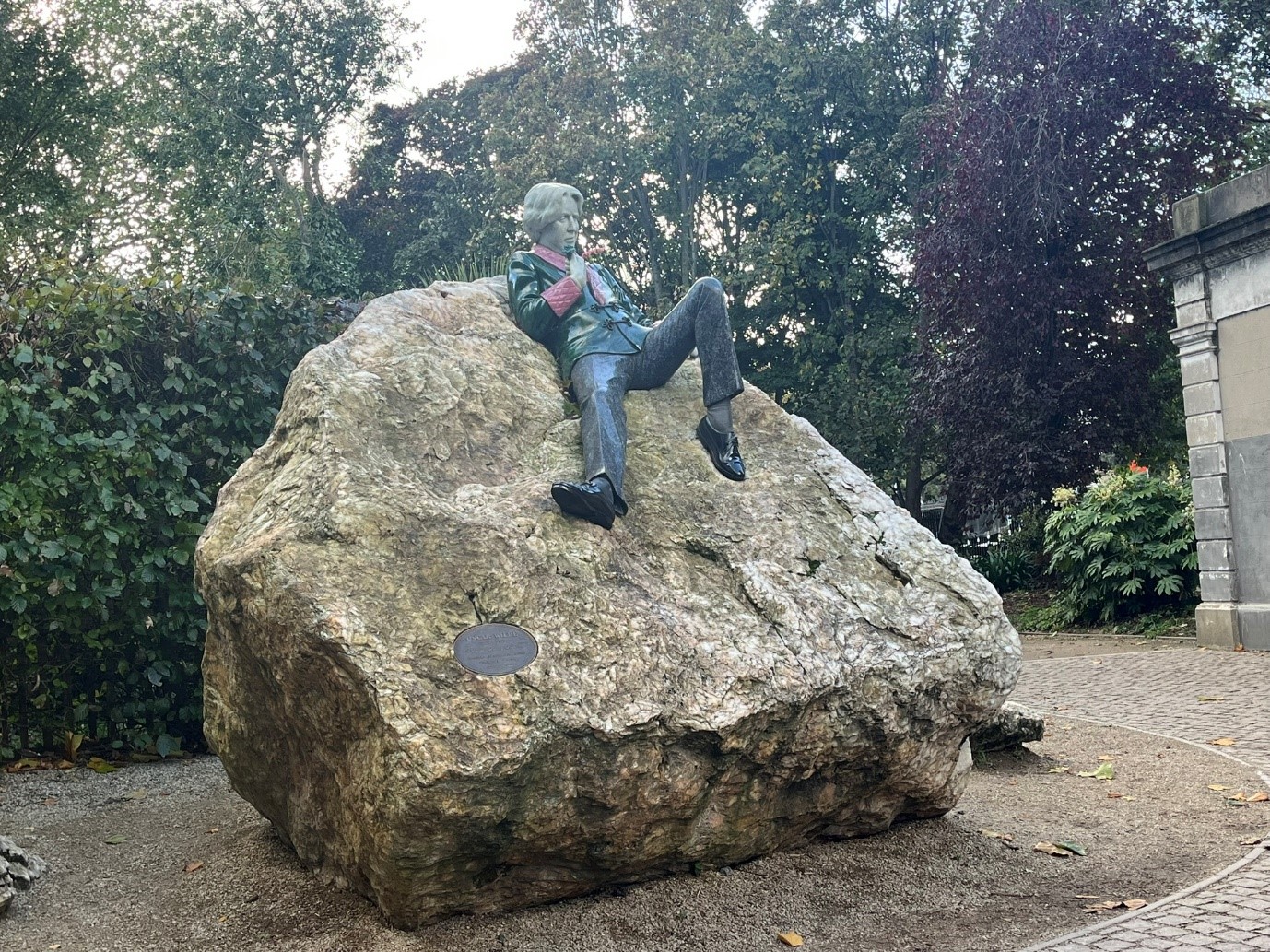
The Oscar Wilde statue in Merrion Square opposite the Oscar Wilde house. A statue of Oscar Wilde by Melaine lo Brecquy The outside of Wilde’s family home from 1855 to 1879An image published in Harper’s Bazaar during Oscar Wilde’s tour of America. A portrait of Oscar Wilde in his childhood bedroom A portrait of a young Oscar Wilde in a dress hung in his childhood bedroomOscar Wilde’s birth and baptism certificate and a copy of his parent’s marriage certificate. Some books that were written by Oscar Wilde and an Oscar Wilde action figure A portrait of Oscar Wilde hanging at his house. Some of Oscar Wilde’s published worksThe outside of Oscar Wilde‘s house at 1 Merrion Square The outside of the Old Library at Trinity College, Dublin, where a young Oscar Wilde studied.
The International Literature Festival Dublin has revealed the programme for this year. And like many of this year’s cultural events affected by the pandemic, this programme will take place online. Dhai Almutairi chats with those involved in the upcoming virtual festival.
Photo taken by Michael Casey. Sourced from Flickr.
Joey Kavanagh from the International Literature Festival Dublin spoke to The City about this year’s programme.
“Normally the festival takes place in May with physical events that people can attend in person, but due to the Covid 19 pandemic, we had to postpone this year,” said Joey Kavanagh,
The programme is scheduled to run from the 22nd to the 28th of October 2020. It offers pre-recorded conversations, live streams, and podcasts for literary fans of all ages.
Dublin City Council initiative, International Literature Festival Dublin annually presents a collection of great Irish and international authors and artists, and this year is no different.
There is a new podcast series, Tall Tales, which will feature interviews with children’s writers for the younger readers.
There will be discussions on representation in children’s books, book recommendations, and tips on how to get children reading.
The lineup of authors for younger readers includes Frank Cottrell Boyce, Adiba Jaigirdar, David Stevens, Sharna Jackson, Chris Riddell, Laureate na nÓg Áine Ní Ghlinn, Lorraine Levis, and David O’Callaghan, as well as events with Oliver Jeffers, Onjali Rauf, Robin Stevens, Sinead Burke, Chris Judge, Maggie O’Farrell.
There will be a fun family writing workshop with Gerard Siggins and the innovative Buggybird art and story workshop with Niamh Sharkey and Mary Murphy.
The lineup of participants for grown-up readers includes international famous authors and artists like Roxane Gay, Yanis Varoufakis, and artist Ai Weiwei. Irish participants include Roddy Doyle, Mark O’Connell, Elaine Feeney, Bob Geldof, Anne Enright, and Patrick Freyne.
The International Dublin Literary Award’s recipient will be announced during the festival. In its 25th year, the International Dublin Literary Award is the world’s most valuable annual prize for a single work of fiction published in English, with the winner receiving €100,000.
“The nomination process for the Award is unique as nominations are made by libraries in the capital and major cities throughout the world,” said Mr Kavanagh.
He added, “Participating libraries can nominate up to three novels each year. Over 400 library systems in 177 countries worldwide are invited to nominate books each year.”
The novels on this year’s shortlist were nominated by public libraries in Canada, France, Germany, Greece, Ireland, Jamaica, New Zealand, Poland, the UK, and the USA.
The Award is open for novels written in any language and by authors of any nationality, given the book has been published in English or has an English translation. The Award will be announced on Thursday the 22nd of October, at 11am. The shortlist includes one Irish author Anne Burns, author of Milkman, and winner of the 2018 Man booker Prize for Fiction.
Lord Mayor of Dublin and Patron of the Award, Hazel Chu, applauded the Award for the opportunity to promote Irish writing internationally and promote excellence in world literature.
“It’s more important than ever that Dublin City Council does its best to support the Arts in such challenging times, and the International Dublin Literary Award is a huge statement of encouragement for writers.” said Lord Mayor Chu.
The International Literature Festival Dublin has also started a new initiative, ‘Compass’, a series of events that celebrates contributions and stories of those whose roots lie outside of Ireland.
“With the Compass initiative, ILF Dublin is showcasing new voices and fresh perspectives from a number of people now living in Ireland whose roots lie outside of the country,” explained Kavanagh.
“Following an invitation for proposals in February 2020 from Black, Asian and Minority Ethnic (BAME) individuals and groups with stories to share, six events will be presented next week in the festival,” he added
The themes explored by the six events include the concept of Irishness, migration, and the power of language, stories, and multiculturalism with art forms ranging from poetry and theatre to music and dance.
Compass’s six events are free to attend, but the festival is inviting donations from audiences, and the donations go directly to the artists and writers in the programme.
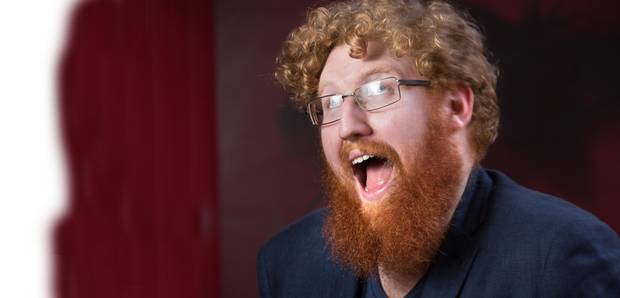
As a teen, Dave Rudden used stories and fantasy as a retreat. With his shock of red hair and glasses, he found himself a natural target for bullies. “From the age that people started to bully people I was bullied,” he says. This problem was compounded by issues with anxiety and depression, and during his teen years he escaped into the literature of writers like Terry Pratchett and Neil Gaiman. And while he wasn’t consciously learning how to write, he was all the time developing his narrative voice.
“Before I knew what fanfiction was, I was writing out my version of events in video games. I played Baldur’s Gate, this RPG, and I wrote the story for the first few levels. And in my head, this wasn’t fanfiction, I was just bored and lonely. Weirdly, I found later on that I was just training myself to be a writer,” he says.
But these early building blocks proved the foundation for a bright future. Flash forward to 2013. Dave, now a college graduate, has written his first draft of a young adult fantasy novel called Knights of the Borrowed Dark. On the strength of that draft he has an agent, and on his following birthday, he gets a call saying that Puffin wants to publish his novel.
That original novel spawned a trilogy that concluded in March of this year, and Dave was recently hired to write a series of short stories based on the dense mythology of Doctor Who called Twelve Angels Weeping. Since the release of the first Knights book in 2016, he has toured over 300 schools doing workshops and masterclasses showing children and teens how to develop stories and characters. “At that age, kids don’t think about genre as much. If a story has magic, or monsters, or grief or divorce or issues, like mental health, they don’t classify them the way adults do. It’s just a story, they’re more open,” he says.
Knights of the Borrowed Dark began as one of Dave’s creative writing assignments for his masters // Puffin
But the process of creative writing sometimes feels like an intangible skill. Is it divine inspiration that only a lucky few can possess, or is it something that can be built through diligent effort? “Writing is a mechanism, and it is a mechanism you can learn. It’s a skill; the more you do it, the better you get. 80% of writing is this machine, that you feed yourself to, and anybody can learn how that machine works,” though Dave concedes that the writing process can sometimes feel like “genius and gunsmoke”, and other times “like climbing up a hill made of broken glass”.
Another intangible element of writing, especially in the fantasy genre, is world building. Authors like J.K. Rowling and George R.R. Martin have conjured detailed worlds, complete with diverse characters and dense histories. While the craft of writing can be learned, how does an author weave an engaging and entertaining fictional world? For Dave, the character comes first, namely his Knights trilogy’s main protagonist, Denizen Hardwick.
“The character is a microcosm of what I want to do with the books. I love middle-grade adventure, but I wanted to dissect it and question some of the tropes that have become really common and overdone. To do that, I would need a character that would provide a lens. So, Denizen stormed onto the page fully formed, and quite pissed off about it all. And I just got to show things to him, and show the tropes to him, and see what he made of them. He arrived first, and the world grew around what I wanted to show him.
“Every single bit of world building has a specific reason to be there, it serves the story, it speaks to the theme, and they all connect and form a narrative unity,” he says.
But when the story is finished, does it still belong to the author? In the age of the internet, where there is a seemingly deafening cacophony of differing voices on social media, movies and franchises have become divisive issues. The casting of a character, or a certain creative decision can send a lurking online fanbase into nuclear uproar. The Last Jedi caused an online schism among Star Wars fans on social media, and the casting of an all-female Ghostbusters seemed to raise the ire of certain fans of the original movies. Discussing this modern phenomenon, Dave draws a parallel with the evolution of comic books.
“When X-Men was being written in the 60s and 70s you’re getting all of these different stories. Then in the 80s and 90s, for the first time, the people who are writing X-Men were fans of it as kids. So you saw a lot of cyclical storytelling, where people were like, ‘I get to tell my version of the Dark Phoenix saga or the Brood war.’ And you’re seeing that now with Star Wars where the people who are making Star Wars would’ve watched it as kids.
The Knights series is being developed as a TV and anime series // Puffin
“Force Awakens was a New Hope fan fiction. It follows the same beats. The prequels were not very good, but full of original ideas, and Force Awakens was so by-the-numbers that it actually suffered. I liked the Last Jedi, but a small, vocal minority didn’t like it. They said ‘this isn’t our Star Wars.’ But Star Wars doesn’t belong to you,” he says.
For his own take on an established continuity in his Doctor Who anthology, Twelve Angels Weeping, he believes it’s important to respect the world and the history, while also bringing your own creativity to the table. “I made the best effort possible to be accurate to the tone, mythology and the science, such as it is, and the world, but I still wanted to tell a story,” he says.
His series, Knights of the Borrowed Dark, has been picked up by a production company, with a view to making it into a TV series. And he has also written a script for an anime series set in the same universe which is also being developed. After such success, it’s easy for Dave to look back and wish he could tell his younger self how well everything would turn out. But ultimately, his experiences back then ultimately shaped the person he is today.
“Terry Pratchett said that once you know how stories work you can tell your own story. And people treat you very differently when you stop calling yourself overweight and start calling yourself a big guy.”
He continues: “I tell people about what I’ve gone through, because I can always spot the kid like me in every class, and they need to hear that things get better. If I could go back, I’d tell 15-year-old Dave what was coming, but at the same time, he had to go through all that stuff to become me. And I watch too many shows about time travel to want to change that.”





You must be logged in to post a comment.