Tag: loneliness

  • How Communities are Tackling Loneliness in the Elderly

    How Communities are Tackling Loneliness in the Elderly

    By Paul Lee

    A recent study from The Irish Longitudinal Study on Ageing (TILDA) in Ireland shows that about one-third of adults over 50 in the Republic of Ireland have experienced emotional loneliness at some point, with 7% feeling lonely often.  

    The research found that loneliness tends to decrease between the ages of 50 and 67 but rises again after that. 

    People over 75 are more likely to report feeling moderately lonely compared to younger groups. Factors like lower education, living alone, poor self-rated health, physical limitations, and chronic health conditions were linked to higher levels of loneliness. 

    Ireland is currently ranked number one in Europe for people suffering grom loneliness as of last year, with the coronavirus pandemic forcing generations to feel isolated.   

    Source: Institute of Public Health 

    Men above 65 years old saw a 25.1% increase in living alone, while women over 65 saw an 18.4% increase in the last six years. “The numbers are only going to continue rising,” said psychotherapist Maggie Molloy. 

    “I often deal with young people suffering from loneliness, so I know how bad it must be for the elderly who have far more reasons, most of which are out of their hands for feeling lonely.” 

    Last year The World Health Organization (WHO) declared loneliness to be a pressing global health threat, with the US surgeon general saying that its mortality effects are equivalent to smoking 15 cigarettes a day. 

    Anne Butler is a woman who knows the effects of loneliness all too well, inspiring her to commit her life to helping the most vulnerable in her community. 

    “Loneliness is a big issue for older people, and I don’t think the general public realises this enough,” said Mrs. Butler, who is the manager of Walkinstown Social Service Centre. 

    “It is dangerous to the elderly, we are social creatures that need to interact and get out of the house, but for some people that’s just impossible. It is heartbreaking because some of the faces around here were stuck in nightmare cycles of being upset, refusing to eat, or turning to drinking alcohol at home. It’s stories like these that make me so happy that we’re making an impact in the community and the bigger problem,” she says.  

    The centre takes in 60 people daily between lunch and dinner with some walking and others taking the centre’s bus that collects them from their houses. The centre charges €10 for transport, a meal, and bonus activities, whether that is a game of bingo, or a fitness instructor to get them exercising. 

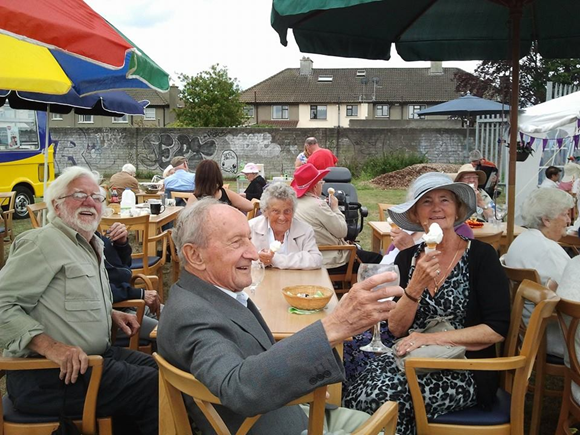
    Members of the centre enjoying the warm summer 
    Source: Facebook – Walkinstown Social Service Centre 

    Group day trips around the country are organised and voted on. Special events happen year-round with ‘Strictly Come Dancing’ watch parties and even live shows with staff members performing dances. 

    “I’ve been coming for the last few years now and it’s just brilliant,” said Monica Walsh, age 72. 

    “I’m not great on my feet any more so going out wasn’t really possible unless I waited for my kids to come and bring me out somewhere. The centre is great because I get a sense of independence back, able to go out on my own. 

    “I feel like a kid again, going out with friends, singing songs. This place has given me some of the best moments I’ve had in years. All the staff are true heroes.” 

    The centre’s staff is made up of half full-time workers and half part-time voluntary workers from the local area such as Amanda Nic Fhannchaidh.  

    “I don’t work on Thursdays or Fridays, and I’d just be watching the Telly all day, so it’s really a no-brainer for me to come here, have a laugh, and feel good about myself for helping out where I can,” said Amanda.   

    Both local schools, the Assumption Secondary School Walkinstown and Drimnagh Castle Secondary School, have included helping out at the centre as a part of the transition year experience. 

    “It’s the right thing to do, so it’s what the lads will do. It gives the school a good name in the community and a chance for the boys to see how far a little help can go,” said Drimnagh Castle Secondary School principal John Haze. 
  • Therapy dogs helping the elderly feel less lonely this Christmas

    Therapy dogs helping the elderly feel less lonely this Christmas

    By Amy Connaughton

    For many people, Christmas is their favourite time of year. It’s a happy time spent with family, friends and loved ones. Sadly though, for many elderly people, Christmas can be a tough time to get through. Nearly a quarter of the elderly do not look forward to Christmas because of loneliness and fears that it will bring back bad memories, according to research carried out by Age UK in 2014.

    The research suggested that the effects of loneliness increase during the winter months with a fifth of elderly people worried about not being able to go outdoors as much because of shorter, darker days and poor weather conditions. Age UK is the UK’s largest charity dedicated to helping everyone make the most of later life.

    One charity that is making a positive impact on the lives of the elderly in Ireland, is Irish Therapy Dogs. Irish Therapy Dogs was founded in 2008 with the aim of using pet therapy to provide comfort and companionship to people in long-term or daily residential care.

    Their mission is to provide physical, therapeutic and educational benefit to people, young and old, fit and frail, alert and impaired, in hospitals, nursing homes, day care centres, and schools.

    Today, more than 270 ‘Volunteer Visiting Teams’ make weekly visits to day care centres across Ireland.

    Owners and their dogs give one hour each week to visit their assigned care centre. Once there, they circulate amongst the residents allowing their dog to be cuddled, petted and played with.

    Research has shown that canine companionship brings a number of health benefits, such as lower blood pressure, lower triglyceride and cholesterol levels, as well as increased production of serotonin and dopamine.

    Humans have a basic need to touch and a dog fulfils this need. Stroking, holding and fussing over a dog helps reduce the sense of isolation and loneliness. The companionship of a dog can help to calm and soothe us, ease anxiety and boost our mood.

    “I get so much more out of it than I put in, it’s great. Ruby is amazing and she doesn’t even realise the joy she brings”

    Irish Therapy Dogs visit care centres and enrich the lives of people there by interacting with them. The dogs do not need any specialised training, but it is important that they are friendly, gentle, confident, patient and at ease in any situation. They must enjoy human company and be happy to be petted and handled. The suitability of both the owner and dog, working as a team, is subject to a formal assessment process.

    Orla Keogh, from Deansgrange in Dublin, has been volunteering for Irish Therapy Dogs for two years now. She visits Belmont Nursing Home for an hour a week with her dog, Ruby. Orla said: “I get so much more out of it than I put in, it’s great. Ruby is amazing and she doesn’t even realise the joy she brings.”

    Orla described how visiting the residents has such a great impact on their day: “Basically, even residents that don’t respond or speak, get so happy when they see Ruby. There’s one who’s deaf and dumb and she hates everyone, but she is obsessed with Ruby and when she sees me coming with the dog her whole face lights up.”

    Jane Connaughton who is the activities coordinator in Belmont Nursing Home sees first-hand the effects that the therapy dogs have on the residents. “The reaction the residents have is just great to see. Straight away when the dogs come in you can see their faces just light up and there’s a nice, happy buzz around the room.

    “Loneliness with old people is such a common problem and it’s very sad. A lot of residents here don’t have much family or don’t see their family very often.

    “Some of the residents love to pet the dogs and hold them but some of them are happy enough to just sit and watch everything that’s going on. Either way, everyone has a smile on their face and it’s really great.”

    Peata is another Irish charity dedicated to helping people reap the benefits of therapy dogs. Peata is a voluntary association established in 1996. Every year, they do a Christmas Carol Service in Christ Church Cathedral where there is a blessing of the therapy dogs.

    Jane said: “The residents really enjoy it. We sit right up at the front and there’s a part of the service where all of the therapy dogs go up to the altar to be blessed. The residents love seeing all the dogs right up close to them.

    “After the service, there is tea and coffee and mince pies and a chance for the residents to mingle with all the dogs.”

    Irish Therapy Dogs is a voluntary registered charity and is completely self-funded. Funds are raised by membership fees, donations, sponsorship, personal gifts and various fundraising events.

    If you would like to become a volunteer you can get in touch with the charity at 01 2189302 or you can visit their website at www.irishtherapydogs.ie

  • Emigrated? How’s yer mammy?

    Emigrated? How’s yer mammy?

    Because I'm leaving on a jet plane, don't know when I'll be back again..
    Because I’m leaving on a jet plane, don’t know when I’ll be back again..

    Irish mothers are more likely to be depressed if their children have emigrated according to a new report by Trinity College’s Irish Longitudinal Study on Ageing (TILDA).

    The new report shows that the mental health of Irish mothers is suffering as a consequence of their children emigrating during the recession.

    It also shows that these mothers experience increased symptoms of depression and greater loneliness than mothers whose children did not emigrate.

    The researchers found, however, that with the exception of fathers aged over 65, fathers did not suffer an equivalent decline in mental health following the emigration of one or more of their children.

    In the year ending April 2006, 36,000 people had emigrated from Ireland, emigration numbers hit 89,000 in 2013 and are still rising.

    These high rates of outflow meant that a large number of TILDA participants saw their children emigrate.

    Dr Irene Mosca of TILDA says that the report shows the effect on those left behind:

    “Emigration is often discussed in terms of the people who leave, but our study shows that there are also real impacts on the people left behind.”

    “There is a narrative out there that this was a recession that impacted on young people, as negative equity and debt primarily affects young people,” said Alan Barrett of the Economic and Social Research Institute, who co-authored the study with Dr Irene Mosca.

    “But we have now identified a group of older people who have suffered a mental health difficulty as a result of the recession, because of the emigration of their kids… Mental health difficulties often develop into physical health difficulties, so the massive increase in emigration in recent years has public health implications.”

    Some Irish mammies who were left behind when their children emigrated spoke to The City about how they are coping.

    Margaret Hennessy saw her son hop the water to London in search of work as did Elaine Keoghan’s daughter, while Kathleen McCormack’s son James went further afield to Brisbane to work on the pipe lines.

    When Kathleen found out her son was moving to the other side of the world in search of work she said she felt “sad and broken-hearted. I knew I was going to be lonely. James and his wife, Ursula, were only supposed to be going to Australia for two years but that soon changed as they found good, well paid jobs and started a new life together over there. They are there almost four years now.”

    “I still miss them so much, especially now that they have just started their family over there. It was heart-breaking not being part of that. As any mother would I wanted to be there for my son on the birth of his first child, but physically I just couldn’t. I Skype them all the time but it’s just not the same as having them home”

    “Whenever I think about the huge distance that’s between us and all that he is missing out on, I just start to cry. I think it’s a maternal thing. Luckily, I have three other children at home, and grandkids too, so I am kept busy. I can only imagine what it would be like for a mother with only one child having emigrated, their whole life torn away.”

    Una Nannery, 53, took a different approach. With two of her sons gone to Australia she was fed up of being lonely and depressed so three years ago Una, her husband Eugene and their youngest son Ciaran packed up their bags and followed their two older sons, Brendan and Declan, to Melbourne.

    “‘The main influencing factor for our move was unemployment, as Eugene had no work for two years previous to our move and had no prospects of getting anything.  Also, the fact that both our eldest sons had already emigrated and were starting families here influenced our decision in a big way, we were stuck at home missing out on the most important time of our son’s lives and we missed them terribly.” So Una upped and left Ireland and hasn’t looked back since.

    “We are living in Melbourne now, in a lovely suburb called Ivanhoe.  There are many Irish over here for the same reasons as us.”

    So how does life on the other side of the world compare to home? “There’s a much better standard of living here in Australia. Eugene is working full time and on a good wage, I’m not working and we still are way better off. The weather is a huge plus also. Life here compared to life in Ireland is similar, in that during the week it’s the usual routine of work, school etc.  The main differences are work and the weather.” Una continues “Living day to day is similar here to Ireland.  Depending on the supermarket you go to and the brands. Meat is dearer here; chicken and lamb are a lot more expensive. However petrol is cheaper. Clothes and footwear are expensive.  Both eating out and alcohol, like home, can range from expensive to fairly reasonable depending on the areas you are in.  A pint of lager is $7.00 that would work out pretty similar to Dublin pub prices.”

    Speaking about the work situation Una says “There is plenty of work in the building, mining, and general outdoor work. Men seem to get work easy enough. It seems harder for women, but yet not as hard as at home. There are good agencies here, so the ladies get sorted after plenty of interviews and that, but can take 3 to 4 weeks.”

    Emigrating is a tough decision to make, no matter what age, says Una “Emigrating is ok if it is for the right reason, but right now it is the only option for many.  But yes, I would tell all young people to travel, as it really is the best experience and learning curve in any person’s life.  Ciaran is living proof, also the older boys. They love it here and have adapted so well. For me, well I’m just happy to have all my family together again.”