Tag: Mass

  • AS IT HAPPENED: Supermarket sweep — watching the shelves empty at the height of viral stockpiling

    AS IT HAPPENED: Supermarket sweep — watching the shelves empty at the height of viral stockpiling

    STRICT: Currently, queueing outside supermarkets is the new normal, with many outlets only allowing in one shopper at a time and banning children in some cases as Coronavirus continues to spread (Photo: Paul Caffrey)

    During the month of March, the population went on a €363million panic-buying spree. The shops are much calmer now, but queuing outside supermarkets — with stricter controls on how many customers can enter a store at any one time — has become the new normal. In words, pictures and video, TheCity.ie’s Paul Caffrey has been keeping track of the “shopageddon” phenomenon since March 13

    “No sausages. No teabags. No potatoes,” the senior security guard at a north Dublin supermarket boomed with a wry grin to a colleague over his two-way radio.

    The weary-looking herds of shoppers rushing from one aisle to another — just trying to grab what they can — didn’t seem to have registered a word of his worrying summary.

    But that was only the start: there was no bread left and most of the fruit, vegetables and frozen food were gone, too – even though there was a full delivery to this store at eight o’clock this morning. 

    Meanwhile, queues for the checkouts — one family after another with an overflowing full-size shopping trolley — were snaking back into the aisles. 

    It was nearly 6pm on the evening of Friday, March 13 at Tesco Kilbarrack in north Dublin — 31 hours since Leo Varadkar announced a virtual shutdown of the country on account of the global Covid-19 outbreak — and the place was full of people completely ignoring Government pleas not to panic buy. 

    Throughout this large store, which acts as a lifeline to thousands of families and elderly people in the long-established north Dublin areas of Raheny, Kilbarrack, Coolock, Artane and Donaghmede, there was an air of quiet panic. 

    Even though people here were keeping calm and being respectful to others, many seemed grimly determined to buy up everything in sight.

    However, this “emergency” buying wasn’t quite what you might put at the top of your essentials list for what was then expected to be a fortnight of being housebound. At one checkout, a man was hurriedly purchasing exactly 20 Easter eggs and not much else. 

    NEW ORDER: Local councils were quick to create new markings on walkways to reflect the social distancing rules intended to combat the spread of Covid-19 (Photo: Paul Caffrey)

    At 11am on Thursday, March 12, the Taoiseach announced from Washington that all colleges, schools and various other public facilities would close for at least two weeks.

    Up until that moment, students at TU Dublin Aungier Street had been assured by college officials it was largely “business as usual”, with classes proceeding as normal. 

    Everything changed on that Thursday morning, when students were suddenly told to leave the building by 6pm and not return until further notice. 

    Similar to the situation in supermarkets, the college library was gripped by a sense of panic as students anxiously rushed to get the books and other materials they’d need to complete their assignments (not due for months).

    The original worst-case scenario, that the college won’t reopen at all for the rest of this academic year, now looks the most likely outcome. It’s been reported widely that lockdown measures are likely to continue beyond May 5.

    SHUTDOWN: How TU Dublin announced the initial fortnight’s closure
    (Photo: Twitter/TU Dublin)

    At supermarkets across Ireland, the Fine Gael leader’s announcement led to huge queues — despite Business Minister Heather Humphreys pointing out there was “no need” whatsoever to panic-buy as retailers and distributors had a “sufficient supply chain”. 

    “If people go out and buy products that they don’t need to stockpile, they are going to cause a problem,” Minister Humphreys warned on Thursday, March 12. And she tweeted the following day: “Shop as normal.”

    But her advice, echoed by Health Minister Simon Harris, was largely ignored. In scenes that have been echoed the world over, throngs of eager shoppers descended on supermarkets and chemists, even leading to some forced store closures.

    Tesco in Clarehall on Dublin’s Malahide Road was forced to close temporarily on Thursday, March 12 for restocking, while Tesco Liffey Valley reportedly shut down for 30 minutes that day after a big influx of customers. Lidl and Aldi then introduced “product purchasing limits” on selected items.

    Gardaí were placed on alert, with officers told to “patrol the environs of supermarkets and chemists, with a view to providing comfort and reassurance” to shoppers, according to a memo sent by Assistant Garda Commissioner Pat Leahy to rank-and-file members on the night of Thursday, March 12.

    SLICED PANIC: This north Dublin Tesco was fully sold out of bread by midday on Friday, March 13 – but these shelves had been full only three hours earlier (Photo: Paul Caffrey)

    On Friday March 13, my first visit to Tesco Kilbarrack is at 9.30am, when stocks are at healthy levels thanks to an 8am delivery.

    I recognise a friendly local taxi driver who wisely makes straight for a well-stocked bread aisle. By midday, every last sliced pan here will be gone. 

    Normally stationed at the Dublin Airport rank, he’s decided that his normal place of work is a no-go zone due to the Coronavirus outbreak.

    The self-employed middle-aged Dubliner will be out of pocket as a result, but he’s accepting of the situation and even appears relaxed about it. 

    “There’s no way I could work the airport today. They’ll all be coming back from Cheltenham, full of booze and all over each other, then jumping into my car.

    “Not to speak of the people who could be flying in from anywhere in the world. I’ll sit tight for a few days — it’s for the good of our health, after all,” he tells me.

    At a café opposite the Tesco, a cautious barista is very short on customers. Wearing a standard-issue facemask, he’s trying to offload his best fresh pastries for the knockdown price of €2 each.

    This Tesco store nearly ran out of all fruit and veg by the afternoon of Friday March 13, with bananas, cucumbers, lettuce and potatoes all sold out by 4.30pm (Photo: Paul Caffrey)

    When I return to the Tesco itself some hours later, at about 4.30pm, a team of three senior staff is standing near the frozen food section looking suitably grave in a huddle with their arms folded. 

    The bread section is completely cleared out; I’m told all sliced pans were gone by midday — while most of the fruit, vegetables and frozen food has also disappeared. 

    The most senior-looking one remarks quietly to his number that panic-buying in supermarkets wasn’t this chronic even just before the crippling March 2018 snow blizzards that forced us all to stay indoors due to the “risk to health”.

    It took only four days before that extreme weather eased off and life was largely back to normal. 

    The managerial team walk around surveying the empty and near-empty shelves, making notes on their clipboards. Pointing to one well-raided cosmetics shelf, one of the executives remarks: “Those will all be gone by tomorrow.”

    How one newspaper reported the disquiet in our shops in its Friday, March 13 edition
    (Photo: Twitter/Irish Daily Star)

    At the checkouts, an elderly woman queuing just ahead of me with a modest number of purchases in her black and red tartan wheelie bag is bemused by the slightly frenzied atmosphere and crowds of customers surrounding her. 

    “I don’t know what all the fuss is about,” she calmly tells me.

    “Though, I’m just buying for myself. At least this has made them open a few more checkouts than they normally do, but it’s still not enough, is it?”

    Reflecting on the public health emergency at hand, she tells me: “I’m 89, so I’m supposed be in the ‘at-risk’ category, aren’t I?

    “But I’m not letting it worry me. I don’t see why we can’t go about our business as normal — as long as we don’t travel.” 

    Later that afternoon, I call round to my 101-year-old neighbour. She’s exceptionally fit and alert and still leads an active life. I’ve known her since I was a small child and she’s never seemed afraid of anything before.

    Despite no official guidelines having yet been issued for the over-70s, she already intends to stay indoors at all times and is resigned to miss Mass, regular coffee mornings with her friends or any other activities involving the outdoors or groups of people for at least a fortnight.

    Gesturing towards her television that’s switched to standby while we chat, she insists: “I won’t be going anywhere until this is all over. It’s out there somewhere, so I could catch it.”

    DESERTED: Dún Laoghaire town centre at 5pm on the dot on a weekday in March 2020. For decades, this key intersection has been chock-a-block without fail during evening rush hour (Photo: Paul Caffrey)

    Hours after our chat, several parishes around the country start cancelling church services to stop the spread of the virus. Present-day, you’d now find it extremely difficult to find any church holding a service on its premises. However, as reported by TheCity.ie, some priests have been finding ways to connect with the faithful online.

    By the night of Sunday, March 15, this north Dublin Catholic church was in shutdown, with a typed notice on the main doors advising parishioners: “Mass in this church is suspended until further notice.” (Photo: Paul Caffrey)

    And in line with the increase in the numbers of tragic deaths and reported cases of Covid-19 in Ireland — and based on scientific evidence — the Government has since strongly advised over-70s and anyone extremely medically vulnerable to “cocoon” at home.

    This means that people in those at-risk groups should not leave their homes at all, even to go to the shops. However, the Government has confirmed this measure is advisory and not mandatory.

    At midday on Saturday, March 14, I returned to Tesco to find the shelves well stocked again. But, pointing to the bread shelves, the head security guard told me: “If you need any bread, I would get it now.”

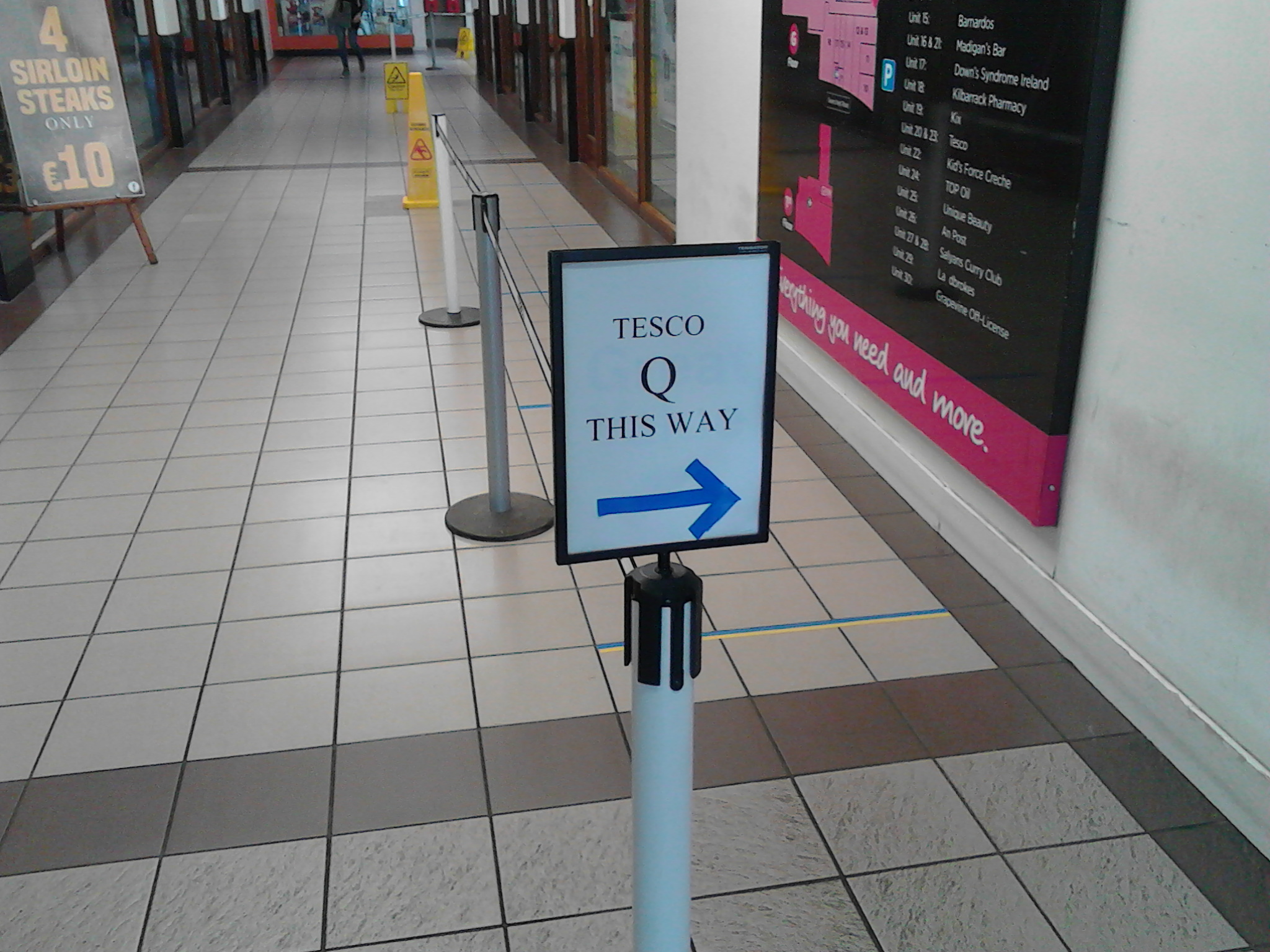
    Present-day at the same supermarket, the numbers entering the premises are being more tightly controlled with customers made to queue outside — and only being allowed in one at a time. This is enforced by in-store security.

    This has made queuing outside supermarkets the norm in April 2020, with families being encouraged to send only one person — or as few as possible — to get the weekly shop. Some supermarkets are reportedly even banning children now.

    On Sunday March 15, all pubs were asked to close until March 29 at the earliest — but not all publicans immediately complied.

    TheCity.ie called to three Dublin public houses on that Sunday evening and while two were closed completely, one was still defiantly doing a brisk trade.

    In the weeks since then, you’d be extremely hard pressed to find any public house open in the capital. But at least one Dublin publican this month started delivering pints and Sunday roasts to his customers.

    How one popular north Dublin neighbourhood pub announced its closure on Sunday, March 15 on foot of Government advice (Photo: Paul Caffrey)

    You can catch up with how “shopageddon” had eased off by March 26 — only for panic-buying to make a return on March 28, the morning after lockdown was announced — in this follow-up video.

    WATCH: ‘The calm before the storm’

    This video made by Paul Caffrey for TheCity.ie documents events of March 26-28 in the supermarkets and on the streets of Dublin

    During a €363million nationwide panic-buying spree in the second half of March, €3.5million was spent on loo rolls alone, according to consumer habits researchers Nielsen.

    Since then, Tesco.ie has asked its customers to shop in store if possible because home-delivery slots have become a “precious resource” that should be set aside for those who need it. The grocery giant has been experiencing high demand for its home-delivery service, with a message on its homepage for registered customers this week warning of low stocks.

    This warning to would-be home-delivery service users appeared on Tesco.ie’s homepage for registered customers this week (Photo: Tesco.ie)

    As of April 28, there are 19,877 confirmed cases of Covid-19 in the Republic of Ireland. There have been a total of 1,159 deaths related to the virus here.

    Last Friday, April 24, Leo Varadkar warned the current lockdown could be extended by weeks if people don’t adhere to the restrictions. 

    All important updates on the virus situation within the State are being posted here on the Government website as they happen.
  • Mass cutbacks threaten future of rural communities

    Mass cutbacks threaten future of rural communities

    By Aoife Kearns

    It’s a Saturday evening. Sitting at the kitchen table, my laptop is open and aside from the regular distractions that most 22-year-olds give into, such as WhatsApp notifications, or opening the Facebook tab to name a few. At ten-past-seven every week, there is another distraction in my house. In the kitchen, there’s a scramble for car keys, upstairs a fight over the shower and in the sitting room my 89-year-old Grandmother sits, immaculately dressed, handbag on her shoulder, waiting for the 10 minutes of madness to end so she can be on time.

    I was once a part of this madness. Five years ago, I would have been pacing the landing with a reading in my hand, recounting a story that St. Paul told the Corinthians. Admittedly, I was focusing more on the delivery, but I was always happy to be given the opportunity to read and, in my own way, help the community. I was never a natural reader, to be honest the fact it didn’t come easy was one of the reasons I put myself forward in the first place. The nerves that I felt were always lessened by the knowledge, that everyone who was sitting in the church was a neighbour, a friend or acquaintance, or a part of my family that dutifully attended mass every week.

    Nowadays, this scene is very much the same, but the location has somewhat changed. From this month onwards, St. Killogue’s Church Kilnaspic in the parish of Mooncoin, Co. Kilkenny, is one of the many Catholic churches in the diocese of Ossory, (whose parishes include parts of Kilkenny, Laois and Offaly), that will no longer hold weekly mass. Instead ceremonies will now be held once a fortnight. As I sat at the table with my laptop on that December evening, the difference was that my family weren’t going to meet their neighbours outside the church-gate for a chat, or visit the grave, as this change had already come into effect.

    In his Winter Pastoral letter, Bishop of Ossory, Dermot Farrell addressed these changes outlining what it will mean for the churches impacted. He said: “Beginning on the First Sunday of Advent there will be changes in the number of masses in our parishes.

    “These changes reflect the changing character of our parishes and communities; not only the effect of fewer clergy, but also the need for greater collaboration between parishes.”

    In relation to what this might mean for the future, Bishop Farrell said:

    “This is an exciting time in our Diocese, new shoots are emerging, new supports are being given, and new structures are developing. It is ordinary, and yet always extraordinary, to see our community, all of its members; discussing, responding, growing, and continuing today what the Lord began with the Apostles long ago.”

    These “exciting” times that the Bishop refers to, are certainly not the sentiments reflected by everyone who has been impacted by the change. As someone who grew up with Kilnaspic Church on my doorstep, to me, it is one of the remaining things that brings the people within the surrounding areas together. Although the church is located within the parish of Mooncoin, the people of Kilnaspic have had their own identity throughout history. Be it the short-lived Clogga hurling team of the 1940s, or Aylward’s shop that ceased operation in the early 1980s, this small pocket of the village was once a smaller remote village with its own amenities, and innate sense of community.

    One major fact that I have left out of this idyllic image of the Church and area, is that the number of people attending mass in Kilnaspic and other small churches and parishes nationwide, has decreased significantly. I am one among others in my generation that were raised Catholic, but don’t attend weekly mass. For some people it might be a case of clashing schedule in our increasingly busy lives; for others it might come down to a lack of interest, or disillusionment with the current practices and past failings within the larger organisation.

    This falling number has been in reflected national polls conducted by the likes of the ESRI and Amárach Research, which saw church attendance drop from 56% to 35% in a ten-year period alone. In Dublin, The Irish Times reported that in 2016 weekly mass was as low as 2-3% in some parishes. This national downward trend was one of the reasons for the decision, to cut back on weekly masses throughout Ossory, and the verdict was made following a headcount as Mooncoin Parish Priest, Fr Martin Tobin explained.

    He said: “The Bishop asked us to have a look at the schedule of masses that were in each and every parish, and as a result of that he took a look at the number of churches that were in each parish.

    “He then took a survey of how many people were attending mass, which was conducted over three weekends in November of 2018, and if my memory serves me correctly that came in at about 24%. From this figure it became clear that there were far too many churches and masses for the population.”

    In terms of the knock-on effect that the cut-back will have on rural communities, Fr Tobin acknowledges that there will be a danger in these places losing an important meeting point.

    He said: “I would be one of the few that would have felt rather uncomfortable about taking the masses out of the smaller communities as the churches are in one sense, their source of identity.

    “How do we survive these changes and remain a kind of entity? While equally acknowledging the reality of the situation, at the moment we do not have enough priests to cover the present structure considering male celibates are the only people allowed do all of this.”

    Kilnaspic is one example of the once bustling townlands of rural Ireland, that now have little to no amenities left aside from the church. With masses being cut in these areas, there is a sense of foreboding fear felt among locals that religion aside, their sense of self could be under threat. The development has already been rolled out in this part of the country, but is inevitably going to happen in other parts of Ireland in the near future.

  • Christmas: A time when we all become devout Catholics?

    Christmas: A time when we all become devout Catholics?

    All over Ireland, candles on Church Advent Wreaths are being lit as the weeks advance throughout December, stirring excitement in the hearts of parishioners.

    Advent Wreath at the Carmelytte Church, Aungier Stree in Dublin
    Advent Wreath in Whitefrier Street Church, Aungier Street in Dublin

    Thecity.ie reporter Sarah Reilly chatted with two Dublin Priests about the season of Advent and all that is Christmas.

    According to Fr. Ó Cochláin from St. Canices Church in Finglas, many people love the period of preparation and waiting that Advent brings. “The number of people attending daily Mass rises, as Advent is a great preparation for our celebration of Christmas. The Scripture readings at Mass are woven beautifully and form a programme to prepare our hearts and souls for the coming of Jesus. Sundays too see a small rise in attendance, particularly with young parents and their families. They often make an extra effort coming up to Christmas to stop, get off the hurtling whirlwind of spending that is so stressful, and to find the true well of happiness”, he said.

    Fr. Cahill from the Church of the Annunciation in Finglas, explained that while people are drawn into the spirit of Advent, he does not see an increase in attendance just yet. “I have not noticed any significant increase in attendance…but I am aware that young people will take-part in a carol service in our Church before Christmas so that might help to increase the numbers”.

    Church of the Annumciation, Finglas
    The tableau of the Holy Family above the main entrance of the Church of the Annunciation in Finglas

    When asked why Christmas attracts more people to Church, Fr. O Cochláin said, “That is hard to call. Some come because of personal worry or anxiety. Some come just to be there. Some are not satisfied that the contemporary world contains meaningful values and they wish to find the source of deeper meaning. Some might be conscious that they should make a greater effort in the run up to Christmas and put Jesus Christ first”.

    According to Fr. Cahill, there is something about Christmas that touches the hearts of us all.  “It seems easy to relate to the birth of a little baby, to the wonder of new life, to the difficulties of a struggling family and to the excitement of sharing”, he said.

    Prior to the beginning of Advent, the final Sunday in November is the Feast of Christ the King. Masses on this day draw upon the four final things that await us after we die – Heaven, Hell, Purgatory and Judgement. Despite the poignant symbolism, Fr. Ó Cochláin said, “The theme attracts a number of people to Mass as it mirrors their experiences of losing loved ones and invites them to consider what happens after they die”.

    However, he describes Advent as ‘a new ball game’. “It’s a fresh start, a time of waiting for the coming of the Lord. Advent is about things being made new. Two important touchstones appear in the liturgy of the Church – the Advent Wreath and the Jesse Tree. They add a newness and an expectation to the Mass and remind us that just as the people of Israel waited for their first coming of the Messiah, the Church throughout Advent waits for his second coming when Jesus will judge the people with fairness”, he added.

    Fr. Cahill describes the Church of the Annunciation’s liturgical decor as “reflecting the spirit of the advent season”.  The Advent colour of purple is used extensively around the Church and an empty stable is placed in the sanctuary. According to Fr. Cahill, the stable’s emptiness deepens our longing for Christ. Each week, an additional candle on the Advent Wreath is lit by a member of the congregation and is said to be a symbol of the light of Christ growing stronger in our hearts. “There is a deliberate starkness present on the wreath to draw us into a spirit of waiting”, said Fr. Cahill. The Church of the Annunciation also has a Christmas Tree but it will not be lit up until Christmas Eve.

    The Church of the Annunciation will host five Masses in celebration of Christmas – two on Christmas Eve and three on Christmas Day, and according to Fr. Cahill, attendance at the five Masses is expected to reach 5,000.

    Meanwhile, hundreds of parishioners are drawn to St. Canices Church every Christmas Eve for their special children’s Mass. According to Fr O’Cochláin, “People come from everywhere, out of the woodwork, out of the nooks and crannies of our parish. Why do they come in such numbers? Where are they for the remainder of the year? Do they come selfishly? Do they come to salve their conscience? Why do they not give Jesus pride of place every weekend by joining the parish at Sunday Mass? Only God knows!”

    The star of David in it's pride of place on Gardiner Street Church
    Elsewhere in Dublin, The Star of David takes its annual pride of place on Gardiner Street Church