
By Liam Murphy
Dublin Councillor Nial Ring has welcomed An Bord Pleanála’s decision to approve Hammerson’s controversial redevelopment plan, calling Moore Street’s current state a disgrace.
This comes days after An Bord Pleanála’s approval of a highly debated plan that will see a €500 million redevelopment undertaken between Moore Street and O’Connell Street.
The UK property group first made applications for this redevelopment in summer 2021, with approval following just seven months later in January.
However, appeals were made to the board and Dublin City Council by a number of Moore Street preservationists, campaign groups, and businesses, which caused for more than two and a half years’ worth of delays.
“I see huge benefits of this project for the local area,” said Councillor Ring, who, along with being a member on the Moore Street Advisory Group, represents the North Inner City electoral area.
“Not only in preserving the history and heritage of the street, but also in bringing Moore Street back to life. It is a disgrace at present.”
The plans, made up of three applications, include the demolition of several buildings, the construction of a nine-storey hotel, the development of a public gallery and café, and the development of a public square – plans which are allowing Hammerson up to 12 years construction on site.

A generated image of Moore Street post-Hammerson development – Photo: Dublin Central / Hammerson
The An Bord Pleanála decision and announcement coincides with the 10-year anniversary of campaign group ‘Save Moore Street from Demolition’, who have gone on to receive over 380,000 signatures opposing Hammerson’s plans.
The group started in September 2014, when members Bróna Uí Loing, Vivenne Kelly, Diarmuid Breatnach and Mel Mac Giobúin met to begin a weekly presence on the street with a campaign table, leaflets, and petition sheets.
“Moore Street is of huge importance, not just to Dublin, or Ireland, but to the world,” Breathnach told The City. “We have been here over 500 Saturdays. We talk to people, we take photographs, we hear stories – sometimes stories from people coming up with their parents when they were children, others tell us of them coming up to Croke Park for matches and coming home with bangers.
“People have different views as to what we can do with the street,” he said. “Some of us think there should be small shops and stalls here, no chain stores. Any restoration work done should be done piece by piece so that there’s not a huge disruption to the street”.
“The Hammerson plan envisages destruction of some buildings, a high-end shopping area, a street cut through the terrace and up to 12 years of building,” Breatnach said. “That would just kill any street market here.”

Diarmuid Breatnach, co-founder of the ‘Save Moore Street from Demolition’ campaign group – Photo: Liam Murphy
The National Monument buildings of 14-17 Moore Street are currently earmarked for a 1916 Rising Commemorative Centre with an estimated cost of €16.25 million.
The building was originally due to open in 2016 to mark the centenary, before being pushed back to 2023.
Work, however, has not yet started.
“The National Monument site has approval for funding, and it is imperative that this be worked on immediately,” Councillor Ring said. “Now that this [An Bord Pleanála’s] decision is out, I think it will give everyone time to reflect and, in memory of the men of women of 1916, make sure that the work starts immediately.”
“I have an interest in the project, not only as a local councillor, but my grandfather and his four brothers were in the GPO garrison,” Ring said. “It really distresses and depresses me to walk down the street and look at the national monument site, in particular, knowing that some people with their own agenda have managed to delay work on that site for many years.”

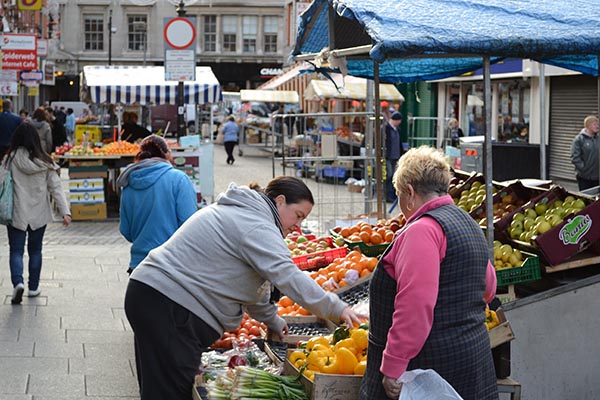
One of the many stalls on Moore Street – a street currently under threat of demolition – Photo: Liam Murphy
Hammerson’s plan outlines potential for up to 2,500 jobs after the development, but those currently trading on the street aren’t as optimistic.
“The plan means losing my job,” Andrea, a jeweler who has been trading on the street for two years said. “While there may be jobs after the building, it will destroy our jobs during that time. I’m only new here, but there are people here whose family have traded for 100 years. No one will want to come to a market if there’s construction being done nearby.”
“Other than what it means to me losing my job, my trade, and my community, it’s also what it means for the people of Dublin,” she said. “Those people care about this street. This street’s history is retail.”
“I lived in Spain for quite a while and saw a lot of markets,” she said. “But I have never seen something like Moore Street. Here we have a street full of its background, culture, and history, but also a marketplace. There’s a lot of potential in this street and I don’t think it’s being used.”
“In what world does someone think it’s a good idea to erase all this history to put more shopping centres and hotels.”
You must be logged in to post a comment.