Tag: NFL

  • Lopez Sanusi: The story behind Ireland’s NFL trailblazer

    By Scott McCabe

    Get to know one of the most exciting National Football League [NFL] prospects that Ireland has ever produced. 

    Lopez Sanusi was born in Dublin, Ireland. As a child, he experienced life in Nigeria and the United States before his family settled down in Belfast when Lopez was 17 years old. 

    During his time in the United States, Lopez loved nothing more than playing one particular game with his friends at recess: two-hand touch football. The game was a simplified version of American football, and it was Sanusi’s first introduction to the sport.

    Image via: (Thomas Park- Unsplash)

    From that point onwards, Lopez began to prioritise American football over other sports.

     “Soccer is good, but for me personally, I’m a bigger athlete. I realised that this was a sport I really wanted to play,” Sanusi said.   

    Lopez comes from a sporting family, his brother played professional soccer and his sister ran track, so it was quite a surprise to the family when Lopez was fixated with a sport that most of his family had never even heard of. Lopez still jokes to this day that he’s the only one who knows anything about American football in his family. 

    Becoming a student of the game

    Once Lopez knew that American football was a sport he wanted to pursue, that’s when the grind began. Lopez scoured the internet for his nearest American football club which just so happened to be the Belfast Trojans, who operate in the Irish American Football League [IAFL]. 

    Lopez entered his Trojans career with little to no playing experience [unless you count playing two-hand touch during recess]. Sanusi started out on the Trojans’ youth team before he was rapidly called-up to the senior team after a string of impressive performances.

    The Belfast Trojans squad after winning the Shamrock Bowl in 2020. Image via (Belfast Trojans)

    “It was all about hard work and dedication to the game. The Trojans had training twice a week, but I could only make training once a week due to work. Every day, I used to go to the gym or the field and workout,” Sanusi said. 

    Scoring touchdowns was an element of American football that Lopez wanted a slice of. However, his coaches thought he’d be suited to the defensive side of the ball rather than the offensive side- they were right. 

    “It took a lot of convincing from my coaches to change my position from running back to defensive end. I used to watch a lot of Derrick Henry and I looked up to him. When they told me to give the defensive line a chance, I wasn’t too happy, but I’ll never forget my first game as a defensive end.

    Running back Derrick Henry [right] in action for the Tennessee Titans- a player Sanusi idolises. Image via (Andy Lyons/Getty Images)

    “I had to step up against the South Dublin Panthers. We were lacking players on defense. I had two sacks and a couple of tackles for loss. From that day onwards, I was like, this is my position,” Sanusi said with a smirk.

    Sanusi battled with injuries during his first season but showed enough in the games he did participate in to win Defensive Player of the Year with the Trojans.

    The NFL Academy

    Located in Loughborough, England. The NFL Academy offers student athletes ranging from 16-19 years of age the chance to perfect their game by learning from full-time professional coaches. The NFL Academy consists of American football prospects from all over the world. 

     Once the academy coaches witnessed Lopez in action, they were intrigued but there was severe competition for academy spaces from other hopeful athletes.

    “I sent them my film and from then on, the coaches were really interested in me. They had over 1,000 applications and only accepted 30 people, and I was one of those 30,” Sanusi added. 

    Lopez is the only Irish-born player in the NFL Academy. He’s also the only player to make it from the Irish domestic league [IAFL] to the NFL Academy.

    “It’s a blessing, every single day I count my blessings,” Sanusi said.

    A statement from Sanusi announcing his journey to the NFL Academy. Image via Belfast Trojans

    “I’m trying to put Ireland on the map. I’m trying to do big things. I’m trying to motivate kids to show them that anything is possible. Dreams do come true if you work hard,” he added.

    Sanusi is hoping to follow in the footsteps of Efe Obada and David Ojabo. Both players started their footballing careers outside of the United States with minimal knowledge of the sport. Now, both players are active in the NFL, Obada with the Washington Commanders and Ojabo with the Baltimore Ravens.

    “I’ve met Efe Obada. All those guys are amazing. There’s no messing around. They’ve been in the same spot that I’ve been in and then when you look at where they’re at right now, it’s amazing,” Sanusi said.

    Efe Obada suited up with the Washington Commanders. Image via: (Joe Glorioso: All-Pro Reels)

    “In Ireland, it’s not that easy to play American football, it’s more of a soccer-based country. I think if a kid is interested in playing American football, they should search up the same thing I did: ‘American football teams near me’. Find out the rules about American football, try-out for teams and move forward from there,” Sanusi added.

    The Irishman is currently training with the NFL Academy with the goal of receiving a footballing scholarship to continue his playing career at the collegiate level, and from there, make it to the National Football League.
  • The City Sports Podcast Episode 2

    The City Sports Podcast Episode 2

    Host Leo McGuinn is joined by his regular guests to discuss Ireland’s 2-0 win against Moldova, all the other football news, the Super-8s, and the latest from the NFL.

  • Rugby’s changing its attitudes towards concussions

    Rugby’s changing its attitudes towards concussions

    Finally it seems common sense has prevailed, as players are no longer allowed play the “hero” when they have sustained head injuries on the field of play. The power is now firmly in the hands of team doctors and referees.

    This was on full display in Ireland’s final game of the autumn series against Australia, where four Irish players Johnny Sexton, Gordon Darcy, Rob Kearney and Conor Murray were assessed for concussion. Murray’s case was particularly telling however as the player clearly didn’t want to come off after receiving an Australian knee to the head.

    Dr Eanna Falvey the Irish team doctor took control however, and made sure that proper protocols were observed before allowing the Irish scrumhalf to re-enter the game.

    Despite the potential repercussions at such a critical juncture in the game, taking a player out of the game in this instance sends out a very positive message to the rugby world.

    High profile instances like this are vital in order to change the culture within rugby and put player safety number one.

    Rugby still has a ways to go however, for example Ireland’s and Ulster’s Luke Marshall sustaining four concussions between March 2013 and February 2014 was not acceptable.

    Perhaps the IRB can learn from the NFL who were recently hit with an $675m concussion settlement with an additional $112m in player’s lawyer fees.

    This has resulted in much stricter protocols in regards to concussions especially in regards to a player suffering multiple concussions in a season. All players that suffer suspected concussions are automatically taken into the locker room for assessment and in most cases are ruled out of the remainder of the game.

    Although rugby’s process for assessing concussions on the pitch are up to scratch, perhaps they should take a leaf out of the NFL’s book in regards to multiple cases. Cleveland Tight End Jordan Cameron has missed a month of action after suffering multiple concussions this season in direct contrast to how Luke Marshall was treated.

    I’ve talked to Eoin Cremen who is the physio for Seapoint RFC who compete in Division 2A of the AIL. He told me how he had the power to remove a player from the pitch if they have suffered a concussion.

    He also said how awareness has made his job much easier as a referee’s can now request a player leave the field for assessment if deemed necessary. He outlined how attitudes are changing but it is an ongoing process as medics have little precedent due to rugby still being in early years of professionalism making it necessary to learn on a case-by-case basis.

  • Painting October Pink for cancer awareness

    Painting October Pink for cancer awareness

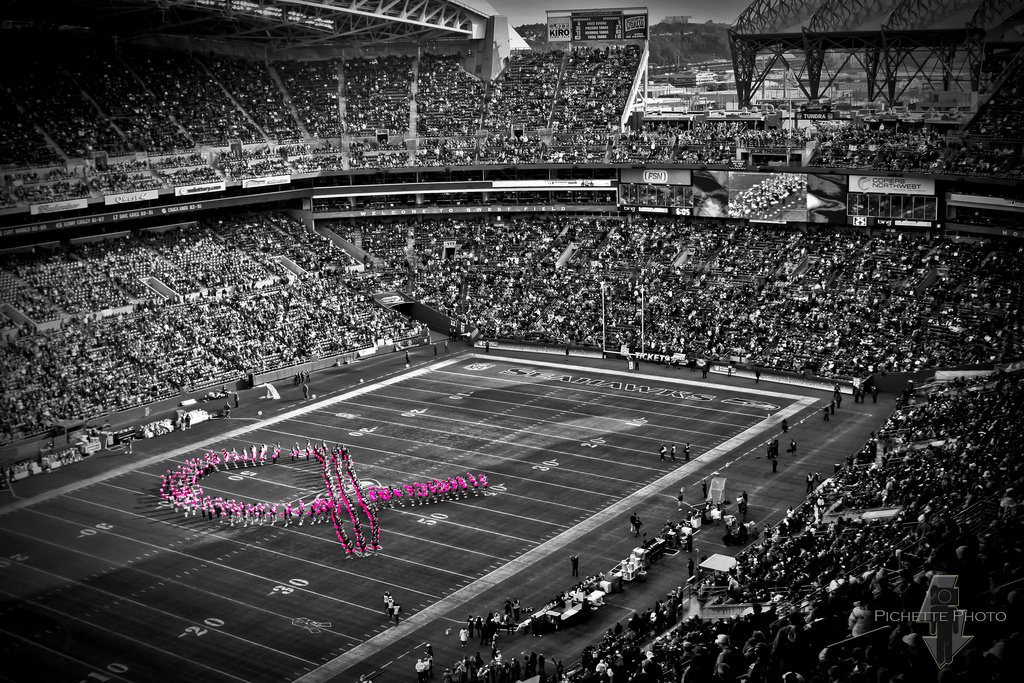
    The NFL is just one of the many major organisations involved in cancer awareness month. Image by: aliciacandraw
    The NFL is just one of the many major organisations involved in cancer awareness month. Image by: aliciacandraw

    ‘Real men wear pink’.

    This is the slogan of one of the biggest cancer awareness events in America, organised by the National Football League.

    ‘A Crucial Catch’ is the NFL’s annual event aimed to raise awareness throughout the country – and the globe- based on their campaign to increase their international audience.

    The campaign involves players, coaches and officials wearing customized pink game attire, which is then auctioned off to raise money for the American Cancer Society.

    Bids of $1,800 and $3,500 have been made for a Reggie Bush signed game-worn jersey, and a Vernon Davis signed game-worn jersey respectively. An Aaron Rodgers signed game-worn jersey recently sold for just shy of the $30,000 mark which is an example of the campaign’s potential financial reach.

    Closer to home pink is main theme of many companies who are also trying to do their own bit for cancer awareness throughout October.

    The chain store Harvey Norman have also begun their pink campaign, with staff illuminating the stores in fresh pink polo shirts.

    The company is in its third year of a partnership with the Marie Keating Foundation – which has released its new brand campaign ‘sleep pink’.

    Harvey Norman are expecting to raise €30,000 for the charity.

    “It is a great cause to get behind”, said Administration Manager Glenda Finlay, “we are expecting to raise 30 grand, but hopefully we get more than that and it gets closer to 40.

    “We are doing all the ‘sleep pink’ products and we are also encouraging the ‘add a euro’ system at the tills to encourage customers to add a euro to their sale as a form of donation.”

    The Irish Cancer Society have joined up with various Irish companies to create a group of ‘pink partners’.

    Centra have designed a ‘Pink Bag for Life‘ available for €3, with all the proceeds  going towards breast cancer research.

    The store also plans to donate proceeds generated from their own brand Pink Bouquets of Flowers and Potted Plants, Pink Milk, Pink Lady Apples and Punnets of Mushrooms.

    Some of the other companies involved in the ‘Pink Partners’ scheme include: Ballyfree Eggs, Barry’s Tea, Boots, Esso and GHD.

    The Irish Cancer Society is also hosting a Halloween masquerade ball at the Shelbourne Hotel, Stephen’s Green on November 1st.

    A single tickets is €85, but tables of 10 and 12 are available for purchase. The night includes a 3 course silver service meal and entertainment from The Nualas.

    The hope is that the event will go towards making up for the sizeable shortfall in funds raised on Daffodil Day earlier this year, which was hampered due to typical Irish weather.

  • DEBATE: Redskins should change their name

    DEBATE: Redskins should change their name

    The name of the Washington football team has been an issue of contention for the past number of years. Image by: Keith Allison
    The name of the Washington football team has been an issue of contention for the past number of years. Image by: Keith Allison

    Racism is something that, as a society, we like to imagine has been eradicated, but the simple fact is that it has not. It is still rampant, and there is no clearer indication of this than the Washington Redskins.

    The most frequently used word to justify the use of the term “redskin” as the team’s moniker is ‘tradition’ – so let’s discuss the Redskin tradition.

    The Redskins were founded by George Preston Marshall – a well renowned racist, who petitioned the league to excluded black players from its ranks. After the league failed to back the proposal, he ensured that his team remained ‘white-only’ for as long as possible.

    He famously quipped that “We’ll [the Redskins] start signing Negroes when the Harlem Globetrotters start signing whites.”

    Marshall bought the football team when they were a Boston outfit called the Braves. He moved them to Washington and claimed that he didn’t want the association with the previous team so renamed his team the more highly obvious Redskins.

    Is that really a tradition that the Washington team and its current owner Dan Synder really want to preserve, or worth preserving for that matter?

    Dan Synder recently wrote in a letter defending the team’s name that a recent poll showed that 90 per cent of Native Americans claimed they were not offended by the team’s name. But the fact remains, ten per cent are.

    To paraphrase the current NFL commissioner, Rodger Goodell, if one person is offended, let alone one in every ten, then change must be seriously considered.

    Many black people, especially those in the music industry, have attempted to claim the n-word as their own. To remove it from a word of hate and instill within it a sense of respect.

    Despite the modern-day dilution of the historical racial connotations attached to the n-word, the idea of it being used as a sports name is inconceivable.

    Never will a day come that the Baltimore Blacks or the New York Negroes line out in the NFL, so why should it be deemed acceptable by the team’s owners, the league’s upper echelon, or the general public, to have a name derived from hate grace the sport.

    Dan Synder, and anyone else who who roots for the name to remain, will argue that the nickname is honorary.

    However, this could not be further from the case.

    Honorary monikers are those in which celebrate tribes names such as the Braves, the Blackhawks, the Chiefs. The Redskins does not fall into that category.

    The term Redskin evolves from the practice of scalping Native Americans to collect a bounty in precolonial America.

    The term describes a period in which Native Americans endured horrific and barbaric treatment at the hands of imperialists, in the pursuit of profit. And the exploitation of the Native Americans for profit is still ripe today.

    Forbes currently value the Washington Redskins trademark at $1.1 billion – the 8th richest sports franchise trademark in the world.

    The only colour that the owners of the Redskins are concerned about is green.

  • Is sport inherently homophobic?

    Is sport inherently homophobic?

    The question of homophobia in sports is something that will always be hard to prove or disprove. Image by: David Michael Morris
    The question of homophobia in sports is something that will always be hard to prove or disprove. Image by: David Michael Morris

    The recent crackdown on the LGBT community in Russia, along with the recent ban imposed on the planned gay rights parade in Serbia has brought angry finger-pointing from the vast majority of western society.

    But when one of the biggest social norms (sport) in western society is examined for homophobia, should the finger really be pointing towards a mirror?

    The four most popular professional sports in the US are Football (NFL), Baseball (MBA), Basketball (NBA) and Ice Hockey (NHL). These four sports have a combined annual attendance of 130 million people.

    The four most popular leagues – Premier League, La Liga, Bundesliga, Serie A – from the most popular sport in the world, football, generate an annual attendance of 45.5 million people.

    That is a combined figure of 175.5 million people visiting stadiums yearly to watch these sports – yet alone the billions of people that view them across the world.

    The most recent Super Bowl had a television audience of 164.1 million viewers. That puts the sheer volume of people who consume these sports on a yearly basis into perspective.

    But how pro-homosexual are these sports?

    Jason Collins became the first openly gay sportsman of the four major US sports when he announced his sexual persuasion earlier this year. And despite big-name NBA stars such as Kobe Bryant congratulating Collins on his decision, the NBA centre is finding a new team hard to come by.

    Collins was a free agent after the 2012-13 season, but was expected to be picked-up in free agency, though he has yet to find a suitor for his skills.

    Ironically, Bryant was fined $100,000 by the NBA in 2011 for a gay slur that commissioner David Stern called “offensive and inexcusable.”

    The highest grossing, and most popular US sport – NFL – has an extremely poor history when it comes to homophobic behavior from its stars.

    Prior to the 2013 Super Bowl, San Francisco 49ers cornerback Chris Culliver said, “I don’t do the gay guys, man. I don’t do that, Ain’t got no gay people on the team. They gotta get up outta here if they do. Can’t be with that sweet stuff.”

    As idiotic as these comments were, they seem even more so when you consider that Culliver just so happens to play for a team based in the gay capital of America.

    Culliver later apologized, but his statements summed up what seems to be the unspoken consensus in sport.

    Former 49ers running back Garrison Hearst said, “I don’t want any faggots on my team. I know this might not be what people want to hear, but that’s a punk. I don’t want any faggots in this locker room,” when asked on his opinion of former NFL defensive tackle Esera Tuaolo publicly outing his sexuality.

    Baseball has also seen vile hate-statements from players. Pitcher Julian Tavarez called the San Francisco fans, “a bunch of assholes and faggots,” while pitcher John Rocker infamously painted the terrible picture of the New York transport system saying, “imagine having to take the 7 Train to the ballpark…next to some queer with AIDS”.

    Homophobic statements are not just specific to the professional sports. The college Ole Miss is currently investigating some of its football players after allegations that they made gay slurs during a play in which one of the characters comes out as gay.

    The most famous case involving sport in Europe was that of former Brighton player Justin Fashanu. Fashanu revealed in an interview with The Sun that he was a homosexual. His brother, John Fashanu did an interview later with The Gay Times and claimed that his brother “was offered even more by others who wanted him to stay in the closet. No club has offered him a full-time contract since the story first appeared.”

    Most professional athletes come out when they are finished their career, or when it is coming to the end. Those are the few who  must be credited for their bravery, but as of now it would seem that the stimga attached to gays is still rampant in sport.