Tag: Northern Ireland

  • Randolph resistant in stalemate at Aviva Stadium

    Randolph resistant in stalemate at Aviva Stadium

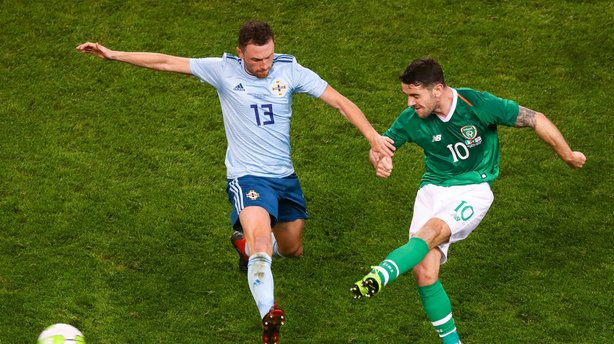
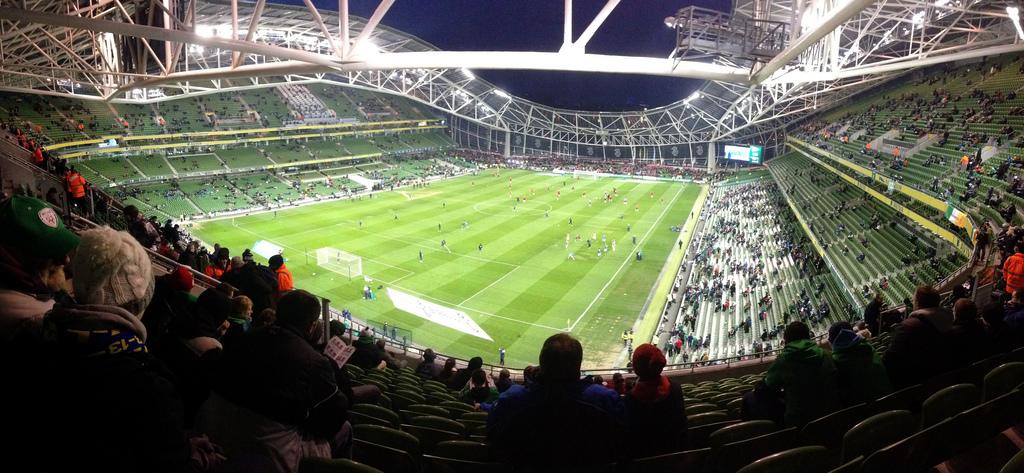
    A man-of-the-match display from Middlesborough’s Darren Randolph rescued Ireland from defeat against neighbours Northern Ireland in front of 31,241 people at the Aviva Stadium.

    Ireland welcomed the return of Robbie Brady ahead of next week’s match against Denmark after a year on the international side-line, along with returning Séamus Coleman who missed the game against Denmark.  

    Despite this boost, Martin O’Neill’s men failed to find any sustained periods of possession in the final third in a game that was crying out for a creative midfielder to link with the attack.

    Randolph pulled off heroics in either half to deny Gavin Whyte and Jordan Jones from close range.


    A laboured performance from Ireland marked what was likely to be Glenn Whelan’s final international appearance of an 85-cap career that has spanned over a decade. He was replaced by Aston Villa teammate Conor Hourihane before halftime.

    Ireland featured six changes to their starting 11 and played with a 3-5-2 formation, with James McClean and Séamus Coleman flanking Jeff Hendrick, Robbie Brady and Whelan in the middle of the park.

    Blackburn’s Darragh Lenihan marked his second international appearance with an assured performance alongside Shane Duffy and John Egan.

    Michael Obafemi remained on the bench after declaring for Ireland amid speculation about his international future, while Seanie Maguire suffered yet more hamstring bother after he limped off just 13 minutes after being introduced as a substitute.

    Ireland travel to the Parken Stadium on Monday to face Denmark in what is now a crunch clash after the goalless draw between the two in Dublin.

    ROI: Randolph, Lenihan, (Christie, 84) Duffy, Egan, Coleman, Hendrick, Whelan ©, (Hourihane, 36), Brady, McClean (Stevens, 66), O’Dowda (Curtis, HT), Robinson, (Maguire, 66) (Hogan, 79)

    NOI: Peacock-Farrell, Lewis, J Evans ©, Saville, Davis. Boyce, C Evans, (McNair, 65), Dallas, Whyte (Jones, 61), Cathcart, Smith, (Ward, 74)
  • ’71 Review

    ’71 Review

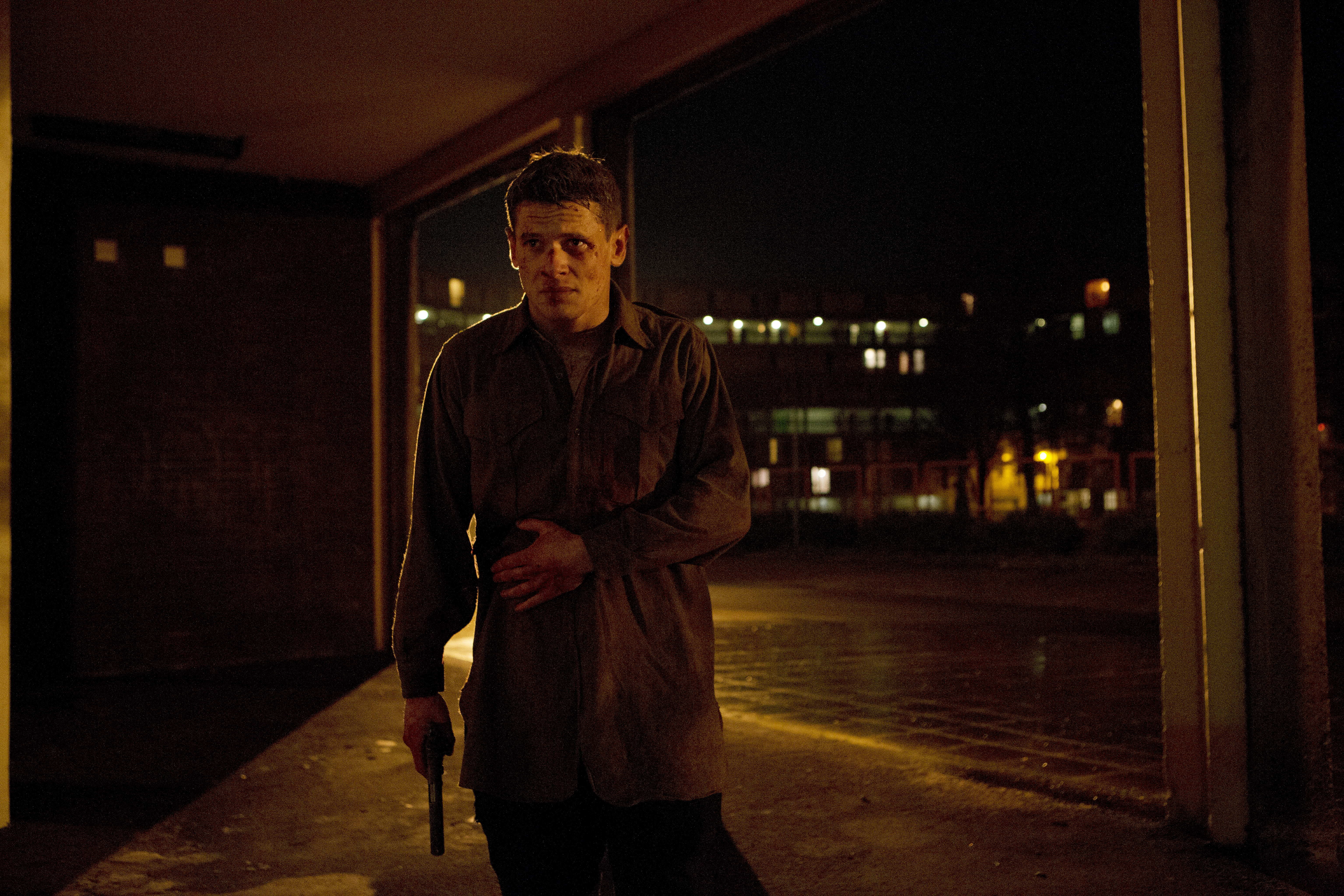
    ’71 is a war film about a British soldier in Belfast during the troubles left behind on a routine mission gone awry. He’s stranded and is trying, for the entire film, to get back to his barracks.

    ’71 adds a fresh perspective on the Troubles, in that it is told from the perspective of a British soldier. This is no tired rehash of old material. Nevertheless, it does have certain similarities to the films that have come before it. The shaky realism and extreme close ups are reminiscent of Greenwoods’ Bloody Sunday or the solitary British soldier in dire straits: Jordan’s Crying Game the list goes on.

    All the usual war film tropes are present. There are interesting, experimental techniques used by the director but the audience isn’t deprived their share of action and suspense. “Posh c**ts telling thick c**ts to kill poor c**ts,” one enlightened local tells Hook. “You’re just a piece of meat to them.” This we presume is the films message. War is bad. No controversy there.

    It’s how the director tackles the issue that’s interesting, not the idea itself. The music and camera techniques all conspire to create an atmosphere of delirium. He has quickly found himself in a situation he doesn’t understand. The films style mimics his panic and disorientation, and forces on the audience a similar sense of unease. He is innocent and we fear for him. There are elements in the film similar to Tarkovsky’s, Ivan’s Childhood in that we root for a relatively innocent soldier behind enemy lines. In that case the soldier was a child, which increases our emotional commitment, but Hook is vulnerable and in many ways quite childlike, and we do want him to find his way, which adds to the suspense.

    He blunders he’s way through the streets and Belfast that take on a nightmare quality. Death and hatred reside in every corner. The distinctions between good and evil, right and wrong, friend and foe, quickly dissipate and he moves through the complexity of troubles era Belfast like a Virgil-less Dante. It’s a dirty war. One’s motives and intentions rarely reflect their actions. Subterfuge is the norm.

    Nonetheless we are enthralled by the violence: the old problem of the impossibility of an anti-war film rears its head.

    The film ultimately succeeds in highlighting the perverse reality of the troubles, and by extension war itself. The contagion of conflict has spread into every home and can burst through any door at any time, and we’re there to watch as it does, gleefully.

    Image and trailer courtesy of Optimum Pictures.


  • Should Ireland amalgamate in international soccer?

    Should Ireland amalgamate in international soccer?

    credit Steven Depolo on Flickr
    credit Steven Depolo on Flickr

    When you look to Irish national teams for a source of pride, rugby comes to mind first. It is a great testament to this small nation that we compete with countries that have 10 times the population to work with.

    So based on that, one would assume that any possible question regarding an amalgamation of the Republic and Northern Ireland soccer teams has to be answered with a yes. I however, disagree.

    The Republic of Ireland national team has shown before that it has the quality in its arsenal to compete with the best in the world and to make the latter stages of major tournaments.

    In the World Cup in 1990, 1994, and 2002, the Republic’s soccer team reached the quarter finals, and made it to the final 16 twice, respectively. During the same time period Northern Ireland failed to qualify on all occasions.

    For the European Championship in 1988 and 2012 the Republic reached the group stages of the tournament. The upper quadrant of the island has never reached a European Championship.

    Despite neither side succeeding in securing a trip to Brazil in 2014, the Republic still managed  to maintain a somewhat respectable record in terms of wins and draws compared to Northern Ireland’s shambolic campaign in which the green of the North recorded a draw and a loss against both Luxembourg and Azerbaijan.

    When you move the argument away from the pitch the sensible notion still points towards the Republic remaining a separate entity.

    The Football Association of Ireland (FAI) have purpose built grounds in the Aviva Stadium which is the home of Irish soccer. Northern Ireland do not have that luxury. Instead, they have leased the rights from Linfield F.C. for the use of Windsor Park. In return for this lease, 15 per cent of all revenue of gate receipts and TV rights leaves the Irish Football Association‘s (IFA) pockets and lines Linfield’s.

    The issue surrounding political and religious difference also needs to be considered. The Irish rugby team works as a combined entity because a) it has always been this way since its inception and b) the vast majority of rugby supporters would be of a higher social class and background. Not meaning to pigeonhole, but football supporters would have a greater tendency towards unruliness and hooliganism than their rugby counterparts.

    The only foreseeable benefit gained for the Republic of Ireland by amalgamation is that the Republic of Ireland would not have to press players who are born in the six counties to declare for the Republic.

    However, most Irish managers have a tendency to acquire players not only from Northern Ireland, but also Scotland, Wales, and England. Once they were born on the island or have a grandparent who was, they can declare for the Republic – therefore all of the Northern Ireland squad is fair game for the Republic of Irish team, they just need to be ahead of the curve in terms of recruiting them.

    Another issue is that the League of Ireland, which is already on the fringes of the FAI’s agenda, would become even more so, as an amalgamation of both countries national teams would result in an inevitable combination of both football associations.

    Northern Ireland’s only potential commodities are already available to the Republic and therefore the south will be offering up a much greater investment for what are limited dividends!

  • The national football question

    The national football question

    Ireland’s national football question has always been a divisive issue.

    It’s a question which has frequently evoked not just sporting rivalry, but impassioned and trenchant opinions from political and religious establishments alike since the inception of association football on this island.

    Impractical

    Many argue that merging our national teams simply isn’t a viable option. Given the difficult relationship between the north and south since partition, certain aspects either side of the border say that any potential amalgamation of the two associations would be impractical and even dangerous.

    However, a significant element would tend to disagree, and there’s plenty of evidence to back up their position.

    To say that both the Republic of Ireland and Northern Ireland national teams are underperforming at the moment would be an understatement.

    Having both endured a calamitous qualifying campaign for World Cup 2014, large elements of support are urging root-and-branch reform to ensure a swift return to our more competitive days of yore.

    But while pundits continue to carefully tiptoe around the substantial issues behind our teams’ failures, others point to the real impracticalities that exist within the current system.

    For a region with just over six million inhabitants to expect to field two top-class international sides is nothing short of ludicrous. With neither of the Irish sides now troubling the top 50 of the world rankings, surely now is the time to pool our resources and reinstate some pride in the green of Ireland.

    Of course, this difficult history to which I’ve alluded means that many are reluctant to the idea of an amalgamation. But the simple fact is that it works for virtually every other sport- rugby, GAA, cricket, hockey, golf- so why shouldn’t the leading lights in football subscribe?

    Tug of War

    For one thing, it would at least negate the diplomatic issues that have plagued north-south relations recently. No longer would we be subjected to the unedifying spectacle of an international tug of war over our alleged future stars, as in the high-profile cases of Shane Duffy and Marc Wilson.

    Instead, the new national side would be able to reap the abundance of talent that resides amongst the ranks of both the IFA and the FAI without such debacles about allegiance.

    The issue of team cohesion is also hugely overstated.

    Various members of the current Northern Ireland setup already hold a Republic passport, and given the collective home nations approach of recent years- poaching any talent with a tenuous connection to the emerald isle from English and Scottish academies- that particular argument is a real non-entity.

    One potential stumbling block is the fact that any amalgamation would essentially leave us with a new entity in world soccer, which would in turn leave the new unified Irish team with no points ranking history and in the precarious position of being lowest seed in future qualifying draws.

    A New Era

    However, a quick glance at the meteoric rise of Montenegro, a country of just over half a million people, in the world rankings since the national team’s disaffiliation with Serbia in 2007 provides ample evidence for any naysayers that a new and improved Irish team could do the same.

    Who knows, if the move to unify the two national teams were to go ahead it may even usher in a new age of acceptance and social cohesion in north-south relations.

    Just look at the case of the Setanta Cup. Far from causing the disharmony that some anticipated, Ireland’s latest cross-border domestic competition has shown how we can reap the dividends of greater cooperation between the two associations.

    In many instances the beautiful game has helped to mend fractious relationships the world over. Who knows, in this age of greater social acceptance, it may play a bigger role than ever in bringing people together rather than tearing them apart.

    (Featured image courtesy Steven Depolo on Flickr)