
Tag: nutrition

  • Plant powered athletes

    Plant powered athletes

    Do veggies make you run faster? Image via Pexels.com

    There’s no doubt that veganism has been rising in popularity in recent years – a lifestyle that was once obscure has now become common. Still, the words vegan and athlete don’t seem to go together.

    When it comes to sports nutrition, we are told protein is key. This is often wrongly assumed to be something a plant based diet can ultimately lack – conjuring the image of one who follows the diet as a frail, weak, possibly malnourished person.

    Thankfully it’s 2021 and that particular image is, slowly but surely, dying out. 

    “I was always interested in nutrition, especially for improving performance,” says Gerard Prendergast, a gym owner, personal trainer, triathlon coach and yoga instructor.

    “I felt [veganism] would suit my training at the time which was endurance sports. I was blown away at how my body adapted to eating a wholefoods, plant-based diet. I had more energy, felt lighter, my stamina improved and even my mood and mental health seemed to improve.”

    Prendergast began boxing and weightlifting at an early age and went on to play for the ROI VI International Futsal team at 28. At 32, he completed his first triathlon, which encouraged him to take on bigger and more challenging events.

    Gerard Prendergast crosses the finish line at DecaUK – Image courtesy of Gerard Prendergast

    “In 2017 I entered into DecaUK, 10 Ironman distance triathlons in 10 consecutive days. Every day for 10 days I was required to swim 3.8k, Cycle 180k, and run a full marathon – 42k. I won that event 4.5 hours ahead of the second place finisher.

    “In 2018 I completed 52 Ironman distance triathlons in 52 weeks to raise money for Mental Health Ireland. I have completed other challenges such as 100 mile run on a 500m loop and cycling the height of Everest on an indoor trainer.”

    Judging by Prendergast’s impressive lifestyle, it appears there’s no doubt a vegan diet can provide an athlete with the power they need to succeed.

    “Athletes absolutely can thrive on a plant based diet,” he says. “It’s been proved all over the world over the past few years with athletes like Serena Williams, Novak Djockovic and Lewis Hamilton all seeing great benefits to their careers by eating plant-based. I myself can back that up, after struggling to finish a 5k run in 2012 to becoming a Deca Ironman champion.”

    “Athletes absolutely can thrive on a plant-based diet and it’s been proved all over the world over the past few years.”

    Gerard Prendergast

    “I had always worked out and eaten well but I really wanted to go even further with knowing what is in my food,” says Dawn Butler, a 35-year-old athlete from Kildare. 

    An ex professional wrestler, Butler now trains in Brazilian jiu jitsu as well as partaking in weightlifting. On days spent away from the intensity of the gym and training, Butler enjoys long walks, hikes, and hill climbing.

    After recovering from stage four Hodgkin’s Lymphoma, Butler turned to veganism as a way to repair and nourish her body.

    Dawn Butler on a plant powered hike in the Connemara mountains. Image courtesy of Dawn Butler

    “I took my time and looked into lots of research and eventually I just couldn’t stand dairy anymore. I was really put off when I saw where dairy comes from and I knew I couldn’t be a part of that world,” explains Butler.

    “I knew with the level of training I do that I have to really pay attention to my nutrition. I always check in with how I’m feeling and I always get a good variety of foods. I notice that I have more energy being vegan.”

    Despite her fitness level and rigorous training, Butler admits she is no stranger to ridicule from her gym buddies due to her diet choices.

     “I train as hard as anyone I know – I have muscles and strength and I train with a lot of men. I definitely do not feel I am any weaker because of my diet. I get very frustrated when some people try to tell me about my protein intake when, in fact, they can’t tell me theirs. They assume because they eat meat they get more than me when in truth I probably get twice the amount of protein.

    “If I am seen having a protein shake, it’s because my diet is ‘wrong’, but that does not apply to a meat eater who also uses protein shakes. I don’t use protein shakes because I am vegan. I use them as part of the diet and lifestyle that I have.

    “People assume and don’t ask. If somebody asks me about it I’m happy to chat and educate but when someone assumes my protein intake it gets very disheartening. It feels like a throwaway ‘fact’ and a way to debunk veganism.”

    As annoying as such remarks might be, Butler has no plans to ditch her plant based diet any time soon and has her sights set on pursuing Brazilian jiu jitsu, currently training to take part in a tournament later this year.

    Veganism undoubtedly has the potential to enhance one’s athletic performance, but Butler has some advice for those starting out.

    “I do believe it’s possible for athletes to thrive on a vegan diet. I do however think it is harder. There is less room for error and I think you need to keep on top of it. It’s very important to keep the range of foods wide and get sources of everything in there.”
  • Can calorie information tackle Ireland’s growing obesity crisis?

    Can calorie information tackle Ireland’s growing obesity crisis?

    Obesity #1

    Photo by Ingo Bernhardt, Flickr.

    Most of us don’t question how many calories are in a steaming plate of creamy tagliatelle when out for a meal or while ordering our favourite takeaway, but very soon we will not be able to avoid this. In February this year, Ireland’s health minister Leo Varadkar announced that by 2016 all menus from restaurants, takeaways and any establishments serving food must include the calorie information on the menu.

    While statistics show that obesity is a growing crisis in Ireland and something that must be tackled – according to the Irish Heart Foundation (IHF) obesity has increased by 67% between 1990 and 2000  –  do we really need to know the calorie count for our meals when we’re eating out? What once in Ireland may have been a monthly treat has now turned into a regular occurrence and with so many people eating a number of their meals outside of the home, will calorie information positively impact on Ireland’s obesity crisis?

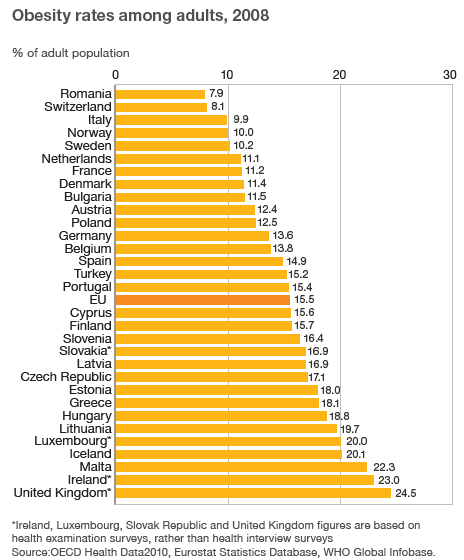
    Irish Obesity rates are now the second highest in Europe at 23 percent according to the Organisation for Economic Co-operation and Development. European obesity levels map

    2 out of 5 adults are overweight and 1 in 5 children aged between 5 and 12 are overweight or obese.Irish obesity level statistics

    “I think there is an issue with passive eating,” says Sinead Shanley a dietician from the Irish Heart Foundation. “There are studies showing after 20 minutes of sitting, there is a massive change in hormones, in your resting metabolic rate, in the calories you burn, in the fat you burn. We are sitting down for much longer, with sedentary lifestyles people are sitting down for at least eight hours a day, and this affects our bodies.”

    Obesity may not just be a matter of calories, but of appetites fuelled by the content of our food. Calorie information alone without details of fat, sugar and salt may be missing a big part of the problem. “The overriding message is we are eating too many convenience foods and whether we like it or not, they tend to be high in fat or high in sugar and/or salt,” Shanley says.”Anything that is high in energy and low in nutrition and is eaten on a regular basis makes it really, really difficult to try to control and manage your weight.”

    Stacey Machesney, from Glenville Nutrition, agrees that there are many factors contributing to the massive increase in obesity rates in Ireland. “We must look at the overall picture, the increase in fast foods, the accessibility and convenience of cheap processed foods, the increase in the variety of high sugar foods, the cost of the ‘bad’ food compared to the healthy options, taste, increase in sedentary lifestyle, the list goes on,” she says.

    While Ireland continues to lose the obesity battle, is it only governments that have a responsibility to keep up the fight? If our changed lifestyles are the main culprit for obesity, then the health sector, the food industry and the education system, among others, need to work together to ensure the problem is dealt with.

    “The onus is on the wider community and government to fund and allow charities to go in and implement initiatives and give support,” Shanley says. “It is the responsibility of society, the community and the food industry to try and regulate and make the healthier choices the easier choices. We need to support the individual making the choices.”

    People still choose foods based on factors other than health. Machesney recalls: “The Irish Universities Nutrition Alliance carried out a nutrition survey of 1,500 adults between 18 and 90 years of age in 2011 to see what adults are eating. They were given six food choice motives, including taste, cost, health and nutrition, convenience, ‘feel good’ (i.e. mood), and weight control. What do you think was the number one? Taste. Even when adults know about food health they still choose taste over health.”

    Rachael from TheCity, spoke with the managers of Joe Burger Jo’Burger on Castle Market Street and Urban Picnic Urban Picnic in George’s Street Arcade about the calorie information on menus and the effects this will have on their business.

    Calorie information in restaurants will no doubt help the public on better educating themselves on rough guidelines when eating out, and it is a step in the right direction, but, as Shanley says, “just a step”.  She says the Irish Heart Foundation would particularly like to see an emphasis on informing eaters about salt content: “Overeating and excess calories is a real problem in Irish obesity but this information doesn’t highlight the salt, so that would be a huge difficulty we would have with it. If we reduce our salt intake by half a teaspoon per day it would prevent 900 deaths per year from stroke or heart attack.”

    The IHF also recommends a traffic light system which looks at fats and the quality of fats along with calories. “We are looking at what type of fats are in the food. From our point of view the quality of fats is really important and that is missed completely.”

    Again, Machesney agrees. “I think it is never too late to make a change. As a society we are getting bigger in numbers and in waist sizes. We need to educate ourselves on what we are eating. It is great adding calorie information to menus but then let us also teach people how to read calories properly. It is not enough to count calories but we need to know what portion is being given to protein, carbohydrates and fat. If we could help people to help themselves we will have a better chance than trying to force change.”

    There is also the argument that the implementation of calorie information on the culinary industry will have grave repercussions for small businesses due to cost. The Food Safety Authority of Ireland (FSAI) have an online tool for businesses but Shanley suggests there needs to be more support.

    Shanley is, in the end, optimistic. “When calories are displayed, restaurants will make more of an effort to actually change and opt for healthier options because they are exposed,” she says. “The government have said calorie posting was one of a range of measures on obesity planning for 2015 and other measures will be revised like healthy eating guidelines a new obesity policy action plan such as the Health and Wellbeing Operational Plan 2015.”

    Looking at calories alone is not enough to ensure a healthy balanced diet but it can help people avoid meals that are extremely high in calories – which will more likely be high in fat, sugar and salt. But the focus needs to be more on overall health. The onus is on everyone from the schools to businesses and everyone in between to make the effort to provide healthy foods and to educate people on healthy eating, which in turn will lead to society making better choices with food.

    Experts’ Top 3 tips for a healthy lifestyle

    Sinead Shanley, dietician from the Irish Heart Foundation, recommends:

    • Reducing consumption of processed foods. We know now that they are generally the types of foods that are high in the unhealthier fats and also can be high in sugar and salt. Some 65 to 70% of our salt intake comes from processed foods. Freshly prepared food would be number one. That goes from breakfast to lunch boxes to dinners.
    • Keeping fats to a minimum. Keep high-quality fats in your diet, particularly polyunsaturated, which is in line with the Mediterranean style diet and the diet we advocate.
    • Prioritising fibre is key as it reduces your bad cholesterol, makes you feel fuller for longer. It is almost a negative calorie, as the body does not absorb any of the calories from fibre as it simply pushes through the body.

    Stacey Machesney from Glenville Nutrition recommends:

    • Eating the Rainbow – ensure you are eating a colourful range of fruits and vegetables.
    • Eating a little protein with every meal to help balance insulin levels and keep you fuller for longer.
    • Measuring your portion size. Many people are overeating without even knowing. The recommended meat portion is the size of a deck of cards.

    Links to more information and articles on obesity and the growing crisis in Ireland Storify Irish Obesity and Calorie Info

    By Rachael Hussey