
Tag: phibsborough

  • Dalymount Park renovation faces another roadblock 

    Dalymount Park renovation faces another roadblock 

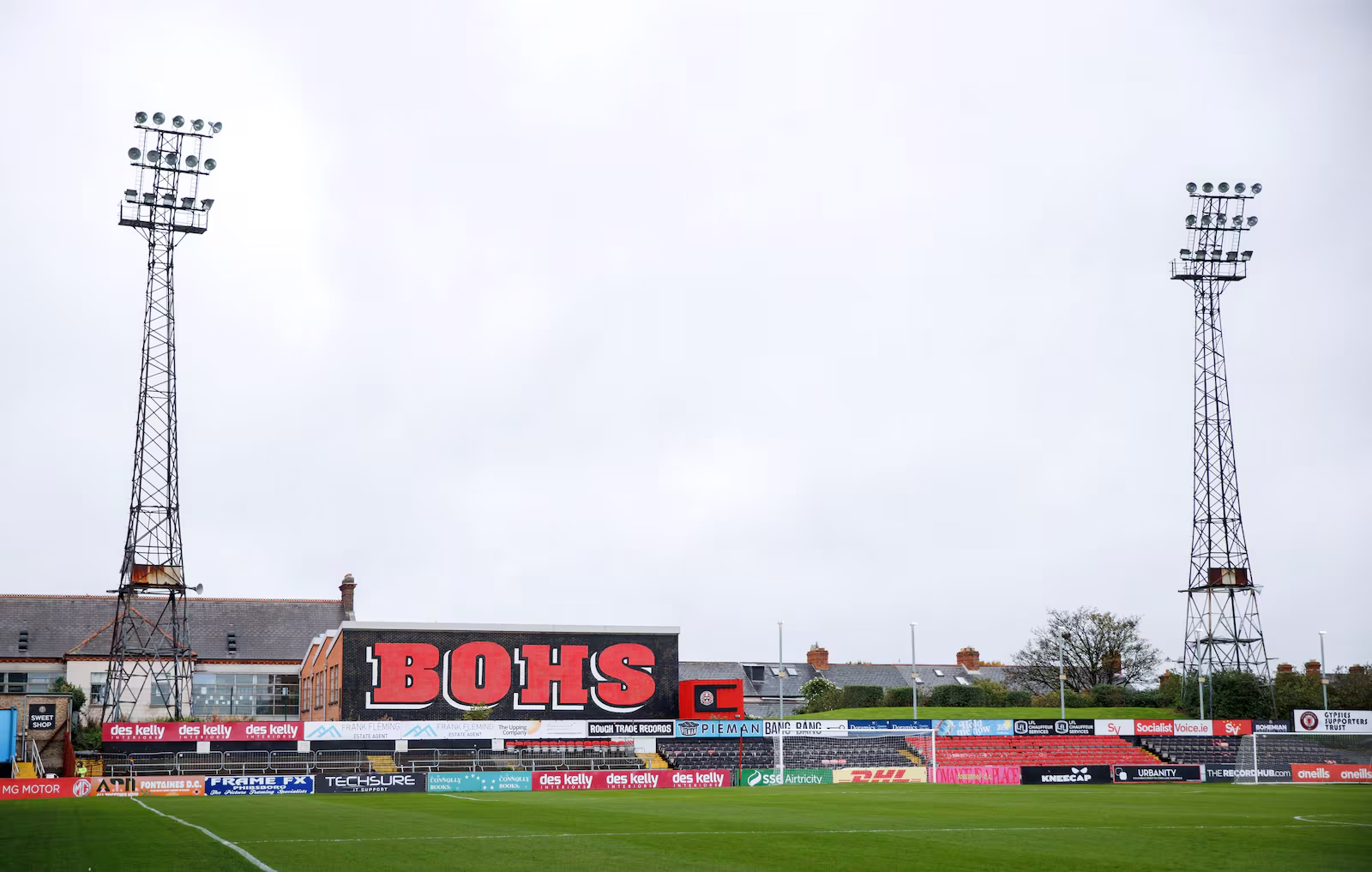
    Dalymount Park football stadium in Phibsborough, home to Bohemian Football Club, faces problems with its redevelopment again. 

    The cost of redeveloping the Dublin pitch has more than trebled since Dublin City Council (DCC) bought the stadium a decade ago, reaching as much as €63 million. On top of that, the construction of the stadium is expected to be delayed by as much as two years. 

    In 2015, the council purchased the sports ground from Bohemians for €3.8 million. The following year, it unveiled plans for a new stadium costing an estimated €20 million. 

    In the same year, DCC purchased Drumcondra’s Tolka Park, home to Shelbourne Football Club, with the goal of selling the property to raise money for Dalymount’s renovation into a facility for both teams. 

    However, following a campaign by Shelbourne supporters to maintain the ground, it subsequently modified its plans regarding Tolka Park. 

    The council agreed in 2022 to abandon plans to rezone Drumcondra’s stadium for housing and to redevelop Dalymount Park as a standalone project. 

    In February 2024, planning permission was granted for Dalymount’s demolition and reconstruction, with a new 8,000-seater stadium the aim for the redevelopment. 

    One of the entrances to Dalymount Park football stadium, home of Bohemian Football Club (picture taken by Patryk Goron)

    At that point, the project’s total cost, which included team facilities, club offices, a bar/function room, and community facilities had increased to over €40 million. The cost had again risen to €56.6 million by the end of the previous year when the council released its capital plans for 2025-2027. 

    New estimates, submitted to municipal councillors last Monday, suggest the cost has reached €63.75 million.  

    The council has received €25.6 million in government funding, an additional €2.6 million from levies paid to the municipality, €1 million from the long-term lease of Tolka Park back to Shelbourne FC, and €500,000 from UEFA. This results in a gap of over €34 million. 

    Around €25 million will come from government funding but Dublin City councillors have now approved the borrowing of €34 million to get the project under way. Repayments will be “partly funded from the annual rental income, match day revenue and non-match day revenue,” the council said. 

    It is expected that work will begin around the end of 2026 or early 2027, with the reconstructed stadium opening in time for the new League of Ireland season in February 2029. 

    Bohemian FC praised the council’s ruling in a statement, calling it “the final step in a process that began with DCC acquiring Dalymount exactly 10 years ago.” 

    The borrowing, along with government funding, “will allow for the historic stadium to be fully redeveloped and serve the people of Dublin and beyond long into the future.” 

    Councillors questioned if the stadium’s capacity could be extended to accommodate European football games, whether there was a business plan for the stadium’s operation, and how the project’s cost could be kept within budget. 

    Don Daly, the Council’s Capital Projects Manager, stated that Bohemian FC’s decision to have terraces for standing was one of the reasons the stadium could not be constructed to category 4 standards, while Richard Shakespeare, CEO of Dublin City Council, stated that it would require “a whole different level of pain financially” to make the stadium eligible for hosting European games. 

    Additionally, Mr. Shakespeare stated that while the stadium’s operational elements are still being worked out, the predicted costs have “a whole range of contingencies built into it” and he expressed confidence that the project will be completed within the allocated budget. 

  • Stay With Us: The Community-Led Cafe

    Stay With Us: The Community-Led Cafe

    Have you ever been in a coffee shop and thought you could make it better? That is exactly what Steven Harris thought before he opened Stay With Us cafe in 2022. A dream project that became reality after Harris was advised to have another income on the side, as his job was only a 6-month contract work in sports. Stay With Us has grown its own community in the small space it occupies just down the road from St. Peter’s Church in Phibsborough.

    Harris said working as a barista was what inspired him to open his own business. He had saved up money and started looking for a place to open. “I say to people [I did] not [have] enough to buy a house but enough to start a business,” he said.  Harris said he did not intentionally choose Phibsborough; it just happened to have a unit that was the size he wanted and within the price range he was looking for.

    Harris and his friend did all the labour to make sure the unit was up and ready for business in just 6 short weeks. When asked about the quick turnaround, he explained how not having to wait on any tradesmen meant they could work quickly. Though Harris did not have a background in construction, he said he was lucky to have some DIY knowledge and had the advantage of asking people he knew for some help; he also relied on some YouTube tutorials. He said because they were doing the work for free at the start it “gave the business a kickstart off the bat without having a lot of outgoings.”

    Hot chocolate bought in Stay With Us, latte art creating a swan on top. Photo credit: Zita Fox

    When asked about the possibility of expanding the Stay With Us brand, Harris informed The City that he already has another cafe in Dublin. Opened on the 31st of May and located in Temple Bar, Mantle, is more of a premium specialty coffee product, as opposed to the more community -oriented cafe in Phibsborough. Harris wanted to open something new rather than opening a replica; he wanted it to be the polar opposite to what he already owned. “I find when people expand out or change, for example, you kind of lose that personal touch of the area,” he said.  

    Harris is a physiotherapist for the NHS in Scotland for most of the year. That is where he got the idea to have multiple different establishments.  There is a man in Edinburgh who owns around 12 coffee shops, but they all have different names and none of them are related to each other. He goes on to say that they are a similar fit if you know what to look for then of course, you would realise it is the same person who owns them all.

    Harris points out how all those cafes have their own little communities, workers, and regulars and how he too wanted to have that broad appeal. He said having the different brands to market makes it far more interesting for himself: “everything’s just slightly different and a bit fresher.”

    Stay With Us continues to pull people in with its charm. Full of treats and drinks, mainly coffee, the cafe has created a small, safe bubble in the centre of Dublin. Whether you go in when it is lashing rain, morning time, or the last order of the day, you will be greeted with some of the most welcoming staff around. For now, it seems that Harris is happy with just the two cafes, but who knows what the future holds.