Tag: Recession

  • Feeling the Pulse of the Nation: Part 3

    Feeling the Pulse of the Nation: Part 3

    This final article in the series on the Pulse of the Nation by Sinead Farrelly  will examine the effect that political events, both foreign and domestic, have had on Irish people’s feelings towards the economic situation.

    Despite everything, it was interesting to see that generally people always felt happier, than they did stressed, over the entire period, except for at the end of 2010 when the International Monetary Fund (IMF) came into Ireland.

    Unlike the overall Economic Recovery Index (ERI), which was not hugely affected by political events, the impact on people’s emotions was much clearer. When the statistics were examined, it appeared as though when there was a time period of political instability with resignations or elections, then people appeared to be more stressed as there was an uncertainty as to who was leading the country in a time of economic strain.

    first-graph-sinead-farrelly
    Source: Sinead Farrelly

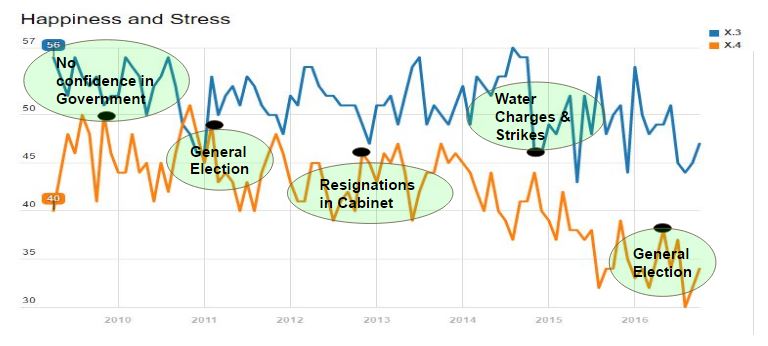
    In this first graph, happiness is indicated by the blue line, and stress is indicated by the yellow line. The major spikes in stress and dips in happiness came at times when the government was unsettled.

    The year of 2010 saw a flurry of resignations from ministers across the board as there was a general unease in the government at the time. While at the same time, votes of no confidence were put in against then Taoiseach Brian Cowen and also leader of Fine Gael Enda Kenny. Both motions lost and they each retained their positions. In 2012, there was also a vote of no confidence against Minister for Health James Reilly and this led to the resignation of Minister for Primary Care Roisin Shortall.

    The year 2011 began with the Green party withdrawing from government and automatically paving the way for a general election. Taoiseach Brian Cowen also resigned from his position at this time.

    In 2014, there were no major changes to the government or to the cabinet but people still were unhappy with the government as water charges were formally introduced at €60 per one adult household and €160 thereafter. Some 350,000 second level students were also forced out of school as teachers took industrial action over changes to the Junior Certificate.

    Each of these times saw the Irish people becoming more stressed and less happy, according to the Amárach research.

    This year’s general election saw Ireland without a government for a three month period as the Dáil voted four times to elect a Taoiseach. The Amárach results show that during those times that Ireland had an unstable government, the Irish people once more felt more stressed and less happy.

    As well as domestic political affairs, the Amárach research also questioned people on their feelings towards foreign political events. From October 2010 until December 2013, every month they posed the question: “The News From Other Countries Makes Me Confident The Recession Will End Soon.”

    second-graph-sinead-farrelly
    Source: Sinead Farrelly

    An interesting result which can be seen in the graph is that Irish people felt most confident about the recession ending soon when other countries required a bailout from Europe.

    The three major peaks in confidence in this graph appear in the summer of 2010, May 2011 and May 2012 when Greece, Portugal, Spain and Italy each received their bailouts. Famously (with Ireland included) these countries who received bailouts became collectively known as the PIIGS.

    The major dips in the graph came in November 2010, when the IMF came into Ireland and the country was at its worst point, and in July 2011 and June 2012. The two latter dips both correlate to events seen in Greece, firstly when they voted in a fresh round of austerity measures and received a second bailout, and secondly when the pro-austerity party won a landslide victory in the country’s elections.

    Both these events saw austerity measures becoming a mainstay in the Greek political landscape and both of these might have caused an upset in the Irish confidence as it proved that austerity measures were going to stay.

    The Amárach Research polls stopped asking a specific question about foreign affairs at the end of 2013. However, they did bring the topic back up again in June of this year in the wake of Brexit.

    On June 24th, the day after the Brexit referendum, there was a special Amárach poll carried out on the topic. It found that 37% of Irish people were going to become more cautious about their spending and saving following the shock result in the UK.

    This poll aligned with the July 2016 standard monthly results which showed 6% less people feeling financially comfortable and 5% less people feeling optimistic, while enjoyment and happiness both dropped by 3% and 6% respectively, with stress and anxiety both rising by 3%.
  • Is the Irish Economy Finally back on track?

    Is the Irish Economy Finally back on track?

    There has been much talk in recent weeks and months to suggest that Ireland may finally be on the up and up, after many years of foundering in the mires of economic recession.

    In the past month Ireland’s rate of recovery has been praised by the Organisation for Economic Cooperation and Development, ECB president Mario Dreghi and European Commissioner for Economic and Monetary Affairs and the Euro Olli Rehn.

    As part of the latest quarterly KCB Bank Ireland/Chartered accountants of Ireland business sentiment survey 47% of respondents reported an increase in business activity, the highest number of positive responses since 2007.

    According to figures from the Quarterly Economic Commentary for Autumn 2013 our economy could grow by as much as 2% in GNP terms this year.

    The people of Ireland protest against austerity in 2009 Photo: SebastianDooris on flickr
    The people of Ireland protest against austerity in 2009 Photo: SebastianDooris on flickr

    As well as this, Minister for Social Protection Joan Bruton has said she expects live register numbers to fall below 400,000 in the next month or so, the lowest they will have been since 2009, although the drop in this number will in part be due to emigration.

    Another good sign for the economy is the relatively easy-going budget for 2014 announced yesterday by the government. Although there will still be many cuts; senior citizens have been hit especially hard, it is being billed as “the last austerity budget” and Enda Kenny has said he expects it to provide the state with a primary surplus in 2014, which will allow Ireland to begin to decrease national debt.

    Ireland is also poised to exit the bailout next year, and Olli Rehn has expressed confidence in the country’s ability to survive in the Eurozone unaided by a precautionary credit line. However Mario Dreghi declined to comment on whether Ireland would require a precautionary credit line as it was still being “discussed by the relevant authorities”.

    With a prevailing feeling of cautious optimism now surrounding the fate of the Ireland and its chances in the future, The City took to the streets to find out whether or not the nation has confidence in the Irish economy.

    Video

    Reporter: Megan Naughton

    Videography and editing: Kay Cairns

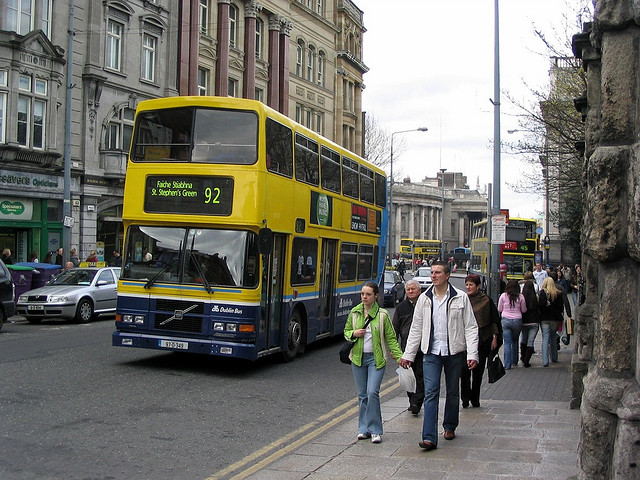
  • City commuters reach deep into pockets to pay increased transport fares

    City commuters reach deep into pockets to pay increased transport fares

    By: Aidan Knowles

    Photo courtesy: Flickr/Steve A

    AFTER SATURDAY, 1st December 2012 – cash and leap card fares for Dublin Bus, Luas, Iarnród Éireann and Bus Éireann services will increase.

    Prepaid tickets prices will also increase, but this change will not come into affect until early 2013.

    The move, approved by the National Transport Authority, was made due to Ireland’s “difficult economic circumstances” and increasing fuel costs – despite cost cutting measures in the industry.

    For Dublin Bus, the last fare increases were introduced in January 2012.

    What does this mean for the city’s commuters?

    Cash paying commuters are the worst affected by the increase. While those using Leap Card and prepaid tickets will still suffer price increases, these options still offer better value over cash fares.

    On Dublin bus – the new price adjustment will see cash fares increase by an average of 11%. Meanwhile, leap card fares will be increased by an average of 7%.

    For example, a cash paying adult travelling 8 to 13 stages on Dublin Bus previously had to pay €2.15. After December 1st 2012, this same journey will now cost €2.40.

    Dubliners availing of the Dublin Bus’  ‘City Fare’ to get around the capital are also affected – with their cash paying fare increasing from €0.60 to €0.65 cent.

    How do these new fares compare with nearby European capitals?

    Across the pond – London’s bus service charges passengers a flat cash fee of £2.30, or at a discounted fare of £1.35 if using the Oyster Card (similar to Dublin’s Leap Card).

    Meanwhile in Paris, the French pay a flat fee of €1.70 per bus journey.

    Further South, commuters in Madrid pay a flat cash fare of €1.50 per bus journey.

    What adult passengers paid Dublin Bus before the fare increase
    What adult passengers are paying Dublin Bus after the fare increase